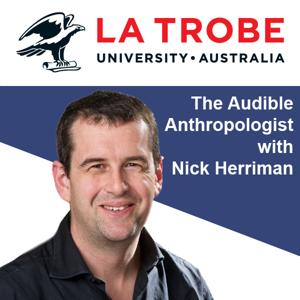
The Audible Anthropologist

The Audible Anthropologist

By Dr Nicholas HerrimanEducation
Download on the App Store

The Audible Anthropologist episodes

  • Moral Economy
    The concept of "moral economy" describes our perception of how people in our economy should behave. "Riots" in 1700s England, historian EP Thompson explains, were only partly caused by a lack of food. More important for the rioters was that farmers sold their products to ‘scalpers’. These ‘scalpers’ bought grains in bulk and sold them on to the common folk at inflated prices. Rioters thought this kind of behaviour was reprehensible, so they took to the cobbled streets. Moral economy has proven to be a powerful concept in understanding contemporary societies, including our own. Listen and find out why.
    Copyright 2013 Nicholas Herriman / La Trobe University, all rights reserved. Please contact for permissions.

    11 min
  • Structure
    “Structure” refers to the way humans organise themselves economically, socially, and politically. It also refers to the way language and thought is organised. Obvious examples of social structures can be found in the organisation of class (upper/middle/lower), gender (male/female), race (black/white, Aryan/Semitic), religion (priest/laity), economy (boss/worker), and politics (state/citizen). The structures often appear quite natural to us. Yet closer analysis demonstrates that what we humans construct as class, gender, race, religion, economy, and politics. Moreover, these structures clearly have political implications. Changes in these structures (e.g. the transformation from a society based on king/subject to a society based on state/citizen) are often revolutionary and mark the changes in eras of human history.
    Copyright 2013 Nicholas Herriman / La Trobe University, all rights reserved. Please contact for permissions.
    9 min
  • History
    Although the past is something we often take for granted, in fact the past is understood differently in different cultures. Anthropologists studying history, typically analyse the way a culture generally makes sense of the past. In the Western Desert of Australia, for example, the past is composed of a Dreaming period, when superhuman ancestors created the world and set out the rules which humans must live up to. The heroic past establishes a spiritual imperative for those living in the present. In 1800s England, by contrast, the vision of history was one of progress of savage to barbaric to civilised life. Anthropologists understand such different visions of history in a cultural and social context.
    Copyright 2013 Nicholas Herriman / La Trobe University, all rights reserved. Please contact for permissions.
    10 min
  • Syncretism
    When we talk about the spread of world religions, like Christianity or Islam, we tend to assume a one-way process: the world religions simply replace indigenous religions. In fact, the process is often more interesting. Indigenous people often respond to the introduction of a world religion by blending indigenous beliefs with the beliefs of the world religion. This is what anthropologists call “syncretism”.
    Copyright 2013 Nicholas Herriman / La Trobe University, all rights reserved. Please contact for permissions.
    8 min
  • Gender
    Notions of gender are culturally specific. Until recently, at least, Western societies tended to define sexuality (ie. homo-, bi-, and hetero-sexuals) in terms of sexual orientation or attraction. In Western understandings of rape, women’s genitalia and sexuality were frequently understood as inherently vulnerable and subject to brutalisation, while men’s were thought inherently brutalising and penetrative. However, for various reasons, mostly circulating around conceptions of the body, these ideas are not shared in all societies. In this episode, we consider several examples from non-Western societies that conceptualise and work with gender in unique ways.
    Copyright 2013 Nicholas Herriman / La Trobe University, all rights reserved. Please contact for permissions.
    10 min
  • Culture
    Of all the living organisms in the world, plant and animal, humans start life least equipped. We have almost no instincts for survival, such that most of what we know and do, we need to learn. That stuff which we learn and share is culture. Most of it we also take for granted. And that's where anthropology comes in. Anthropologists study this learnt, shared, and assumed stuff; stuff which we call culture.
    Copyright 2013 Nicholas Herriman / La Trobe University, all rights reserved. Please contact for permissions.

    8 min
  • Rationality - What it is to be Modern
    What is rationality and why is it important? According to Weber, the most rational actions are scientific ways of achieving scientific ends. You and I act according to scientific means and ends, and this defines us as modern. As such, our guiding principles for action are general, universal and abstract. For instance, medieval European cathedrals were built mostly according to specific local knowledge and practical trial and error. Modern buildings are constructed largely according to general laws of gravity, abstract engineering principles, and universal ideas about construction. Honestly, I’m not sure which kind of building I’d rather spend my time in, but I know I’d rather hop on plane that built according to scientific principles. As for Weber, he detested the modern, rational world, seeing it as an iron cage that we have built around ourselves.
    Copyright 2012 Nicholas Herriman / La Trobe University, all rights reserved. Please contact for permissions.
    12 min
  • Commodity, Use and Sentimental Value
    Commodity value is the most beautiful and metaphysical product of the capitalist market and our imagination. Few things could be more supernatural than this value; it makes a pound of gold appear ‘naturally’ more valuable than a pound of steel. And the day gold stops appearing naturally more valuable (that is, the day commodity value disappears) is the day capitalism dies.
    Copyright 2013 Nicholas Herriman / La Trobe University, all rights reserved. Please contact for permissions.
    10 min
  • The Symbols of Christmas, Part 2
    What is the hold that Christmas has on so many people? Maybe we all share an unconscious symbol of two births—spirit and body. Perhaps the nativity and passion story follows a set of universal structures. Or, do the symbols provide us with a model of the world and for how to behave? In this episode, I consider these and other approaches to explain why Christmas is so significant for millions.
    Copyright 2012 Nicholas Herriman / La Trobe University, all rights reserved. Please contact for permissions.
    10 min
  • The Symbols of Christmas, Part 1
    I Googled “Christmas” plus “time of reflection” and got literally hundreds of direct hits. We all know the internet can’t be wrong, so I guess for many of us, Christmas is a time of reflection; reflection, I would add, about what is most important in our lives.
    Anthropologists are particularly interested in what members of a society find important and how it is represented through symbol and ritual. So in this episode, I want to analyse the way Frazer, Durkheim, and Freud—being among the most influential thinkers for anthropology—would analyse the symbolism of Christmas.
    Copyright 2012 Nicholas Herriman / La Trobe University, all rights reserved. Please contact for permissions.
    10 min

About The Audible Anthropologist

From the publisher's feed

Anthropologists study human culture and society. They ask “what it is to be human?”. Anthropologists answer this question by analysing diverse societies to find out what all humans have in common. To…

More shows like The Audible Anthropologist

Ancient Greece: Myth, Art, War by Professor Chris Mackie and Dr Gillian Shepherd

Ancient Greece: Myth, Art, War

36 Listeners

Epics of Rome by Dr Rhiannon Evans

Epics of Rome

9 Listeners

History of Children's Literature by David Beagley

History of Children's Literature

37 Listeners

Early Imperial Russia by Dr Adrian Jones

Early Imperial Russia

26 Listeners

Ancient Greece: City and Society by Dr Gillian Shepherd

Ancient Greece: City and Society

15 Listeners

Australian Aboriginal History by Professor Richard Broome

Australian Aboriginal History

6 Listeners

The Philosophy of Descartes by La Trobe University

The Philosophy of Descartes

3 Listeners

The Roman World by Dr Rhiannon Evans

The Roman World

33 Listeners

Biography by La Trobe University

Biography

3 Listeners

Gallipoli and the Great War by La Trobe University

Gallipoli and the Great War

0 Listeners