
Sign up to save your podcasts
Or

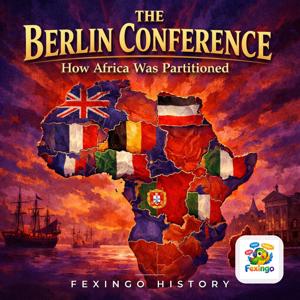


In this episode of The Berlin Conference series, Lucas and Luna delve into the brutal reality of King Leopold II's Congo Free State after the 1885 conference. They explore how the Berlin Act's recognition of Leopold's personal colony led to a ruthless rubber extraction system enforced by the Force Publique. Discover the horrific practices of hostage-taking, mutilation, and the 'red rubber' scandal that sparked international outrage. Learn about figures like Henry Morton Stanley, the role of missionaries such as Reverend John Harris, and the investigations by Edmund Dene Morel and Roger Casement that exposed the atrocities. This episode also covers the economic forces behind the rubber boom and the ultimate transition to Belgian state control in 1908, shaping Congo's tragic colonial legacy.
#CongoFreeState #KingLeopoldII #ForcePublique #RubberTerror #BerlinConference #ScrambleForAfrica #HenryMortonStanley #EdmundDeneMorel #RogerCasement #RedRubber #Atrocities #ColonialHistory #BelgianCongo #RubberBoom #JohnHarris #CongoReform #History #FexingoHistory
Keep every episode free: buymeacoffee.com/fexingo
This episode takes you inside the Berlin Conference of 1884-1885, the diplomatic meeting that set the rules for Europe's scramble for Africa. Lucas and Luna explore how Otto von Bismarck orchestrated the conference to balance European rivalries, the creation of the Congo Free State as King Leopold II's personal domain, and the crucial 'principle of effective occupation' that forced colonizers to actually control territory they claimed. They examine the General Act of Berlin, which promised free trade on the Congo and Niger rivers but delivered none of that to Africans. Learn about the cast of characters — from Bismarck to the Portuguese envoy — and how a map drawn in a Berlin ballroom redrew the African continent in ways that persist today. The episode also touches on the legacy: the Berlin Conference didn't cause the scramble, but it legitimised it. Perfect for anyone who wants to understand how Europe carved up Africa without a single African voice at the table.
#BerlinConference #OttoVonBismarck #ScrambleForAfrica #GeneralAct #CongoFreeState #KingLeopoldII #EffectiveOccupation #CongoRiver #NigerRiver #EuropeanImperialism #1884 #Diplomacy #Colonialism #AfricaHistory #19thCentury #History #FexingoHistory #PartitionOfAfrica
Keep every episode free: buymeacoffee.com/fexingo
In this episode of The Berlin Conference, Lucas and Luna explore one of the most dramatic consequences of the scramble for Africa: Portugal's dream of a transcontinental empire linking Angola and Mozambique. The Mapa Cor-de-Rosa, or Pink Map, was a bold territorial claim that collided with Cecil Rhodes' Cape-to-Cairo vision and the British Empire's strategic interests. Learn how the Berlin Conference's principle of effective occupation emboldened Portugal, only to lead to the humiliating British Ultimatum of 1890, which forced Portugal to abandon its corridor and reshaped southern Africa. We delve into the negotiations, the key figures including King Carlos I and Lord Salisbury, and the lasting impact on Portuguese national pride. A story of ambition, confrontation, and the harsh realities of colonial politics.
#PortugueseEmpire #MapaCorDeRosa #PinkMap #BritishUltimatum1890 #CecilRhodes #ScrambleForAfrica #BerlinConference #Angola #Mozambique #CapeToCairo #LordSalisbury #KingCarlosI #PaulKruger #ColonialHistory #19thCentury #DiplomaticHistory #History #FexingoHistory
Keep every episode free: buymeacoffee.com/fexingo
The Berlin Conference of 1884-85 set the rules for the Scramble for Africa, but its real impact was felt on the ground, especially along the Swahili Coast. In this episode, Lucas and Luna explore how the Conference's General Act, which declared free trade and navigation on the Niger and Congo rivers, had little to do with East Africa, yet legitimized Germany's claims to territories like the Kilimanjaro region and Dar es Salaam. They delve into the 1886 Anglo-German Agreement that carved up the Sultanate of Zanzibar's mainland possessions, creating German East Africa (Tanganyika) and British Kenya. Lucas explains how Sultan Barghash bin Said, who had fought to maintain his realm's independence, was forced to accept a rump state of the islands. The episode also covers the Heligoland-Zanzibar Treaty of 1890, where Britain traded Heligoland to Germany for Zanzibar and Pemba, and the Abushiri Revolt of 1888-89, a major uprising against German colonization. Throughout, Lucas highlights the role of figures like Carl Peters, Hermann von Wissmann, and Abushiri bin Salim al-Harthi. The discussion reveals how the Berlin Conference's abstract principles translated into concrete, often violent, colonial takeovers.
#BerlinConference #SwahiliCoast #Zanzibar #CarlPeters #AbushiriRevolt #GermanEastAfrica #SultanBarghash #HeligolandZanzibarTreaty #EastAfrica #Colonialism #Imperialism #1884 #History #FexingoHistory #ScrambleForAfrica #Tanganyika #Kenya #Africa
Keep every episode free: buymeacoffee.com/fexingo
In this episode of The Berlin Conference series, Lucas and Luna examine the partition of the Swahili Coast during the Scramble for Africa. They focus on the strategic and cultural importance of the region, from the ancient trading cities of Kilwa, Mombasa, and Zanzibar to the competing claims of Germany and Britain. The episode highlights the role of the Sultan of Zanzibar, Barghash bin Said, who faced pressure from European powers to cede control. The Heligoland-Zanzibar Treaty of 1890 is discussed, in which Britain traded the North Sea island of Heligoland to Germany in exchange for recognition of British claims over Zanzibar and the mainland territories that would become Kenya and Uganda. Lucas shares details about the Swahili language and culture, the importance of the clove trade, and the resistance led by Abushiri bin Salim al-Harthi against German occupation. The conversation also touches on the lasting impact of the partition on the region's ethnic and political boundaries.
#BerlinConference #ScrambleForAfrica #SwahiliCoast #Zanzibar #SultanBarghash #HeligolandZanzibarTreaty #AbushiriRebellion #GermanEastAfrica #BritishEastAfrica #CloveTrade #Kilwa #Mombasa #OmanEmpire #Imperialism #1880s #1890 #ColonialHistory #FexingoHistory
Keep every episode free: buymeacoffee.com/fexingo
In this episode, Lucas and Luna explore the Battle of Staouëli, the pivotal clash that decided the French invasion of Algeria in 1830. They discuss the tactics of General de Bourmont, the resistance of the Algerian forces under Agha Ibrahim, and the impact of the janissaries and Barbary corsairs. The conversation also covers the aftermath: the capture of Algiers, the exile of Dey Hussein, and the looting of the Casbah. This episode provides a fresh angle on the conquest, focusing on the military engagement and its consequences.
#BattleOfStaouëli #Algiers1830 #GeneralDeBourmont #DeyHussein #Janissaries #BarbaryCorsairs #Casbah #CharlesX #FrenchColonialism #AlgerianResistance #AghaIbrahim #BattleOfAlgiers #NorthAfricanHistory #19thCenturyWarfare #ColonialHistory #FexingoHistory #History #Podcast
Keep every episode free: buymeacoffee.com/fexingo
While the Berlin Conference of 1884-85 carved up Africa on paper, the real conquest happened on the ground. In this episode, Lucas and Luna explore France's brutal campaign to seize the Western Sudan—a vast region stretching from the Senegal River to Lake Chad. They focus on the key figure of Colonel Louis Archinard, who led French forces against the Tukulor Empire of Ahmadou Sekou and the Bambara kingdom of Segou. The episode covers the fall of Segou in 1890, the strategic use of the Niger River, and the role of the tirailleurs sénégalais—African soldiers recruited into French colonial units. They also discuss the controversial 'Archinard system' of direct military rule, which bypassed civilian administrators and set a precedent for harsh colonial governance. Along the way, they touch on the legacy of El Hadj Umar Tall, the Tukulor founder, and the resistance of figures like Babemba Traoré. Specific details include the capture of the Kasso fort, the burning of Sikasso, and the eventual French victory at the Battle of Togbao. A fresh angle that moves beyond the coastal partitions to the inland empires.
#BerlinConference #ScrambleForAfrica #WesternSudan #LouisArchinard #TukulorEmpire #AhmadouSekou #Bambara #Segou #ElHadjUmarTall #TirailleursSenegalais #FrenchColonialEmpire #NigerRiver #Sikasso #BabembaTraore #History #FexingoHistory #Colonialism #MilitaryHistory
Keep every episode free: buymeacoffee.com/fexingo
In this episode of The Berlin Conference series, Lucas and Luna explore the role of Henry Morton Stanley, not as the explorer of Livingstone fame, but as a key figure whose expeditions across central Africa from 1874 to 1877 paved the way for the Scramble. They trace his journey from Zanzibar to the Lualaba River, his encounter with Tippu Tip, and the brutal realities of his march, including the Congo River's cataracts. The conversation examines how Stanley's reports shaped European perceptions of the Congo's potential and how Leopold II of Belgium used them to justify his colonial ambitions. Lucas explains the controversy surrounding Stanley's methods, including the use of violence and the loss of life among his porters. The episode also highlights the geographical obstacles Stanley faced, such as the Livingstone Falls, and how his surveys of the Congo basin directly influenced the Berlin Conference's territorial claims. A must-listen for understanding how exploration narratives were weaponized for imperial conquest.
#HenryMortonStanley #CongoRiver #LivingstoneFalls #TippuTip #Zanzibar #LualabaRiver #LeopoldII #BerlinConference #ScrambleForAfrica #Exploration #CongoFreeState #AfricanHistory #Imperialism #19thCentury #Geography #Colonialism #History #FexingoHistory
Keep every episode free: buymeacoffee.com/fexingo
This episode of Fexingo History dives into the Bombardment of Alexandria in 1882, a key event that paved the way for British occupation of Egypt. Lucas and Luna explore the causes, including the Urabi Revolt against the Khedive's corruption, and the British naval attack that destroyed parts of Alexandria and triggered a full-scale invasion. They discuss the role of Admiral Seymour, the ambiguous orders, and the long-term consequences for Egypt's sovereignty. Listeners will learn about the political turmoil in Cairo, the international debt crisis, and how the British occupation shaped modern Egyptian history. The episode also touches on the broader context of European imperialism in Africa and the Mediterranean, connecting the dots from the Berlin Conference to the Scramble for Africa.
#BombardmentOfAlexandria #Egypt1882 #UrabiRevolt #AdmiralSeymour #KhediveTawfiq #BritishOccupation #ScrambleForAfrica #MediterraneanHistory #Imperialism #NavalWarfare #TelElKebir #Gladstone #AhmedUrabi #Cairo #Alexandria #History #FexingoHistory #19thCentury
Keep every episode free: buymeacoffee.com/fexingo
In this episode, we explore the British bombardment of Alexandria in 1882, a pivotal moment in the Scramble for Africa that unfolded just before the Berlin Conference. We delve into the Urabi Revolt, led by Egyptian nationalist Ahmed Urabi, which threatened European financial control over the Suez Canal. The conversation covers the role of Khedive Tawfiq, the dual control of France and Britain, and the casus belli that led to Admiral Seymour's naval attack. We discuss the aftermath, including the British occupation of Egypt that lasted until 1956, and how this event set a precedent for imperial intervention justified by protecting investments. The episode also touches on the bombing's impact on Alexandria's cityscape and the subsequent trial of Urabi. This episode offers a fresh angle on the Berlin Conference era by examining a key military action that shaped colonial policy in Africa.
#BerlinConference #BombardmentOfAlexandria #UrabiRevolt #AhmedUrabi #KhediveTawfiq #AdmiralSeymour #RoyalNavy #SuezCanal #BritishEmpire #Egypt #Imperialism #ScrambleForAfrica #1882 #19thCentury #MilitaryHistory #ColonialHistory #HistoryPodcast #FexingoHistory
Keep every episode free: buymeacoffee.com/fexingo
From the publisher's feed