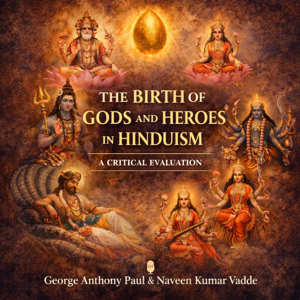
The Birth of Gods and Heroes in Hinduism: A Critical Evaluation

The Birth of Gods and Heroes in Hinduism: A Critical Evaluation

Download on the App Store

The Birth of Gods and Heroes in Hinduism: A Critical Evaluation episodes

  • Birth 5: The Dextral Derivative—Brahma from the Right Side of Shiva

    Birth 5: The Dextral Derivative—Brahma from the Right Side of Shiva

    In the final installment of our "Births of the Gods" series, we examine a narrative that turns the Hindu hierarchy on its head. In the Shaiva Puranas, Brahma—the purported Creator—is demoted to a mere "dextral derivative." According to the Shiva Purana and Linga Purana, after producing Vishnu from his left side, Shiva secreted a "nectar" from his right side, from which Brahma manifested as a subordinate assistant.

    We subject this "thoracic parturition" to a devastating biological and logical prosecution. If the Shudra is marginalized for being born from the "feet," what does it say about a god born from a skin secretion—the physiological equivalent of sweat or waste? We explore the chromosomal chaos of this motherless birth and contrast the dependent, "secreted" Brahma with the self-existent "I AM" of the Bible.

    Key Topics Covered:

    • The Right-Side Emanation: Analyzing the scriptural hierarchy in the Śiva Purāṇa, Liṅga Purāṇa, and Skanda Purāṇa.
    • The Biological Prosecution: * The Dextral Asymmetry: The anatomical impossibility of the right thoracic region (containing the liver and lungs) functioning as a reproductive organ.
      • The Secretion Scandal: Why, in physiological terms, Brahma's birth from a "nectar" or "essence" makes him a byproduct of bodily waste, lower than the limbs he uses to categorize the caste system.
      • The mDNA Dead End: How a motherless birth creates a "biological zombie" devoid of mitochondrial DNA and cellular respiration.
    • The Nutrition & Waste Paradox: Examining the lack of a placental exchange or life-support system for a god manifesting on the surface of another's skin.
    • Sectarian Propaganda: How these birth myths were used as theological weapons in the historical (and often violent) conflicts between Shaivites and Vaishnavites.
    • The Biblical Contrast: Comparing the "Secreted Derivative" to the "Uncreated King." Why the God of the Bible has no beginning, no "side," and no anatomical origin.

    References in this Episode:

    • Hindu Scriptures: Śiva Purāṇa (Rudra-saṃhitā), Liṅga Purāṇa (Book 1), Skanda Purāṇa.
    • Biblical Verses: Exodus 3:14 (The Self-Existent One), Galatians 3:28 (No hierarchy in Christ).
    • Scientific Concepts: Thoracic anatomy, mDNA inheritance, Dermal secretions (Sweat/Sebum), Chromosomal stability.
    10 min
  • Birth 4: The Lateral Liquor—Vishnu from the Side of Shiva

    Episode Notes: Birth 4: The Lateral Liquor—Vishnu from the Side of Shiva

    The Hindu "Trinity" is often presented as a unified front, but the Puranic scriptures tell a much more chaotic story of competition and biological absurdity. In this episode, we explore the Shaiva narrative from the Shiva Purana and Skanda Purana, where Vishnu—the great Preserver—is described as being "secreted" from the left side of Shiva as a "liquorine essence of nectar."

    We subject this "liquid manifestation" to a rigorous scientific prosecution. From the impossibility of spontaneous cellular synthesis from skin secretions to the logical "circularity" of the Hindu gods (where each god seems to give birth to the other in a never-ending loop), we expose the instability of these myths. We contrast this dependent, "secreted" version of Vishnu with the eternal, self-existent nature of the Biblical God, who requires no biological loophole to exist.

    Key Topics Covered:

    • The Liquid Manifestation: Examining the Shiva Purana and Skanda Purana accounts of Vishnu emerging from Shiva’s side.
    • The Secretion Fallacy: A biological critique of "dermal-liquid synthesis." How can sweat or "nectar" reorganize into complex, multi-cellular protein-based life?
    • The mDNA Dead End: Revisiting the mitochondrial DNA paradox—if Vishnu is an emanation of Shiva’s side, where is the maternal line required for cellular energy?
    • The Logical Circle: Deconstructing the "divine musical chairs" of the Puranas. If Brahma comes from Vishnu, Shiva from Brahma, and Vishnu from Shiva, who is the actual First Cause?
    • Theological Subordination: How these birth myths were used as propaganda in historical conflicts between Shaivites and Vaishnavites.
    • The Biblical Contrast: Comparing the "Liquid Derivative" to the "Eternal I AM." Why the God of the Bible is never a byproduct of anatomy but the Sovereign Creator of all matter.

    References in this Episode:

    • Hindu Scriptures: Shiva Purana (Rudra-samhita), Skanda Purana, Linga Purana.
    • Biblical Verses: Psalm 90:2 (Everlasting to Everlasting), John 6:35 (The Bread of Life).
    • Scientific Principles: Organic chemistry, ATP production, Genetic blueprints, Cellular differentiation.
    9 min
  • Birth 3: The Frontal Lobe Fury—Shiva from the Eyebrows

    Episode Notes: Birth 3: The Frontal Lobe Fury—Shiva from the Eyebrows

    Episode Summary: In this final installment of our "Births of the Gods" series, we examine one of the most bizarre origin stories in the Puranic tradition: the birth of Rudra (Shiva) from the furrowed brow of a frustrated Brahma. According to the Śrīmad-Bhāgavatam and the Viṣṇu Purāṇa, when Brahma's "mind-born" sons refused to procreate, his cosmic rage manifested physically between his eyebrows, resulting in the emergence of a howling, blue-red child.

    We put this "cranial parturition" under the microscope of modern science and logic. How does a multi-limbed deity exit a skull without a birth canal? Can adrenaline and cortisol transmute into skeletal-muscular tissue? We explore the biological farce of a god born without a mother and the theological implications of a "Supreme Being" who is merely the byproduct of another god’s temper tantrum.

    Key Topics Covered:

    • The Rudra Manifestation: Analyzing the scriptural accounts in the Śrīmad-Bhāgavatam, Viṣṇu Purāṇa, and Brahmāṇḍa Purāṇa.
    • The Biological Prosecution:
      • The Neuro-Vascular Nightmare: The anatomical impossibility of a "glabella birth" (birth from the space between the eyebrows).
      • The Biochemistry of Rage: Why a surge of neurotransmitters cannot spontaneously generate 16,569 base pairs of mitochondrial DNA.
      • The Species Barrier: The genetic paradox of a four-headed father producing a five-headed son through a sweat gland.
    • The Logical Failure: Why an entity that "emerges" from a forehead is a dependent effect, not a sovereign, eternal cause.
    • The "Howler" vs. The Savior: Contemplating a god born of rage (Rudra) versus a God who is the definition of Love.
    • The Biblical Contrast: Comparing the "Forehead-Born" deity to the Logos (The Word) of John 1:1—the Uncreated Light who has no beginning and no biological "loophole" birth.

    References in this Episode:

    • Hindu Scriptures: Śrīmad-Bhāgavatam (Canto 3, Ch. 12), Viṣṇu Purāṇa (Book 1, Ch. 7), Brahmāṇḍa Purāṇa.
    • Biblical Verses: John 1:1 (The Eternal Word), The Gospel of Luke (The Birth of Christ).
    • Scientific Concepts: Mitochondrial inheritance, Neurochemistry of anger, Cranial anatomy.
    9 min
  • Birth 2: The Cosmic Omelet—Brahma from the Golden Egg (Hiranyagarbha)

    Episode Notes: Birth 2: The Cosmic Omelet—Brahma from the Golden Egg

    Episode Summary: In this episode, we investigate the second major creation narrative of Brahma: his emergence from the Hiranyagarbha, or the primordial Golden Egg. According to the Manusmṛti and the Rig Veda, the "Self-existent Lord" placed a seed in the causal waters that became a glowing egg, from which Brahma was born after a divine year.

    We subject this "Cosmic Omelet" to a rigorous scientific and logical prosecution. How can an egg exist without a mother to provide calcium and nutrients? How did an embryo survive submerged in water without oxygen? Furthermore, we explore the internal contradictions of Hindu mythology—if Brahma is born from an egg in one story and a navel-lotus in another, which one is true, and why do they negate each other’s claims to supremacy?

    Key Topics Covered:

    • The Hiranyagarbha Narrative: Examining the scriptural basis in Manusmṛti 1.9–12 and the famous Rig Veda hymn.
    • The Biological Prosecution:
      • The Maternal Void: Why an egg without a mother violates the fundamental laws of biogenesis and mass conservation.
      • Mitochondrial Impotence: The scientific impossibility of a complex organism existing without maternal Mitochondrial DNA (mDNA).
      • The Atmosphere of the Egg: Applying Fick's Law of Diffusion to show why a "Creator" would have asphyxiated in a submerged cosmic shell.
    • Mechanical Impossibilities: The sheer physical force required for a newborn to shatter a "cosmic" shell and separate the heavens from the earth.
    • The Logical Trap of Self-Creation: The "pre-existence paradox"—how can a being place a seed to cause its own birth if it doesn't already exist?
    • The Mythic Conflict: How the "Golden Egg" story and the "Navel-Lotus" story represent a direct conflict in divine hierarchy between Brahma and Vishnu.
    • The Biblical Contrast: Comparing the "Shell-Born" god to the "Uncreated Eternal" (Exodus 3:14) who does not "become" God but eternally is God.

    References in this Episode:

    • Hindu Scriptures: Manusmṛti, Matsya Purāṇa, Ṛg Veda (Maṇḍala 10, Hymn 121).
    • Scientific Principles: Biogenesis, Mitochondrial inheritance, Laws of Thermodynamics, Fick's Law of Diffusion.
    • Biblical Verses: Exodus 3:14 (The Self-Existent "I AM"), The Incarnation of Christ.
    17 min
  • Birth 1: Brahma from the Navel

    Birth 1: Brahma from the Navel

    Episode Summary: In this episode, we tackle one of the most famous images in Eastern mythology: the emergence of the "Creator" god, Brahma, from a lotus sprouting from Lord Vishnu’s navel. While traditionally viewed as a beautiful poetic allegory, we subject this account to the rigors of biological science, logical consistency, and theological scrutiny.

    From the "Mystery of the Divine Scar" (the navel) to the "Amnesia of the Lotus-Born," we ask the hard questions: Can a creator be confused about his own identity? Why does an eternal being possess a navel—a biological marker of prior birth and a mother? We contrast the dependent, bewildered Brahma of the Puranas with the self-existent "I AM" of the Bible, exploring why the nature of a god’s birth determines the nature of the salvation they offer.

    Key Topics Covered:

    • The Scriptural Basis: A look at the Srimad-Bhagavatam, Brahma Purana, and Matsya Purana accounts of the Padma-sarga (Lotus Creation).
    • The Biological Prosecution: * The Umbilical Paradox: Why Vishnu’s navel implies he was once a fetus in a womb, undermining his claim to be the "Unborn."
      • Genetic Impossibilities: The missing Mitochondrial DNA and the "Photosynthetic Placenta."
    • The God Who Forgets: Analyzing Srimad Bhagavatam 3.8.17, where a bewildered Brahma has an existential crisis, proving he lacks omniscience.
    • Logical Contradictions: Why "self-creation" is a philosophical impossibility—an entity must exist before it can act to bring itself into existence.
    • The Caste Connection: How Brahma’s "architectural" role in the Varna (caste) system contrasts with the message of Jesus.
    • The Biblical Contrast: Comparing the "Lotus-Born" god, who sits above the world, with Jesus, who entered a manger to reach the "unclean" and the outcast.

    References in this Episode:

    • Hindu Scriptures: Srimad-Bhagavatam (Canto 3), Brahma Purana (Ch. 71), Matsya Purana (Ch. 168).
    • Biblical Verses: Exodus 3:14 (The Self-Existent God); The Gospels (The Virgin Birth and the Manger).
    • Key Terms: Pralaya (Dissolution), Isnad (Chain of Transmission), Tapasya (Penance), Varna (Caste).
    17 min

About The Birth of Gods and Heroes in Hinduism: A Critical Evaluation

From the publisher's feed

The Birth of Gods and Heroes in Hinduism: A Critical Evaluation

Explore the fascinating origins of gods, goddesses, and legendary heroes in Hinduism with George Anthony Paul and…