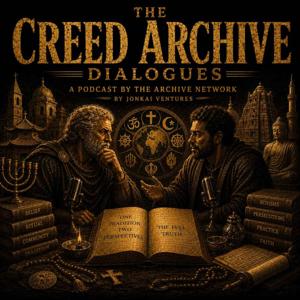
The Creed Archive Dialogues

The Creed Archive Dialogues

Download on the App Store

The Creed Archive Dialogues episodes

  • Jehovah's Witnesses
    Imagine a small group of people, gathering in private homes, their eyes fixed on the pages of the Bible, debating the fate of the world. In the shadows of industrial America, they believed that the end could come at any moment—and that they might be among the first to know.In the late eighteen seventies, the American religious landscape was alive with expectation. Across the northeast, in cities like Pittsburgh and Allegheny, ordinary people formed study groups, drawn by the promise of restored truth and the hope of a soon-coming Kingdom. It was here that a young man named Charles Taze Russell, born in eighteen fifty-two, started his own Bible study circle. Russell was restless, surrounded by the legacy of the Second Great Awakening and the fervor of Adventist prophecy. He wanted answers—about the end of the world, about what it meant to be truly Christian. And he believed those answers had been lost somewhere in the centuries since the apostles.Aurelius and Malik take on this case in full — 5 chapters, 36 minutes, one complete story.Learn more at: https://thecreedarchive.com/creed/jehovahs-witnesses

    The Creed Archive Dialogues is part of The Archive Network by Jonkai Ventures. In every episode, curators Aurelius and Malik take one religious tradition and follow it from origin to living practice — one setting out the belief on its own terms, the other pressing on the harder ground.

    The Archive Network is an independent, solo-run project. Everything is free, with no ads and no paywalls. Support doesn't unlock anything; it simply keeps the work going:

    https://thearchivenetwork.com/support

    Explore this archive:

    https://thecreedarchive.com

    Discover more archives and stories:

    https://thearchivenetwork.com

    Hosted on Acast. See acast.com/privacy for more information.

    36 min
  • ISKCON (Hare Krishna)
    Imagine a city street in nineteen sixty-six New York, echoing with unfamiliar music, saffron robes swirling, and voices chanting 'Hare Krishna' in a language few passersby understand. It’s a spectacle, an interruption—yet behind this new sound is an old story, stretching back centuries and continents, now suddenly rooted in the heart of the Western world.In the swirl of mid-twentieth-century New York, a remarkable transplant was taking place. The International Society for Krishna Consciousness, now known worldwide as ISKCON or the Hare Krishna movement, was about to be born. But its story does not begin in Manhattan. To understand how ancient Bengali devotion found new life among Western youth, you have to trace two powerful currents: the sixteenth-century spiritual revolution led by Caitanya Mahaprabhu, and the determined, print-driven revival of the nineteenth and twentieth centuries. ISKCON presents itself as the living branch of a lineage, or parampara, that goes back to Caitanya, who was born in Bengal in fourteen eighty-six. Devotees frame ISKCON’s founding as the modern flowering of this ancient tree. Scholars, meanwhile, see the movement as part of a larger story—one shaped by colonial encounter, reform, and the restless search for meaning in the modern age.Aurelius and Malik take on this case in full — 5 chapters, 35 minutes, one complete story.Learn more at: https://thecreedarchive.com/creed/iskcon

    The Creed Archive Dialogues is part of The Archive Network by Jonkai Ventures. In every episode, curators Aurelius and Malik take one religious tradition and follow it from origin to living practice — one setting out the belief on its own terms, the other pressing on the harder ground.

    The Archive Network is an independent, solo-run project. Everything is free, with no ads and no paywalls. Support doesn't unlock anything; it simply keeps the work going:

    https://thearchivenetwork.com/support

    Explore this archive:

    https://thecreedarchive.com

    Discover more archives and stories:

    https://thearchivenetwork.com

    Hosted on Acast. See acast.com/privacy for more information.

    36 min
  • Inuit Spirituality
    Beneath endless Arctic skies, where the ice shifts and the sea breathes, stories shape survival. There’s no single founder here—only elders, spirits, and the relentless cold, all forging a living tradition on the edge of the world.In the circumpolar north, Inuit Spirituality is not just a belief system. It is a set of practices, stories, and roles that have grown over centuries, woven into the land and sea. With no single prophet or central text, its origins stretch back through millennia of adaptation. Archaeologists trace Inuit lifeways to ancient cultures like the Dorset and Thule. Through changing hunting technologies and shifting settlements, communities built a way of life fitted to the unpredictable Arctic. Oral historians and ethnographers record that many of the stories and rituals now central to Inuit Spirituality have roots in pre-contact times. Even after first encounters with Europeans, these practices continued to adapt.Aurelius and Malik take on this case in full — 5 chapters, 36 minutes, one complete story.Learn more at: https://thecreedarchive.com/creed/inuit-spirituality

    The Creed Archive Dialogues is part of The Archive Network by Jonkai Ventures. In every episode, curators Aurelius and Malik take one religious tradition and follow it from origin to living practice — one setting out the belief on its own terms, the other pressing on the harder ground.

    The Archive Network is an independent, solo-run project. Everything is free, with no ads and no paywalls. Support doesn't unlock anything; it simply keeps the work going:

    https://thearchivenetwork.com/support

    Explore this archive:

    https://thecreedarchive.com

    Discover more archives and stories:

    https://thearchivenetwork.com

    Hosted on Acast. See acast.com/privacy for more information.

    36 min
  • Ibadi Islam
    In the deserts of Arabia and the bustling city of Basra, a quiet revolution was unfolding in the wake of the Prophet Muhammad’s passing. It was not the story of kings or conquerors, but of teachers, jurists, and communities searching for a faithful path amid chaos. How did a small movement, born in the turbulence of Islam’s first century, shape its own identity—and why does its legacy endure today?To trace the origins of Ibadi Islam is to step into one of the most contested chapters of religious history. After the death of the Prophet Muhammad in six thirty-two, the Muslim community fractured over questions of leadership and legitimacy. The decades that followed were marked by dramatic upheavals—civil wars, disputed caliphates, and new schools of thought. In this volatile environment, some Muslims sought a different way. They claimed continuity with the earliest community but insisted on a distinct approach to law, morality, and communal leadership. At the heart of the Ibadi story is Jabir ibn Zayd, an early scholar in Basra whose teaching and judgments shaped the foundation of this tradition. His influence endures in the chains of transmission that Ibadis cite to this day. But the Ibadi narrative isn’t just about ideas. It’s anchored in real places—Basra in present-day Iraq, the rugged landscapes of Oman, and, later, North Africa’s Maghreb. These were not just backdrops, but crucibles where faith and practice were tested, refined, and preserved.Aurelius and Malik take on this case in full — 5 chapters, 36 minutes, one complete story.Learn more at: https://thecreedarchive.com/creed/ibadi-islam

    The Creed Archive Dialogues is part of The Archive Network by Jonkai Ventures. In every episode, curators Aurelius and Malik take one religious tradition and follow it from origin to living practice — one setting out the belief on its own terms, the other pressing on the harder ground.

    The Archive Network is an independent, solo-run project. Everything is free, with no ads and no paywalls. Support doesn't unlock anything; it simply keeps the work going:

    https://thearchivenetwork.com/support

    Explore this archive:

    https://thecreedarchive.com

    Discover more archives and stories:

    https://thearchivenetwork.com

    Hosted on Acast. See acast.com/privacy for more information.

    36 min
  • Hòa Hảo
    In the flooded rice fields of southern Vietnam, a young man’s voice begins to echo across villages. Nineteen thirty-nine. A time of hardship, uncertainty, and colonial rule. But in the village of Hòa Hảo, something unexpected is stirring—a movement that will reshape the spiritual and social fabric of the Mekong Delta.Picture the Mekong Delta in the late nineteen thirties. Rice paddies stretch to the horizon. Riverboats drift between small, tightly knit villages. Life is rural, labor is hard, and the everyday world is watched over by a patchwork of local deities and Buddhist shrines. French colonial rule weighs heavily. Rural families live with both material insecurity and moral anxiety. Into this landscape steps Huỳnh Phú Sổ—a charismatic, rural-educated young man. Village elders and farmers gather as he delivers teachings in a language everyone understands. He calls for a simplified, heartfelt form of Buddhist practice. His sermons offer hope, ethical clarity, and a promise: ordinary people can find a path to spiritual renewal without elaborate temples or monastic hierarchies.Aurelius and Malik take on this case in full — 5 chapters, 35 minutes, one complete story.Learn more at: https://thecreedarchive.com/creed/hoa-hao-buddhism

    The Creed Archive Dialogues is part of The Archive Network by Jonkai Ventures. In every episode, curators Aurelius and Malik take one religious tradition and follow it from origin to living practice — one setting out the belief on its own terms, the other pressing on the harder ground.

    The Archive Network is an independent, solo-run project. Everything is free, with no ads and no paywalls. Support doesn't unlock anything; it simply keeps the work going:

    https://thearchivenetwork.com/support

    Explore this archive:

    https://thecreedarchive.com

    Discover more archives and stories:

    https://thearchivenetwork.com

    Hosted on Acast. See acast.com/privacy for more information.

    35 min
  • Heathenry (Ásatrú)
    Imagine a group of poets, farmers, and seekers gathering in Iceland, determined to breathe life into ancient rites most thought were lost forever. In the shadow of volcanic mountains, they reach back into the mists of time, searching for the voices of gods and ancestors whose names echo from medieval sagas. What does it mean to reclaim a religion from the fragments of myth and memory?In the late twentieth century, a unique religious movement began to emerge—one that looked not to distant lands, but to the very soil and stories of Northern Europe. Heathenry, often called Ásatrú, traces its roots to a convergence of scholarship, folklore, and cultural revival. Practitioners sought to reconstruct the pre-Christian beliefs of the Norse and Germanic peoples, drawing inspiration from the Poetic Edda and the Prose Edda. These thirteenth-century Icelandic texts, according to many Heathens, preserve the sacred narratives and ritual memories of their ancestors. Yet historians caution that these works are products of their medieval context, shaped by Christian scribes like Snorri Sturluson. As a result, the journey from ancient myth to modern ritual is one of interpretation, adaptation, and creative reconstruction. The Viking Age, with its ship burials and rune stones, provides some archaeological foundation, while the Icelandic Commonwealth period offers insight into social roles and legal concepts that modern practitioners have revived. But can a tradition built from scattered sources find coherence and meaning today? The answer, it turns out, is as complex and diverse as the movement itself.Aurelius and Malik take on this case in full — 5 chapters, 36 minutes, one complete story.Learn more at: https://thecreedarchive.com/creed/heathenry

    The Creed Archive Dialogues is part of The Archive Network by Jonkai Ventures. In every episode, curators Aurelius and Malik take one religious tradition and follow it from origin to living practice — one setting out the belief on its own terms, the other pressing on the harder ground.

    The Archive Network is an independent, solo-run project. Everything is free, with no ads and no paywalls. Support doesn't unlock anything; it simply keeps the work going:

    https://thearchivenetwork.com/support

    Explore this archive:

    https://thecreedarchive.com

    Discover more archives and stories:

    https://thearchivenetwork.com

    Hosted on Acast. See acast.com/privacy for more information.

    37 min
  • Haitian Vodou
    In the dark forests of eighteenth-century Saint-Domingue, enslaved men and women gathered at night, risking their lives. They called on spirits, invoked ancestors, and made oaths—setting in motion a chain of events that would shake an empire.This is the story of a faith born at the crossroads of violence and hope. Haitian Vodou did not emerge in silence. Its birth was a collision: African memory, Catholic symbols, and the brutal machinery of colonial slavery. The French colony of Saint-Domingue—now Haiti—became the most profitable sugar producer of its age by the seventeen hundreds. But its wealth was built on the forced labor of hundreds of thousands taken from West and Central Africa. In this crucible of suffering and survival, the religious lives of the enslaved blended and transformed. Concrete details anchor this story. The massive importation of Africans, the dominance of the plantation system, and the decisive insurrection that would culminate in Haitian independence after seventeen ninety-one: these are undisputed facts. Yet within this grand historical sweep, Vodou practitioners remember particular moments and people. One such moment is the Bois Caïman assembly of August fourteen, seventeen ninety-one. In the telling of many, it was here that a Vodou ceremony ignited the flame of revolt.Aurelius and Malik take on this case in full — 5 chapters, 36 minutes, one complete story.Learn more at: https://thecreedarchive.com/creed/haitian-vodou

    The Creed Archive Dialogues is part of The Archive Network by Jonkai Ventures. In every episode, curators Aurelius and Malik take one religious tradition and follow it from origin to living practice — one setting out the belief on its own terms, the other pressing on the harder ground.

    The Archive Network is an independent, solo-run project. Everything is free, with no ads and no paywalls. Support doesn't unlock anything; it simply keeps the work going:

    https://thearchivenetwork.com/support

    Explore this archive:

    https://thecreedarchive.com

    Discover more archives and stories:

    https://thearchivenetwork.com

    Hosted on Acast. See acast.com/privacy for more information.

    36 min
  • Falun Gong (Falun Dafa)
    In the early nineteen nineties, a new practice began to ripple across the parks and plazas of northeast China. But this was no ordinary morning exercise group. Within just a few years, millions would gather, drawn by promises of health, spiritual clarity, and a mysterious cosmic wheel. What sparked such sudden devotion—and why would it become a flashpoint for the Chinese state?In the city of Changchun, amid the rapid social changes of post-Mao China, a man named Li Hongzhi began teaching a unique blend of slow-moving exercises and moral philosophy. These teachings, called Falun Gong or Falun Dafa, emerged publicly in nineteen ninety-two, according to both the movement’s own accounts and outside historians. The timing was crucial: China, having just emerged from the turmoil of the Cultural Revolution, was experiencing a revival of qigong—ancient practices for cultivating energy, health, and sometimes spiritual insight. The government had relaxed its controls on physical culture, leading to a boom in new qigong schools, public classes, and televised mass demonstrations. Into this lively landscape, Falun Gong introduced something that set it apart. Its teachings combined five distinct exercises with a detailed moral program, emphasizing the refinement of one’s moral character and a central symbol—the Falun, or dharma wheel—that practitioners believed could be placed within the body through practice.Aurelius and Malik take on this case in full — 5 chapters, 36 minutes, one complete story.Learn more at: https://thecreedarchive.com/creed/falun-gong

    The Creed Archive Dialogues is part of The Archive Network by Jonkai Ventures. In every episode, curators Aurelius and Malik take one religious tradition and follow it from origin to living practice — one setting out the belief on its own terms, the other pressing on the harder ground.

    The Archive Network is an independent, solo-run project. Everything is free, with no ads and no paywalls. Support doesn't unlock anything; it simply keeps the work going:

    https://thearchivenetwork.com/support

    Explore this archive:

    https://thecreedarchive.com

    Discover more archives and stories:

    https://thearchivenetwork.com

    Hosted on Acast. See acast.com/privacy for more information.

    37 min
  • Ethiopian Orthodox Tewahedo
    A legend whispers through the Ethiopian highlands—the Ark of the Covenant, lost from Jerusalem, is not lost at all. It is hidden, guarded, and venerated. But how did Christianity take root in this ancient African land, and what stories shaped its earliest community?To understand the Ethiopian Orthodox Tewahedo Church, we must travel back to the kingdom of Aksum, a crossroads of empire and faith. In the fourth century, Aksum was a powerful state, trading gold and ivory, issuing coins stamped with regal faces, and building stelae that still tower over the city of Axum today. This was a world connected to Rome, Arabia, and the Red Sea. Here, Christianity found not just a foothold, but the foundation for a living tradition.Aurelius and Malik take on this case in full — 5 chapters, 34 minutes, one complete story.Learn more at: https://thecreedarchive.com/creed/ethiopian-orthodox-tewahedo-church

    The Creed Archive Dialogues is part of The Archive Network by Jonkai Ventures. In every episode, curators Aurelius and Malik take one religious tradition and follow it from origin to living practice — one setting out the belief on its own terms, the other pressing on the harder ground.

    The Archive Network is an independent, solo-run project. Everything is free, with no ads and no paywalls. Support doesn't unlock anything; it simply keeps the work going:

    https://thearchivenetwork.com/support

    Explore this archive:

    https://thecreedarchive.com

    Discover more archives and stories:

    https://thearchivenetwork.com

    Hosted on Acast. See acast.com/privacy for more information.

    35 min
  • Eckankar
    In nineteen sixty-five, in the midst of America’s restless spiritual experimentation, a new movement quietly took shape. It promised not just belief, but a way to experience the divine directly—through the Light and Sound of God itself.Few expected that what began with a single man’s vision would ripple outward, shaping a distinct path followed by seekers around the world. The founding of Eckankar was more than the launch of a new religion; it was a response to a unique moment in American culture. As traditional forms of worship were being questioned, and interest in mystical practices surged, one figure—Paul Twitchell—stepped forward with a message that would draw on ancient themes yet boldly claim a new beginning.Aurelius and Malik take on this case in full — 5 chapters, 36 minutes, one complete story.Learn more at: https://thecreedarchive.com/creed/eckankar

    The Creed Archive Dialogues is part of The Archive Network by Jonkai Ventures. In every episode, curators Aurelius and Malik take one religious tradition and follow it from origin to living practice — one setting out the belief on its own terms, the other pressing on the harder ground.

    The Archive Network is an independent, solo-run project. Everything is free, with no ads and no paywalls. Support doesn't unlock anything; it simply keeps the work going:

    https://thearchivenetwork.com/support

    Explore this archive:

    https://thecreedarchive.com

    Discover more archives and stories:

    https://thearchivenetwork.com

    Hosted on Acast. See acast.com/privacy for more information.

    36 min

About The Creed Archive Dialogues

From the publisher's feed

The Creed Archive Dialogues is part of The Archive Network by Jonkai Ventures, a collection of podcasts dedicated to the stories that shaped our world.


Every episode is a conversation.…