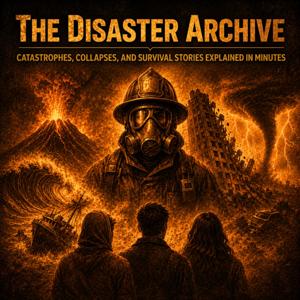
The Disaster Archive - History's Greatest Catastrophes and Tragedies explained in minutes

The Disaster Archive - History's Greatest Catastrophes and Tragedies explained in minutes

Download on the App Store

The Disaster Archive - History's Greatest Catastrophes and Tragedies explained in minutes episodes

  • Spanish Flu - Part 2: The early alarms, official hesitation, and the danger of dismissal
    It began as a fever among soldiers in Kansas. Then, in barracks and cities around the world, clusters of illness appeared—familiar, but spreading too quickly. The alarms were there, but the world refused to listen. What happens when warning signs are ignored?In early March nineteen eighteen, at Camp Funston in Fort Riley, Kansas, something changed. The camp’s hospital filled with men suffering fever, sore throat, and exhaustion. The symptoms seemed ordinary, but the speed was alarming. Soldiers moved through mess halls and sleeping quarters, folding the sick back into daily routines. The infection moved faster than any one person’s suspicion. Military necessity made things worse. Replacements had to be sent, schedules kept, ships and trains kept moving. Cities followed the same logic. Ports remained open, and the machinery of war couldn’t be paused for an outbreak. Shutting down would seem like sabotage. Caution lost to urgency. The disease tested the limits of power, and it was winning.Learn more at: https://thedisasterarchive.com/disaster/spanish-flu

    The Disaster Archive is part of The Archive Network by Jonkai Ventures, a collection of podcasts dedicated to exploring history's greatest disasters and the lessons they leave behind.

    Support the podcast and access exclusive content on Patreon:

    https://thearchivenetwork.com/support

    Discover more archives and stories:

    https://thearchivenetwork.com

    Explore this archive:

    https://thedisasterarchive.com

    Hosted on Acast. See acast.com/privacy for more information.

    6 min
  • Spanish Flu - Part 1: Modernity’s illusion of safety and the world before the invisible invasion
    Modernity gave people confidence that distance meant safety. Trains, ships, and telegraphs shrank the world, but they also created blind spots. In spring nineteen eighteen, catastrophe slipped quietly into familiar routines—a sickness that looked ordinary, hiding in the machinery of war.Cities in Europe and North America believed they had left massive epidemics behind. Sanitation was improving, bacteriology was advancing, and officials trusted that mortality could be measured and managed. Epidemics seemed like old history, not a threat to the new world. Influenza was counted as a nuisance of winter, rarely deadly on a large scale. Meanwhile, armies in the First World War moved millions of young adults through barracks, trenches, and crowded ships. These were places built for speed, not for health. Governments prioritized war over illness. News of disease was often suppressed to protect morale. In most capitals, influenza blended into the background noise unless it threatened discipline. Spain, neutral and with a freer press, reported openly when their king fell ill. Because of this, people everywhere started calling the outbreak the “Spanish flu”—even though it likely started elsewhere. The name was a product of wartime silence, not geography.Learn more at: https://thedisasterarchive.com/disaster/spanish-flu

    The Disaster Archive is part of The Archive Network by Jonkai Ventures, a collection of podcasts dedicated to exploring history's greatest disasters and the lessons they leave behind.

    Support the podcast and access exclusive content on Patreon:

    https://thearchivenetwork.com/support

    Discover more archives and stories:

    https://thearchivenetwork.com

    Explore this archive:

    https://thedisasterarchive.com

    Hosted on Acast. See acast.com/privacy for more information.

    7 min
  • San Francisco Earthquake - Part 5: How disaster changed a city and shaped American risk
    The long aftermath of the nineteen oh six earthquake did not begin with celebration. It began with investigation. Scientists, engineers, and city officials worked to understand what had happened to the ground, the buildings, and the systems meant to keep San Francisco safe. The city had not suffered just one disaster, but two: the earthquake and the fire, each making the other worse. This new awareness became San Francisco’s lasting legacy: a warning that prosperity and modernity do not guarantee safety.The disaster’s lessons unfolded slowly. The United States Geological Survey later identified the San Andreas Fault as the source, refining the magnitude to seven point nine. Commissions examined the city’s water supply, construction practices, and lack of seismic codes. The findings were blunt. San Francisco’s vulnerability was not just bad luck, but the result of decisions—about materials, planning, and the mistaken belief that rare disasters could be ignored. Blame scattered: some to builders, some to emergency planners, some to the limits of the era’s technology. Lawsuits and insurance battles followed, as the city’s losses were translated into claims and responsibility. But the deeper lesson was clear. The city’s modern appearance had been conditional, not secure. Its systems had failed when it mattered most.Learn more at: https://thedisasterarchive.com/disaster/san-francisco-earthquake

    The Disaster Archive is part of The Archive Network by Jonkai Ventures, a collection of podcasts dedicated to exploring history's greatest disasters and the lessons they leave behind.

    Support the podcast and access exclusive content on Patreon:

    https://thearchivenetwork.com/support

    Discover more archives and stories:

    https://thearchivenetwork.com

    Explore this archive:

    https://thedisasterarchive.com

    Hosted on Acast. See acast.com/privacy for more information.

    9 min
  • San Francisco Earthquake - Part 4: Counting the loss and searching for order
    When the flames finally subsided, San Francisco was a city transformed. Streets that had been boulevards of commerce were now rows of ash, and parks had become camps for the displaced. The city was no longer a place of business and routine, but a field hospital, a refugee camp, and a military zone all at once. Now, the real reckoning began: counting the dead, caring for the wounded, and rebuilding something from the ruins.The response unfolded in chaos and scarcity. Federal troops enforced order where they could, while firefighters and volunteers formed rescue parties in the few passable streets. Hospitals overflowed. Public spaces became places of triage, shelter, and mourning. According to the official relief records, supplies were rationed: food, water, and blankets had to be distributed to thousands whose homes were gone. The city’s normal systems—water, communication, transportation—remained crippled. For many, survival meant finding their name on a relief list.Learn more at: https://thedisasterarchive.com/disaster/san-francisco-earthquake

    The Disaster Archive is part of The Archive Network by Jonkai Ventures, a collection of podcasts dedicated to exploring history's greatest disasters and the lessons they leave behind.

    Support the podcast and access exclusive content on Patreon:

    https://thearchivenetwork.com/support

    Discover more archives and stories:

    https://thearchivenetwork.com

    Explore this archive:

    https://thedisasterarchive.com

    Hosted on Acast. See acast.com/privacy for more information.

    8 min
  • San Francisco Earthquake - Part 3: How the city’s destruction became a battle with flames
    When the fires took hold, San Francisco became an urban furnace. The earthquake had cracked the city’s spine, but the flames finished the work. Throughout downtown, people watched as embers leapt from roof to roof, transforming scattered blazes into a wall of advancing fire. Streets that had been busy yesterday were now corridors of smoke and panic. In those hours, every block was a battleground, and survival meant escaping not just the ruins—but the fire itself.The mechanics of destruction were relentless. The quake left broken mains and collapsed roads, so firefighters could not rely on their usual tactics. Hoses sputtered. Water pressure dropped. In desperation, officials ordered dynamite used to create firebreaks, hoping to deny the flames their fuel. But the explosions often caused more harm than good, toppling weakened buildings and spreading debris. According to the official report, even these desperate measures could not halt the fire’s advance. Across the business district, buildings that survived the shaking now burned, their interiors exposed and fireproofing no match for heat that lasted hours. Ornate facades crashed into streets. Metal warped. Smoke thickened until day and night blurred. Survivors moved what they could—furniture, ledgers, family goods—into parks or open ground, only to flee again as flames closed in. The city’s wealth was visible, even in ruin, as scorched account books and blackened safes littered the ruins. People carried their most valuable items until fire or exhaustion forced them to leave everything behind.Learn more at: https://thedisasterarchive.com/disaster/san-francisco-earthquake

    The Disaster Archive is part of The Archive Network by Jonkai Ventures, a collection of podcasts dedicated to exploring history's greatest disasters and the lessons they leave behind.

    Support the podcast and access exclusive content on Patreon:

    https://thearchivenetwork.com/support

    Discover more archives and stories:

    https://thearchivenetwork.com

    Explore this archive:

    https://thedisasterarchive.com

    Hosted on Acast. See acast.com/privacy for more information.

    5 min
  • San Francisco Earthquake - Part 2: When the ground refused to keep its promise
    Before dawn on April eighteenth, nineteen oh six, San Francisco’s confidence shattered in the space of forty-two seconds. No alarms sounded. The warning came as a low, rising roar and a sudden, terrible motion. People woke to beds pitching, walls cracking, and their world tilting on its axis. In that instant, the city learned what it meant to be vulnerable.A disaster often announces itself with sirens or smoke. But this one arrived in silence, then violence. At five twelve a.m., while most of San Francisco still slept, the first tremors rolled across the city. The shaking was enough to wake thousands. In boardinghouses, kitchens, and hotels, dishes fell, furniture slid, and people scrambled for shoes and shelter. Early workers on the street felt the ground shift beneath their feet, while dockworkers saw piers and ships lurch as if the city itself were adrift. The mainshock, later measured by the United States Geological Survey as magnitude seven point nine, lasted just forty-two seconds. But those seconds changed everything. The San Andreas Fault, a name known to few outside geology, had slipped along nearly three hundred miles, releasing energy stored over decades. The rupture sent waves of motion through every street, every home, every business.Learn more at: https://thedisasterarchive.com/disaster/san-francisco-earthquake

    The Disaster Archive is part of The Archive Network by Jonkai Ventures, a collection of podcasts dedicated to exploring history's greatest disasters and the lessons they leave behind.

    Support the podcast and access exclusive content on Patreon:

    https://thearchivenetwork.com/support

    Discover more archives and stories:

    https://thearchivenetwork.com

    Explore this archive:

    https://thedisasterarchive.com

    Hosted on Acast. See acast.com/privacy for more information.

    8 min
  • San Francisco Earthquake - Part 1: The illusion of safety in a city built on a fault
    San Francisco in the early nineteen hundreds looked unstoppable. Its hills bristled with homes, banks, and hotels, rising confidently toward the Golden Gate. But beneath these streets, something restless waited, and almost no one was listening. Could a city’s greatest strength turn out to be its blindest spot?At the start of the twentieth century, San Francisco was a city in motion. Streetcars rattled along Market Street, clerks hurried with ledgers, and newly wealthy merchants built showpiece mansions on Nob Hill. The city’s reputation soared as a modern metropolis, a place where commerce and ambition seemed to guarantee a bright future. To its boosters, San Francisco was proof that urban life could conquer nature. The port pulsed with trade, and everywhere, people acted as if the ground beneath them would always remain firm. But this confidence was built on an uneasy foundation—literally. The idea that the earth itself could threaten the city was, for most, an abstract worry. Only a handful of scientists spoke of seismic belts and fault lines. The San Andreas Fault was known to a few geologists, not to the daily life of the city. There were no seismic building codes. Most homes and businesses stood because they always had. Brick and unreinforced masonry were the norm, not yet seen as dangerous. The city’s safety systems were partial and untested. Fire companies existed, but their plans relied on water pressure staying constant, on hydrants that would work, and on streets that would not crack. No one really questioned whether these systems would hold if the ground moved. The spring of nineteen oh six was unusually dry, making the city’s outer neighborhoods more vulnerable. Wooden houses packed tightly across hillsides meant that a single ember could leap from roof to roof, turning a small fire into a citywide crisis. The fire alarm system worked for ordinary emergencies, but it had never faced a disaster that could break water mains and block streets all at once.Learn more at: https://thedisasterarchive.com/disaster/san-francisco-earthquake

    The Disaster Archive is part of The Archive Network by Jonkai Ventures, a collection of podcasts dedicated to exploring history's greatest disasters and the lessons they leave behind.

    Support the podcast and access exclusive content on Patreon:

    https://thearchivenetwork.com/support

    Discover more archives and stories:

    https://thearchivenetwork.com

    Explore this archive:

    https://thedisasterarchive.com

    Hosted on Acast. See acast.com/privacy for more information.

    7 min
  • Hindenburg Disaster - Part 5: The End of an Era
    The Hindenburg’s ashes cooled quickly, but the investigation began almost as soon as the flames were out. On May sixth, nineteen thirty-seven, the world’s largest airship burned in view of crowds, reporters, and cameras. The wreck became both a rescue site and a case study for what went wrong.German and American investigators combed the debris, interviewed survivors, and analyzed every fragment that survived the fire. The outline of the disaster was clear—a fire started aft of the control car and swept through the hydrogen-filled hull in seconds. The initiating spark remained a matter of debate. Was it static electricity? Was it a structural failure? The one certainty was that the hydrogen made tragedy all but inevitable once ignition began.Learn more at: https://thedisasterarchive.com/disaster/hindenburg-disaster

    The Disaster Archive is part of The Archive Network by Jonkai Ventures, a collection of podcasts dedicated to exploring history's greatest disasters and the lessons they leave behind.

    Support the podcast and access exclusive content on Patreon:

    https://thearchivenetwork.com/support

    Discover more archives and stories:

    https://thearchivenetwork.com

    Explore this archive:

    https://thedisasterarchive.com

    Hosted on Acast. See acast.com/privacy for more information.

    8 min
  • Hindenburg Disaster - Part 4: Rescue Amid the Ruins
    The collapse of the Hindenburg was not the end—only the beginning of a new emergency. The moment the flames died down, the field at Lakehurst became a desperate zone of rescue, confusion, and reckoning.In the minutes after the fire, Navy personnel, firefighters, and medical crews rushed onto the smoldering wreck. Smoke and the stench of burned fabric hung in the air. The survivors—burned, shocked, or barely conscious—were pulled from the debris or found wandering the grass. Others lay motionless, their fate uncertain as the first lists began to form.Learn more at: https://thedisasterarchive.com/disaster/hindenburg-disaster

    The Disaster Archive is part of The Archive Network by Jonkai Ventures, a collection of podcasts dedicated to exploring history's greatest disasters and the lessons they leave behind.

    Support the podcast and access exclusive content on Patreon:

    https://thearchivenetwork.com/support

    Discover more archives and stories:

    https://thearchivenetwork.com

    Explore this archive:

    https://thedisasterarchive.com

    Hosted on Acast. See acast.com/privacy for more information.

    8 min
  • Hindenburg Disaster - Part 3: Thirty-Four Seconds to Ash
    It began with a flicker near the tail, barely visible at first. Within seconds, the world watched as the Hindenburg—once a symbol of luxury—became a firestorm racing across the New Jersey sky. There was no time to process, only to witness.Minutes earlier, the Hindenburg had been an aircraft, gliding over Lakehurst, ready for landing. The weather was still, the crowds attentive. Then, a patch of flame erupted at the rear of the ship. According to the official German inquiry, the fire started aft of the control car and spread almost instantly through the hydrogen-filled hull. Later investigations debated the spark, but not the sequence. Once the fabric and gas cells ignited, the ship ceased to be a vehicle and became a burning skeleton in midair.Learn more at: https://thedisasterarchive.com/disaster/hindenburg-disaster

    The Disaster Archive is part of The Archive Network by Jonkai Ventures, a collection of podcasts dedicated to exploring history's greatest disasters and the lessons they leave behind.

    Support the podcast and access exclusive content on Patreon:

    https://thearchivenetwork.com/support

    Discover more archives and stories:

    https://thearchivenetwork.com

    Explore this archive:

    https://thedisasterarchive.com

    Hosted on Acast. See acast.com/privacy for more information.

    7 min

About The Disaster Archive - History's Greatest Catastrophes and Tragedies explained in minutes

From the publisher's feed

The Disaster Archive is part of The Archive Network by Jonkai Ventures, a collection of podcasts dedicated to the stories that shaped our world. This series tells the stories of history's greatest…

Best of The Disaster Archive - History's Greatest Catastrophes and Tragedies explained in minutes

Ranked by our users in the last 21 days