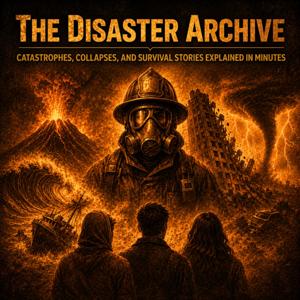
The Disaster Archive - History's Greatest Catastrophes and Tragedies explained in minutes

The Disaster Archive - History's Greatest Catastrophes and Tragedies explained in minutes

Download on the App Store

The Disaster Archive - History's Greatest Catastrophes and Tragedies explained in minutes episodes

  • Bhopal Disaster - Part 2: How small failures set disaster in motion
    It began quietly, with numbers on gauges and the hiss of pipes—signs that only a handful of people could see. In the sleeping neighborhoods outside, no one sensed the danger building just beyond the fence. Yet inside the Union Carbide plant, a chain of warnings was already snapping, one by one.The story of Bhopal’s disaster did not start with a single catastrophic event. It started with a series of compromises, maintenance shortcuts, and missed alarms that built up over days, months, even years. In the methyl isocyanate, or M I C, area of the plant, storage conditions were already strained. Later investigations by the Indian government and technical panels focused on one critical detail: water entered Tank six ten, setting off a reaction that the plant was not ready to stop. The safeguards meant to prevent this kind of escalation—cooling, isolation, emergency scrubbers—were either disabled or inadequate. The disaster was not a bolt from the blue, but the final step in a long sequence of small, documented failures. Every warning was easier to postpone than repair. According to technical histories, about forty tons of M I C were in Tank six ten that night—a scale that made containment nearly impossible once the reaction began. That figure is not an abstraction. It is the difference between a manageable incident and a catastrophe.Learn more at: https://thedisasterarchive.com/disaster/bhopal-disaster

    The Disaster Archive is part of The Archive Network by Jonkai Ventures, a collection of podcasts dedicated to exploring history's greatest disasters and the lessons they leave behind.

    Support the podcast and access exclusive content on Patreon:

    https://thearchivenetwork.com/support

    Discover more archives and stories:

    https://thearchivenetwork.com

    Explore this archive:

    https://thedisasterarchive.com

    Hosted on Acast. See acast.com/privacy for more information.

    7 min
  • Bhopal Disaster - Part 1: The city that grew beside a silent hazard
    On the southern edge of Bhopal, the Union Carbide plant stood tall, a symbol of hope for a hungry nation and a silent neighbor to thousands. No one imagined their ordinary night would depend on machines and chemistry they could neither see nor understand. Yet, sometimes, the greatest dangers wait unnoticed, hidden in plain sight.In nineteen eighty-four, Bhopal was a city in motion. Families migrated there for work, the city’s markets and tea stalls buzzed with late-night life, and the promise of industrial progress seemed close enough to touch. The Union Carbide India Limited plant promised more than just jobs. It was the engine of a new era, producing pesticides to help India feed itself. Its large tanks and smokestacks became familiar shapes on the horizon, a backdrop to daily life for neighborhoods like Jayaprakash Nagar. But beneath that familiarity, there was a tension. The plant sat right against crowded settlements—homes of brick and tin, narrow lanes, hand pumps for water. The boundary between factory and city was only a fence, not a buffer. Most people living nearby were daily-wage laborers, rickshaw pullers, vendors, or mill workers. Their children played and slept within sight of the factory’s walls. For them, the facility was a source of wages, not worry. The plant’s actual risks were technical, buried in systems and safety layers few outsiders ever saw. But the absence of distance—between hazardous chemicals and sleeping families—made Bhopal uniquely vulnerable in ways few recognized.Learn more at: https://thedisasterarchive.com/disaster/bhopal-disaster

    The Disaster Archive is part of The Archive Network by Jonkai Ventures, a collection of podcasts dedicated to exploring history's greatest disasters and the lessons they leave behind.

    Support the podcast and access exclusive content on Patreon:

    https://thearchivenetwork.com/support

    Discover more archives and stories:

    https://thearchivenetwork.com

    Explore this archive:

    https://thedisasterarchive.com

    Hosted on Acast. See acast.com/privacy for more information.

    8 min
  • Krakatoa Eruption - Part 5: Counting the cost, studying the sky, and the birth of warning systems.
    The story of Krakatoa did not end with the last wave. It began again in the struggle to understand what had happened. The Dutch colonial government sent investigators into the ruined strait. Their work—led by Rogier Verbeek—turned disaster into record.They gathered testimony, mapped the changed coast, and pieced together the sequence of eruption, collapse, and tsunami. The official report became a foundation for modern volcanology. Later scientists learned that Krakatoa’s destruction was more than an explosion. It was a chain reaction—fragmentation, collapse, and displacement of the sea. This template changed how future volcanic disasters would be studied.Learn more at: https://thedisasterarchive.com/disaster/krakatoa-eruption

    The Disaster Archive is part of The Archive Network by Jonkai Ventures, a collection of podcasts dedicated to exploring history's greatest disasters and the lessons they leave behind.

    Support the podcast and access exclusive content on Patreon:

    https://thearchivenetwork.com/support

    Discover more archives and stories:

    https://thearchivenetwork.com

    Explore this archive:

    https://thedisasterarchive.com

    Hosted on Acast. See acast.com/privacy for more information.

    8 min
  • Krakatoa Eruption - Part 4: Rescue in the ruins, and the struggle to measure absence.
    After the last echoes faded, the first task was survival. Ships that had ridden out the waves picked through the wreckage. Survivors stumbled through ash and debris, searching for familiar landmarks in a world that had changed shape overnight.The Sunda Strait, once a busy corridor, was now a scatter of broken coasts. Rescue was slow, improvised, and local. Boats searched for the living and the lost. People who had survived by chance—being inland, or on higher ground—tried to help those around them. The colonial administration struggled to collect information. Roads and harbors were gone. Telegraph lines were broken or useless. Reports arrived piecemeal, each one expanding the scale of the disaster. No one could say how many had died, or where the worst destruction lay.Learn more at: https://thedisasterarchive.com/disaster/krakatoa-eruption

    The Disaster Archive is part of The Archive Network by Jonkai Ventures, a collection of podcasts dedicated to exploring history's greatest disasters and the lessons they leave behind.

    Support the podcast and access exclusive content on Patreon:

    https://thearchivenetwork.com/support

    Discover more archives and stories:

    https://thearchivenetwork.com

    Explore this archive:

    https://thedisasterarchive.com

    Hosted on Acast. See acast.com/privacy for more information.

    8 min
  • Krakatoa Eruption - Part 3: The loudest sound in history, and a disaster with no single face.
    The air turned to dusk at midday. Ships rocked under invisible blows. And then, across the water and land, a sound so violent it traveled for thousands of miles—Krakatoa was no longer just a volcano. It had become a machine for destruction.On August twenty-sixth, eighteen eighty-three, Krakatoa erupted with force that stunned every witness. The sequence began in the afternoon and accelerated through the night into the following day. What started as ash and thunder became a series of explosive events that left survivors grasping for words.Learn more at: https://thedisasterarchive.com/disaster/krakatoa-eruption

    The Disaster Archive is part of The Archive Network by Jonkai Ventures, a collection of podcasts dedicated to exploring history's greatest disasters and the lessons they leave behind.

    Support the podcast and access exclusive content on Patreon:

    https://thearchivenetwork.com/support

    Discover more archives and stories:

    https://thearchivenetwork.com

    Explore this archive:

    https://thedisasterarchive.com

    Hosted on Acast. See acast.com/privacy for more information.

    8 min
  • Krakatoa Eruption - Part 2: Warnings rise from the strait, but the world keeps moving.
    It started as a rumor—ash on the wind, a haze above the trees. By the time sailors noticed, Krakatoa was sending up plumes that refused to be ignored. The signs were real, but no one could say what they meant.In May of eighteen eighty-three, Krakatoa began to change its voice. The volcano sent up columns of ash, sometimes visible from passing ships, sometimes dusting the villages along the Java and Sumatra coasts. By June and July, the eruptions were frequent enough to enter ship logs and colonial reports. But in a region used to volcanic activity, a single burst of ash was not enough to convince anyone of new danger. It was the repetition that mattered. Each new plume added weight to the story. These were not isolated curiosities—they were the start of a pattern.Learn more at: https://thedisasterarchive.com/disaster/krakatoa-eruption

    The Disaster Archive is part of The Archive Network by Jonkai Ventures, a collection of podcasts dedicated to exploring history's greatest disasters and the lessons they leave behind.

    Support the podcast and access exclusive content on Patreon:

    https://thearchivenetwork.com/support

    Discover more archives and stories:

    https://thearchivenetwork.com

    Explore this archive:

    https://thedisasterarchive.com

    Hosted on Acast. See acast.com/privacy for more information.

    5 min
  • Krakatoa Eruption - Part 1: A busy waterway, a quiet island, and dangers hiding in plain sight.
    Beneath the busy crossings of the Sunda Strait, an island slept. Sailors called it Krakatoa, a landmark as familiar as the tides. But below its calm slopes, a different story was waiting to surface—one that would change the meaning of safety forever.The Sunda Strait in the late nineteenth century was no wilderness. It was a crossroads—Dutch steamers threading between Java and Sumatra, villagers hauling boats at sunrise, trade and routine woven into the shoreline. Krakatoa, the island at the heart of this world, was part of the ordinary map. Its green slopes were visible from passing ships and nearby villages. People lived and worked in the shadow of the volcano, trusting that the calm meant safety. The volcano’s last serious eruption was out of living memory. To the colonial Dutch, it was dormant—charted, named, and considered contained. This sense of control was an illusion. The Dutch East Indies government kept meteorological records, but in eighteen eighty-three, there were no seismic networks, no underwater sensors, no warning system for tsunamis. If Krakatoa woke, the people closest to it relied on memory and rumor, not official alarms. That gap between knowledge and action would become fatal.Learn more at: https://thedisasterarchive.com/disaster/krakatoa-eruption

    The Disaster Archive is part of The Archive Network by Jonkai Ventures, a collection of podcasts dedicated to exploring history's greatest disasters and the lessons they leave behind.

    Support the podcast and access exclusive content on Patreon:

    https://thearchivenetwork.com/support

    Discover more archives and stories:

    https://thearchivenetwork.com

    Explore this archive:

    https://thedisasterarchive.com

    Hosted on Acast. See acast.com/privacy for more information.

    7 min
  • Chernobyl - Part 5: Counting the cost and the legacy that endures
    The immediate death toll from Chernobyl—thirty-one, by official records—was only the beginning. The real cost would take years, even decades, to measure. Some lived with scars, others with silence. Some left behind empty homes and a city reclaimed by wind and grass.The long-term health impact is still debated. According to the United Nations Scientific Committee on the Effects of Atomic Radiation, or UNSCEAR, and the World Health Organization, the largest numbers once reported in the press have not been supported by evidence. Most deaths from acute radiation syndrome were among the plant workers and first responders. But uncertainty remains. Cancer rates among the exposed are higher, and the legacy of illness and displacement stretches across generations.Learn more at: https://thedisasterarchive.com/disaster/chernobyl

    The Disaster Archive is part of The Archive Network by Jonkai Ventures, a collection of podcasts dedicated to exploring history's greatest disasters and the lessons they leave behind.

    Support the podcast and access exclusive content on Patreon:

    https://thearchivenetwork.com/support

    Discover more archives and stories:

    https://thearchivenetwork.com

    Explore this archive:

    https://thedisasterarchive.com

    Hosted on Acast. See acast.com/privacy for more information.

    9 min
  • Chernobyl - Part 4: Evacuation, confusion, and the search for truth
    The sun rose over Chernobyl’s wreckage, and with it came a second disaster: what to do next. Emergency crews moved through ruins, fire, and invisible radiation, improvising their response. Firefighters and plant workers were already showing signs of radiation sickness before the world outside knew what had happened.The Pripyat hospital, once a place for routine care, became a scene of crisis. Doctors saw men with vomiting, burns, and rapid decline—symptoms that didn’t fit the pattern of any ordinary fire. According to later reports, Lieutenant Vladimir Pravik and his fire crew were among the first to fall ill. Some were rushed to Moscow for treatment, but the damage had already been done. The first responders’ bodies told the story: this was not just an industrial accident. It was a radiological disaster.Learn more at: https://thedisasterarchive.com/disaster/chernobyl

    The Disaster Archive is part of The Archive Network by Jonkai Ventures, a collection of podcasts dedicated to exploring history's greatest disasters and the lessons they leave behind.

    Support the podcast and access exclusive content on Patreon:

    https://thearchivenetwork.com/support

    Discover more archives and stories:

    https://thearchivenetwork.com

    Explore this archive:

    https://thedisasterarchive.com

    Hosted on Acast. See acast.com/privacy for more information.

    8 min
  • Chernobyl - Part 3: Explosion, confusion, and an invisible catastrophe
    At one twenty-three and forty seconds, the world changed. The reactor at Chernobyl’s Unit Four exploded—not once, but twice in rapid succession. The night was torn open by a force no one in the control room could have truly imagined.The disaster wasn’t a single event. It was a sequence—steel, concrete, and graphite ripped apart, radioactive debris hurled into the air, and the core left burning and exposed. According to later investigations and survivor accounts, the first blast sent the one-thousand-ton lid of the reactor vault flying. The second explosion ripped through the building, shattering walls and tossing burning material onto the roof. The control room was chaos—plaster fell from the ceiling, alarms blared, and men staggered in shock. Some saw darkness where there should have been light. Others glimpsed the ruined operating floor. The test was over. Now, it was a fire scene. But this fire was not ordinary.Learn more at: https://thedisasterarchive.com/disaster/chernobyl

    The Disaster Archive is part of The Archive Network by Jonkai Ventures, a collection of podcasts dedicated to exploring history's greatest disasters and the lessons they leave behind.

    Support the podcast and access exclusive content on Patreon:

    https://thearchivenetwork.com/support

    Discover more archives and stories:

    https://thearchivenetwork.com

    Explore this archive:

    https://thedisasterarchive.com

    Hosted on Acast. See acast.com/privacy for more information.

    8 min

About The Disaster Archive - History's Greatest Catastrophes and Tragedies explained in minutes

From the publisher's feed

The Disaster Archive is part of The Archive Network by Jonkai Ventures, a collection of podcasts dedicated to the stories that shaped our world. This series tells the stories of history's greatest…

Best of The Disaster Archive - History's Greatest Catastrophes and Tragedies explained in minutes

Ranked by our users in the last 21 days