
Sign up to save your podcasts
Or



I’m starting to read a book proposing that the Book of Acts was written primarily to defend Paul for his forthcoming trial in Rome. Acts was supposedly a legal brief, and thus, it’s not really meant for Christians to see as canon (unless you see it as a legal brief). So, in order to make his point, John Mauck starts writing about the Roman Empire and the emperors around the time that the Book of Acts is covering. And he writes about how many, such as Gaius (AKA Caligula) thought they were gods and demanded worship.
The book of Philippians 2 compares and contrasts Jesus with Caligula. According to Josephus, Caligula “went beyond the bounds of human nature in his conceit of himself, and by reason of the vastness of his dominions made himself a god, and took upon himself to act in all things to the reproach of the Deity itself.” The writer of Philippians says to the early Christians, “Let this mind be in you which was also in Christ Jesus: Who, existing in the form of God, did not consider equality with God something to be grasped, but emptied Himself, taking the form of a servant, being made in human likeness. And being found in appearance as a man, he humbled himself and became obedient to death— even death on a cross.” (Philippians 2:5-8).
You might wonder why I’m writing this on The Drama of It All and not my Christian Substack. As I was reading part of the book about people worshiping their leader, I was reminded of all those people who believe that there are Trump Worshippers. This is something that Democrats like to say. They suggest that everyone who voted for Trump was somehow tricked and lied to enough that they joined a Trump cult and will worship everything he does without questions.
I know some people (who spent a lot of time online) really believed in the Q drops and did think some outrageous things like Trump was still working for the US in the background after Biden became the president. But the Democrats (who say every Trump voter is in a cult) think that it’s everyone. There’s no middle ground for those folks. They cannot believe that most Trump voters don’t worship him and they can’t believe that someone would vote for him even if they may not even like him personally.
NOTE: I’m using the term “Trump voter” rather than “Trump supporter” because I’m not sure there is even a common definition of what a “Trump supporter” is, and whether or not you voted for Trump is an objective reality we can all agree on.
Why They Think All Trump Voters Are in a Cult
And, you know what? I understand that. They believe a lot of lies about Trump because of their hatred. The corporate media has been spewing lies about Trump for about 8 years now and none of that would have mattered if these people didn’t idolize the media and have hate in their hearts.
When you see a person or organization as “above you” or as an “expert” in some field where you may be ignorant, you can begin to give up your responsibility to trace down the sources, to figure out if they’re honest, especially if you are lazy or overworked. You start taking what they say as gospel. You cannot believe that they would lie to you.
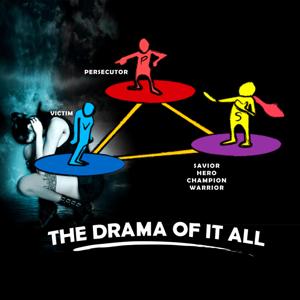
Many democrats, due to pride, thought they were the “good guys” (“Savior” types) and they thought Republicans were the “bad guys” (“Persecutor” types), so they couldn’t see a way in which Republicans were right, on anything. They will dehumanize and put down Republicans to the point that they wouldn’t be caught dead agreeing with one on anything. This leads the more manic ones to want to do the opposite of what Republicans are doing even when it’s crazy and harmful.
Their hatred of, and looking down upon Republicans, and their trust that the media is telling them the truth, lead them into a situation where they cannot understand how anyone in their right (sane) mind would vote for Trump. It’s splitting (black-or-white thinking). In their minds, if someone voted for Trump it means that they agree with everything the media claims about Trump, so obviously that Trump voter is a fanatic.
This is Projection
Not all Democrats are like that and some feel politically homeless right now. But for those who do believe all the lies of the media about Trump and cannot understand how anyone could vote for Trump it’s because they’re projecting their own idolatry onto Trump voters.
They take what the corporate media says as gospel. They may disagree with other people on small issues so long as the other also takes what the corporate media says as gospel. And, there do exist some Blue Anon folks who have found internet echo chambers that may even question the media when it doesn’t hate Trump enough.
This situation is odd in that they don’t worship any particular person as their god. But they do have a devil and his name is Donald Trump. He’s their scapegoat for all their own repressed sins. Now some climate activists, we could argue, make tithes and sacrifices for Mother Earth. But, again, that’s not a specific person.
They don’t worship, as the word “worship” demands some love and reverence be made to someone. The old Roman Emperors probably would have demanded sacrifices to get the impression that they were loved by the people. This is not that. This is a religion of hate. And that hate comes from fear.
Fear is a Lack of Faith
There are so many things that could possibly happen in this world that humans have had fears forever. Even the story of Adam and Eve eating a fruit from the Tree of Knowledge could be portrayed as FOMO (Fear of Missing Out). If you have faith that everything is working out for you, even when something you consider “bad” happens, then you don’t have to fear those unknowns.
But, as I’ve written about before, the “woke,” communist ideas, etc. cannot work because they are born from fear. They do not believe that the world will be fair unless they force other people to do things (against their will). Democrats, communists, the woke, etc. all believe that if left to their own devices people would not give of themselves and “save” people whom they see as “victims.” And, it’s true. That’s why they require force through the governments to get some movement on their social justice desires.
Although Democrats like this have a limiting belief that it’s because Republicans are inherently evil, people who can see outside of that Drama Triangle paradigm know that there are other reasons. It’s because they disagree that the people are actually “victims” or that just giving in like giving them money would solve anything.
What that comes down to is that people (such as Trump voters) do not see the world through the same lens as Democrats. But because these sorts of Democrats are so caught up in the Drama Triangle mindset, they cannot see in terms of grey, only black or white. They think you’re either with us or you’re a “persecutor.”
And there is no faith that Trump Voters would “do the right (moral) thing.” There seems to be no faith that a God would do that either.
From Pew Research:
Party identification among atheists, agnostics and ‘nothing in particular’
Atheists and agnostics, who make up relatively small shares of all religiously unaffiliated voters, are heavily Democratic.
Among those who identify their religion as “nothing in particular” – and who comprise a majority of all religious “nones” – Democrats hold a smaller advantage in party identification.
More than eight-in-ten atheists (84%) align with the Democratic Party, as do 78% of agnostics.
62% of voters who describe themselves as “nothing in particular” identify as Democrats or lean Democratic, while 34% align with the GOP.
Atheists and agnostics are more rare, but there’s a clear preference in that group to the Democratic party. And even if you believe in a God, you may not have faith that that God will work things out the way you want them to work out. Because many Democrats do not have faith in a God working through people to help those whom they view as “victims” they look to the government to be the “Savior” or “Rescuer.”
And, because there is not one single person that they look to as a “savior” perhaps this makes it so they don’t feel as if they are in a state religion. By combining many people together into a government through elections, it may feel as if it’s not them who is the “savior” figure and it’s not a single person, so it’s not a religion.
They feel the need to sacrifice for their cause and uplift or support their government. You could say they feel the need to “save their democracy,” but we all know they don’t mean what we mean when they use the term. If they did, they wouldn’t be complaining that the majority of voters electing Trump was a danger to our Democracy.
Ultimately, it can come down to their feeling of needing to “save” themselves because there isn’t a God that will do it for them. But since they reject the idea of personal responsibility (for themselves and others), they see things solely through the Drama Triangle paradigm, and that makes everyone involved feel powerless.
When you feel powerless you are in a fear state. And your brain cannot think of new ways to view the situation you are in. You start thinking one-dimensionally, rather than from multiple perspectives or a higher-dimensional perspective.
This means they will always lose. It’s only those who can relax and come up with solutions who will win in the long run. And, it’s people who have faith (in God or themselves) who will be able to be confident, trust that things can work out, take personal responsibility, and do what needs to be done to succeed.
Yes, I think the “Woke” phenomenon is a religious cult, but it’s an oddball one with no one to worship, no love, only fear and that will be its downfall. They obviously project their own insecurities and “sins” or “demons” onto other people in order to not face them. I think that to face them would be like “death” to their egos.
They thoroughly enjoy being looked at like the “good guy” saviors and that makes it impossible to view their own faults. And if you don’t want to hear anything else about Christianity, you can be done now.
They are just like the Pharisees.
Matthew 23:23 Woe to you, scribes and Pharisees, you hypocrites! You pay tithes of mint, dill, and cumin. But you have disregarded the weightier matters of the law: justice, mercy, and faithfulness. You should have practiced the latter, without neglecting the former. 24 You blind guides! You strain out a gnat but swallow a camel.
25 Woe to you, scribes and Pharisees, you hypocrites! You clean the outside of the cup and dish, but inside they are full of greed and self-indulgence. 26 Blind Pharisee! First clean the inside of the cup and dish, so that the outside may become clean as well.
27 Woe to you, scribes and Pharisees, you hypocrites! You are like whitewashed tombs, which look beautiful on the outside, but on the inside are full of dead men’s bones and every kind of impurity. 28 In the same way, on the outside you appear to be righteous, but on the inside you are full of hypocrisy and wickedness.
Social Justice Warriors continue to speak on justice and mercy, but they forget to start with cleaning themselves up before wanting to change the world. But, all Jesus said was woe to them and that they’ll be sent prophet and after prophet, whom they will kill because they don’t like the message. And in the end, their house will be desolate/abandoned (Matthew 23:38).
They can’t win the way they’re going. How could they? The fear keeps them blind to reality. Of course, they’ll end up in ditches.
Only the humble will learn from their mistakes and re-group.
Pride goeth before destruction, and an haughty spirit before a fall.
I certainly don’t trust Donald Trump to do things flawlessly, but at the very least, I think his near-death experience with the attempted assassination humbled him.
What do you think?
This is a free post so feel free to share it (you can earn great rewards for referring people to this Substack now!). Also, consider becoming a free or paid subscriber. If you don’t want to set up a subscription you can give a one-time donation by clicking the button below.
BTC Donation Address: bc1q4s6h8rhyqawqlz46ppc3zc5v43duycp8m57h9p
If you enjoyed this article, you may enjoy this one as well:
The book is titled Paul on Trial: The Book of Acts as a Defense of Christianity by John W. Mauck. That’s a referral link if you want to purchase it and help the Substack out.
Isn’t it weird that the book of Acts (of the Apostles) focuses almost solely on Paul? You can learn more about the book The Nazarene Acts (that focuses on Apostle Peter) here.
There is some good discussion on this page about what the emperor claiming to be a god means, as we don’t have the same understanding today. Today we think of “god” as something entirely not human, more like a spiritual being. That wasn’t their mindset back then. You could also read my article, “Christ said, ‘Ye are Gods’.” What Did He Mean?”
Clearly, this article is for the US citizens reading my Substack. Please don’t vote in the US Election if you are not a US citizen. 😉
I voted for Trump in 2016 because he was up against Hillary. I already had a strong dislike for her, but just knowing that sexist women were voting for her only because she was a woman instead of her merits made me want to vote for Trump. In 2020, after seeing the unconstitutional lockdowns and mask mandates I voted for Jo Jorgenson, the Libertarian candidate. I wanted the United States to be more free. Trump has a better plan this time.
Because he lost in 2020, I knew we were miswanting Trump to win that time. I trust that there is a higher plan, even when I have no idea what it is. It made some evil way more visible.
And Trump really is fired up this time. He knows who won’t stand by him better. He knows he mistrusted people. He’s got better people around him to inform him, like RFK Jr. #MAHA
I don’t think of Trump as a “Savior.” He’s not going to rescue us. If he wins it will only be because people took personal responsibility to vote and/or gather votes for him no matter the social consequences that they may face. The people did that. They probably hit rock bottom and figured out they had to.
I have pointed out that Trump falls into the “victim” narrative at times. He’s been a bit better than that in recent months, perhaps more so after his assassination attempt.
I have written that I think Vivek may have been the better choice (from my Drama Triangle perspective) to be the Presidential Candidate. But, Trump has the bigger backing. I understand that.
Some People Feel Voting’s Pointless
I know some people feel like it’s pointless to vote. They feel disempowered. I keep thinking, if they could cheat, why are they so afraid of Trump winning? If they have it in the bag, why was almost assassinated? Why do they keep trying to call him Hitler? They make themselves look like a stupid cult when they really don’t need to if it’s all choreographed.
I wrote something on Notes today that I realized many of my readers wouldn’t see. So I figured maybe I would place it here for you.
Even if you are in an all-red or all-blue state it is important to give Trump your vote because this may actually be what we need for him to win the popular vote (not just the electoral vote). If he wins the popular vote, the Democrats will basically be slapped in the face emotionally. It’s enforcing a boundary.
It’s saying, “No” in larger numbers than before. It’s our way of saying, “Sit the F down, and let Trump take this on.”
I wrote in another article about the meaning of the word “mandate.” It means that we the people have told our representative what we want him/her to do. By winning the popular vote, Trump can feel as if he has a mandate to deport criminals, etc.
Wouldn’t it be nice to mandate the government for a change?
Get out and vote. Your vote does matter even if you don’t change the electoral results.
If Kamala wins the popular vote, you know the Democrats will claim that there is no mandate from the people for Trump to do as he does. You know they will whine about changing the way our voting system works. Wouldn’t you like to stop that before it occurs?
Also, if you do not vote, the representatives who get elected don’t feel as if they represent you. They don’t attempt to win favor with you. They don’t try to do what you want. They don’t care what you think. They make their decisions based on the people who vote. Those decisions they make are based on whether or not what they do will get them votes or lose them votes. If your vote doesn’t matter, you won’t even figure into their plan whatsoever.
When you sit out and don’t vote, it shows them that you don’t care. It can also be seen as a passive, “Okay, whatever you want.” You can be seen as nonchalant. They think you will be obedient. Are you indifferent? Or do you care deeply?
The Biden-Harris team wanted to force people to get injected and then got upset when people didn’t want to do it. They thought they had every right to demand such a thing. They are for forcing women’s locker rooms and team sports to include males if they so choose, among many other things that all basically boil down to abuse.
To say “No” to that is to enforce a boundary.
Two Wings of the Same Bird?
I’ve seen people saying it’s two wings of the same bird. In other elections, I might agree. Not this election. Trump is talking about deporting criminals who illegally migrated here, getting males out of women’s locker rooms and sports, stopping child abuse (transgender surgeries & hormonal therapies), lowering energy prices, getting rid of income tax (huge blow), and more. I have not seen a Republican be so hard-hitting on the major issues that affect us and could have a tremendous impact on the country and entrepreneurs. So many Republicans are wishy-washy and don’t have a spine. Trump cares about the people of this nation. His narcissism works for him in this respect. He doesn’t care what the media thinks of him. He’s doing what the people want.
He wants to be remembered for doing a lot of good, as one of the best presidents, etc. Who cares if he is a narcissist if his will aligns with that of the people? So long as it doesn’t align against the will of the people (more with the corporate press and big corporations).
Was the country better off with him as president? Yes. He’s clearly shown he can run the nation better than Kamala can. I don’t see this as a difficult choice based on looking at the past.
Get Out and Vote
If you haven’t already, I am asking you to vote to send a message that you’re through with the abuse that Harris was a part of for the last almost-4 years. Enforcing your boundaries is important. They will never stop if you don’t say, “No.”
This is a free post so feel free to share it (you can earn great rewards for referring people to this Substack now!). Also, consider becoming a free or paid subscriber. If you don’t want to set up a subscription you can give a one-time donation by clicking the button below.
BTC Donation Address: bc1q4s6h8rhyqawqlz46ppc3zc5v43duycp8m57h9p
I love the truth. I believe God is truth. I want the truth. I prayed to not be deceived, because the bible says even the elect could be. Not knowing the truth can harm you. I even wrote a poem about that.
Truth is bold as a lion—steady and firm. Liars fear questions, get angry, and squirm. If someone you know is against all questioning, They may be a liar in fear of a reckoning. It's okay if they choose to cower, afraid. Everyone has to lie in the bed that they've made. Those who love truth, love questions as well, To be incorrect (and not know) might be living hell. But if you love truth, there's nothing to fear, Boldly question beliefs 'til your mind becomes clear.
If you build your worldview on faulty beliefs you will be like a house built upon sand when the rains come and wash the house away. You need a solid foundation of truth to withstand the rains of life, of reality. People who believe they are transgender and want others to “affirm” that, are like a house built on sand. When reality comes crashing in they can have a mental break.
Believing that vaccines are good for you comes with consequences. It’s autumn now and the time of year when people go in for their COVID booster and Flu vaccines. I’ve heard and seen the consequences. I’ve seen someone have to lie down at work because of the side effects of the “vaccine.” I’ve heard that people plan to get their shots when they have time to recover from the side effects. They plan around it because reality hit them in the past and they acknowledge that they have health issues after getting vaccinated.
I’m what would be called an anti-vaxxer. I was never big on getting shots for vaccines. I had shots as a child when I had no say in the matter. But since researching them (after I prayed not to be deceived) I decided they were not for me and that I might have slight vaccine damage. In fact, I think many people probably have slight vaccine damage and we just think of it as normal only because most people are vaccinated. I shared plenty of anti-vaccine posts when I was still posting on Facebook. I still have plenty of anti-mask and anti-vaccine memes on my computer.
I was also against the lockdowns from the very beginning and thanked God that I lived in South Dakota where that didn’t happen!
So I’m Pro-Gates?
So imagine my surprise to wake up to people on Notes suggesting I don’t know vaccines cause harm and that I’m somehow pro-Bill-Gates! It all started when I watched this clip on Substack Notes.
The video has the following text at the top, “I FINALLY FOUND THE VIDEO OF BILL GATES ADMITTING IT. This clip has been utterly scrubbed from the internet, even the original TED Talk. Save it.” The clip is from a Ted Talk in 2010 (the full video is still available on YouTube and their website).
The clip has Bill Gates saying, “The world today has 6.8 billion people. That's headed up to about nine billion. Now, if we do a really great job on new vaccines, health care, reproductive health services, we could lower that by, perhaps, 10 or 15 percent.” In the same video, another man comes on to comment about the video saying, “Common sense would tell you that if you have a man standing in front of you saying he's going to reduce the world's population by 10 or 15% using vaccines - what does that mean to you? That means somebody's going to die because you put a vaccine in them. It doesn't mean you're going to save people. That's pretty much common sense in my brain. But, yet, I saw him - I saw him say it. He said it. And, here we are."
Overpopulation is a Myth
Apparently, I have to let people know that I am against population control as well. Overpopulation is a myth and there are plenty of resources for you out there to study that if you think the world is overpopulated or that it is a concern for us. Bill Gates says he is concerned about having too much population in that Ted Talk and I believe he is concerned about overpopulation.
In the TedTalk Bill Gates is concerned about CO2 and how to get that to zero. He is happy to reduce how many babies will be born (how the population of the future will go down) because they increase CO2. I believe it’s a concern based on lies, which again is why a love of truth is so important. If you base your decisions on lies you make stupid decisions.
Two Lies in One Video
So, silly me, I thought that it had been scrubbed, since that’s what the video claimed, and then I shared the Note with a repost saying, “The context shows he wasn't talking about killing people with vaccines. I watched it before the scrubbing. This is another reason why censorship is stupid. This will be shared and no one can refute it because the real video was censored. Idiotic move by YouTube. Smooth move Exlax as they used to say…”
The video has a couple of lies, one of which did not affect me because I watched the original video when I first prayed to not be deceived and went down some rabbit holes as a “Truther.” The second lie was that the video had been scrubbed. And I thought that one could be true because there is so much censorship, especially with YouTube. I’ve had videos removed from YouTube plenty of times. YouTube has cried wolf too many times to be thought of as “Truthworthy.” They bet and lost all their trust chips a long while back.
Because of my dislike for YouTube, at first, I was willing to believe the lie about it being scrubbed. However, because I love truth more than lies, I did more research and I’m sharing that it was a lie and I’ve edited my Note to reflect that.
Now that I’ve watched the fuller video and checked out the transcript, I don’t think that this is the particular video that I watched when I first did my research. I remember Bill Gates explaining that families have many children in poorer countries because some of the children die (the mortality rate is high), and they try to beat the odds. I tried to find that video and I couldn’t. This could be because search engines have become less useful (they have exponentially lowered usefulness in the past 10-15 years). However, I did find an article that shares this information.
“Bill’s dad had set up a dinner at Seattle’s posh Columbia Tower Club with the Program for Appropriate Technology in Health (PATH). While the meeting started with birth control—among other efforts, PATH taught Chinese condom makers to test their products before shipping them—Gates began consuming data that startled him.
In society after society, he saw, when the mortality rate falls—specifically, below 10 deaths per 1,000 people—the birth rate follows, and population growth stabilizes. “It goes against common sense,” Gates says. Most parents don’t choose to have eight children because they want to have big families, it turns out, but because they know many of their children will die.
“If a mother and father know their child is going to live to adulthood, they start to naturally reduce their population size,” says Melinda.”
So, Bill Gates thinks that if you can keep infants and children alive (with vaccines), then parents will have fewer children and you’ll have lower population growth, which reduces the future population numbers.
I am pretty sure I saw that in a video, with charts as he was speaking, which is why I confused it with the one shown. I don’t remember reading it in an article. If you know where the video is then please let me know in the comments.
Who Would Admit They’re a Murderer in a Talk
I know Bill Gates thinks he’s smarter than he is, and has a savior complex. He is the epitome of the monkey “saving” a fish from drowning in water.
But, do you honestly think that if he was trying to kill people with vaccines he would just tell a group of people (in a video still available on the internet) that he was doing that? I’m assuming my regular subscribers won’t be that gullible. But apparently, people actually think this.
While researching truther topics I’ve heard it said that “they” have to tell you before they do something so they’re not bound by karma. I don’t believe that. They’re going to face consequences regardless. I don’t think “they” actually believe that. But even if they do, people like that are not going to admit to killing people outright as they claim that Gates is doing in that video.
If they had this video (which they have for many years and it’s still on the internet) of Bill Gates admitting to killing people with vaccines, why would anyone take the vaccines and why isn’t he in jail? The idea that he actually said he was killing people with vaccines rather than suggesting that the projected population would go down when people were vaccinated is absurd. Note the “projected” population distinction.
When people say that he is talking about lowering our population through killing, they make it seem like he’s talking about the current population. He is referring to lowering the future projection.
“The world today has 6.8 billion people. That's headed up to about nine billion. Now, if we do a really great job on new vaccines, health care, reproductive health services, we could lower that by, perhaps, 10 or 15 percent.”
Also, note the other ways that the population will be lowered. He refers to getting people healthier (which goes along with his thoughts in that article quote). He also refers to “reproductive health services,” which likely means abortion. Yes, if you advance abortion you will definitely lower the projected population. That is killing people, for sure! But that’s not what people focus on when they share this video. They don’t take it to mean that he wants to kill babies to lower the population, they say he’s talking about vaccines. Why make that jump?
Why do they believe it’s all about the vaccines? Because of hate. Our hate can lead us to be illogical. Negative emotions override the logical thinking parts of our brains. It’s why I jumped to the conclusion that the video was banned - hatred of YouTube’s censorship.
Willingness to Ignorantly Label Quickly
The reason I decided to write about this was because of people’s willingness to quickly label me as pro-vaccines or pro-Gates with absolutely no evidence.
People with hate in their hearts want to strike out at others verbally (because they feel powerless otherwise). Truthers who play Drama Triangle games feel like “Victims” and see others as “Persecutors.” They like to take on the role of “Savior” as well. People share this misleading video because they want to feel like they’re “doing something” to strike back at people like Gates. They want him to feel pain for the pain he’s caused others.
There’s a bit of the savior mentality in them as well, wanting to save people (even if it is by sharing lies or misleading videos). Isn’t that just what they claim Gates is doing? Hmm.
Drama-less Truthers don’t need to share misleading or false things to prove a point. That comes from them not sharing information out of a place of hatred. They dislike lies. They don’t share the information about deception and evil out of hate, they share it out of love.
Because the Drama-Triangle Truthers engage in splitting, seeing people as all good (allies/victims) or all evil (persecutors), they had to label me as a “persecutor” because, in their minds, no ally would debunk this. If I wasn’t an ally and not signaling that I was a vaccine-injured person (victim), then I had to be a “persecutor.”
People like to be able to categorize others as threats or allies in order to feel safe and comfortable. Just because we’re online, doesn’t mean that sort of categorization stops, especially if they believe words are violence.
Bad Interactions Flavor Future Predictions
These sorts of people likely had enough interactions in their past to think, “If someone says this video is false, then they usually turn out to be an enemy (they are mean to me),” so they make this assumption with everyone else that they interact with on the internet. Sometimes they’re wrong. They may be wrong most of the time. That can happen with splitting. People also interact with zealots online and may assume more people feel that way than really do. They may also be projecting their splitting behavior onto others.
Projecting Bad Habits?
I was told sharing the misleading video is not a big deal because the ends justify the means as well, which is plain wrong. Lying just makes people not trust you. That’s not the first time I’ve heard that line from supposed truthers either.
The problem with sharing a misleading video like this is that the only people who will see this video and get mad are already willing to hate Gates. And when they find out that it is an incredibly misleading video they will stop hating Gates and start hating “Truthers.” They may then tell others to hate and disbelieve “truthers.” Lies and manipulation (like whoever created this video was a part of) are like poison.
It was people filled with hate and a propensity to lie who were upset at my explaining that the video was misleading. I know plenty of so-called “Truthers” out there who are willing to lie and mislead others to try to get their points across. It’s not just this. This is not even the straw that broke the camel’s back. That was the “fake Simpsons’ predictions that were not predictions” posts on Facebook. I’ve been denigrating the propensity to lie by truthers for years.
And, trust me, I know there are good ones out there. It makes these people stand out all the more. No Truther movement can survive without people calling out liars. The lies are like yeast taking over the whole loaf. You have to root that stuff out.
People need to love truth more than their hate.
But these people have hate and don’t mind using lies to get their point across. The emotional charge of hatred for Gates may very well be because they’re projecting their own bad habits onto him.
And that doesn’t mean I think Bill Gates is good or even neutral. He has not been a net benefit for the world, IMHO. God, the things I’ve posted about Gates in the past. These people do not know me at all to suggest I’m pro-Gates. You may not know me either. But I was a truther posting about Agenda 21 and vaccines well before 2020. It’s why I was never afraid of COVID and thought we should have COVID parties and never should have locked down. I’m not one of these late-to-the-party people on vaccines.
I don’t care what all the haters say. Why would the opinion of lovers of lies matter?
But I wanted to write about that splitting and how it causes people who agree to fight with imaginary enemies. I’m not pro-Gates and I’m not pro-vaccines. These people just made up things and fought with those imaginary enemies for no good reason.
A lot of people on the internet argue with those who agree with them, and it’s amazing. That sounds ridiculous, right? It’s not just this, sometimes people disagree about the meaning of a word but they agree in the most basic understanding. They think they disagree with each other because no one defined the word publically. People could be getting along with each other much more commonly, but they don’t. Their hatred gets in the way. People don’t ask questions, such as “What do you mean by that?” We don’t give people the benefit of the doubt any longer (in general).
There is so much division that doesn’t have to happen. It’s mindblowing when you think about it. This happens every day, multiple times a day. It doesn’t get pointed out. People just fight with others who they agree with regularly. I’ll have none of that.
This is a free post so feel free to share it (you can earn great rewards for referring people to this Substack now!). Also, consider becoming a free or paid subscriber. If you don’t want to set up a subscription you can give a one-time donation by clicking the button below.
BTC Donation Address: bc1q4s6h8rhyqawqlz46ppc3zc5v43duycp8m57h9p
My Backstory & Introduction
I have many thoughts on veganism and the Drama Triangle. If you’re already a subscriber to The Drama of It All, you know half of that. If you’re a subscriber to my “Christian” Substack, then you may know some of the other half.
Please, consider reading the whole article to get the whole picture. I am not proselytizing. I am going to discuss the Drama Triangle. It just takes a while to get there.
My guess is that I have more meat-eaters than not reading my posts. I’m curious. Here’s a poll.
In 2015, I was unhealthy in pretty much every way, and I prayed to God to heal me (or help me heal myself). I prayed for the truth because Jesus said deception would be so strong that, if possible, even the elect would be deceived. Praying for the truth was the most powerful prayer that I’ve prayed and I suggest it to others. But you have to do the work of questioning and/or studying through fear as well.
Questioning Christianity
I was led to uncover many falsehoods within Christianity itself. Although some of my more loyal (to the truth, not me) YouTube followers enjoyed it, I became an outcast to many. I was lied about and called a “witch.” I was viewed as a “persecutor” by those who thought themselves “Saviors.” They thought people would be swayed by me speaking about my thoughts. They wanted to censor me. They couldn’t.
Questioning long-held religious (cult-like) beliefs is scary. I literally wondered about my “salvation” because of the cult-like beliefs from my past. You have to be strong to wonder if you’re wrong. I made a tearful video about it. But God wants all to know the truth, so there is power to get anyone through that questioning period. Since I’ve walked through that fire on more than one, extremely heavy issue, I do have faith that I was being led to the truth.
Everything in the bible became clearer after I learned the truth. A sign that you have been led to the truth is clarity (which is part of how I can see and break down things into the drama triangle so well), and it matches up with the real world. People who lie must come up with complicated stories about why what you are seeing in reality doesn’t “seem” to match up with their beliefs.
Becoming Vegan
You may wonder what this has to do with veganism. After I prayed to get healthier I was led to stop eating meat and dairy (at different times). My main health issue (that I prayed about) eventually disappeared as I also lost plenty of fat. This was a real-world “proof” that what I was doing was healthy. It also made sense to me (from my faith-based beliefs).
During that period of time, I started to question what was real about Christianity and figured, since I knew the bible had been edited (via mistranslations and actual additions) I should go to the source. I asked, “What did the early followers of Jesus believe?” I started studying the Essenes/Ebionites. They didn’t believe in a trinity (because that was man-made). They also didn’t believe in eating meat. They were vegetarian because Jesus told them we were not supposed to eat meat.
Side note: The incident at Antioch was likely that Paul taught it was okay to eat meat and Peter knew it wasn’t. Although people take Paul’s side, everyone in the bible took Peter’s. (From Wikipedia: “To Paul's dismay, the rest of the Jewish Christians in Antioch sided with Peter, including Paul's long-time associate Barnabas”). I could write a lot about the difference between the Essenes and mainstream Christians, and have. But, for this article, I’ll move on.
The things that I was led to by the spirit after I prayed were being spoken about by the followers of Christ in the Nazarene Acts of the Apostles. It felt like they were a confirmation that I was hearing correctly. As if my weight loss and health improvement weren’t enough.
Many Christians will view this idea as sacrilege. I’ve been attacked over it plenty of times. And I know the arguments. I’ve countered them. I trust the Spirit over random people online.
Drama Triangle Dynamics of Meat-Eaters
There are multiple Drama Triangle perspectives there. Christians may view me as a “persecutor” misleading people (apparently unable to think for themselves) into a “Doctrine of Demons.” They would equate me with a demon (persecutor) or say I’m being deceived by demons (victim) and doing their bidding, misleading others.
From a law of attraction perspective, is it any wonder after writing this post all day that someone decided to write the following note to me, insinuating that by cleaning my life up I was inviting demons into it? “You have my prayers” means Andy thinks of me as a “victim” who needs saving via “luck” and “prayers,” by him, of course. I’ve already written about the Drama Triangle dynamics in Christianity.
The Strawman
Others may also see me as a “persecutor” telling them to stop eating meat. I have no desire to do that. But people like to make that up like a strawman argument. Because of my past experiences, I half-expect a response in that vein from someone who was filled with anger and didn’t read the whole article.
People often disagree emotionally (get triggered into a fear state), and in that emotional state of rage, they don’t want to discuss it with rational “arguments”, so they immediately attack a strawman to feel like they’ve “fought” it and won. Yeah, they won an imaginary argument; big win. /sarcasm
Another way to view this in the Drama Triangle comes from meat-eaters seeing me as a “victim” of a “poor diet” (“persecutor”). They want to “save” me and get me to eat meat. I remember meeting someone who found out my blood type and said because I’m O+ I need to be eating meat. It didn’t matter that my body was healing on a vegetarian/vegan diet. Their recently read book was to be trusted against my own experience.
Vegans & The Drama Triangle
My point for bringing this up is that I was in groups on Facebook with Christian Vegans & Vegetarians and friends with many of them. I saw auxiliary posts on my Facebook feed from vegans. I had vegans watching my content commenting on it and had videos shared with me. I know how many of them think.
The Early Followers of Jesus
The early vegetarian followers of Jesus believed that eating meat allowed demons in. They feared demons (persecutors) and thus feared eating meat. But they took personal responsibility not to eat it and to be sure that whoever they ate with wasn’t eating it either (hence the incident at Antioch). They didn’t seek to stop people from eating meat. They didn’t proselytize. They just didn’t engage with them. When I first read this and saw the anger produced by people who didn’t want it to be true (because they wanted to continue to eat meat) I thought that the anger was excessive. It seems like there is an addictive quality to meat eating that causes people to have anger issues. I’m not writing this to say meat-eaters are filled with demons. It may be the early Christians saw the anger reminiscent of an addict as proof of demons.
The Facebook Vegans
As I mentioned I saw plenty of Facebook posts by vegans. I heard the powerlessness that they felt. They see animals in concentration camps factory farming facilities as “victims.” They see those who buy meat as essentially hiring hitmen to kill “victims”, so they’re “persecutors” for bankrolling this practice. The government subsidizes so they’re “persecutors” as well.
One woman said she found it difficult to sleep, she went to bed crying over what’s being done to the animals. The raping of cows, boiling of pigs, and blending live baby chicks, was too much for her to handle. The woman felt like she should be able to stop it like it was her responsibility to take the weight of the world on her shoulders to save these animals, but she couldn’t. It wasn’t her responsibility. It’s the responsibility of the factory farm owners and those who purchase the meat keeping them in business. I know we can only do what we can do and we should not take other people’s responsibility onto us.
Hell is here on earth for these animals. I think that the desensitization that led people to be okay with these horrible practices is part of why we (in general) attracted being locked down during the COVID pandemic. People who become insensitive to the feelings of innocent others (animals) being locked in a cage, don’t care about other people’s feelings in similar situations. If your response is, “But many of the people who locked down were vegan Democrats!” my response would be that they also are often insensitive to the feelings of innocent babies (in the womb) and pro-abortion. We have a problem with being insensitive to the feelings and rights of the innocents who cannot defend themselves.
I don’t often call others “victims” but when you cannot fight back, or take responsibility for the situation (like those animals bred into captivity and babies in the womb can’t) I think they qualify.
I’m not writing this to “save” them or to “save” you. Motivated Reasoning Keeps Us From Changing Minds. It’s impossible. So that’s not my job.
Do You Want to Play Drama Games?
Do you want to play Meat-Eater vs Vegans?
I don’t want to play this game. It wasn’t until 2015 that I started eating healthier. Before then I ate meat. I loved peanut butter & bacon sandwiches and all sorts of chicken (mostly from KFC). I remember as a teenager thinking I could never stop eating cheese because it was in almost everything I ate. No matter how much I enjoyed eating (and the ability to eat out), it would never occur to me to make fun of vegans the way people do today.
There is hatred of vegans that causes people to mock and antagonize them. I don’t understand it. Well, I mean I guess people just want the drama. They want the fight. That has to be part of it. They’re getting some sort of emotional boost by dunking on vegans. It may be because they felt attacked first (felt like a “victim”).
Many people I follow and like to read are very pro-meat-eating. I ignore the notes. Last week there was an article about how a Vegan Diet was Linked to Bowel Cancer in a study.
I quoted it in a note, and added the following video:
There’s a study suggesting that a “plant-based diet, especially when rich in healthful plant foods, is associated with better survival among patients with metastatic CRC (Colorectal Cancer).”
In the beginning of Christopher Cook’s article, he writes, “The assault on fat and meat has gone on for years, thanks in large measure to collusion between big agribusiness (especially Big Sugar/BigCorn), dishonest scientists and doctors, and politicians. A couple of fraudulent studies came out in the middle–late twentieth century saying that animal fat is bad for your health.”
I like Chris’s work. I share it enough that I got a free “paid” sub for a month. But I see this logical fallacy and I’ve seen enough stupid (in my humble opinion) fighting against vegans for no good reason that it prompted me to want to write about it.
I agree that there are fraudulent studies. I think many scientists, even when they’re not trying, tend to influence their studies to fit their own preconceived notions. I believe I shared this article in the past, but it fits perfectly here as well.
Experiments are supposed to be replicable. The authors should have done it themselves before publication, and all you have to do is read the methods section in the paper and follow the instructions. Sadly nothing, it seems, could be further from the truth.
After meticulous research involving painstaking attention to detail over several years (the project was launched in 2011), the team was able to confirm only two of the original studies' findings. Two more proved inconclusive and in the fifth, the team completely failed to replicate the result.
"It's worrying because replication is supposed to be a hallmark of scientific integrity," says Dr Errington. Concern over the reliability of the results published in scientific literature has been growing for some time.
According to a survey published in the journal Nature last summer, more than 70% of researchers have tried and failed to reproduce another scientist's experiments.
Most scientists 'can't replicate studies by their peers'
What good is a study? Chris wrote that he believed some scientists have put out fraudulent studies, and then posted about another study because it fit his narrative (veganism is bad). And, I saw many people, many of whom I subscribe to, share it because of the same reason. People want to push the narrative that veganism is bad. If that’s you, I would have you ask yourself why that is. What is the motivation for you? It’s a good mindfulness question. It doesn’t have to be public, but if you want to you can leave a comment with your answer.
Gell-Mann Amnesia Effect & Confirmation Bias
The “Gell-Mann Amnesia Effect” was coined by American author Michael Crichton in a 2002 speech, named after American physicist Murray Gell-Mann. It refers to “the phenomenon of a person trusting newspapers for topics which that person is not knowledgeable about, despite recognizing the newspaper as being extremely inaccurate on certain topics which that person is knowledgeable about.” (source of quote)
When you are knowledgeable and know studies can and have been inaccurate because scientists have bad motives, why go on and believe the same group of people?
It’s the fallacy of “appeal to authority” where the authority is a study. But we should already be suspicious of studies. We have competing studies. Mic the Vegan has tons of studies “proving” veganism is healthier than meat-eating.
Am I saying his studies are better? No. I don’t want to talk about studies. I don’t want to be in a battle of who has the better study (appeal to authority). I’m just asking, “Why do we all of a sudden believe studies now that they agree with us?” It’s confirmation bias and often it comes from a desire to dunk on vegans, who are often considered “persecutors.”
Don’t Conflate Vegans & Climate Change Activists
I don’t know any vegans that used studies to dunk on meat-eaters. Maybe the mainstream media that promotes Climate Change has used studies to try to get people to change their behavior. The climate change propaganda narrative is different than veganism. There is some crossover. This Venn diagram is not based on stats or to scale. I don’t know how many vegan climate activists there are. But I see people conflating vegans and climate activists a lot.
If you want more support you shouldn’t alienate people who agree with you. I don’t want to “eat the bugs.” I don’t want to be carbon taxed to “save” the planet as if it’s some victim we can “save.” I made a video on my YouTube channel in 2016 about not trying to get people to go vegan because of the “climate.” That was 8 years ago.
I’ve written: “Climate Change is a Gnostic faith/belief that there is no (good) God watching over the climate of the world. It's a faith in Scientism (not science because they reject scientists who reject the climate change theory). Proposed climate taxes are similar to a tithe to the religion. Since some people reject this theory, it is not a fact we all agree on, but a belief system.”
And I’ve written: “the person with a savior mentality takes on responsibility from thousands to millions or billions of people onto themselves. It depends on what particular political cause strikes them as most important. But, the climate activists think they’re trying to save every single person on earth and all of their future lineage. That is a lot of misplaced responsibility.”
I’m going to continue to write about the Drama Triangle dynamics from a perspective outside of it. I just was a bit tired of seeing people use faulty logic to feel “better” by dunking on vegans with a new study.
Why Do You Care What People Eat?
I feel like a lot of the sharing of these articles dunking on the vegan diet comes from people who don’t want the government to interfere in their lives. They’re probably tired of the propaganda. You and me both. But vegans, in general, aren’t the ones propagandizing you.
Vegans Acting Like They Have the Moral High Ground?
Someone mentioned that they don’t like vegans taking a moral high ground. I’ve seen many meat-eaters puffing themselves up about their morality and intelligence. It happens on both sides. But, since the meat-eaters become accustomed to their kind, they probably don’t see that they’re posting more about eating meat than vegans are posting the opposite. The percentage is very skewed on Substack. It’s probably been 95% pro-meat-eating and 5% anti- and I’m giving that a buffer. I’ve only seen one other person posting about how veganism is good (besides me if you can count me).
But you may be following different accounts than I am. Maybe keep a list and count how many of each side you see in a day if you think I’m wrong. You might be surprised if you start keeping track. And if you’re following people who post pro-veganism stuff and you hate it, stop following them. Why subject yourself to stuff you hate on a daily basis?
Why Do You Care What They Think?
Some of you may feel like vegans think they’re better than you, and this is “putting them in their place.”
Why do you care about what people (who you think are stupid) think about you?
See, I had issues caring about what other people thought about me, and I had to ask myself, “Why do you care what these very mean people think about you?” Turns out I shouldn’t care what they think. And that by caring about what they think and letting it get to me was making me a slave to them and what they thought. So, after going through the process and realizing what was really going on (drama triangle dynamics), I stopped caring about what they thought of me.
If you are of this variety and think that by sharing that “veganism is bad” you are putting them in their place, knocking them off some moral pedestal, then you might want to ask yourself why you cared to “prove” that. It can be (and I’m not suggesting in your case it is) a sign of doubt. A lot of people like sharing “proof” as a self-soothing action to ease the doubt that was previously felt. Also, remember that you’re not making a difference to a vegan. You’re not making a difference to the NWO climate change activists either. You can’t change their minds. That’s not your responsibility.
Leave a Comment
I could write about other reasons why I think people enjoy dunking on vegans. But, I’ll leave the comments open and let you have your say if you’re one of them. People make the joke that vegans make sure to let you know that they’re vegan. But I find meat-eaters to be way more vocal about it.
Vegans tend to have to explain it (when they’re asked why they’re not eating something that someone gave them or why they can’t have something). I never realized how much of our family get-togethers and special occasions and activities are centered around eating until I started fasting and going vegetarian and then mostly vegan. Yeah. I’m not 100% (I eat honey and farm eggs) and the vegans will probably hate me too. So what? My faith is what I base my diet on. I don’t base it on what a vegan organization decided was good.
I don’t want to fight with you all. I don’t care what you do. But if you’re reading this substack, I thought this was a drama triangle dynamic that I could come at from multiple angles, and hopefully, you found it interesting.
This is a free post so feel free to share it (you can earn great rewards for referring people to this Substack now!). Also, consider becoming a free or paid subscriber. If you don’t want to set up a subscription you can give a one-time donation by clicking the button below.
BTC Donation Address: bc1q4s6h8rhyqawqlz46ppc3zc5v43duycp8m57h9p
In recent news, a Democrat donor was arrested for threatening to kill 6 Supreme Court Justices and a survey was taken asking if America would be better off if Donald Trump died. “28% of Democrats answered yes to the question—that America would be better off—and 24% of Democrats said they were unsure” according to the Daily Signal.
Many people think the country would be better off if certain individuals died, and I think that it is lopsided on the side of the Democrats. If you asked Republicans if the country would be better off if Biden or Kamala were dead, I think you’d get far fewer affirmative responses. But, Republicans know that they’re up against a “system” of sorts. If Biden or Kamala died (God forbid) the problems the Republicans see in the political system would go on without any changes. One or two deaths wouldn’t make a difference. I’m sure most of them know that.
Why is it different for the Democrats? Why do they not see that the problem isn’t a couple of Supreme Court judges or one former President? I’m thinking that it’s the media in this case. The mainstream media focuses intently on the dangers of Republicans packing the Supreme Court or the dangers of Trump. But those right-leaning news media stations and channels tend to focus on the Democrats or the deep-state, larger groups, rather than individuals. But I don’t watch much “mainstream” TV, so let me know if I am wrong in the comments.
As I’ve written about before, the Democrats look to the government as a “Savior” far more often than a Republican or Libertarian would. It does tend to be the Democrats who fall into the victim mentality, and Social Justice Warriors are “Rescuers.” For some reason that party is so far stuck in the Drama Triangle that they cannot find their way out. They either do not want to take personal responsibility or they believe other people (whom they view as “Victims”) do not have to or can’t take personal responsibility for themselves.
People who feel like “Victims” can fantasize that the removal of a “Persecutor” through assassination would fix things. They can place the assassination on a pedestal and view it as a type of “Savior.” They think that if a person would come in and do that, then they’d be saved.
That’s not how this works though. People are miswanting another person dead. The powerlessness that they feel is torturous. But rather than get mental and/or spiritual help for that, they look to fill the hole by taking someone else’s life (or simply wishing that it would be taken).
That’s really about responsibility shifting. It is their responsibility to make themselves feel powerful again. Do you know the best way to feel empowered? By taking personal responsibility. It seems to be anathema to many on the left which is why they always feel powerless.
Everyone trying to put more laws in place and control what other people, down to controlling whether or not a person breathes their last breath, is doing so because they feel powerless over their own life. They think that by taking control of someone else, they’ll feel better. That’s not how this works though as I said.
The hole inside is caused by the feeling of powerlessness that comes from not owning your own responsibilities. Every time you feel like it’s someone else’s responsibility to make you feel better, you become enslaved to those people and whether or not they do what you want.
But, let’s look at death. People wish for Trump to die. If he did, would they feel better? They may feel “euphoria” for a moment in time. But far sooner than you would guess, the honeymoon effect comes in and they go back to feeling the same way before the event happened. There’s a paper on Harvard that I read about that in my article “All About Miswanting.” But you can also see my article about Miswanting (concerning Gender Affirmation.)
As soon as you get the thing that you think you want, you don’t normally stay with those high emotions. You forget to be thankful / grateful. You become complacent. Then, since you didn’t actually fix the emotional hole, something new will trigger you and you will find a new “persecutor” to blame.
We saw how Democrats, when they thought Trump might not be the Presidential candidate in 2024, started to label Governor Ron DeSantis as evil. In this video, they debate the question, “Would a DeSantis presidency pose a greater danger than another Trump presidency?”
When you think about gun control, you can remember that the Democrats keep wanting to pass more and more laws, but it’s never enough. They are insatiable. It’s because their fear provides them with new “Persecutors” when another one vanishes. It’s like their mind is moving the goalposts on them. But every time they think, “This time it’s going to work!”
Nope. That’s not how this works. If you’re ever thinking, “If only that person would die,” it’s time to question why you feel like that would make you happier. Consider what, in particular, is making you unhappy. Then find a way to fix it yourself. It will probably be a fear that you are avoiding.
It’s time for us to face our fears because if we don’t we’ll be running on that hedonic treadmill forever.
There are ways to not go back down to baseline happiness, but it takes work. I mentioned one of them already. Do you remember what it is?
Most of us are lazy about our happiness. We want to make it other people’s responsibility to keep us happy. But if it’s always someone else’s responsibility to keep you happy, you’ll never be happy. Maybe you’ll have a moment of euphoria, but then you will dip into dysphoria again because of the Honeymoon Effect.
Democrats, in general, seem to have a belief that it really is okay to make other people do things (such as using “preferred pronouns”) so they will feel happier. They may call you selfish if you don’t go along with it, but if you re-read that previous sentence you’ll see that they’re the ones being selfish. It’s just projection.
The paper from Harvard suggests that no matter the election result, we’ll all go back to our baseline levels of happiness or well-being. For most of us, that is probably the case. But I, personally, intend on taking responsibility for my happiness and increasing it regardless of the results.
Your happiness depends upon you, not someone else, and you certainly don’t need people (whom you’ve never even met) to die to make you or this country happy. It’s not their responsibility or fault for why you’re not happy. You are.
This is a free post so feel free to share it (you can earn great rewards for referring people to this Substack now!). Also, consider becoming a free or paid subscriber. If you don’t want to set up a subscription you can give a one-time donation by clicking the button below.
BTC Donation Address: bc1q4s6h8rhyqawqlz46ppc3zc5v43duycp8m57h9p
Democrats now claim it’s chicken on this grill and not a cat. Who in their right mind would videotape someone grilling chicken and claim it was a cat? People don’t consider normal behaviors like grilling chicken worth recording.
People lose their minds when they have motivated reasoning to believe a certain way. Everyone who claimed Trump was crazy will simply double down because they don’t want to be seen as “crazy.”
If you label anyone who thinks they’re eating cats in Ohio as “crazy,” then you will never want to concede that you were wrong. You don’t want to be a part of the “crazy” group and your peers, friends (allies), and perhaps coworkers will think you’re “crazy” if you start to question this story.
Echo Chambers Make It Difficult to Break Free
If you missed it, I also wrote about people who fawn in peer groups because they’re afraid to stick out and be kicked out of the community. If you heard your coworkers or friends laughing at the idiotic people who think cats are being eaten, how easy would it be for you to consider that maybe Trump was right? Would you admit it if you started to believe a cat was being grilled in Ohio?
You have to be very strong to wonder if you’re wrong.
When you live in an echo chamber, it is difficult to hear actual news without the biases and inflammatory language. It’s difficult to consider losing your social status with your peers. But the longer you stay in an echo chamber the more ridiculous the beliefs become because they go unchecked. They’re not questioned, so they get flimsier and flimsier.
Everyone on the outside of the echo chamber can look at it and think those beliefs are ridiculous. But from inside the echo chamber, it seems to be accurate because all you hear are echoing voices of agreement with you providing you with a sense of assuredness.
It’s always good to question whether you’re wrong. It’s nice to look at what the opposition to your beliefs says. You can question your beliefs and decide that you think they’re solid. But at least you’re questioning them and making sure they’re solid beliefs, not flimsy ones.
The life you live is based on your beliefs. You should want to make sure to test those beliefs if you’re going to use them as a foundation for your whole life.
If you want a strong bridge, you test the materials, and you test the workers, to make sure you get a steady bridge that can carry the weight of people driving on it every day. If you hire someone else to build a bridge and they put it together using tissue paper, would you want to drive on it? Make sure your beliefs are tested and found solid. Make sure you’re the one doing the testing. Don’t let someone else provide the materials and just trust them. You want to test them also to see if they’re worthy of your trust.
I understand that the people in an echo chamber would call me a hypocrite. They’d say I’m in an echo chamber if I believe something so ridiculous. There is a lot of projection that happens with people in echo chambers. That’s something to keep an eye on. It’s part of what keeps people locked into their own way of thinking.
This is a free post so feel free to share it (you can earn great rewards for referring people to this Substack now!). Also, consider becoming a free or paid subscriber. If you don’t want to set up a subscription you can give a one-time donation by clicking the button below.
BTC Donation Address: bc1q4s6h8rhyqawqlz46ppc3zc5v43duycp8m57h9p
If you want something in your world to change and it hasn’t changed so far, then you will have to do something uncomfortable.
Social Justice Warriors Desire Change
Social Justice Warriors (SJWs) want things to change. They see a problem caused by a “persecutor” and they see “victims” everywhere. They like to play “Savior.” I’ve written about them plenty of times.
So, what do they do? They attempt to force other people to change. Is that difficult? Well, sure they may think that it’s difficult to change other people. In fact, it’s literally impossible. No matter how much you censor information or try to make thoughts into a crime, you can’t stop people from thinking differently.
Choosing the Impossible vs. the Uncomfortable
Because many social justice warriors don’t want to do the personal work to feel better or think better-feeling thoughts, they, instead, want to change the world through force. I’ve written about how those who want to force others to use “preferred pronouns” are shifting the responsibility for their personal feelings onto the general public in “The Drama Around Pronouns & Gender Identity”.
And I also wrote about identity issues in “Do You Believe In Your Identity?”
What struck me while listening to the song was how completely opposite it must be for those who don’t just prefer you to use their “preferred pronouns” but demand it. There is likely no comfort for them in knowing who they are inside. How could there be? They look to other people to “affirm” their identity to them. If you ever give the responsibility to feel comfortable in who you are to other people, you will be sorely disappointed.
We can’t even feel comfortable with ourselves all of the time. That’s the benefit of trusting God’s higher perspective on us rather than our own limited perspective on ourselves. You can hear the power she emanates while singing. There is such power in believing what God says about you, that you’re loved, strong, and held, and belong with Him. It’s satisfaction. That is truly satisfying. There is no longer a hole in your soul that you need anyone else’s opinion on you to fill, than His opinion.
Those who want other people to “affirm” their worth, “affirm” their identity, will never be satisfied. They’re looking for love in all the wrong places. It has to come from within, not without, not from the world.
It’s Uncomfortable To Change Oneself
It is difficult to look at why you want to force others to do things (or not do things). Do you want to ban guns? Why are you afraid of them? You could take on personal responsibility to assuage your fears through meditation, mindfulness, going to therapy, taking self-defense or gun classes, etc. But these things are going to be difficult or uncomfortable for you.
I suspect those of you reading this are willing to do uncomfortable things to see change in your mind and in your world. But, you can see a lot of times people are not willing to be uncomfortable and change themselves. Instead, they shift their focus toward the impossible task of changing other people.
You may not be as bad at this as a social justice warrior, but you may do this in some areas of your life. You might want to spend some time considering that. When you find places in your life where you could take control (instead of demanding others change), you will feel more powerful.
This morning, I wrote a note about this.
…When people focus externally on changing what other people are doing (or not doing) they feel powerless. (Yes, that means the people in the government feel powerless, it’s why they’re striving to gain more control)
When people focus internally, they feel powerful. When you focus on what (in your personal & very local life) you can change, then you feel powerful. Your changes may seem like they’re not affecting the big picture, but they are, because you become a different person when you feel powerful and you interact with others. Your interactions with others spark a light in them as well.
You can feel powerful again, by focusing locally and personally. When other people see the change in you, they will want to join you.
When people feel powerful (by focusing personally/locally) they no longer desire to control other people.
Yes, that’s the key 🔑 to the freedom from oppression we want….
Get Uncomfortable If You Want Change
If we want things to change we will have to try to become comfortable with feeling uncomfortable. We have to learn that it’s not a “bad” thing. It feels weird because it’s different. But if we want to get a different result, we need to start behaving differently. Eventually, over time, it won’t feel that “bad” or “weird.” You’ll become used to the new version of yourself.
This is a free post so feel free to share it (you can earn great rewards for referring people to this Substack now!). Also, consider becoming a free or paid subscriber. If you don’t want to set up a subscription you can give a one-time donation by clicking the button below.
BTC Donation Address: bc1q4s6h8rhyqawqlz46ppc3zc5v43duycp8m57h9p
There is advice about cultivating a mindset out there that will make you feel extremely powerful in life, and many people will advise you against giving it. If you suggest that someone look for places in their life where they have control, even when they were not “at fault,” some will suggest you are “victim blaming.”
If someone drugs/rufies a woman in order to rape her, we can say she’s a “victim.” We can all agree with that. But some people, out of a weird “protective” mindset will say you’re “victim-blaming” if you say that she should be more careful about what or how she drinks in public in the future or ask why she wasn’t more careful leading up to it.
If someone accuses you of “victim blaming” when you suggest someone look for ways to protect themselves, they are taking on this sort of momma-bear “savior” role. And, just like in every other instance, if someone wants to play “savior” their advice will keep their perceived “victims” as “forever victims.” In other words, their advice will be horrible and backfire.
Those who want to play “savior” will look at you (suggesting personal responsibility) as “evil.” This is because they live with a very limited perspective, stuck in the Drama Triangle. You are either an “ally” (playing “savior” along with them), a “victim”, or a “persecutor.” If you suggest that the woman take some responsibility to protect herself in the future, they will stop thinking of you as an ally and associate you with the “persecutor” (or rapist in this case). All of a sudden, to them, you will be just as evil as the rapist.
To you, you want the woman not to feel like a victim for the rest of her life and to have a better life experience. But to them, you are harming her by “victim blaming.” When something bad happens to someone, you can simultaneously see them as a “victim” of a crime or immoral behavior and also see them as capable of taking action to better their experience in the future.
And, the most important point here is that when you take responsibility for your life, you feel empowered! If you give your responsibility away to others, you become dependent and powerless. When you say, “It should not be my responsibility to make sure I don’t drink a date-rape drug while at a bar,” you are shifting the responsibility to other people and giving away your power to those people.
If you want to feel like you are in control of your life, you will need to take personal responsibility regardless if other people are a******s. Even if you did not do anything morally wrong, you can still look for weak places that you could have done better, to build resiliency and become more empowered than you were before.
In the following old video of Louis Rossman, he explains that he attempted to call a customer back when the repair was finished (early). The customer came back weeks later complaining that Louis was keeping the repair too long and then gave him a horrible review. Everyone in the office said that Louis did what he could and the customer was wrong. Yes, the customer was wrong. But Louis knew that the best thing to do was to look for ways in which he could have made this experience go better. He ultimately figured out where his business had a weak spot and fixed it.
He wanted to have a successful business and, in order to do that, you have to look for weak points and improve those.
“I don’t want my business’ success to be based on somebody else.I want my business’ success to be based on me.” ~Louis Rossman
If you don’t want to look for all the places in your life where you could improve and want to responsibility shift onto others, you will be forever their slave. If Louis was comfortable in saying, “The customer was an a*****e,” and leaving it at that, whether or not he succeeded in business would be the responsibility of his customers, not himself. His successes (or lack thereof) would be a slave to how his customers acted, rather than how he acted. That lazy perspective would lead him to be powerless over how well his business did.
Do you want your life to be the result of how other people acted or failed to act? Or do you want to be in control of your life regardless of what other people are doing or saying? If it’s the latter, then you will have to ask yourself where you could improve, even when other people are a******s. Even if you didn’t do anything morally or ethically wrong, you will have to look for weak points and improve those points to make your life a better experience. That’s so utterly empowering that it’s shocking odd that people would advise you against it or label you “evil” for suggesting it. Of course, it’s not too shocking really when you understand how being stuck in the Drama Triangle limits your perspective of the world.
You can think of responsibility as your potato. I wrote about how people like to pass it on to others like they’re playing hot potato in a previous article. If you hold onto your responsibility then you have power over your life. If it starts to get hot, you can grab yourself a towel to hold it. If it’s cold, you can heat it up without waiting for someone else to do it for you.
But, if you give your responsibility away to others, then you are at the mercy of whether or not they want to take care of it for you. Other people are fickle, and it may take them a long while to do something. They may pass it on to someone else (playing hot potato) without your knowledge or consent. Or maybe they really don’t want to do it and keep you hanging on with no intention of doing any work for you at all. This is why I say you are enslaved to those to whom you pass your responsibility. They will keep you hanging on. If you want something done on your schedule, you can take personal responsibility to get it done rather than give that responsibility away and just complain.
That doesn’t have to mean you have to do it all yourself. You can take personal responsibility to hire someone to do something for you, rather than waiting around for someone to offer to do it free of charge. But if you find that someone who you hired isn’t doing a good job, it’s still your responsibility to do what’s necessary to fix the situation.
Suggesting someone take responsibility in their life is great, empowering advice. Those who think that’s wrong are often playing “savior” and subconsciously want there to always be victims to pretend to save and look for persecutors to be upset with. They love drama and don’t want it to end. Taking advice from people who don’t want drama to end is not very smart, but feels good emotionally. Remember when I said that emotional people don’t behave rationally/logically? If you are a fresh victim, the natural reaction is one of emotionality. That’s understandable.
It doesn’t come easily to people who have just been victimized to see things rationally. This excellent advice about looking for weaknesses and becoming resilient is the hard pill to swallow at that moment. The Drama Triangle response of calling rational people “victim blamers” and dehumanizing them is the comforting lie that many want to hear.
If you find someone who has gone through something that you would call literal victimization and see that they want to take personal responsibility so that they can lower the chances of something like that happening again, they are pretty unique. That’s a great sign, the opposite of a red flag.
I do want to touch on something here that’s related, but slightly different. Sometimes there is a desire to take responsibility for things (that wasn’t their fault or responsibility to begin with). That is a sign of past childhood abuse. When you, as a child, feel as if you have no control over what is happening, you will look to take on the responsibility for other people’s emotions and actions. That’s actually a form of “parentification” where you feel as if you, the child, have the responsibility over the adult’s emotional state. This helps to feel you have more control than you actually do. It gives a sense of power when power is so very lacking. So, for some people, there is some work to be done to not take responsibility for other people’s reactions.
You can’t change the way other people react. That was never your responsibility in the first place. But you can change yourself to buffer your life so you’re not really affected by other people’s reactions in the same way as before.
Some people may confuse these two ideas because they think other people’s emotions (whether or not people get offended) are their responsibility. I wrote about why that’s untrue, here, in the Real Reason You’re Offended article.
Conclusion
This article was not written to suggest a victim cannot be mad or upset about an injustice, crime, or immorality. Noticing that something is unwanted, listening to the emotion of anger, is a good thing. You would be doing yourself a disservice to ignore the information that the emotion of anger is giving you. It means you have a personal boundary you don’t want other people to cross.
But, you hold no power over what other people do or don’t do. Although people like to think they can have power if they can get a “Savior” to strongarm folks. Waiting for a savior to protect you is still inaction on your part. There will always be someone willing to test your boundaries and ignore them completely. So, if you choose to not look for ways to protect yourself from future similar events, that too, is a disservice to yourself.
So the best thing to do is to ask yourself where are your weak points and try to make those stronger so that you can protect yourself better in the future. It’s a process and you’ll get better as you do it over time.
And don’t worry about other people thinking this is just “victim blaming.” I think it’s pretty obvious that waiting around, not looking for ways to improve your situation, makes you less empowered. And labeling you or someone you know as a “victim blamer” is just an emotional outburst from someone locked in the Drama Triangle perspective.
This is a free post so feel free to share it (you can earn great rewards for referring people to this Substack now!). Also, consider becoming a free or paid subscriber. If you don’t want to set up a subscription you can give a one-time donation by clicking the button below.
BTC Donation Address: bc1q4s6h8rhyqawqlz46ppc3zc5v43duycp8m57h9p
I started watching this video on Tucker Carlson’s thoughts on Bitcoin. I studied cryptocurrency in 2015. I spent some time on the BitcoinTalk website studying it and I worked for some forms of crypto through that website. I enjoy the idea of being given cryptocurrency for my work. I do want us all to be able to move into a society where we are not dependent on fiat currency. I do hold cryptocurrency, not just Bitcoin. So although I’ve never written about it here, I do have that background and those interests.
Something came to me while I was listening to Tucker in the video and it relates to the Drama Triangle. So I thought I would write something about it here.
Choosing Credit Cards Over Cryptocurrency
People choose to use credit and debit cards, usually because they think they have to (like victims of our economic & banking system) or it’s because it’s better than using a check. But, there are a few reasons that I can think of why a regular person would choose to use a credit card instead of cryptocurrency to purchase something. These reasons may be why there is a reluctance to switch over and thus why Bitcoin hasn’t gone mainstream.
* The regular person doesn’t understand cryptocurrency, how it works, how to get some, and how & where to pay with it.
* Credit cards are tied to a more stable currency (in general) compared to the often volatile value of cryptocurrencies. In general, the regular person wants to know how much they can buy with their money and that’s more of a variable with crypto. To know the current value of crypto would take a little more work or the value may feel out of your control. With inflation, this comparison between the two of them may change.
* Credit card transactions are processed instantly, whereas some cryptocurrency transactions can take longer to confirm, depending on the network congestion and the cryptocurrency used. With crypto, you’d have to know to plan ahead, which is more work.
* Using a credit card responsibly can help build and improve credit history, which can be very important for obtaining loans and other financial products.
* Many credit cards offer rewards programs, cashback, travel perks, and other benefits that are not typically available when using cryptocurrency. As a side note, some cryptocurrencies do offer “staking” which is a form of interest, but you can’t use your crypto if you’re staking it. It’s more like a savings plan, than a reward.
* If your credit card is stolen, you can get your credit company to stop the payments so you don’t lose money. If someone has your private key for a cryptocurrency wallet, they can spend your money and you can’t do anything about it.
Many Reject Taking Personal Responsibility
Many people are not taking responsibility right now and certainly don’t want to be taking on more responsibility. No one wants to feel like a “victim” of credit card fraud, but there are easier steps to take to take some personal responsibility to protect yourself from it. There are companies out there that can warn you of breaches, and they can put alerts on your credit, and you can get money back that someone stole via a lost or compromised credit card number. All of that has happened to me, so I know how much easier it is with credit cards than with cryptocurrency.
You don’t have to search hard and long online to find tales of people losing their cryptocurrency. They may have thrown out or lost a flash or hard drive with the private keys to the wallet. They may have been hacked. They may have been sent to a phishing site that looked like a real site where they put in their private keys. They may have held it on an exchange that got hacked itself.
It takes a lot of work to know how to protect yourself from cryptocurrency theft. I was asked by my father to look into it to get him some, and I spent a lot of time researching it so that I would not lose it once I got it for him. Then, of course, I cared about protecting my own crypto when I started making some (via work).
People simply don’t want to take that responsibility. It takes time and energy. They want to continue on with their lives as is and look up to the credit and debit card companies as their “savior” who will take on the responsibility of protecting their funds from theft. If your money is in their wallet, it’s their responsibility to keep it safe, not yours.
If you don't own your private keys, you don't own that cryptocurrency
If you leave your cryptocurrency on an exchange, you’re leaving it in someone else’s wallet. It’s not yours until you know the private keys to spend it. Cryptocurrency exchanges have targets on them. People who want to steal cryptocurrency will go after them. Most people won’t trust them over a bank for multiple reasons. If you ever talk to someone who knows anything about crypto, they’ll tell you to never leave your crypto on an exchange.
But, it takes personal work to get cold storage, an offline wallet, somewhere to put your cryptocurrency and that’s just for saving it long term. If you actually want to spend it, you need some in a hot wallet. That will take more research, to trust a website or app to hold your cryptocurrency without them being hacked or downloading a compromised app.
On a personal note, to give more context of where I’m coming from, in 2015, I actually started to learn how to use Linux to create cold storage. I created paper wallets while the computer was offline on a fresh install to make sure it was secure. This is how far I went with my personal responsibility in this area.
The following video is for educational purposes only. I’m not suggesting you do this to store your crypto on it. You have to take personal responsibility and look up risks, etc.
Dealing w/Crypto Takes Loads of Responsibility
Understanding crypto, getting it, using it, and storing it all take time and energy if you don’t want to end up feeling like a “victim.” You have to take responsibility for your crypto if you don’t want to have it held in someone else’s wallet.
Cancel Culture & Banks
Now, we know that some banks and credit/debit companies have “canceled” people for their viewpoints. This means that those people could not utilize their income which was rightfully earned, or could no longer bring in funds that people freely wanted to give to them.
When the truckers protested in Canada they tried taking in cryptocurrency when the banks froze their accounts.
Canadian banks have begun freezing the accounts of people linked to the trucker protests in Canada and the federal government is promising to take more accounts offline in coming days in an attempt to clear demonstrators from Ottawa, which has been occupied for nearly a month.
On February 17, Deputy Prime Minister Chrystia Freeland said in a press conference that financial institutions have started freezing accounts and canceling credit cards in accordance with the Emergencies Act, which Prime Minister Justin Trudeau invoked earlier this week.
Newsweek Article
They tried to gain funds via the very untrustworthy website GoFundMe, and they were blocked as well.
Crypto fans of the Canadian truckers' anti-vax protest have raised more than $900,000 in bitcoin after donations via GoFundMe were blocked.
Trucks in the "Freedom Convoy" have clogged roads in Canada's capital Ottawa since late January to protest against the country's COVID-19 vaccine mandates.
Supporters donated $10 million to the truckers on GoFundMe. But the crowdfunding platform blocked distribution of the funds to its organizers last weekend, saying the protest was not peaceful and that authorities had raised concerns.
In response, a Canadian bitcoiner group known as "HonkHonkHodl" started a campaign on crypto crowdfunding platform Tallycoin.
Business Insider Article
The Canadian government then tried to make it so the truckers would be unable to use the cryptocurrency that had been freely sent to them.
A total of 34 cryptocurrency wallets allegedly associated with the Canadian truckers protesting COVID-19 restrictions, which had been raising money with Bitcoin for the Freedom Convoy 2022 campaign have reportedly been blocked.
In particular, the Royal Canadian Mounted Police (RCMP) Canada’s national police force has issued an order requiring all FINTRAC-regulated organizations in Canada to stop interacting with 34 crypto wallets, according to The Counter Signal.
It is still unknown whether or not this request from the police will result in a breakdown in the disbursement of the funds. The order comes after Canadian Prime Minister Justin Trudeau invoked the Emergency Act for the first time since 1988 in response to the continuing trucker protests on February 14.
Finbold Article
I tried searching to see if this hindered the Trucker protest, but I couldn’t find that information. I’d appreciate it if you could leave a comment if you know more about that.
From what I understand this meant that the truckers who were given access to a wallet full of Bitcoin would not be able to trade (via FINTRAC-regulated exchanges or businesses) the raised Bitcoin for their currency of choice to actually spend it on anything.
I believe that they could still trade Bitcoin to another person (who had their own personal wallet) in a free exchange. If a bunch of people wanted to buy some cryptocurrency, they could have bought it from the truckers, helping them out. But this exchange would have been people-to-people, not people-to-exchange-to-people. They would be cutting out the middleman.
Without the use of cryptocurrency exchanges, this may have made it a more local issue, where people needed to meet in person to exchange cash for crypto. I wasn’t there, and don’t know much about how they actually handled this. Any information you have on it would be welcomed in the comment section.
Freedom Comes From Personal Responsibility
Being free to exchange cryptocurrency in that moment would come from people taking a bunch of personal responsibility to know about crypto, to use it, without a middleman. It takes plenty of research or guts to not fear the funds being stolen. But they had just had their funds stolen in a way, hadn’t they? The banks and charity site had frozen their accounts. What else did they have left to lose?
It often takes being backed into a corner, and hitting rock bottom before many people are willing to take the personal responsibility to fix their lives. But, when the responsibility is in your hands, not someone else’s, then you are free.
Sadly, I think it will take a lot more instances like this before cryptocurrency takes off. But there are plenty of people, like Andrew Torba (founder of Gab), who are doing the work to try to help us have a parallel economy. Those people who do this, often do it because they’ve been blacklisted (pushed to the limit where they had to do something).
Most people today are willing to give up a little freedom for safety.
Those who would give up essential Liberty, to purchase a little temporary Safety, deserve neither Liberty nor Safety. Ben Franklin
I hope I was clear enough about cryptocurrency for those who know nothing about it. But you can feel free to leave a comment with any questions you have. Thanks for reading. If you found it useful or insightful, please give it a “like” and share it.
Edit: Here’s a good video with RFK Jr. talking about Bitcoin and the Trucker Protest (about 14 minutes into it):
This is a free post so feel free to share it (you can earn great rewards for referring people to this Substack now!). Also, consider becoming a free or paid subscriber. If you don’t want to set up a subscription you can give a one-time donation by clicking the button below.
BTC Donation Address: bc1q4s6h8rhyqawqlz46ppc3zc5v43duycp8m57h9p
I have mentioned the term “miswanting” before. I picked it up when I took the free online class from Yale on how to be happy called, “The Science of Well-Being.” (I highly recommend it). In that class, the instructor referenced the paper “Miswanting: Some Problems in the Forecasting of Future Affective States” by Daniel T. Gilbert and Timothy D. Wilson. The link for the PDF was to Harvard’s website here.
I referenced that PDF on Substack Notes the other day and thought, “I wonder if anyone will read that,” remembering that the PDF is very difficult to read. It was oddly printed in landscape mode while being presented in portrait. You basically have to print it out in order to read it, and it’s got a bunch of grey spots from being copied poorly. I edited it to make it much more readable.
I’m not claiming it’s my work, and I’m sure the writers won’t agree with all my comments elsewhere on Substack. But, to make this more accessible, I thought it might be nice if I read it for you all. I hope you enjoy it.
The original PDF is available here. My cleaned-up PDF version is here.
8. Miswanting
Some Problems in the Forecasting of Future Affective States
DANIEL T. GILBERT AND TIMOTHY. D. WILSON
"It would not be better if things happened to men just as they want."
Heraclitus, Fragments (500 b.C.)
Introduction
Like and want are among the first things children learn to say, and once they learn to say them, they never stop. Liking has to do with how a thing makes us feel, and wanting is, simply enough, a prediction of liking. When we say, “I like this doughnut,” we are letting others know that the doughnut currently under consumption is making us feel a bit better than before. When we say, “I want a doughnut,” we are making an abbreviated statement whose extended translation is something like, “Right now I'm not feeling quite as good as I might be, and I think fried dough will fix that.” Statements about wanting tend to be statements about those things that we believe will influence our sense of well-being, satisfaction, happiness, and contentment. Hence, when we say we want something, we are more or less promising that we will like it when we get it.
But promises are easier to make than to keep, and sometimes we get what we say we want and feel entirely unhappy about it. We order a cheeseburger only to find that it looks and smells precisely as cheeseburgers always look and smell, and despite that fact, we have absolutely no interest in eating it. We are perplexed and embarrassed by such mistakes and can only offer cunning explanations such as, "I guess I didn't really want a cheeseburger after all." Dining companions often consider such accounts inadequate. "If you didn't want the damned thing, then why did you get it?" they may ask, at which point we are usually forced to admit the truth, which is that we just do not know. We only know that it looks exactly like what we said we wanted, we are not going to eat it, and the waiter is not amused.
Although we tend to think of unhappiness as something that happens to us when we do not get what we want, much unhappiness is actually of the cheeseburger variety and has less to do with not getting what we want, and more to do with not wanting what we like. When wanting and liking are uncoordinated in this way you may say that a person has miswanted. The word sounds odd at first, but if wanting is indeed a prediction of liking, then it, like any prediction, can be wrong. When the things we want to happen do not improve our happiness, and when the things we want not to happen; do, it seems fair to say that we have wanted badly. Why should this happen to people as clever and handsome as us?
When wanting and liking are uncoordinated in this way you may say that a person has miswanted.
The Fundamentals of Miswanting
In a perfect world, wanting would cause trying, trying would cause getting, getting would cause liking, and this chapter would be missing all the words. Ours is apparently not such a place. How is it possible to get what we want and yet not like what we get? At least three problems bedevil our attempts to want well.
Imagining the Wrong Event
The fundamental problem, of course, is that the events we imagine when we are in the midst of a really good want are not precisely the events we experience when we are at the tail end of a really disappointing get. For instance, most of us are skeptical when we hear movie stars describe how relentless adoration can be a source of suffering, or when terminally ill patients insist that a dreaded disease has given their lives deeper meaning. We feel certain that we would be delighted in the first instance and devastated in the second because most of us have no idea what stardom or terminal illness actually entail. When we think of “adoring fans,” we tend to envision a cheering throng of admirers calling us back for an encore performance rather than a slightly demented autograph hound peeping through our bedroom window at midnight. When we think of “terminal illness,” we tend to envision ourselves wasting away in a hospital bed, connected to machines by plugs and tubes, rather than planting flowers in the hospice garden, surrounded by those we love. Terminal illness is not an event, but a class of events, and each member of the class unfolds in a different way. How much we like an event depends mightily on the details of its unfolding. When the imagined cheeseburger, (a half-pound of prime-aged beef) is not the experienced cheeseburger (three ounces of rubbery soy), it seems inevitable that our wanting and our liking will be poorly matched.
Given how varied a class of events can be, we might expect people prudently to refrain from directing their wants toward classes ("I don't know if I want a cheeseburger") and direct them instead toward particular, well-understood members of the class ("However, I know I don't want that cheeseburger"). Research suggests that people are not always so prudent and that when asked to make predictions about future events, they tend to imagine a particular event while making little provision for the possibility that the particular event they are imagining may not necessarily be the particular event they will be experiencing (Dunning, Griffin, Milojkovic, & Ross, 1990; Griffin, Dunning, & Ross, 1990; Griffin & Ross, 1991; Lord, Lepper, &.Mackie, 1984; Robinson, Keltner, Ward, & Ross, 1995).
When our spouse asks us to attend “a party” on Friday night, we instantly imagine a particular kind of party (e.g., a cocktail party in the penthouse of a downtown hotel with waiters in black ties carrying silver trays of hors d'oeuvres past a slightly bored harpist) and then estimate our reaction to that imagined event (e.g., yawn). We generally fail to consider how many different members constitute the class (e.g., birthday parties, orgies, wakes) and how different our reactions would be to each. So we tell our spouse that we would rather skip the party, our spouse naturally drags us along anyhow, and we have a truly marvelous time. Why? Because the party involves cheap beer and hula hoops rather than classical music and seaweed crackers. It is precisely our style, and we like what we previously did not want because the event we experienced (and liked) was not the event we imagined (and wanted to avoid).
Using the Wrong Theory
If imagining the wrong event were the sole cause of miswanting, then we would only miswant objects and experiences when the details of their unfolding were unknown to us. The fact is, people often want - and then fail to like - objects and experiences whose details they know quite well. Even when we know precisely the kind of party our spouse is hauling us to, or precisely the kind of cheeseburger this particular restaurant serves, we may still be surprised to find that we enjoy it a great deal more or less than we had anticipated. For example, Read and Loewenstein (1995) asked subjects to plan a menu by deciding which of several snacks they would eat when they returned to the laboratory on each of three consecutive Mondays (cf. Simonson 1990). Subjects tended to order a mixed plate that included instances of their favorite snack (“I'll have a Snickers bar on the first two Mondays”), as well as instances of their next favorite (“And tortilla chips on the third Monday”). Alas, when it actually came time to eat the snacks, subjects were not so pleased on the day when they arrived at the laboratory only to find themselves faced with a snack that was, well, not their favorite. Their disappointment was perfectly understandable. We should be disappointed when we do not get what we like most, and the only thing that seems hard to understand is why subjects wanted something that they knew perfectly well they did not like perfectly well?
Apparently, subjects in this study believed that variety is the spice of life - and in this case, they were wrong (cf. Kahneman & Snell, 1992). A Snickers with every meal is indeed a dull prospect for anyone, but a Snickers once a week is just about right. As such; Snickers-lovers are made less happy - and not more happy - when their weekly Snickers is replaced by a less desirable treat. Because subjects in this study had erroneous theories about their own need for variety over time, they miswanted tortilla chips when they planned their menu.
The moral of this ripping yarn about snack foods is that even when people have a perfect idea of what an event will entail (i.e., tortilla chips are deep-fried corn pancakes covered with salt - period), they may still have imperfect ideas about themselves and thus may make imperfect predictions about how they will react to the event: People who can imagine sun, surf, sand, and daiquiris in exquisite detail may still be surprised when their desert island vacation turns out to be a bust - not because they imagined this island and ended up on that one, but simply because they did not realize how much they require daily structure, intellectual stimulation, or regular infusions of Pop Tarts. Highbrows fall asleep at the ballet, pacifists find themselves strangely excited by a glimpse of world-class wrestling, and tough guys in leather jackets are occasionally caught making clucking sounds by the duck pond. To the extent that we have incorrect theories about who we are, we may also have incorrect beliefs about what we will like.
Misinterpreting Feelings
If we could imagine events exactly as they were actually to unfold, and if we had complete and accurate knowledge of our relevant tastes and attitudes, could we necessarily avoid miswanting? Unfortunately not. When we imagine a future event, we normally have an affective reaction to its mental representation (imagining one's spouse happily entwined with the mail carrier usually illustrates this fact convincingly), and we naturally take this affective reaction to the mental representation of the event as a proxy for the affective reaction we might have to the event itself. If the mere thought of a mate's infidelity makes us feel slightly nauseous, then we have every reason to suppose that the real thing would end in an upchuck. Our affective reactions to imaginary events are, in a sense, experiential previews of our affective reactions to the events themselves, and they figure prominently in our predictions of future liking. Few of us need to consult a cookbook to know that we should avoid any event involving liver and maple syrup. That funny feeling right here is information enough (see Forgas, 1995; Schwarz & Clore, 1983; Schwarz, 1990).
Wantings, then, are based on three ingredients: the particular details that we imagine when we consider a future event, our beliefs about the ways in which people like us are likely to react to such events, and the "gut reactions" we experience when we imagine the event. Just as the first two of these ingredients can lead us to miswant, so too can the third. How so?
Wantings, then, are based on three ingredients: the particular details that we imagine when we consider a future event, our beliefs about the ways in which people like us are likely to react to such events, and the "gut reactions" we experience when we imagine the event.
The crux of the problem is that the feelings we experience when we imagine a future event are not necessarily or solely caused by that act of imagination. We may feel enormously excited when we contemplate spending next Sunday at the circus, and thus we may drop buckets of money on ringside tickets without realizing that the good news we received about our aging uncle's miraculous recovery from psoriasis just moments before we purchased our ticket has contaminated our affective reaction to the thought of dancing elephants (Wilson & Brekke, 1994).
Come Sunday, we may find ourselves bored to tears beneath the big top, wondering why we paid good money to see a herd of clowns in a little car. Our miswanting in this case would not have been a result of having imagined the wrong event ("Oh, I was thinking of a flea circus") nor of having had a false conception of ourselves ("Why did I think I liked men in floppy shoes?"). Rather, we would have miswanted because when we initially thought about the circus we felt excited, and we took that fact as information about the circus rather than as information about Uncle Frank's remission. Feelings do not say where they came from, and thus it is all too easy for us to attribute them to the wrong source.
Feelings do not say where they came from, and thus it is all too easy for us to attribute them to the wrong source.
Experimental demonstrations of this home truth abound. People may mistakenly believe that their lives are empty when, in fact, their gloomy mood is a consequence of rain (Schwarz & Clore, 1983); they may mistakenly believe that a person is attractive when, in fact, their pounding pulse is being caused by the swaying of a suspension bridge (Duttoq & Aron, 1974); and so on. Because we cannot always tell if the feelings we are having as we imagine an event are being caused solely by that imagining, we may use these feelings as proxies for future liking, and hence, miswant.
Thinking and Feeling
We ordinarily experience both thoughts and feelings when we imagine a future event, and these influence our wantings to different extents, under different circumstances, and with different results. Sometimes, our affective reactions to an imagined event provide an excellent basis for wanting, but our cognitive reactions muck things up. This seems to be what happened when Wilson et al. (1993) offered college students a reproduction of an impressionist painting or a poster of a cat with a humorous caption.
Before making their choices, some students were asked to think about why they liked or disliked each poster ("deep thinkers") and others were not ("shallow thinkers"). When the experimenters phoned the students later and asked how much they liked their new objet d'art, the deep thinkers were the least satisfied. Presumably, the shallow thinkers used their current affective reaction as the basis for their decision and ended up liking the posters they had chosen.
Deep thinkers, on the other hand, had some badly mistaken theories about their own aesthetic preferences (“Now that I think about it, the olive green in the Monet is rather drab, whereas the cat poster is bright and cheery”), and when they allowed these cognitive reactions to overrule their affective reactions, they inevitably miswanted.
At other times, however, our cognitive reactions can provide an excellent basis for our wantings, and our affective reactions may lead us astray. For example, Gilbert, Gill, and Wilson (1998) asked shoppers at a grocery store to write down all the items they had come to buy, and allowed some shoppers to retain that list. Next, they asked some shoppers to eat a quarter pound of blueberry muffins before entering the store. As shoppers exited the store, the experimenters examined their cash register receipts. When shoppers were deprived of their shopping lists, those who had eaten blueberry muffins bought fewer unwanted items than did those who had not eaten any muffins. Presumably, when these listless shoppers encountered items in the store, they had more positive affective reactions to the items when they were unfed (“The marshmallow cookies look so delicious!”) than they did when they were well-fed (“I never want to eat again”) and thus were more inclined to buy items that they had not intended to buy.
Shoppers who had their lists in hand, however, were unaffected by the blueberry muffins, and bought no more unwanted items when they were unfed than when they were well-fed. These listful shoppers surely had the same affective reactions as did their listless counterparts, but because they had in hand a copy of A Theory About What I Will Want in the Future (aka a grocery list), they were able to avoid basing their choices on their affective reactions and thus they were able to avoid miswanting.
It seems, then, that feelings sometimes serve us better than theories, and theories sometimes serve us better than feelings. Alas, sometimes neither serves us well at all. Gilbert et al. (1998) asked college students to predict how much they would enjoy eating a bite of spaghetti the next morning or the next evening. Some of the students were hungry when they made these predictions, others were not; Some students were allowed to think deeply about their predictions, and others were distracted while they made their predictions.
When the students were distracted, they relied on their gut feelings to make their predictions, and thus the hungriest students naturally predicted that they would like spaghetti more the next day than did the less hungry students.
Notably, the time of day at which the spaghetti was to be eaten made no difference to them at all. When students were allowed to think deeply, however, they relied on their theories to make their predictions, and thus they predicted that they would enjoy spaghetti (which is generally considered a more appropriate dinner than breakfast) more the next evening than they would the next morning. Notably, the students' current hunger made no difference to them at all. Finally, when students were actually brought to the laboratory in the morning or evening and given a bite of spaghetti, neither the extent of their hunger the day before nor the time of day at which the spaghetti was eaten had a measurable influence on their enjoyment of the food. In other words, students relied on their cognitive reactions when they could, their affective reactions otherwise, and in this instance, neither of these reactions to the imagined event enabled them to want correctly.
Miswanting Over Time
What do spaghetti, cheeseburgers, marshmallow cookies, tortilla chips, and Snickers bars have in common? They are objects that can be wanted today and liked tomorrow, but once that liking occurs, they quickly become a trivial bit of personal history that only our thighs remember. Each of these objects can be experienced, but none of these experiences has enduring emotional consequences, and thus none provides an opportunity for us to think about how people might want or miswant in the long run. When we want a bite of pecan pie or a warm shower or a sexy kiss, it is not because we think these things will change us in some significant way, but because we think they will be perfectly lovely for as long as they last.
On the other hand, when we want a promotion or a wedding or a college degree, it is not so much because we believe these things will improve our lives at the moment we attain them, but because we think they will provide emotional rewards that will, persist long enough to repay the effort we spent in their pursuit. Significant events are supposed to have significant emotional consequences, and the duration of these consequences matters a lot.
If it is difficult to know whether we will be happy 15 minutes after eating a bite of spaghetti, it is all the more difficult to know whether we will be happy 15 months after a divorce or 15 years after a marriage. Gilbert, Pinel, Wilson, Blumberg, and Wheatley (1998) have suggested that, people tend to overestimate the duration of their emotional reactions to future events - especially negative events - and that this can lead them to miswant in the long term. For example, Gilbert et al. (1998) asked assistant professors to predict how happy they would be in general a few years after achieving or failing to achieve tenure at their current university, and they also measured the general happiness of those former assistant professors who had or had not achieved tenure at the same institution. Although assistant professors believed that the tenure decision would dramatically influence their general happiness for many years to come (and hence desperately wanted tenure), the former assistant professors who had not achieved tenure were no less happy than the former assistant professors who had.
Similarly, Gilbert et al. (1998) asked voters in a gubernatorial election to predict how happy they would generally be a month after an election. Voters believed that they would be significantly happier a month after the election if their candidate won than if their candidate lost. As it turned out, a month after the election, the losers and winners were just as happy as they had been before the election (see Brickman, Coates, & Janoff-Bulman, 1978; Taylor, 1983; 1996; Wortman & Silver, 1989).
Do not misunderstand: Those assistant professors who were promoted and those voters whose candidate triumphed were surely happier about the event, and were surely happier for some time after the event, than were those who lost their jobs or who backed the incumbent governor, who lost hers. But after just a little while - a much littler while than the assistant professors and voters had themselves predicted - the emotional traces of these events had evaporated (see Suh, Diener, & Fujita, 1996). What might cause people to overestimate the enduring emotional impact of such events?
Focalism: The Invisible Future
When asked how we might feel a year after losing our left hand, we tend to imagine the immediate emotional impact of this calamity (“No more clapping, no more shoe tying - I’d be sad”). What we do not do is go on to calculate the impact of the dental appointments, foreign films; job promotions, freak snowstorms, and Snickers bars that will inevitably fill the year that follows our unhanding. Rather, we naturally focus on the event whose emotional impact we are trying to gauge and then make some provision for the passage of time (“I guess a year later I'd be a little less sad”). But how we will feel in general a year after losing a hand, and how we will feel about losing a hand a year after the loss, are not the same thing.
Predicting the latter may be relatively simple, but predicting the former requires that we estimate the combined impact of the focal event and all the nonfocal events that follow it. Put another way, our general happiness some time after an event is influenced by just two things: (a) the event, and (b) everything else. If we estimate that happiness by considering only the event then we are ignoring some of the most powerful determinants of our future well-being (see Loewenstein & Schkade, in press; Schkade & Kahneman, 1997).
Wilson, Wheatley, Meyers, Gilbert, and Axsom (1998) demonstrated how focalism (the failure to consider the consequences of nonfocal events when making predictions about the ultimate affective impact of focal events) can give rise to the durability bias and hence promote miswanting. College students were asked to predict their happiness the day after their football team won or lost an important game. Some students were also asked to complete a “future diary” in which they listed the events that they thought would occur in the 3 days after the game. Those students who completed the diary, and who were thus most likely to consider the impact of future nonfocal events when making their predictions, made less extreme predictions about their general happiness - predictions that turned out to be more accurate when their overall happiness was measured the day after the game.
It seems that merely considering the emotional impact of an event can lead us to overestimate that impact, simply because we do not also consider other impactful events as well. Focalism is an especially vexing problem because avoiding it seems to require that we do the impossible, namely, consider the impact of every event before estimating the impact of any event. If we think of happiness as a general state that is determined by innumerable events, it does indeed seem likely that no single event will have the power to influence our general happiness for very long.
Indeed, those events that seem to make a big difference (e.g., moving to a new country) tend to be those that give rise to many other events, which suggests that the ramifications of an event - that is, the sheer number of experiences it alters - may be the best predictor of its ultimate emotional impact. Although few parents would believe it, the death of a spouse may have more impact than the death of a child, simply because the former produces more changes in one's life than does the latter (see Lehman et al., 1993). In any case, it seems quite clear that focusing on an event can cause us to overestimate the duration of its influence on our happiness, and, hence, to miswant.
Immune Neglect: The Invisible Shield
Many shrewd observers of the human condition have remarked on people's extraordinary ability to change the way they feel simply by changing the way they think. When circumstances threaten our psychological well-being, we execute an assortment of cognitive strategies, tactics, and maneuvers that are designed to prevent, limit, or repair the damage (e.g., Festinger, 1957; Freud, 1937; Steele, 1988; Taylor & Brown, 1988; Vaillant, 1993; Westen, 1994).
These maneuvers usually have two properties. First, they work like a charm, enabling all of us to be well above average in all the ways that count. Second and more important, we tend not to know we are executing them, and what looks like rationalization to the giggling onlooker feels very much like rational reasoning to us. Taken together, the mechanisms that protect the sources of our psychological well-being (e.g., our sense of competence, integrity, and worth) in the face of assault constitute a psychological immune system that seems to be both powerful and invisible to the person it serves.
If our happiness is, in fact, defended by an invisible shield, then it is easy to see why we overestimate our vulnerability to the slings and arrows of outrageous fortune. Recall that voters in the Gilbert et al. (1988) study overestimated the duration of their emotional reactions to their candidate's electoral triumph or defeat.
Interestingly, voters in that study were also asked to predict how their opinions of the candidates would change once one was elected, and their answers may tell us something about why they overestimated the durability of their emotions. Although voters flatly denied that the outcome of the election would change their opinions of the candidates by even a hair, a month after the election, those voters whose candidate had lost had experienced an unforeseen transformation: Although the new governor had yet to take office, had yet to perform an official act, and had yet to make a substantive speech, those who had voted against him had a significantly higher opinion of him than they had had a month earlier. It seems that those voters overestimated the duration of their disappointment because they did not realize that once they were stuck with a governor whom they had not wanted, their psychological immune systems would help them locate 16 new reasons to like him anyway.
Gilbert et al. (1998) provided direct experimental evidence of immune neglect: the tendency for people to fail to consider how readily their psychological immune systems will vitiate their despair. Students were given the opportunity to apply for an exciting and lucrative position as an ice cream taster in a model business. The application process included answering several questions before a video camera while judges watched from another room. The situation was arranged such that if students were rejected, their psychological immune systems would have much more work to do in one condition than the other.
Specifically, students in the “difficult rationalization” condition were shown a number of highly relevant questions and were told that while answering these questions they would be observed by a panel of judges, who would then vote on the student's appropriateness for the job. Unless the judges unanimously disapproved of the student, he or she would be offered the job. In the “easy rationalization” condition, students were shown a number of largely irrelevant questions and were told that while answering these questions they would be observed by a single judge who would solely determine whether or not they were offered the job. Students in each condition predicted how they would feel if they were rejected, and how they would feel 10 minutes later. All participants then answered the relevant or irrelevant questions before the video camera and were promptly rejected. Their happiness was measured immediately following the rejection and then again 10 minutes later.
As the top (left) part of Figure 8.1 shows, the students believed they would be much less happy immediately following rejection than they actually turned out to be. But as the bottom (right) part of Figure 8.1 shows, the more interesting effect occurred 10 minutes later; Not only were all the students happier than they expected to be 10 minutes after being rejected, but they were happier when they had been rejected by a solo judge who had heard them answer irrelevant questions than when they had been rejected by a panel of judges who had heard them answer irrelevant questions.
This difference reveals the work of the psychological immune system, which should have found it easier to heal the wounds of rejection in the easy rationalization condition (“One guy doesn't think I'm competent. So what? Maybe I look like his ex-roommate, or maybe he's biased against Southerners, or maybe he just didn't have enough information to go on”) than in the difficult rationalization condition (“An entire group of judges agreed on the basis of adequate information that I'm not smart enough to taste ice cream? Yikes!”). The important point is that the students did not anticipate this difference, which suggests that when they looked into their emotional futures, they saw only the pain of rejection. What they did not consider was the ease or difficulty with which their psychological immune systems would dispatch their malaise.
Immune neglect can have important interpersonal consequences too. For example, few of us would expect to come undone if an irritated motorist shouted a few choice words about our parentage as we crossed against the light, but we might well expect to be shocked and dismayed if a good friend did the same. We expect an insulting remark from a stranger to be less painful than an insulting remark from a friend, and thus we might naturally expect the former to have less enduring emotional consequences than the latter. Gilbert and Lieberman (1998) asked pairs of college students to evaluate each other's personalities on the basis of brief autobiographies; in which they had explicitly been asked to describe some embarrassing incidents. Some students were told that they would work together as a team later in the experiment ("partners") and others were told that they would never meet ("strangers").
The students were asked to predict how they would feel a few minutes after finding out that the other student had read their autobiography and given them a very negative evaluation, and indeed, they predicted that they would feel worse if the negative evaluation came from their partner than from a stranger. In fact, the students were considerably happier after receiving a negative evaluation from their partner than a from a stranger, and they even forgave their partners more readily than they forgave strangers. Why should this have happened?
Once again, the invisibility of the psychological immune system seems to explain these paradoxical results. Most of us find it rather uncomfortable to interact with people we do not like, and so we are highly motivated to like those with whom we must interact (Darley & Berscheid, 1967). Our psychological immune systems work much harder to help us find ways to forgive our partner's transgressions (“My partner probably didn't realize that the embarrassing incident I wrote about in my autobiography was a unique occurrence, and now that I think of it, I'd probably have made the same negative evaluation myself if I were in the same position”) than to forgive the transgressions of strangers. The insulted students' psychological immune systems did what they were designed to do by enabling them to feel happy about working with someone who had evaluated them negatively. What is interesting, of course, is that the students were unable to predict this outcome just 10 minutes before it happened. Like most of us, they blithely predicted that a big pain would last longer than a little one, unaware that big pains often evoke remedies that little pains do not. Broken legs hurt so much that they cry out to be fixed, whereas trick knees are often allowed to go on hurting for a lifetime.
Immune neglect can cause us to miswant by causing us to fear and avoid outcomes that will not, in the long run, hinder our happiness. But one ironic consequence of the failure to anticipate the operation of the psychological immune system is that we may inadvertently do things that impair its operation, thereby undermining our own hidden talent for happiness. For example, if given the opportunity to shop at a store that allows customers to return merchandise for any reason and another store at which all sales are final, most of us would patronize the first rather than the second - and we might even be willing to pay a bit more just so we could have the luxury of changing our minds later on. We firmly believe that bridges ought to be there for crossing and recrossing, and our aversion to burning them is probably wise in many respects. But if keeping one's options open is wise in many respects, it is not wise in all respects, because open options have the unfortunate consequence of paralyzing the psychological immune system. As dissonance theorists have long noted, it is the firm commitment to a single course of action that most effectively triggers attempts to justify it.
Gilbert and Jenkins (1998) gave college students a short course in black-and-white photography. The students took photographs of their favorite people and places on campus and were then taught how to develop their photographs. After students had printed their two favorite photographs, they were asked to donate one of them to the experimenter's “photography project.” Some students were told that the donated photograph would be mailed to England that evening, whereas others were told that the photograph would not be mailed for 5 days. Students in this latter condition were told that if they changed their minds about which photograph to keep after they made the donation, they could swap the chosen for the donated photograph anytime before it was mailed. When the students' happiness with their photographs was measured 2 days later, those whose decisions were reversible did not like the chosen photograph as much as did those students whose decisions were irreversible. This makes sense inasmuch as these students were probably still in the process, of deciding which photograph they would keep, and thus they did not yet have a final outcome with which their psychological immune systems could help them feel happy. But interestingly, 9 days later, the irreversible deciders were still happier with their photographs than were the reversible deciders - despite the fact that the reversible deciders' “swapping opportunity” had expired days ago and their unchosen photograph was irrevocably winging its way across the Atlantic. It seems that merely having had a brief opportunity to change their minds prevented reversible deciders from ever exercising their hidden talent for happiness.
All of this work on immune neglect leads to one conclusion: Our tendency to neglect the operation of the immune system when anticipating the future can have unhappy consequences. We often want one thing so much more than another that we willingly incur enormous costs in our attempts to avoid the unwanted event. We may spend little time with our children and neglect our hobbies while putting in long hours at the office because we are convinced that keeping our current job will be better than being forced to find a new one. What we fail to realize is that while the thing we wanted to experience is in some ways better than the thing we wanted to avoid, it is probably worse in others, and should we fail to achieve what we wanted, our psychological immune systems will quickly help us locate the ways in which the thing we got was better than the thing we were aiming for. As the man who narrowly missed the opportunity to franchise the first McDonalds restaurant (and hence narrowly missed the opportunity to become a billionaire) noted many decades later, “I believe it turned out for the best” (Van Gelder, 1997). If we do indeed have a greater talent for happiness than we recognize, then our ignorance of this talent may cause us to pay a steeper price for future experiences than we should.
Conclusions
The naïve psychology of happiness is simple: We want, we try, we get, we like. And then, with the help of television commercials, we want some more. Wants are underwritten by our beliefs about the relation between getting and liking, and in this sense they are prescriptions for action. They tell us what to do with our time by telling us what to aim for and what to avoid, and we allow ourselves to be steered by them because we trust that they are, by and large, correct. Most of us feel certain that if we could experience all the events and only the events we want to experience, happiness would inevitably follow.
The research discussed in this chapter suggests that there are at least two flaws in the naïve analysis of happiness. First, our wants are, like any other prediction, susceptible to error. We may misconstrue events, misunderstand ourselves, misinterpret our feelings - and any of these mistakes can be a cause of miswanting. In short, things do not always feel the way we expect them to feel.
Second, even if we could predict how much we would like an event when it happened, we might still be unable to predict how that event would affect us in the long run. One reason is that our general happiness is influenced by a multitude of events. It is impossible to consider all of these influences every time we consider one of them, of course, but unless we do just that, we have little hope of correctly predicting the future states that are their conjoint products.
A second reason why we have trouble predicting the enduring emotional consequences of an event is that liking does not follow from getting so much as it accommodates it. Although our initial emotional reaction to an event is usually based on those properties of the event that caused us to aim for it or avoid it in the first place, once a particular outcome is achieved, we have an uncanny ability to reconstrue it in terms of its most sanguine properties. Because we do not recognize how easily we can reconstrue events in this way, we anticipate more enduring reactions than we often have.
“In the world there are only two tragedies,” wrote Oscar Wilde (1893). “One is not getting what one wants, and the other is getting it.” We all chuckle and nod knowingly when we hear this clever quip, but not one of us believes it for a moment. Rather, our chuckling and nodding are licensed by a serene certainty that the things we run after will, in fact, bring us far greater happiness than the things we run from.
The research discussed in this chapter does not suggest that all ends are emotionally equivalent or that all desires are misdirected. Rather, it merely suggests that if we could know the future, we still might not know how much we would like it when we got there. The psychological mechanisms that keep us from this knowledge are many, and a better understanding of them seems well worth wanting.
For references, please see the PDFs linked to at the beginning of this article.
From the publisher's feed