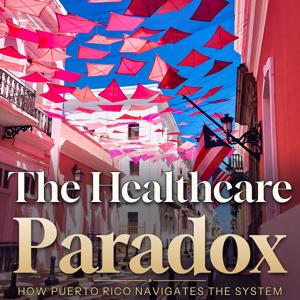
In September 2026, HHS Secretary Robert F. Kennedy Jr. and Governor
Jenniffer González-Colón cut the ribbon on the new Susana Centeno Hospital in
Vieques: $85.5 million, an FAA-certified heliport, an emergency room,
dialysis and infusion centers, diagnostic imaging and behavioral health,
nine years after Hurricane María finished off the clinic that opened in 1996.
The press releases call it a historic victory. The local briefings call the
heliport an admission of failure dressed as a ribbon. This episode sets the
two stacks of sources side by side and reads the receipts: the years of
silence before the building, the Secretary's own history on the island, the
cancer numbers that swing with every study window, and the federal payment
formula that decides whether a night-shift doctor can afford to stay.
1996, an election-year ribbon that took a full year to start delivering
services. No real dialysis, almost no cancer care, limited maternity care,
and a broken air conditioner that shut down the x-ray ward. Anything
serious meant a boat or a plane to the main island. In September 2017
Hurricane María finished the building off, and for years the island's
clinic was parked inside a storm shelter. Dialysis patients crossed the sea
three times a week to survive; several died making the trip.
Two weeks after a death. In January 2020, 13-year-old Jaideliz Moreno Ventura arrived at the shelter clinic with seizures and unable to
breathe. There was no working ventilator; her family bagged oxygen by hand
while they waited for an air ambulance, and she died before she could be
flown out. FEMA obligated $39.5 million for reconstruction two weeks
later. Of the $85.5 million the new hospital cost, $48.3 million came
from FEMA.
The Secretary who went to jail for Vieques. In April 2001, Kennedy was an environmental lawyer protesting the Navy's live bombing range,
two years after a civilian guard, David Sanes Rodríguez, was killed by two
500-pound bombs. With Edward James Olmos and Dennis Rivera he hired a
fishing boat, evaded the Coast Guard and walked onto the range. Judge
Héctor Laffitte gave him 30 days in the Guaynabo federal detention
center; his son was born while he was inside and carries Vieques in his
name. The Navy left in 2003. Twenty-five years later he returns as the
cabinet officer who runs Medicare and Medicaid, the two programs that will
decide whether the new hospital survives.
The cancer numbers. Lower than the rest of Puerto Rico from 1960 to 1979; above the federal ATSDR alert level between 1985 and 1994; a
house-to-house census in the early 1990s that found residents 27% more
likely to have cancer (341 per 10,000 versus 270); 1992 to 1997, the only
window in a series running from 1987 to 2011 in which total, lung and
colon cancer were statistically higher than the main island, with lung
cancer at 2.8 times the Puerto Rico rate in women under 50. Then the
other direction: 2008 to 2012 in the lowest quarter of municipalities, and
an age-adjusted incidence for 2000 to 2021 that is lower than the main
island (296 versus 309 per 100,000). A 2023 spike of 54 cases pushed
the crude rate to 676 per 100,000, and in a population of about 8,000 one
year can swing the rate violently. The data moves; the distrust does not.
What $85.5 million buys, and what it does not. The building is not a tertiary hospital: no complex trauma, no advanced oncology, no major
surgery, no advanced obstetrics. Patients who need any of those still
leave the island. A RAND reconstruction report describes the split
bureaucracy that built it: one authority for construction, General
Services for the equipment, the Department of Health for operations and
licensing, and no single person able to force a deadline. The finished
building was handed over months before it had a medical staff or an
opening date. The heliport is a launchpad away from the hospital they just
built.
The formula under the building. About 670,000 Puerto Rico beneficiaries, 96% of the island's Medicare enrollees, are in Medicare
Advantage, the highest share in the nation. The benchmark is tied to
historically low fee-for-service spending, so past underfunding dictates
future underfunding: rates about 41% below the national average and
roughly 20% below the U.S. Virgin Islands, answered with a 4.01%
increase for 2027. On August 3, 2026, Rep. Dr. Greg Murphy and 13
Republicans asked Secretary Kennedy for a 0.70 floor, and the Governor
has pressed him on the same benchmarks. Behind that fight sits the
Medicaid cliff of September 30, 2027. You cannot recruit a night-shift
physician to an island with expensive groceries and an unreliable ferry if
the reimbursement formula starves the payroll.
The receipts. For Washington: a weekly public operating dashboard within 30 days, with night-shift doctors physically on the island,
dialysis uptime against canceled hours, and CT scanners licensed and
staffed rather than sitting in a box. For San Juan: operating money locked
into a five-year appropriation that cannot be raided. For the providers:
no ghost rosters, credentialing finished before the first ambulance
arrives, and the medicine the island actually needs, dialysis, diabetes,
hypertension and the mental health of decades of environmental stress. For
the patients: a public patients' council that logs every missed specialist
appointment and every emergency-room diversion, and treats geography as
clinical infrastructure. A dialysis session missed because the ferry did
not sail is a clinical incident, not a transportation excuse.
The closing question: it is wonderful that a child in Vieques may no longer
die for lack of a ventilator, and it is cynical that it took a death, nine
years and a cabinet secretary's visit to deliver a standard of care that
other American towns consider ordinary. Gratitude and suspicion belong in
the same sentence. The true test is not the ribbon. It is whether the
Secretary fixes the Medicare Advantage formula, raises the floor to 0.70 and
defuses the 2027 Medicaid cliff. The tarp is finally on the roof; it will
take more than a parade to prove the storm is over.
Listen to The Healthcare Paradox on Spotify, Apple Podcasts, Amazon Music,
iHeartRadio, Pandora, and YouTube.
The federal data behind this show is browsable in the CMS Console.
Music: "News Theme" by Kevin MacLeod (incompetech.com), licensed under Creative Commons: By Attribution 4.0.