
Sign up to save your podcasts
Or



Send us a text
Forget the horror-movie version of “sacrifice.” We step into the sacred grove to unpack the Norse blót as it really worked: a powerful cycle of gifting where communities offered value, shared a feast, raised oaths, and renewed bonds with gods, ancestors, and the land. Through vivid sources and clear explanations, we follow the seasonal rhythm from Vetrnætr and Yule to Sigurblót, seeing how each rite tuned the people to harvest, darkness, and new growth. Along the way, we explore weapons sunk in lakes, blood sprinkled from the hlautbowl, and the moment the cauldron turns sacrifice into supper.
The heart of the episode is the sumbel: three rounds of toasts to the gods, the honored dead, and the living, where words carry weight and oaths become social glue. We talk Bragafull boasts, hāt oaths that can make or break a reputation, and why speech, witnessed by kin, functioned as law. We also reckon with the infamous account of Uppsala’s great blót, weighing Adam of Bremen’s dramatic claims against archaeology and motive, and teasing out what’s likely truth, what’s exaggeration, and why the story still grips us.
Then we bring the rite home with a practical, step-by-step guide to hosting a modern blót—defining intent, preparing a simple hörgr or altar, calling the powers with honest words, making a meaningful offering, sharing a sumbel, and returning the gift to the earth. If you’ve been curious about Norse paganism, community ritual, or how gratitude becomes action, this journey offers clarity and a path to try. Subscribe, share with a friend who loves myth and history, and tell us: what would your next gift-for-gift be?
Support the show
Send us a text
The ancient roots of Norse mythology run deeper than most imagine, stretching back thousands of years before the first Viking longship ever sailed. This journey begins in the misty forests and boglands of pre-Roman Europe, where archaeological discoveries like the Tollund Man—a sacrificial victim preserved in peat for over two millennia—reveal haunting glimpses of forgotten rituals.
By piecing together evidence from archaeology, linguistics, and Roman accounts, we uncover the earliest forms of Germanic worship. The Roman historian Tacitus provides our first written window into these beliefs, describing sacred groves where the goddess Nerthus received offerings and brought peace to the land. His accounts, though colored by Roman bias, reveal a complex spiritual world where gods like Tiwaz (who would later become Tyr) held prominence long before the rise of Odin.
The Migration Period marks a crucial turning point in Northern religious evolution. As the Roman Empire collapsed and tribal movements reshaped Europe, the pantheon shifted to reflect these chaotic times. Odin—god of ecstatic fury, magic, and kingship—rose to prominence, perfectly embodying the unstable world of warlords and upheaval. This transformation culminated in the Viking Age belief system we recognize today, with its nine realms and complex divine relationships. Most remarkably, we owe much of our knowledge to 13th-century Icelandic scholars who preserved these pagan traditions long after Christianity had swept across the North. Through their writings, we glimpse the final, brightest flame of a fire kindled in Europe's ancient past—a tradition forged over a thousand years of cultural evolution.
What forgotten rituals from your cultural heritage would you be most curious to understand? Subscribe now to join us next week as we explore the blót—the mysterious Norse sacrifice at the heart of pagan worship.
Support the show
Send us a text
Who was Ragnar Lothbrok? The name echoes through history as the quintessential Viking warrior—a dragon-slayer, king, raider, and father of conquerors. But when we search for the flesh-and-blood man behind the legend, he seems to vanish into the mists of time.
The saga tells us of a hero who crafted strange, hairy armor to slay a venomous serpent, winning the hand of a princess. It speaks of his marriage to a woman of extraordinary wisdom who bore him sons destined for greatness. And it recounts his defiant death in a pit of snakes, laughing at his tormentors and promising vengeance through his offspring. "How the little pigs would grunt if they knew how the old boar suffers," he supposedly proclaimed as venom coursed through his veins.
Yet contemporary historical records tell a different story—or rather, they tell no story at all. No 9th-century chronicle mentions a Ragnar Lothbrok. Instead, we find fragments: a Viking chieftain who besieged Paris, a Danish king named Reginfrid caught in dynastic struggles, and most significantly, the very real "Great Heathen Army" that invaded England in 865, led by commanders named Ivar the Boneless, Bjorn Ironside, and Halfdan—the very sons attributed to the legendary Ragnar.
This revelation doesn't diminish Ragnar's importance; it transforms our understanding of how myths function in society. The legend of Ragnar wasn't just an adventure tale but a powerful origin story that gave meaning and divine purpose to the very real conquests of his sons. He became the perfect Viking archetype—clever as well as strong, respectful of female wisdom, devoted to his children's legacy, and unflinchingly brave in the face of death.
Whether watching modern interpretations like the TV series "Vikings" or reading the ancient sagas, we're participating in a tradition of storytelling that spans over a thousand years. Ragnar may not have existed as a single historical figure, but the power of his myth has shaped our understanding of the Viking Age in ways that mere historical facts never could.
Join us by the fire at the Heathen's Hearth as we unravel one of history's most enduring legends and discover how sometimes, the sons create the father rather than the other way around.
Support the show
Send us a text
A vast emptiness flanked by two impossible worlds—one of eternal fire, one of endless ice. Where these primal forces first met in the void called Ginnungagap, the Norse universe was born.
The Norse creation story differs fundamentally from many world mythologies. Rather than divine light or spoken word, it begins with tension and violent transformation. From the first melting drops of primordial ice emerged Ymir, father of giants, and Audhumla, the cosmic cow whose milk sustained the earliest beings. When Odin and his brothers slew Ymir, they transformed cosmic chaos into order, crafting our world from his flesh, blood, and bones in a spectacular act of divine dismemberment.
At the heart of this newly formed cosmos stands Yggdrasil, the world tree—arguably the most profound symbol in Norse mythology. This colossal ash connects all nine realms while embodying the eternal struggle between creation and destruction. The squirrel Ratatoskr scurries between the wise eagle at its crown and the destructive dragon Nidhogg at its roots, ensuring cosmic conflict never ceases. This powerful metaphor reveals the Norse understanding that existence itself depends on the delicate balance between opposing forces.
Each of the nine realms offers unique insight into the Norse worldview. From the celestial halls of Asgard where fallen warriors prepare for Ragnarok, to the icy shores of Niflheim where oath-breakers wade through venom, this complex cosmology presents reality as multi-layered and interconnected. Unlike many mythological systems, the Norse cosmos contains the seeds of its own destruction—a cyclical view reflecting their experience in the harsh northern environment.
Join us around the Heathen's Hearth as we explore these ancient stories that still resonate today. Whether you're a mythology enthusiast or simply curious about how our ancestors understood their place in the universe, these tales offer profound wisdom about the nature of existence itself. Subscribe now and continue this journey through the branches of Yggdrasil and beyond.
Support the show
From the publisher's feed
Do you hear the echoes of the North? They are whispers from a time of fire and ice, sagas carried on the salt spray of the longship. But these are more than just stories. They are the…
Welcome to The Heathen's Hearth.
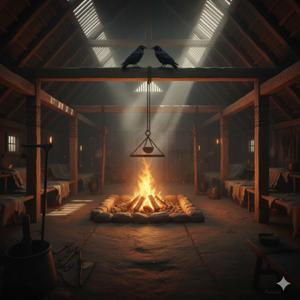
Whether you're a curious newcomer, a history enthusiast, a mythology buff, or a follower of the old ways, you have a seat by the fire. Join us as we explore the epic myths of the Eddas, uncover the real history of the Viking Age, and seek to understand the powerful ideas that continue to inspire so many today.