
Sign up to save your podcasts
Or



Given his history, he should be dead. Or incarcerated. He grew up in Las Vegas in a broken family of eight. In a true story of Hopelessness to Hope, Grant Denton is this week’s guest on The Hope Matrix.
Grant Denton burned through jobs. He became addicted to heroin and crystal meth. He married and divorced twice, having two sons. Because of his addiction, he lost his job and his family, intermittently living on the street from 2007 to 2013.
In 2013, Grant was arrested on burglary charges that could have sent him to prison for five to seven years. The judge gave him a choice: enter drug court and rehab or go to prison. On Dec. 28, 2014, Grant used illegal drugs for the last time. He moved to Reno for a sober living fresh start, working in a homeless shelter, for the Downtown Reno Business Improvement District, and in an addiction treatment center, where he formed a crew of community volunteers that lead to the Karma Box Project.
Today, Karma Box has grown from its namesake mission to become an umbrella organization that “partners with homeless people, meeting them where they are,” Grant says.
This partnership ranges from safe restrooms to counselors in emergency rooms, from secure and sanitary tent communities to helping people obtain identification documents so they can access social services on their journey from homelessness.
In this episode of The Hope Matrix, Grant speaks about his unique experience dealing with Hope and Hopelessness. Kathryn and Grant discuss the stress response, skills, and weaknesses when coming out of the stress response, and how one cannot possibly access their higher-order thinking when in a stressful situation. Coming from a place of such extreme Hopelessness, Grant came into a new place where he activates Hope in those same communities from which he came. His work with the Karma Box Project helps to make Reno the first-ever Hopeful City as part of the Hopeful Cities Project.
You can learn more about Hopeful Cities at https://hopefulcities.org/.
On this week’s episode of the Hope Matrix, our host Kathryn Goetzke meets with Craig Kramer and Katharine and Peter Lee-Kramer to explore the importance of hope and hope skills within a family dynamic. Craig Kramer currently serves as the Mental Health Ambassador, and Chair of the Global Campaign on Mental Health, for Johnson and Johnson. He has traveled the world in pursuit of mental health advocacy, programming, and the continued expansion of initiatives focused on spaces that address mental health. Peter, Craig’s son, is currently attending the Doctor of Psychology program at the University of Denver, and has been a vocal advocate for mental health. Katharine, Craig’s daughter, is completing her master’s degree in Social Work while interning at a psychiatric hospital. Katharine also contributed to the Hopeful Minds curriculums.
In Episode 19 of the Hope Matrix, Kathryn and the Lee-Kramer family talk about both their personal and professional experiences with mental health. They speak about how their personal and professional journeys have impacted their ability to become advocates for, be open about, and recognize their own mental health. As the Lee-Kramer family shows in this week’s episode, family connections can be strengthened by recognizing flaws, opening up to each other, and maintaining nonjudgmental relationships. The Lee-Kramer family provides valuable insights into implementing hope skills at the family level, and perfectly show how our relationships and Nourishing Networks can impact our mental health and hope.
You can learn more about Hopeful Minds at https://hopefulminds.org/.
Now, more than ever, one is able to see how important it is to manage hopelessness on the college campus. This week’s special guest on the Hope Matrix is Max Hennessy. Max grew up in Norfolk, Virginia and graduated from UVA’s College of Arts and Science this past August with a degree in Religious Studies. He started his first side hustle at 14 years old, reselling vintage video games throughout high school. Then, he created his first company, Icy Threads LLC, where he drop-shipped movie and TV show jerseys to a niche audience across the US. In 2018, he created TMH Business Solutions, a web design and social media marketing company for small businesses and non-profits, which he is still running today. Now, he is in the process of getting his real estate license and wrapping up his first manuscript for Ad Infinitum, which will be released next year with New Degree Press.
In Episode 18 of the Hope Matrix, Kathryn and Max delve into how Max utilizes his own Stress Skills and Nourishing Networks to SHINE. He additionally speaks on his own experiences with mental health, managing his mindset, and how his transition to college was supported in different ways. He expresses his thoughts on finding ways to start goals, especially when it comes to being in the moment.
Max and Kathryn delve into how different relationships and resources provide support to those who are feeling despair or helplessness, the two components of hopelessness. Max also speaks on how gratitude has allowed him to realize the importance of always reaching out, and being kind and generous to everyone.
Max provides insights on how important it is to have support and resources for hopelessness for students on the college campus. If you are interested in connecting with him about mental health, business projects or anything else, Max can be contacted at https://www.tmh.business/pages/contact-us .
You can learn more about Hopeful Mindsets on the College Campus at https://hopefulmindsets.com/college-campus/
This week’s special guest on the Hope Matrix is Malia Pruyn. Malia has had her own struggles with mental health throughout high school and leading into college. She is the Panhellenic President at the University of Nevada, Reno, and is greatly involved in her sorority, Pi Beta Phi. She worked for Crisis Support Services of Nevada to help populations in crisis. However, she left to find a role that would allow for preventative mental healthcare, and now works with iFred helping to facilitate Hopeful Mindsets on the College Campus. To her, the keys to mental healthcare are the preventative tools that Hope teaches.
In Episode 17 of the Hope Matrix, Kathryn and Malia delve into how they have used and seen hope in their communities. Malia discusses how she has seen it affect life and community on the college campus. In response, Kathryn and Malia talk about the importance of having support and lessons that teach hope skills on college campuses. Knowing the resources available to each college student, how to connect with peers, and having these hope skills in your toolbox are the keys to eliminating challenges to a hopeful mindset. Malia also discusses her own tactics and skills that she uses to maintain a hopeful mindset.
You can learn more about Hopeful Mindsets on the College Campus at https://hopefulmindsets.com/college-campus/
------
The Hope Matrix can be streamed through:
Website - www.thehopematrix.com
Apple Podcast - https://apple.co/2T6WbLo
Spotify - https://spoti.fi/3dF61h9
Youtube - https://bit.ly/2IFM524
Follow us on Facebook, Twitter and Instagram: @ifredorg
www.ifred.org
This week’s special guest on the Hope Matrix is Matthew Jackman. Matthew lives with Bipolar Affective Disorder and Complex Post Traumatic Stress Disorder (defined by DSM/Psychiatry), is a sibling caregiver to his younger brother and sister who live with enduring psychosocial diverse abilities, and has lost his mother to suicide, and consequently his grandparents due to stigma. His experiences of distress and service use drive his passion for global social change in mental health. He is a global mental health advocate promoting human rights, social justice and lived experience as an academic science from public health and MAD STUDIES disciplines. You can learn more about Matthew below.
In Episode 16 of the Hope Matrix, Kathryn and Matt discuss their journey from hopelessness towards cultivating communities of hope, support, and compassion. They examine the different ways of understanding suffering and vulnerability as sites of knowledge production on the self. Matthew describes the MAD Movement, which challenges the epistemological primacy of biomedicine in representing and informing global mental health.
Through the Australian Centre for Lived Experience (TACFLE), Matthew aims to expand the literacy around mental health to include and prioritize lived experience as a vital source of knowledge. Overall, Kathryn and Matthew remark on the hope found by holding space for others and by participating in a community motivated towards change and support.
More about Matthew
Matthew qualified in Social Work undertaking counseling, case management, group therapy, community development, social research, social policy, and personal/systems-level advocacy across diverse intersectionalities. Matthew's advocacy and research reflect alternatives to biological approaches to wellbeing. He mobilizes MAD STUDIES as the scientific foundation for peer/lived experience work in mental health. Matthew represented the Western Pacific Region on the Global Mental Health Peer Network and was a Global Shaper with the World Economic Forum. He has represented lived experience perspectives on the National Advisory Panel (mental health) for the Australian Association of Social Workers. Matthew is a Global Lived Experience Ambassador for Generation Mental Health. He consults the World Health Organisation in mental health. Matthew is trained internationally in certified peer specialist practice and is a visiting scholar in Psychiatry at Yale PRCH.
Matthew’s vision is to utilize personal power and privilege and mobilize vulnerabilities as strength and resilience, to make space for those with less power. Through giving voice to those silenced in achieving an equitable world justice is strived toward. Matthew instructs Mad Studies co-designing/producing a lived experience-focused critical mental health unit in Social Work. Matthew is proudly Mad, Neurodiverse, and Queer, utilizing his intersectional experiences of oppression and privilege in systemic advocacy.
You can learn more about Matthew by visiting:
https://hopefulminds.org/matthew-jackman/
https://globalhealth.harvard.edu/lived-experience-profile-matthew-jackman/
https://www.linkedin.com/in/matthew-jackman-he-him-57b28951/
More About The Australian Centre for Lived Experience (TACFLE)
TACFLE is an institute for lived experience leadership in global mental health. The Center was founded to challenge the industrial complex around the biomedicalization of human suffering and establish a discipline of lived knowledge for global mental health care.
Website: www.tacfle.com
This week’s special guest on the Hope Matrix is Abbey Johnson. Abbey is the Founder of Live Without Apologies, LLC. She is a child of God, a daughter, sister, friend, Naija, a Mental Health Advocate, passionate public servant and so much more. She created Live Without Apologies to inspire everyone to—“Live life unapologetically on YOUR terms, without judgment or validation from others. She had the idea for Live Without Apologies for over five years, however perfection paralysis prevented her from acting on it. Everything changed in October 2020. Abbey quit her dream job after battling depression, anxiety and feeling a lost sense of identity. Quitting was her freedom. When Abbey quit, she was ashamed and felt guilty, but she gave herself grace to step into the uncertainty of not knowing what came next. She was unemployed for four months. That period of stillness, reflection and listening to God allowed Abbey to rest, re-center, and rediscover her own voice, passions and aspirations. With that said, Live Without Apologies was birthed.
In Episode 15 of the Hope Matrix, Kathryn and Abbey discuss how life experiences, such as breakups, loss of identify, new jobs, and the pandemic can impact both hope levels and your hope journey. Abbey shares how navigating the intersectionalities of her own identity, including race and gender (as a Black Woman), culture (Nigerian-American), generational stereotypes & lived experience (Millennial), and personality (self-proclaimed introvert), helped her to return to a hopeful mindset. She also expands on how grace, living unapologetically, and God all helped her find herself and her hope in times of helplessness and despair (the two ingredients of hopelessness). Kathryn and Abbey also examine how the mental health movement differs in various countries around the world, and debate how we can continue to make mental health a global priority in the wake of COVID-19.
More About Live Without Apologies:
Live Without Apologies is more than a t-shirt brand. We promote a mindset shift. We are a lifestyle/education/advocacy brand that is working hard to encourage everyone to live life unapologetically, AND we are super passionate about raising awareness about the current “epidemic within a pandemic”—the mental health crisis globally!
Website:
https://www.livewithoutapologies.com
https://linktr.ee/Abbey_Perelador
This week’s special guest on the Hope Matrix is Charlene Sunkel. Charlene was diagnosed with schizophrenia in 1991 and her journey since then has exposed her to the challenges experienced by persons with mental disorders within and outside of the mental health sector. This encouraged her to commit herself to fighting the cause for mental health and human rights. She has worked in the field since 2003. Charlene is the Founder/CEO of the Global Mental Health Peer Network (www.gmhpn.org). She serves on a number of international boards and committees. She previously served on the South African Presidential Working Group on Disability and Ministerial Advisory Committee on Mental Health. Charlene is the former Principal Coordinator for the Movement for Global Mental Health.
In Episode 14 of the Hope Matrix, Kathryn and Charlene examine their lived experience of mental health and the unique hope skills that each person develops to manage their stress response and maintain a hopeful mindset. Charlene delves into her own schizophrenia diagnosis, and discusses the hopelessness, stigmas, and obstacles that she has worked to overcome since 1991.
Kathryn and Charlene then step back to explore mental health on a global scale. They highlight how people with mental disorders are treated in different countries, and Charlene presents the work the Global Mental Health Peer Network is doing to remove stigmas and provide support for people around the world.
You can learn more about the Global Mental Health Peer Network at www.gmhpn.org.
More About Charlene:
Charlene has written and produced theatre plays on life stories of persons living with mental disorders (including one on her life with schizophrenia), and written and produced a short feature film based on the storylines of the theatre plays – to raise public awareness. Charlene had been involved in the review/ drafting of various policies and legislation in South Africa and provided technical assistance to national and international mental health related reports and documents. She annually guest lectures at the Stellenbosch University in South Africa and the Indian Law College's International Diploma on Mental Health, Human Rights and Law in Pune in India.
She has published widely on issues related to mental health and human rights, stigma and the needs of people with mental illness in low- and middle-income countries, and she served as a Commissioner on the Lancet Commission on Global Mental Health and Sustainable Development and on the WPA-Lancet Psychiatry Commission on the Future of Psychiatry. She currently is co-editor of the Lancet Commission on Mental Health Stigma and Discrimination, and a Commissioner on the Lancet Commission on Psychosis.
She received a number of national and international awards for her work.
This week’s special guest on the Hope Matrix is Dr. Zachary Burton. Zack co-founded and leads The Manic Monologues, a play and film honoring true stories of mental health and illness to disrupt stigma. The Manic Monologues has drawn accolades from NPR, The Washington Post, Broadway World, Modern Healthcare, and others, and in just a few days, will see a unique pandemic-era virtual premiere with full Broadway and Hollywood cast.
In Episode 13 of the Hope Matrix, Kathryn and Zack address the stigma and feelings of hopelessness sometimes associated with mental health conditions. Zack opens up about living with bipolar disorder, and they discuss the hope tools that they both use to minimize triggers, manage their stress responses, and stay in their upstairs brains.
Zack also shares the motivation and inspiration behind The Manic Monologues. Created by Zack following his own psychotic break in 2017, The Manic Monologues uses twenty stories to represent the diverse experiences of living with mental health conditions, and strives to find stories of hope amidst the obstacles. The Manic Monologues can be viewed for free, virtually on February 18th.
To watch The Manic Monologues, visit https://www.mccarter.org/manicmonologues
------
More About Zack:
Zack earned his Ph.D. from Stanford University and A.B. from Bowdoin College, and lives with bipolar disorder. He is Board Member to the Columbia-WHO Center for Global Mental Health, Advisory Committee Member to Generation Mental Health, and a founding Board Director to the Coalition for Action for Preventive Mental Health in Kenya. He is a past Advisory Council Member to Bring Change to Mind, and is a Stability Leader with The Stability Network. As Managing Editor of the nonprofit The Better Because Collective, he helps individuals publish stories of post-traumatic growth, while his own work has been published by International Bipolar Foundation, Devex, United Nations, The Wall Street Journal, and numerous scientific journals. He has been invited to speak for TEDx, California Hospital Association, Stanford School of Medicine, Project Happiness, the U.S. Department of State, and others.
You can follow Zack and The Manic Monologues on Facebook, Twitter, Instagram, and LinkedIn.
------
The Hope Matrix can be streamed through:
Website - www.thehopematrix.com
Apple Podcast - https://apple.co/2T6WbLo
Spotify - https://spoti.fi/3dF61h9
Youtube - https://bit.ly/2IFM524
Follow us on Facebook, Twitter and Instagram: @ifredorg
www.ifred.org
This week’s special guest on the Hope Matrix is Luis Gallardo. Luis is a social innovator and entrepreneur who is dedicated to increasing awareness on the science of happiness, holistic education, and smart innovation. Luis is the Founder of World Happiness Fest, author of The Exponentials of Happiness, and the President of the World Happiness Foundation.
In Episode 12 of the Hope Matrix, Kathryn and Luis explore the connection between happiness and hope. Luis explains how eastern wisdom and western science are giving a holistic solution to hopelessness, and explores the many ways we can manage our stress response and return to a hopeful, happy mindset. Kathryn and Luis additionally discuss the power of contemplation and meditation, and the benefits that these acts of active surrender have on our wellbeing.
For more information about understanding suffering, happiness, and hope, you can see Kathryn and Luis at the virtual World Happiness Event, March 18-23, 2021.
This week’s special guest on the Hope Matrix is Shamash Alidina. Shamash has been practicing mindfulness since 1998 and runs an international mindfulness teacher training organization. He is the international bestselling author of Mindfulness for Dummies, The Mindful Way through Stress and 7 other books. He’s currently also passionate about offering daily live meditation classes and creating a friendly mindful community, and has been offering a mindfulness class every day for the last 200 days through the pandemic (7.30am UK time).
Mindfulness, or the act of being present, is an important hope skill that can increase happiness and decrease stress and anxiety. In Episode 11 of the Hope Matrix, Kathryn and Shamash delve into the importance of mindfulness. With the Five Keys to Hope as their guide, Kathryn and Shamash examine how the components of mindfulness- kindness, curiosity, acceptance, and stepping back to view the larger picture- can dramatically affect hope, happiness, and health. Shamash even puts his words into action by taking listeners on a two-minute introductory mindfulness session.
For more information on the Five Keys to Hope, visit https://hopefulcities.org/. To learn more about mindfulness and Shamash’s books and courses, visit https://www.shamashalidina.com/ and https://linktr.ee/shamashalidina.
From the publisher's feed
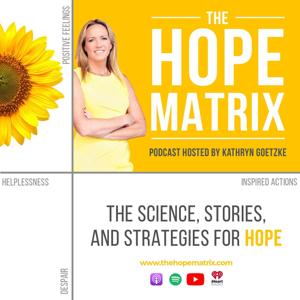
The Hope Matrix explores the science of hope, stories of people that put hope in practice, and strategies you can use in your life to maintain a hopeful mindset. The host, Kathryn Goetzke, is also…