
Sign up to save your podcasts
Or

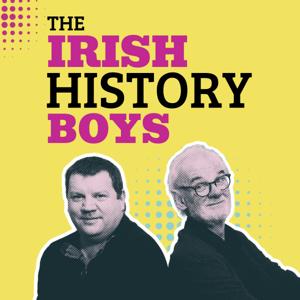
By The Irish History Boys


The podcast currently has 78 episodes available.
The most played episodes among Podcast App listeners.
In this episode of the Irish History Boys, we unpack the dramatic political fallout of August 1976, when the Dublin government declared a shocking, post-WWII state of emergency to combat the rising tide of subversive violence. We examine the introduction of draconian legislation that suspended ordinary laws indefinitely, and the unprecedented constitutional crisis that saw Irish President Cearbhall Ó Dálaigh resign after being publicly branded a "thundering disgrace" by a government minister. We dive deep into the controversial debate over whether the Republic of Ireland was truly a "safe haven" for the IRA, or if the border was simply too porous to realistically police. Along the way, Tim shares his own tense—and highly sarcastic—1990 encounter with the British Special Branch under the Prevention of Terrorism Act. Additionally, we trace the international dimension of the conflict, discussing the 1976 calls for US President Gerald Ford to intervene in Northern Ireland. We detail how John Hume tirelessly worked to internationalise the peace process, laying the groundwork for future US involvement even when Washington insisted the Troubles were strictly an internal UK matter. To conclude, we travel back to 1926 to explore a bizarre and controversial scheme by the Northern Ireland government to subsidise emigration. We look at how Sir James Craig's administration spent £5,000 of taxpayer money on Rich Hill Castle in County Armagh to train young people to leave for Canada, exposing the deep economic anxieties and inter-war decline of the industrial North. Hosted on Acast. See acast.com/privacy for more information.

In this episode of the Irish History Boys, we reflect on the September 1976 IRA bomb attack on the Belfast Telegraph offices and the tragic death of 60-year-old print worker Joe Patton. We examine how rival publications—including the nationalist Irish News —stood in unprecedented solidarity to defend a free press against paramilitary intimidation. We analyze this targeted attack within the context of 1976's grim violence, highlighting the rare targeting of journalists during the Troubles and the paper's defiance in publishing its famous four-page "Penny Marvel" edition straight from the rubble. Additionally, we explore Vanguard leader William Craig’s astonishing political U-turn in September 1976. We discuss his controversial proposal for a voluntary power-sharing coalition with the SDLP, his immediate expulsion from the unionist coalition, and the political paralysis that left Northern Ireland in a bleak stalemate. To conclude, we tackle the long history of British political disinterest in Ireland, tracing a pattern of neglect from G.K. Chesterton’s 1918 warnings to border visits in 1924 and modern Brexit confusion. We also answer listener questions regarding Ireland's World War II defense forces and diplomat Seán Lester's role leading the League of Nations. Hosted on Acast. See acast.com/privacy for more information.
In this episode of the Irish History Boys, we explore the "disease of pessimism" that gripped Ireland in September 1926. Drawing from contemporary accounts warning that this despair threatened to develop into a national characteristic of "moral decrepitude and mental stagnation," we dissect the psychological and economic scars left by the Civil War, the 1925 famine, and rampant emigration. We then fast-forward to the modern era to debate when and how Ireland finally transitioned from post-independence stagnation into a self-assured, highly confident nation. Additionally, we tackle the wild "Northern misconceptions" surrounding the Irish Free State in 1926, where border communities were led to believe that Dublin was in a state of absolute anarchy and gloom. We examine how unionist politicians and regional newspapers exaggerated southern lawlessness to discourage unity, how partition cemented two distinct cultures, and how these political schisms trickled down into everything from the historic 1921 soccer split to the bizarre division of local Morris Minor appreciation clubs along the border. To conclude, we reflect on the extraordinary rise of the Peace People in 1976—a spontaneous, working-class movement born out of a horrific August tragedy in which three innocent children were killed. We discuss the co-founders, Betty Williams and Maria Corrian, and examine the massive, cross-community rallies that saw tens of thousands of people cross the peace lines for the first time, including a highly symbolic demonstration on Derry's Craigavon Bridge. We also analyze whether this powerful, women-led crusade successfully drove down the horrific levels of sectarian violence during one of the grimmest years of the Troubles. Hosted on Acast. See acast.com/privacy for more information.
In the second part of this special series on The Irish History Boys, hosts Tim McGarry and Cormac Moore continue their exploration of the Orange Institution with Dr Jonathan Mattison from the Museum of Orange Heritage. This episode moves beyond the Battle of the Boyne to examine the century of tension that followed, specifically how the unravelling of the Treaty of Limerick and the implementation of the Penal Laws by the Dublin Parliament influenced Protestant community identity. Dr Mattison discusses the unique reverence for King William III in Ireland, explaining that because the war for the 1688 settlement was fought on Irish soil, his image became seared into the psyche of the local Protestant population. The conversation provides a deep dive into the Battle of the Diamond in 1795, illustrating how the Orange Order emerged not just from sectarian rivalry, but from economic warfare between Protestant and Catholic weavers over land and the cottage linen industry. From its official formation at James Sloan’s pub in Loughgall, the episode details the Order's rapid growth as an egalitarian organization that eventually became the backbone of the unionist movement despite initial opposition to the Act of Union. Finally, the discussion addresses the modern role of the institution, its four pillars of faith, culture, charity, and fraternity, and the ongoing challenge of maintaining these traditions in an increasingly secular society. Hosted on Acast. See acast.com/privacy for more information.
In this special July episode of the Irish History Boys, hosts Tim McGarry and Cormac Moore set aside their usual news archives to explore "orange" history with Dr. Jonathan Mattison from the Museum of Orange Heritage. The discussion uncovers the complex international politics of the Glorious Revolution, including the surprising tactical support William of Orange initially received from Pope Innocent XI to counter the influence of the French King Louis XIV. The episode highlights why the Siege of Derry was the most critical strategic engagement of the war and provides unique insights into the Battle of the Boyne, such as the international makeup of the armies and the story of William III being wounded the night before the fight. Beyond the battlefield, the hosts explore how the Williamite victory marked a massive shift in power from the monarch to Parliament, laying the constitutional groundwork for the Bill of Rights and even the American Constitution. The conversation also touches on the bloodier Battle of Aughrim and how the religious toleration of the initial settlement was eventually unpicked by penal legislation. The episode concludes with a recommendation to visit Schomberg House and a preview of part 2 on the 1795 founding of the Orange Order. Hosted on Acast. See acast.com/privacy for more information.
The podcast currently has 78 episodes available.