
Sign up to save your podcasts
Or

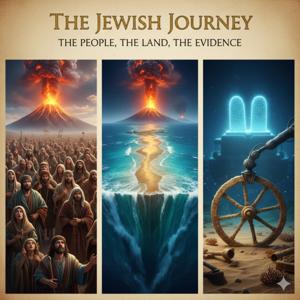


Note: This is a special one-off episode produced out of our regular chronological order in direct response to listener feedback and requests for a deep dive into the dating of the Exodus.
For decades, the standard scholarly view has been that the Exodus never happened because the evidence doesn't exist in the time of Ramses II. But what if we've simply been looking at the wrong century? In this investigative special of The Jewish Journey, we apply a forensic lens to ancient chronologies to recover the "lost" timeline of the Israelites.
In this episode, we unpack:
The 1446 B.C. Anchor: How internal biblical markers and the ancient Seder Olam point to a specific, early date for the departure from Egypt.
The Cartographic and Chronological Error: Why the popular "Ramses Theory" fails forensic scrutiny and how a 200-year inflation in Egyptian dating has obscured the historical Israel.
The Amarna Smoking Gun: Examining the Amarna Letters—urgent diplomatic correspondence from Canaanite kings pleading for help against the invading "Habiru" at the exact moment the Bible places the Conquest.
The Merneptah Stele: Analyzing the earliest extra-biblical mention of "Israel" as an established nation, and why its existence in 1209 B.C. makes a 13th-century Exodus impossible.
Re-aligning History: How the New Chronology fixes the synchronization between the Egyptian Middle Kingdom’s collapse and the biblical arrival of Joseph and Moses.
Join us as we solve the ultimate chronological riddle and place the Exodus back into its true historical context.
"In those days there was no king in Israel; every man did that which was right in his own eyes." In this gritty episode of The Jewish Journey, we investigate the 300-year collapse of the tribal theocracy and the high-stakes trade-off that led to the birth of the Israeli Kingdom.
In this episode, we unpack:
The Failed Theocracy: Why the idealistic "God-people alliance" established at Sinai devolved into a cycle of corruption, tribal isolation, and the devastating Civil War against Benjamin.
The Philistine Iron Monopoly: A look at the ancient arms race. We examine how the Philistines used their secret knowledge of iron smelting to maintain a technological stranglehold over the Israelites.
Misfit Heroes: An analysis of the charismatic but deeply flawed "Judges"—from the guerrilla tactics of Ehud to the tragic, isolated strength of Samson—and why individual heroism was no match for a centralized state.
The Trade for Survival: The people’s desperate demand for a king "like all the nations" and why the prophet Samuel viewed this move toward centralization as a profound spiritual betrayal.
Saul and the Reluctant State: The appointment of Saul as Nagid (Military Commander) rather than Melek (Sovereign King), and the beginning of the end for tribal autonomy.
Join us as we explore the violent, world-changing transition from the era of the Word to the era of the Iron Crown.
In those days there was no king in Israel; every man did that which was right in his own eyes." In this gripping episode of The Jewish Journey, we investigate the high-stakes evolution of a nation as it abandons a failed theocracy for the safety of a crown.
In this episode, we unpack:
The failure of the "God-People Alliance": How the visionary tribal system established at Sinai collapsed into a 300-year cycle of internal corruption and foreign invasion.
The Philistine Iron Curtain: A look at the technological arms race of the ancient world. We examine why the Philistines' mastery of iron weapons and chariots kept the Israelites in a state of military subjection.
Charismatic Chaos: An analysis of the "Judges"—charismatic but often deeply flawed leaders like Samson and Gideon—who provided local relief but could not stabilize a crumbling nation.
The Demand for a King: Why the Israelites eventually demanded a king "like all the other nations," rejecting the unique direct rule of God for a centralized state that could field a professional army.
Saul’s Tragic Rise: The transition to the monarchy under Saul, a man who physically fit the people's ideal but represented the heavy price of national survival.
Join us as we explore the brutal reality of the Iron Age and the birth of the Kingdom of Israel.
"In those days there was no king in Israel; every man did that which was right in his own eyes." In this gritty episode of The Jewish Journey, we investigate the brutal 300-year period known as the Era of the Judges—a time of internal collapse, foreign invasion, and the desperate search for a national identity.
In this episode, we unpack:
The Failure of the Theocracy: Why the idealistic "God-people alliance" established at Sinai devolved into a cycle of corruption, civil war, and tribal isolation.
The Philistine Iron Curtain: Examining the technological gap between the Israelites and the Philistines. We look at the military impact of iron weapons and chariots, and why the Philistines' monopoly on blacksmithing kept Israel in a state of perpetual subjection.
The Cycle of the Judges: A look at the charismatic but flawed leaders like Samson and Gideon—individuals who provided temporary relief but could not solve the underlying crisis of a decentralized nation.
The Demand for a King: Why the people eventually rejected the tribal system, demanding a king "like all the nations" to provide the security and military organization needed to survive the Iron Age.
Saul and the Reluctant Monarchy: The tragic transition from a divine theocracy to a human monarchy, setting the stage for the rise of a centralized Israeli state.
Join us as we explore the violent, high-stakes transition from tribal anarchy to the established kingdom of Israel.
Did the walls of Jericho truly come tumbling down? In this forensic episode of The Jewish Journey, we move beyond the sunday school story to examine the hard archaeological evidence that supports the biblical account of the city’s destruction.
In this episode, we unpack:
The Chronological Anchor: Why the year 1406 B.C. is the non-negotiable date for the conquest, backed by ancient Jewish sources and the urgent pleas found in the Amarna Letters from Canaanite kings.
Forensics of a Collapse: Examining the physical layout of Jericho’s double-wall system and the archaeological finding of mudbricks that fell outward to create a perfect ramp for an invading army.
Pottery and Scarabs: Re-evaluating the 1950s conclusions of Kathleen Kenyon. We look at the unique Cypriot bi-chrome pottery and Egyptian scarabs that place the city's destruction squarely in the Late Bronze Age I.
Evidence of a Short Siege: Why jars brimming with charred grain prove the city was taken quickly after the spring harvest, exactly as the text describes, rather than through a long, starvation-based siege.
The Theological Stake: How the physical evidence of Jericho’s fall validates the transition from a wandering nation to a settled one, establishing the beginning of the Israelites' history in the Promised Land.
Join us as we bridge the gap between ancient text and archaeological reality to see why the rocks of Jericho still speak today.
Can a religion be forensically proven? In this episode of The Jewish Journey, we dissect the "Sinai Standard"—the radical historical claim that the foundation of Jewish faith rests on a public, collective experience rather than a solitary visionary.
In this episode, we unpack:
The Evolution of Covenant: Tracing the journey from Adam’s dawn of moral consciousness to the individual "pilot programs" of Noah and Abraham, leading to the massive national scale-up at Sinai.
The Anti-Conspiracy Logic: Why the decision to reveal the law to millions at once was a deliberate move to prevent the story from ever being dismissed as a fable or a private hallucination.
The Power of Sound over Sight: How the "thick cloud" at Sinai intentionally obscured God's form, forcing an entire nation to rely on "the voice of words"—a shared auditory truth that is more difficult to fabricate than a visual one.
Forensic Memory Aids: The role of the Ark of the Covenant and the Omer of Manna as physical specimens preserved specifically to bridge the gap between historical event and future generations.
The Maimonides Firewall: Analyzing the 12th-century philosopher's argument that Moses' "unmediated" revelation established an absolute standard of truth that can never be challenged by later "private" visions.
Join us as we explore how this unique national witness turned a group of former slaves into a community defined by intellectual commitment and the enduring weight of the Word.
In this episode, we move beyond the cinematic imagery of Hollywood to conduct a rigorous forensic investigation into the most famous escape in history: the crossing of the Red Sea. By re-examining ancient cartography and original Hebrew texts, we uncover a "blind spot" that has misled scholars for centuries and point toward a startlingly different location for this monumental event.
In this episode, we unpack:
The Cartographic Blind Spot: How early AD maps often omitted the Gulf of Aqaba, leading generations of scholars to wrongly focus on the shallow marshes of the Gulf of Suez.
Linguistic Precision: Why the traditional "Red Sea" translation is likely a generic Greek error, and how the original term Yam Suph (Sea of Reeds) points toward the deep, terminal waters of the Gulf of Aqaba.
The Nuweiba Landbridge: A look at the unique underwater geography of the Gulf of Aqaba, specifically the discovery of a shallow underwater landbridge at Nuweiba Beach that crosses a massive deep-sea trench.
Forensic Deep-Sea Findings: Analyzing reports from deep-sea explorers of coral-encrusted chariot wheels, axles, and skeletal remains matching 18th Dynasty Egyptian military designs found at the bottom of the Gulf.
Geopolitical Barriers: Why this evidence remains unverified by mainstream science due to the extreme depth of the site and the Saudi Arabian restrictions on deep-water exploration.
The Midian Connection: Connecting the dots to Moses’ 40-year exile in Midian (modern-day Saudi Arabia), arguing that the crossing was a strategic journey toward a familiar sanctuary outside of Pharaoh's reach.
Join us as we bridge the gap between ancient scripture and bathymetric data to reveal where the desert crossing truly occurred.
This episode serves as a geographical and theological detective story, concluding that the traditional location of Mount Sinai in the Egyptian Sinai Peninsula is incorrect based on cartography, politics, and geology.
The Map Error: For nearly 2,000 years, tradition has placed Mount Sinai at Jebel Musa (St. Catherine’s). However, the hosts explain that early geographers didn't recognize the Gulf of Aqaba as a distinct body of water. Once you acknowledge that "finger" of the sea, the "wilderness beyond the sea" is clearly modern-day Saudi Arabia, not the Sinai Peninsula.
The Political Reality: The Sinai Peninsula was Egyptian territory (Ta Mefkat), filled with military garrisons and mines. Moses, fleeing for his life, would not lead a nation of escapees back into Pharaoh’s backyard; he would lead them to Midian, which was outside Egyptian control.
The Moses Connection: Moses lived in Midian for 40 years. It is logical that he would lead the people back to the specific mountain where he had already found refuge and encountered the Burning Bush.
Volcanic Evidence: The biblical description of Sinai—shaking, smoke like a furnace, fire reaching the heavens, and a loud trumpet-like roar—is a precise match for an active volcanic eruption.
The Geological Gap: There are no volcanoes in the traditional Sinai Peninsula. However, Northwest Saudi Arabia (Midian) contains extensive volcanic fields that were active during the time of the Exodus.
The "Pillar" GPS: The "Pillar of Fire and Cloud" is reinterpreted not as a small hovering mist, but as the volcanic plume of the mountain itself, visible from hundreds of miles away, acting as a massive beacon leading the Israelites toward Arabia.
Survival as Sovereignty: Miracles like the quail and water from the rock are presented as Yahweh commanding nature to sustain His people.
The Unmediated Truth: Philosophers like Maimonides used these events to argue that Moses had a unique, unmediated relationship with God, making the Law delivered at this "Mountain of Fire" an absolute divine decree.
Conclusion: The Exodus was a "theological secession" from Egypt. By moving the mountain from Egypt to Arabia, the narrative establishes Yahweh’s total sovereignty over the physical world and a new cosmic order for the Israelites.
The Core Argument: Sinai belongs in Arabia (Midian)The Scientific "Smoking Gun": The Volcano TheoryLogistics and Theology
In this episode, we explore the radical sociological and theological transformation of the Israelites as they transition from property in Egypt to a self-governing nation defined by an invisible God and abstract ethics. We dissect the tension between the comforting immediacy of visible idols and the difficult demands of a religion rooted in the "Word."
In this episode, we unpack:
A Revolutionary Constitution: How the Mosaic Law provided a revolutionary break from ancient codes like Hammurabi’s by establishing class equality and prioritizing human life over material property.
The Crisis of the Golden Calf: An analysis of the "Golden Calf" as a calculated theological regression toward familiar Egyptian deities like Apis or Hathor, and the shocking symbolic ritual Moses used to force the people to "ingest their own corruption".
The Tabernacle as a Portable Cosmos: A look at the intricate architecture of the Tabernacle—from the "domesticated chaos" of the copper basin to the Menorah as the "Tree of Life"—and how it served as a symbolic restoration of the Garden of Eden.
Enshrining the Word: Why the Ark of the Covenant, unlike the sacred chests of neighboring pagan cultures, contained no physical image of a deity, but only the written stone tablets of the law.
Join us as we explore how the transition from the visual spectacle of Egypt to the abstract covenant at Sinai created a legacy of intellectual mastery and ethical accountability that redefined Western civilization.
In this deep dive, we conduct a "forensic analytical investigation" into the Ten Plagues of Egypt. Moving beyond simple storytelling, we explore the research of physicists like Colin Humphreys and theologians like Brian Godawa to see if these events follow a logical, catastrophic ecological chain reaction.
In this episode, we break down:
The Biological Domino Effect: How a toxic red algae bloom in the Nile could have triggered a mass exodus of frogs, leading to an explosion of disease-carrying insects.
The Meteorological Mystery: How an early spring hail storm—precisely dated by ancient agricultural cycles—set the stage for a devastating locust swarm.
The Theological War: A look at "de-creation," where each plague serves as a direct assault on the Egyptian pantheon, from Hapy (the Nile god) to Raw (the Sun god).
The Ghost of History: We examine the Ipuwer Papyrus, an ancient Egyptian lament that describes a nation in collapse with startling similarities to the Exodus account.
The Supernatural Pivot: Why the tenth plague, the death of the firstborn, defies naturalistic explanation and marks the shift from natural phenomena to direct spiritual judgment.
Join us as we bridge the gap between archaeology, biology, and ancient scripture to uncover the "how" and the "why" behind the fall of an empire.
From the publisher's feed