
Sign up to save your podcasts
Or

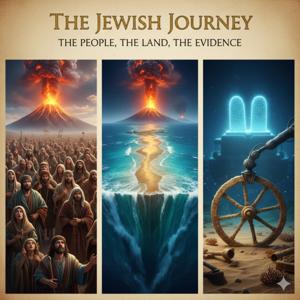


What did it actually cost for a marginalized people to buy their way into modern society? In this episode, we explore the legal and economic battlegrounds of Jewish emancipation in Western Europe. We break down the absolute reality behind the myth of Jewish moneylending, showing how feudal systems intentionally structured antisemitic scapegoats. Then, we step inside Napoleon’s 1806 Assembly of Notables, where European rabbis were forced to choose between rabbinic law and the French Empire, creating a blueprint for the modern citizen at the cost of an ancient culture.
It started in 1654 with 23 exhausted refugees stranded on a wooden dock in New Amsterdam. It ended with one of the most profound cultural and economic transformations in history. In this episode, we trace the epic story of Jewish immigration to America. We uncover how frontier peddlers built massive retail empires, how the brutal sweatshops of the Lower East Side birthed the American labor movement, and the intense "Uptown vs. Downtown" culture clash between assimilated German elites and Eastern European refugees. Finally, we ask the ultimate question: what happens to an identity built on survival when you finally become part of the establishment?
What happens when an Emperor demands you choose between your God and your country? In this episode, we unpack one of the most profound identity crises in human history: the Jewish Emancipation in Europe. We trace the journey from the walled-off isolation of the Venetian ghettos to the intellectual breakout led by Moses Mendelssohn. We explore the strict, conditional equality offered by the French Revolution, and we step inside the room where Napoleon Bonaparte interrogated 71 rabbis to test their ultimate loyalty to France. Finally, we examine the tragic irony of assimilation—how giving up a national identity for citizenship failed to cure society's oldest hatred.
Episode Notes:
The Ghetto: The 1516 Venetian origins of physical and psychological quarantine.
The Haskalah: Moses Mendelssohn translates the Torah into high German.
The French Revolution: Clermont-Tonnerre's ultimatum for individual citizenship.
The 1806 Grand Sanhedrin: Napoleon's 12-question loyalty trap.
The Mutation of Hate: How religious prejudice morphed into inescapable racial anti-Semitism.
What happens when an Emperor demands you choose between your God and your country? In this episode, we explore the dawn of the Jewish Enlightenment and the terrifying, high-stakes loyalty test orchestrated by Napoleon Bonaparte. We track the life of Moses Mendelssohn, the "Jewish Socrates" who built an intellectual bridge out of the ghetto, and we unpack the sheer panic of the 1806 Grand Sanhedrin. When Napoleon forced European rabbis to answer 12 impossible questions about patriotism, intermarriage, and loyalty, their brilliant answers didn't just save their people—they invented the very concept of the modern citizen.
What happens when an elite society of scholars is suddenly challenged by a populist movement fueled by singing, dancing, and mystical ecstasy? In this episode, we dive into the bitter 18th-century civil war that tore Eastern European Jewry apart. On one side: the Hasidim, a joyful, grassroots rebellion that made God accessible to the uneducated masses. On the other: the Mitnagdim, the fiercely intellectual establishment led by the legendary Vilna Gaon—a genius who literally put his feet in ice water to study harder. From brutal excommunications to book burnings, we unpack how the battle between the mind and the heart permanently reshaped the Jewish world.
What was life actually like in the legendary Jewish market towns of Eastern Europe? Spoiler: It wasn't just fiddlers on roofs. In this episode, we strip away the nostalgia to dive into the true history of the shtetl. We explore the geographic prison of the Pale of Settlement, where a marginalized people built a vibrant, self-governing society amidst grinding poverty. From the terror of the Tsar's child-snatching armies to the joyful, musical rebellion of the Hasidic movement, we unpack the daily realities of this vanished world. Finally, we track the massive wave of immigration that brought two million refugees to America, closing the chapter on this unique "portable homeland."
In 1666, the global Jewish diaspora essentially packed its bags and waited for the end of the world. Why? Because a charismatic, deeply unstable rabbi named Shabbetai Zevi claimed he was the Messiah—and a brilliant young PR mastermind named Nathan of Gaza convinced the globe it was true.
In this episode, we explore the anatomy of a mass historical delusion. From the severe trauma of the 1648 massacres that primed a population for a savior, to the viral spread of apocalyptic rumors, we unpack how an entire society lost its grip on reality. Finally, we discuss the ultimate historical anti-climax: the shocking moment the "Messiah" surrendered to the Ottoman Sultan and converted to Islam. Join us for a deep dive into trauma, mysticism, and the devastating fallout of a broken promise.
This episode explores one of the wildest mass delusion events in human history: the rise and spectacular fall of the 17th-century false messiah, Shabbetai Zevi.
The Trauma and the Spark: The episode sets the stage with the 1648 Khmelnytsky massacres, which devastated Eastern European Jewry and left a deeply traumatized population. In the wake of this tragedy, the mystical teachings of Lurianic Kabbalah, emphasizing cosmic repair (Tikkun), primed the masses to look for a savior.
The Messiah and the PR Manager: Enter Shabbetai Zevi, a charismatic but deeply unstable rabbi from Smyrna (Izmir) known for bizarre, taboo-breaking behavior. In 1665, he meets Nathan of Gaza, a brilliant young scholar who becomes his "prophet" and public relations mastermind, declaring Shabbetai the long-awaited Messiah.
The 1666 Global Hysteria: The movement goes viral, spreading rapidly across Europe, the Middle East, and North Africa. Caught in a wave of mass hysteria, Jews sell their homes and businesses, stop working, and prepare to return to the Holy Land in the apocalyptic year of 1666.
The Anti-Climax and Conversion: Shabbetai travels to Constantinople to confront the Ottoman Sultan. Instead of handing over the empire, the Sultan imprisons him and offers a stark choice: convert to Islam or face death. Shockingly, the "Messiah" chooses to convert, taking an Islamic name and donning a turban.
The Fallout: The conversion triggers a catastrophic psychological collapse and deep cognitive dissonance across the Jewish diaspora. While the vast majority abandoned the movement in shame, a radical fringe followed him into Islam, creating the secretive Dönmeh sect.
In 1492, Christopher Columbus sailed the ocean blue—but the exact same year, King Ferdinand and Queen Isabella issued an edict that destroyed the oldest, most prosperous Jewish community in Europe. In this episode, we unpack the terrifying rise of the Spanish Inquisition, the tragedy of the Alhambra Decree, and the massive refugee crisis that followed. Discover how the paranoia surrounding secret converts (conversos) led to state-sponsored terror, and how the exiled Sephardic Jews ultimately found a new golden age under the protection of the Islamic Ottoman Empire.
This episode shatters the misconception that the Middle Ages were a stagnant, dark monolith of religious hostility. Instead, it explores Andalusia (Islamic Spain) between the 10th and 12th centuries—a vibrant, merit-based cultural crucible where Jews, Muslims, and Christians actively collaborated.
The hosts contrast the brutal, state-sponsored anti-Semitism of the 7th-century Visigoths with the relative tolerance of the Umayyad Caliphate (under Abd al-Rahman III). Under Islamic law, Jews held the status of Dhimmi (protected subjects). While still second-class, this system granted them religious freedom, security, and an environment where they could economically and intellectually thrive.
Chazdai ibn Shaprut: A Jewish court physician who monopolized international diplomacy simply because he was fluent in Arabic, Hebrew, and Latin (a language the Arab nobility considered beneath them). He famously brokered a massive peace treaty by convincing Christian monarchs to travel directly into the Caliph's court.
Samuel ibn Naghrela (Samuel HaNagid): A poor Jewish spice merchant whose flawless mastery of classical Arabic calligraphy and statecraft catapulted him to become the Grand Vizier and top military general of the Muslim Kingdom of Granada. Because he had no tribal backing or royal bloodline, he posed zero threat of a coup, making him the safest, most trusted commander for the Berber kings.
Inspired by the Arabic obsession with linguistic purity, Jewish scholars reverse-engineered Hebrew grammar. Utilizing the Masora (vowel sign system), they democratized the language, moving it from a cryptic tongue for elites to a dynamic vehicle for an explosion of secular poetry, science, and mathematics.
The episode concludes with the tragic story of Judah Halevi, a brilliant physician-poet who grew disillusioned with the temporary safety of courtly wealth. He wrote the Kuzari (a philosophical masterpiece defending faith over raw logic) and eventually abandoned his comfortable life for a perilous, ultimately fatal pilgrimage to a ruined Jerusalem—anticipating the brutal collapse of Andalusian tolerance under the fundamentalist Almohad invasion.
What if a medieval society valued raw intellect over royal bloodlines? In this episode, we dive into Andalusia (Islamic Spain) to uncover an era where a Jewish spice merchant became the supreme general of a Muslim army, and a court physician dominated international diplomacy because he was the only one who bothered to learn Latin. We trace the dramatic shift from the brutal oppression of the Visigoths to a thriving cultural meritocracy that completely reverse-engineered the Hebrew language and birthed a poetic revolution. Finally, we explore the structural fault lines of this "Golden Age" through the eyes of Judah Halevi, whose longing for a forgotten homeland anticipated a devastating fundamentalist invasion.
How does a society learn to systematically scapegoat its own neighbors? In this episode, we deconstruct the dark, historical architecture of anti-Semitism in medieval Europe. We track how Jewish communities transitioned from indispensable economic allies into institutionalized targets. From the financial greed driving the Rhineland Massacres of the First Crusade to the lucrative fabrications of the 1144 Blood Libel, and finally, the horrific economic purges disguised as plague panic during the Black Death, we uncover the terrifying mechanics of how conspiracy theories are built, monetized, and weaponized.
This episode explores the systematic "architecture of hatred" in medieval Europe, tracing how the Jewish community went from vital economic partners to institutionalized scapegoats through a series of calculated historical pivots.
Before the 11th century, Jewish communities served as the vital mercantile tissue of a fragmented Europe. Barred from land ownership, they specialized in commerce, literacy, and long-distance trade. They provided the liquidity and international connections that local European economies desperately needed to survive, enjoying a pragmatic, stable coexistence with their neighbors.
The baseline shattered with the rise of Christian fundamentalism and the launch of the First Crusade. While the official target was Muslims in the Holy Land, crusading knights and peasants lacked the liquid cash required to fund their expeditions. Because local Jews were their primary creditors, crusaders flipped the theological narrative—labeling Jews as "enemies of God"—to justify attacking them internally. This allowed crusaders to physically destroy credit ledgers and wipe out their debts. Despite protection efforts by local bishops, rhineland massacres (such as in Worms and Mainz) resulted in unprecedented mass suicides and tragic localized resistance.
Following the mysterious death of a young boy named William in Norwich, England, a monk named Thomas of Monmouth fabricated a graphic narrative claiming the boy was ritually crucified by Jews. While initially dismissed by local secular authorities, the myth was institutionalized by a new bishop who recognized its economic utility. A local martyr shrine attracted wealthy pilgrims, turning a baseless rumor into a lucrative church asset. Later, a convert named Theobald of Cambridge expanded this into a global conspiracy theory, claiming an international council of Jews selected target towns for ritual murder.
When the bubonic plague decimated Europe, a terrified population lacking germ theory conceptualized it as a man-made plot. Under extreme torture at the Castle of Chillon, false confessions were extracted claiming Jews were poisoning public wells. This triggered a massive, organized economic purge. Working-class guilds used the well-poisoning panic as a smoke screen to overthrow patrician ruling classes, eliminate their Jewish creditors, and seize assets, resulting in the eradication of over 300 communities.
1. The Pre-Crusade Baseline 2. The First Crusade (1095): Debt and Holy War 3. The Blood Libel (1144): Fabricating the Myth for Profi t4. The Black Death (1348): The Ultimate Purge
From the publisher's feed