
Sign up to save your podcasts
Or



In 1979 the Iranian left helped bring down the Shah. Tudeh, Iran's communist party, went further — publicly backing the parliamentary candidacy of Sadeq Khalkhali, the cleric who ran the revolutionary courts and became known as the hanging judge. Four years later Tudeh's leadership was on television confessing to treason. Its most important intellectual died in prison; 163 of his colleagues were killed.
Nobody had broken a promise. Nobody had promised. The Islamist side had published its position for years.
This episode asks why two movements with opposite commitments reliably align, and why one partner in that alliance seems to understand its terms while the other does not. The answer isn't ideological affinity — Islamism isn't anti-establishment at all. Revealed law, dietary rules, dress, ritual, boundary maintenance, a claim to uncorrupted transmission: structurally that's a rival originalism, not a fellow traveler. Which makes this a positional alliance against a shared incumbent, and positional alliances require no compatibility whatsoever.
We trace how the contradiction stays invisible from the inside — through Foucault filing dispatches from Tehran on "political spirituality," through Merleau-Ponty defending the show trials, through the Webbs quietly dropping the question mark from Soviet Communism: A New Civilisation? in 1937, at the height of the Terror. And we concede the strongest objection: the American right ran the same alliance in Afghanistan, at greater scale, with worse consequences. The difference wasn't the alliance. It was that they knew.
A sequel to Two Hatreds, One Target, and a caution about what happens when a movement defined by what it opposes meets one that knows exactly what it wants.
In 2025, the two main drivers of antisemitism in America both fell sharply — and violent assaults hit a record high. The data behaves that way because it isn't one phenomenon. It's two.
The usual explanation is horseshoe theory: the far left and far right curve around until they touch. But test it against what each side actually demands. The right demands removal — leave, you don't belong here. The left demands dissolution — assimilate, universalize, stop being a distinct people. Those aren't the same instruction arrived at from two directions. They're opposite instructions. One says get out of our house. The other says come all the way in, and erase your identity at the door.
This episode traces both mechanisms through the record: Toledo's blood purity statutes in 1449, invented because mass conversion had proved insufficient, running in a straight line to Nuremberg in 1935. And on the other track, antisemitism built into the founding of French socialism — Fourier, Proudhon, Toussenel, Marx — through to the Soviet charge of "rootless cosmopolitan," the Slánský trial, and Poland expelling its remaining Jews in 1968, twenty-three years after Auschwitz.
Two trajectories running in opposite directions, passing through the same fixed point. The question is what property of that point puts it on both paths — and why, once you see it, antisemitism turns out to be the most sensitive instrument we have for reading the health of a society.
In history, in law, and in ordinary life, a large body of consistent witnesses is treated as strong evidence. Nobody demands video footage before accepting the Roman Senate existed. That standard is uncontroversial and applied everywhere — with one exception.
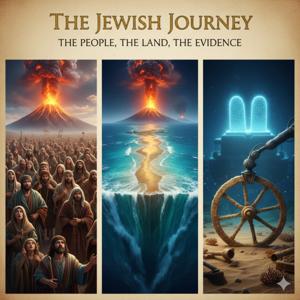
Every major revelatory religion traces back to one person: Muhammad alone with Gabriel, the Buddha's solitary enlightenment, Joseph Smith's private encounter. Judaism's founding claim is structurally different — an entire population, who then became the twelve tribes and began commemorating it immediately, in every household, transmitted parent to child across centuries of civil war and schism. This episode asks whether the evidentiary bar we set for that claim is the same one we use everywhere else. The finale of a three-part series.
For over a century, biology textbooks taught that the appendix was useless evolutionary junk. Surgeons removed healthy tissue on the strength of that claim. It was wrong — and the anomaly that should have caught it, the fact that every human on Earth has one, was explained away instead of examined.
This episode looks at what the evidence for common descent actually establishes versus how completely settled it's presented as being: a fossil record that preserves scaffolding but not machinery, the Cambrian gap Darwin himself called a serious problem, and a pattern worth noticing in the rebuttals — that many of them explain why the evidence would be missing either way. Part two of three.
The standard model of the universe holds that roughly 95% of everything out there is made of substances no one has ever directly observed. Its central measurement — how fast the universe is expanding — sits in what cosmologists themselves call a crisis, one that better telescopes have made worse, not better. And the leading candidate for a "theory of everything" requires seven dimensions nobody has detected and predicts particles that fifty years of searching haven't found.
None of this means science is broken. But it does mean the confident version you were taught is doing work the evidence doesn't support. Part one of a three-part series on what we actually know, how we know it, and why "the science is settled" almost never appears in the journals themselves.
How do you build a nation out of tragedy and chaos? In this episode, we strip away the sanitized myths surrounding the birth of the State of Israel. We explore the deep philosophical shift of the Jewish Enlightenment and the brutal catalyst of the Russian pogroms. We unpack the cynical British diplomacy behind the Balfour Declaration and how the horrors of the Holocaust turned a political movement into a desperate fight for survival. Finally, we examine the violent reality of the 1948 War of Independence—a conflict that secured a homeland for one people while resulting in the displacement of another.
The Failure of the Uganda Plan and the British Mandate
The narrative begins by returning to Theodor Herzl’s desperate "Uganda Plan." After fierce internal debate, the Zionist Congress rejected the British offer of land in East Africa, cementing their focus solely on Palestine. The episode then traces the chaotic implementation of the British Mandate following World War I. While the Balfour Declaration promised a "national home," British foreign policy continually waffled under the pressure of Arab resistance and geopolitical strategy, culminating in the 1939 White Paper, which effectively slammed the doors of Palestine shut to Jewish refugees just as the Holocaust began.
The episode then explores the dramatic shift in Zionist strategy. Driven to desperation by the Holocaust and the British blockade, underground militant groups like the Irgun (led by Menachem Begin) and the extreme Lehi (the Stern Gang) launched a violent insurgency against the British military. The episode details their bombing of British infrastructure, railroads, and the infamous attack on the King David Hotel in Jerusalem, which housed the British administrative headquarters.
Exhausted and nearly bankrupt by World War II, and battered by the insurgency, Britain handed the Palestine problem over to the newly formed United Nations. In November 1947, the UN voted to partition the land into two independent states: one Jewish, one Arab. While the Jewish leadership reluctantly accepted the plan, the Arab states and local Arab leadership fiercely rejected it, setting the stage for total war.
The climax of the episode covers the moment the British Mandate officially ended on May 14, 1948. David Ben-Gurion declared the independence of the State of Israel. The very next day, a coalition of armies from Egypt, Syria, Iraq, Lebanon, and Transjordan invaded. The episode details the brutal, desperate survival war that followed, ending with the 1949 armistice agreements that established Israel's expanded borders and resulted in a massive refugee crisis for the Palestinian Arab population.
How did a desperate refugee crisis evolve into a full-scale insurgency against the British Empire? In this episode, we explore the violent, chaotic, and high-stakes birth of the State of Israel. We track the rising desperation of the Jewish underground, detailing the militant tactics of the Irgun and the Stern Gang as they fought to break the British blockade. We then take you inside the UN's controversial 1947 Partition Plan, and onto the battlefield of the 1948 War of Independence—a brutal conflict where a newly declared nation had to fight five invading armies for its very survival.
How does a modern, civilized society build an industrial assembly line for mass murder? In this chilling episode, we pull back the curtain on the horrific corporate and bureaucratic architecture of the Holocaust. We break down the 1942 Wannsee Conference, where elite state officials calmly organized the "Final Solution" over drinks and cigars. We reveal the complicity of the German railway system, where victims were legally billed for their own deportation fares, and look at the gruesome resource extraction that took place at the death camps. This is an essential deep dive into what happens when state efficiency is weaponized into absolute evil.
How did a 67-word letter from a British politician reshape the entire Middle East? In this episode, we dive into the tangled, cynical web of British diplomacy during the Palestine Mandate. We unpack the intentional vagueness of the Balfour Declaration, the escalating violence of the Arab Revolt, and the failed two-state solution of the 1937 Peel Commission. Finally, we explore the devastating 1939 White Paper, revealing how Britain slammed the doors of Palestine shut just as the shadow of the Holocaust fell over Europe.
How do you build a nation from scratch? In our final episode, we explore the desperate, explosive origins of modern Zionism. We travel from the terrifying, state-sponsored pogroms of the Russian Empire to the shocking anti-Semitism of the Dreyfus Affair in "enlightened" France. Discover how an assimilated journalist named Theodor Herzl turned a grassroots dream into an international political powerhouse, why the movement nearly agreed to build a state in East Africa, and how one man stubbornly resurrected the ancient Hebrew language from the dead.
From the publisher's feed