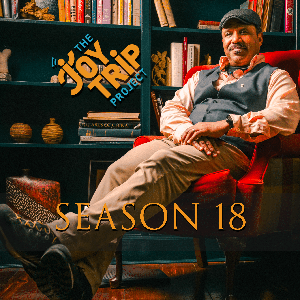
The Joy Trip Project

The Joy Trip Project

Download on the App Store

The Joy Trip Project episodes

  • From The Barbershop To The Backcountry
    The Black Men Northwoods Retreat
    Hey everybody. Happy New Year! I know things seem to be getting off to a rocky start. How’s that for an understatement. But I sincerely believe that by working together we can get past our differences and move forward toward a brighter future. We just need to come up with creative solutions to our many extremely complicated problems.
    For example, in the spring of 2020 I was asked by the National Forest Foundation to create a storytelling project.  They asked me to create a series of photographs and interviews about the Black community and its relationship with the outdoors. Cause you know…that’s kind of my thing. But smack in the middle of the global Covid-19 Pandemic this already complicated project had the added challenges of travel restrictions, social distancing, and the potential of spreading the virus among a group of participants already at the highest risk of contracting this deadly disease.
    But rather than trying to come up with a solution all on my own, I reached out to a dude who knows more about these issues than anyone I know.
    [/vc_column_text][/vc_column][/vc_row]
    Aaron Perry:
    You know, probably the biggest challenge that I'm seeing is we're dealing with three epidemics, you got, you know, obviously covid-19, you have, you know, the health disparities and then you have racial tension.
    My friend Aaron Perry is the founder and executive director of the Rebalanced Life Wellness Center based right here in Madison Wisconsin. He works at helping to overcome the healthcare challenges that Black men face not only southern Wisconsin, but across the country.
    Aaron Perry:
    What I try to do is always be a part of the solution, period, point blank. I'm constantly looking at how can we be creative? How can we get our men to take part or participate in things that that's really kind of out of the box thinking.
    As it happens, the rise of the Coronavirus put into sharp relief many of the institutional disparities that place the Black community in jeopardy. High rates of unemployment, limited access to affordable healthcare, and the prospects of being subjected to racially motivated violence already make this population more susceptible to chronic illness, injury or even death. Black men and women are more likely as well to suffer from ailments such as obesity, high blood pressure, hypertension, heart disease and diabetes, conditions that can be reversed or remedied with physical exercise and better access to more nutritious foods. At a time when all the people of the world are being asked to stay indoors and prohibit their contact with others outside of their immediate families, the Pandemic has taken an even higher toll on those most vulnerable to infection. Ironically, however, the best place for this community to find healing and solace from the trauma of this crisis is in the outdoors.
    For the last few years, I’ve watched and even participated in a few of the outdoor events that Aaron has organized for Black men. Every week, in a bit of out of the box thinking, he offers a group running, walking or bicycling opportunity in the Madison area. A lot of his work focuses on getting Black men to eat right, exercise and get regular checkups at the doctor. And Aaron believes that being healthy also means getting outside in public and unapologetically being part of the wider world.
    Aaron Perry:
    But I started looking at these other activities because I've always said to the guys, I said, please remember, this is our community. This is our country, too, and everything under the sun we're entitled to as well.
    So, with Aaron’s help we recruited a small group of Black men and their sons to experience the outdoors in a meaningful way. We wanted to take them hiking on public land in a natural setting. Everyone got a negative Covid-19 test and we created what I like call, an escape pod, a tight cohort of like-minded folks who can safely venture out together for a common experience. While wearing masks, still maintaining our social distances to further minimize the risk of exposure to the virus, we traveled to northern Wisconsin to walk along a section of the Ice Age National Scenic Hiking Trail through the Chequamegon-Nicolet National Forest. There, in supportive environment among friend, we planned to introduce this group to the natural wonders and restorative powers of the great outdoors.
    Aaron Perry:
    And I know that if we can continue to expose these men, particularly black men, if we can continue to expose them, we're taking them outside of their element, but we're exposing them to something that they can do literally the rest of their life with their family.
    Ready for an adventure our group embarked upon the Black Men Northwoods Retreat. I’m James Edward Mills. And you’re listening to The Joy Trip Project.
    Aaron PerryJust to give you a little more background. Aaron Perry has dedicated life to promoting the health and well-being of Black Men. But he’s not a medical professional or even a social worker. He used to be a cop.
    Aaron Perry:
    When I was a police officer, I've always had this concept that if I arrest someone, I'm literally taking away their freedom. If I take away their freedom, I want to be a part of helping them get their freedom back. That was a role that I wanted to play, you know, we have a job to do, but also, I kept in mind that we don't know what, what people's struggles and their challenges in life and what leads them to maybe cross in that line of, OK, now you have to be placed in custody.
    Aaron has very holistic view both law enforcement and public health. He recognized as a police officer that he had much bigger part to play in serving his community then just locking people up. He wanted to figure out how he could be part of the solution.
    Aaron Perry:
    And doing that work, I realized that for men that I was coming in contact with, they appeared to have sleep deprivation. They appeared to have multiple issues with their health. And I thought if we can improve their health, can we improve their outlook on life? Can we get them to a point where they want to, you know, work hard and find a job? And so that became my focus. And so, you know, when black men are healthy, the community is healthier. We've seen that. And so I decided, well, I'm going to create this organization where I focus completely and solely on improving the health of black men and boys.
    Aaron took a hard look at the health statistics for Black men in his community. He collaborated with the Dane County Public Health Department to commission a report called the “Social and Health Conditions of Black Men.”
    Aaron Perry:
    In Dane County there are sixteen thousand five hundred black men. We account for six percent of the male population, but in that we are at the bottom of everyone's list.
    Black men in Dane County are falling ill and suffering from a wide variety of different ailments with much lower rates of recovery than their white counterparts. Many these diseases are preventable with better lifestyle options that improve nutrition, provide physical activity and reduce emotional stress.
    Aaron Perry:
    And so that became my focus to take apart each of those specific areas and try to improve the health of these black men.
    But part of the problem is that the Black community has an inherent distrust of the medical establishment. Mistreatment at the hands doctors and healthcare professionals that goes back more than two centuries in the United States has made Black men leery, even suspicious of recommendations coming from even the most reliable hospitals or clinics.
    Aaron Perry:
    And so that's how I ended up opening up my men's health center in a barber shop, because that's where men go. That's where they trust. They respect. That just made sense. And really, since opening the doors, we just surpassed serving five thousand one hundred black men. That's almost 30 percent of the male population in Dane County.
    The Rebalanced Life Wellness Center operates out of JP Hair Design, the largest Black-owned barbershop in Madison. Here Black men and boys can get a haircut along with a check of their blood-pressure and detailed information on how to lead a healthier lifestyle. And in the midst of a Global pandemic Aaron believes that maybe he can help to mitigate at least a few of the risk factors that make Black men more susceptible to contracting the Coronavirus
    Aaron Perry:
    What we do know is that if we can get ourselves healthy and give ourselves a fighting chance to fight off this infection if we should get it. And so that’s first and foremost just helping us understand that a lot of what we are dying early from is preventable. And that is what I’ve been preaching. Let’s control what we can control.
    I think in many ways Aaron convinced me that the best way to get a group of Black men from the urban cities of Madison and Milwaukee into the Northwoods of Wisconsin was to meet them where they are. Because the men in his program already had his trust and respected his guidance, connecting Aaron’s message of health and wellness through physical exercise to an outdoor activity like hiking through a national forest wasn’t that big of a stretch. We just had to blaze a trail from barbershop to the backcountry.
    So what would it take to talk a Black man from the city into going on a hiking trip.
    Norman Davis:
    For one, Aaron, because Erin asked me a lot of respect for Erin in the work that he does, you know, he's a person that if he says he's going to do it, he's going to do it.
    Norman Davis is the Civil Rights Director for the city of Madison. He works to prevent racial discrimination in the workplace at government agencies as well as private companies who do business with the city. He understands the importance making sure everyone has equal access to public facilities and resources that promote a good quality of life. And for Norman that includes being able to get outside for exercise....

    23 min
  • Greening Youth ~ A Conversation With DEI Subject Matter Experts
    The Greening Youth Foundation is based in Atlanta but they provide services and programs for clients nation wide. Angelou Ezeilo is the author of the new book Engage, Connect, Protect: Empowering Diverse Youth As Environmental Leaders, now available at Amazon. As we head into the new year and a new decade perhaps now we can all work to create diverse equity and inclusive environments where everyone is welcome.
    39 min
  • One Tough Mother ~ Remembering Columbia’s Gert Boyle
    Early in November Columbia Sportswear matriarch and outdoor industry icon Gert Boyle passed away. She was 95. Having fled Nazi Germany with her family in advance of World War II Gert’s father started the Portland, Oregon-based company that today is worth billions. Throughout her long career Gert cultivated an image as a fierce business woman, but that tough persona was belied by a delightful personality and a generous spirit.
    Way back in 2006 I had the great pleasure chatting Gert at the Outdoor Retailer Show in an interview for the podcast SNEWS Live. In this flash back edition we remember "One Tough Mother". Gert Boyle was one of the truly great original leaders of the Outdoor Industry and her enduring legacy of tenacity and courage will inspire us all for decades yet to come.
     
    Our music in this episode comes courtesy of Artlist featuring original tracks by Polaris Rose and Ziv Moran.
    The Joy Trip Project is made possible thanks to our partners American Rivers, The National Forest Foundation and Patagonia.
    Thanks for listening, but you know I want to hear from you. So please drop me a note with your questions comments and criticisms to [email protected]. For now go be joyful and until next time, take care!
    13 min
  • A Conversation with Author Eddy Harris
    Very early in my career, way back in the 90’s I received the gift of a book, South of Haunted Dreams by Eddy Harris. As a young Black man venture out into a professional environment that was mostly white I took great comfort in this remarkable story of a person with a background similar to my own who was successfully leading a life of travel and adventure. In his book, Harris recounts his experiences of making his way through the Southern United States on motorcycle while enjoying occasional stops on trout streams to do a little fly-fishing. Though concerned that he might subjected to the mistreatment of racism Harris said his ability to navigate through places that are unfamiliar or even a bit frightening hinges upon his willingness to be vulnerable and receptive to the kindness of complete strangers. As writer myself I ask him, is that also a way to be an effective storyteller?
    "I never actually thought of it that way. But it’s something that I do as a literary device. I’m a traveler. I’ve been a traveler since I was 16 years old. The way I travel is not organized. I have no plan when I go someplace. Whatever happens happens," Harris told me in an interview. "When I meet people and they invite me in for coffee or drinks or dinner, I almost never say no. I’m receptive to generosity, and I just put myself out there. I’ve discovered that that if you want people’s stories, you make yourself available to them and they will in fact tell you’re their stories."
    I believe that in many ways Harris’s attitude toward travel and to how find one’s place in the world directly influenced my own. Over the years that followed after reading that first book I went on read his other titles that include Mississippi Solo about his adventures paddling a canoe down the Mississippi River and Native Stranger that details a trip he made through the continent of Africa. But it was in article that he wrote for Outside Magazine 1997 on the disparities among people color as active participants in outdoor recreation that really got my attention. It was through the work of Eddy Harris that I first began to explore the divisions of diversity, equity and inclusion that I call “The Adventure Gap”. Now more than 20 years later I have a wonderful opportunity to learn from one of my favorite literary heroes.
    In 2018 I had the great pleasure of hosting a visit with Eddy Harris at the University of Wisconsin Madison. As adjunct faculty at the Nelson Institute for Environmental Studies it was my honor to speak with him as a guest interviewer on the Edge Effects Podcast.
    After 30 years of reading the work of Eddy Harris as a fan I now count him among my friends. It’s that same spirit of humility and vulnerability that makes him such an endearing person and very compelling writer. You can find more of his work online at Eddyharris.com.
     
    Thanks again to my colleagues at the University of Wisconsin Department of History podcast Edge Effects. New music this week by Ilya Truhanov and Brick Fields courtesy of Artlist.
     
    The Joy Trip Project is made possible thanks to the generous support of American Rivers, The National Forest Foundation and Patagonia.
    31 min
  • Hike It Baby! ~ A Conversation With Founder Shanti Hodges
    Wherever you are in the world I hope you had an amazing summer. I know I did. Over the last several months I’ve been on the road collecting stories for a broad new initiative to explore how people find their way into the outdoors. With grant funding from my partners at the nonprofits American Rivers and the National Forest Foundation along with Patagonia I made stops in the states of Georgia and Oregon to trace the routes of the great rivers that run through their biggest cities. From the Chattahoochee National Forest to Atlanta and the Willamette National Forest to Portland I went searching a direct connection between people in these urban centers and wilderness areas on Federally protected public land about 120 miles away. It didn’t take long for me to realize that for many folks live in cities nature is closer than they think and with just a little bit of help they can find their own pathway to the outdoors.
    Along this journey I connected with an amazing organization based in the city of Portland called Hike It Baby. Created by my friend and colleague Shanti Hodges Hike It Baby connects families with children to wonderful outdoor experiences on short walks along easily accessible trails in cities across America and more than a few foreign countries. Like any great invention Shanti says the mother of her idea was necessity.
    "I just wanted to figure out a way to find people to get outside with. So I initially just built a website a Facebook group and a newsletter," she said in an interview.  "I went on looking for hiking groups in Portland with babies and I found nothing."
    Within a few weeks Shanti added about one hundred people to her newsletter list. She got texts every day wanting to know when she was hiking next.
    "I was leading four or five hikes a week and hundreds of people were texting me and calling me and Facebooking me. And then within a year we had a thousand and then people started writing me around the country," she said. "They started seeing pictures and asking how are you getting out with these groups of people to these amazing hikes? People started writing me and telling me they were lonely and they were looking for friends and could they start a group in their town. I'd pay to send them business cards. I'd have business cards made so they could hand them out so people could find the website, find the hikes and we built a little calendar and it just exploded!"
    Hike It Baby now has members numbering in the tens of thousands. And with hundreds of ambassadors around the world this remarkable organization brings families and children into the outdoors to become not only nature enthusiasts but also environmental stewards. There are Hike It Baby branches located in cities everywhere. If you can’t find one near you, maybe you can start one. If you want to learn more about how you can get involved just visit them online at hikeitbaby.org.
     
    New music this week by Michael Shynes and Paper Planes courtesy of Artlist.


    The Joy Trip Project is made possible thanks to the generous support of American Rivers, The National Forest Foundation and Patagonia.
    25 min
  • Pattie Gonia ~ Queen of The Great Outdoors

    Just a few days before the 2019 Outdoor Retailer Snow Show in Denver I got my reporting assignments. Among the various topics I was tasked to report on was a human interest profile on a young man attending OR for the first time. Wyn Wiley is a professional photographer from Lincoln, Nebraska. He’s also known as the drag queen Pattie Gonia.

    29 min
  • The Pledge ~ A promise of DE&I in the Outdoor Industry
    On Friday the Trump administration signed legislation to reopen the federal government. For many of us, an end to the longest government shutdown in U.S. history couldn’t have come soon enough. The announcement arrived just in time for the 2019 Outdoor Retailer Snow Show that’s starting this week in Denver Colorado. Tens of thousands of federal employees in service of environmental protection can now get back to doing their very important work. And those of us in the business of outdoor recreation can continue our efforts to make our public lands more accessible to a broader cross section of the American public.
    That kind of reminded me of a story I produced over the summer that explores an ongoing initiative to bring more people of color into the outdoor industry. So with OR coming up this week I thought we might take a look back at “the Pledge”.
     
    The Pledge creator Teresa Baker (right) with active lifestyle ambassador Mirna Velario
    For people in business of adventure sports the Outdoor Retailer Show is a really big deal. There you’ll find aisle after aisle of high-tech backpacks, tents, sleeping bags, hiking boots, GPS devices, tasty trail snacks and headlamps. To the outdoor professional it’s pretty much kids…meet candy store! But if you take a look around you’ll also see a lot rugged men with Nordic features, full beards and plaid shirts. These guys kind of embody what you imagine when you think “outdoorsman”.Through most of it existence, the outdoor industry has been…well…pretty white. Not many companies at OR that deal in outdoor gear have many employees who are Black, Latino, Asian or Native American. Only a few can claim a senior executive, owner or board member who is a person of color. But at the 2018 Summer Market Mario Stanley, a rock climbing instructor from Dallas, Texas said this year he noticed something different.
    Rock Climbing instructor Mario Stanley (left)
    Stanley>>Ah…the beautiful wave of brown walking around. I think that's probably the one thing I notice the most. And then I've also noticed that more people are engaging.
    JEM>>Not only were there more people of color at OR this year, Stanley, who’s Black, said there is more conversation around issues of race and what the industry can do to improve its diversity.
    Stanley>>The dialect has changed and they are allowing us to talk or asking us what are we doing for the greater POC community as a whole. And I think the biggest thing that I noticed this year was people are actually asking, “What are we doing?”
    JEM>>Research conducted by the Outdoor Industry Association, a trade group, indicates that people of color or POCs participate in outdoor recreation at rates lower than their white counterparts. In order to grow the market as well as the number of people overall who will help to protect the natural environment there is a concerted effort to bring more black and brown folks into the outdoor industry. Teresa Baker, an advocate for environmental justice, was at OR to promote an initiative she calls The Pledge
    Baker>>The pledge is a commitment that we are asking the owners of outdoor brands and retailers to commit to the work of diversity, racial diversity in the outdoors.
    JEM>>Through the Pledge, kind of a contract, Baker wants company executives to not only hire more people of color, but to create marketing and outreach strategies that appeal to a broader cross section of the American public. She’s not just interested in helping companies sell more products, but rather she hopes to encourage more people to care about the outdoors.
    Baker>>For me it really is about the environment and we need more people of color right now fighting for the environment. There are so many attacks on the land right now and the people that are missing from the conversation and the work are people of color.
    JEM>>As the current administration continues to roll back several of the environmental protections enacted over the last century, many in the outdoor industry are concerned for the long term success of their business. Joe Flannery, general manager of the outdoor equipment and apparel brand Marmot was the first to sign the Pledge.
    Flannery>>And at the end of the day our industry will decline if we don't get more people to participate in getting outside…period.
    JEM>>But there’s more to diversity than signing on to a non-binding agreement.
    Rajagopal-Durbin >>People will sign up because it looks good to be like “yeah I like diversity I'm going to sign this thing” and people are signing it without an actual understanding of what it entails to engage in diversity equity and inclusion.JEM>>Aparna Rajagopal-Durbin is a diversity consultant with a specialty in environmental conservation
    Rajagopal-durbin >>My concern is that companies will sign it without really knowing, without being ready. That readiness won't be there and the actual buy-in to what it entails might not be there.
    Outside the halls of the Denver Convention Center this is good news to aspiring mountaineer and environmental activist Leandra Taylor.
    Leandra Taylor (right) with Mount Kilimanjaro climbing partner Chaya Harris
    Taylor>>I'm seeing a lot more brands putting more action behind the words, you know the inspirational words that everyone is getting behind. So it's really cool to see people moving in that direction. And however slow the progress it's really cool to see progress. Makes me want to come back over and over again to see more progress.
    JEM>>As a member of the first all African-American climbing team to reach the summit of Mount Kilimanjaro in Tanzania last summer, Taylor is full of hope for the future.
    Taylor>>I have so much confidence because I know the people that are next to me are also fighting to change things. And I know that we're so capable of it and we're creating a community and surrounding ourselves with people that have that same vision in mind. So I know it's going to happen.Mi
    When the Outdoor Retailer Snow Show opens in Denver on Wednesday we may indeed see more people of color walking the aisle than ever before. With a concerted effort to create opportunities in the business of outdoor recreation for more folks across all backgrounds to be successful we may be able look forward to a more diverse, equitable and inclusive outdoor industry in the future. You can learn more about this initiative online at diversifyoutdoors.com/pledge.
    Music in production was provided by Artlist.
    The Joy Trip Project is made possible thanks to the support of the Next 100 Coalition a diverse group of environmental activists working toward equity and inclusion in the management of public land through the next century and beyond. Learn about its members and current initiatives at Next100Coalition.org.
    Thanks for listening! But as always I want to hear from you so please drop me a note with your questions comments and criticisms to [email protected]. Or better yet subscribe to the feed on iTunes, Google Play, Stitcher or wherever most fine podcast platforms can be found. There you can leave a message or a write review, but most of all don’t forget to tell your friends. Now go be joyful. And until next time. Take care!
    7 min
  • The Four Footed Shadow ~ An Interview with hunter Jessi Johnson
    Being an environmentalist doesn’t necessarily limit your outdoor recreation pastimes to hiking, mountain biking, skiing or rock climbing. Those of us who indulge these so-called action sports should remember that we share the natural world with folks whose connection to the outdoors also includes activities like hunting and fishing. Personally I took up fly fishing a few years ago and pardon the pun I’m hooked. And on a trip to Wyoming in 2017 I met a young woman who has a passion for hunting. Jessi Johnson is an environmental activist who shared with me the story of a remarkable experience she had while hunting elk in the Wild.
    Along with one’s passion for the outdoors must also come an understanding of the balance between life and death. As a bow hunter Jessi Johnson knows firsthand the responsibilities and obligations that go along with being a full participant in the natural world. Though she hunts for sport, the elk she kills for food bring her closer to the wilderness she aims to protect. In the edition of the Joy Trip Project we explore the  seeming contradictions of wildlife conservation through hunting.
     
    This story details a vivid description an actual elk hunt. Though not overly graphic sensitive listeners should be advised…
    “We are all filled with a longing for the wild. There are few culturally sanctioned antidotes for this yearning. We were taught to feel shame for such a desire. We grew our hair long and used it to hide our feelings. But the shadow of Wild Woman still lurks behind us during our days and in our nights. No matter where we are, the shadow that trots behind us is definitely four-footed.”
    ― Clarissa Pinkola Estés, Women Who Run With the Wolves: Myths and Stories of the Wild Woman Archetype
    Jessi Johnson is the co-founder of Artemis Sportswomen and the Public Lands Coordinator at the Wyoming Wildlife Federation. You can learn about environmental conservation through hunting and other outdoor activities at wyomingwildlifefederation.org
    Our theme music is provided by Jake Shimabukuro. Additional melodies by Ben Winwood and Oren Tsor were provided by Artlist.
    The Joy Trip Project is made possible by the support of the Next 100 Coalition a diverse group of environmental activists working toward equity and inclusion in the management of public land through the next century and beyond. Learn about its members and current initiatives at Next100Coalition.org.
    Thanks for listening! But as always I want to hear from you so please drop me a note with your questions comments and criticisms to [email protected]. Or better yet subscribe to the feed on iTunes, Google Play, Stitcher or wherever most fine podcast platforms can be found. There you can leave a message or a write review, but most of all don’t forget to tell your friends. Now go be joyful. And until next time. Take care!
    29 min
  • Blood On The Crack ~ A Conversation with Adventure Film Maker Heather Mosher
    From the opening frames, a recent movie by Canadian adventure film maker Heather Mosher lets viewers know exactly what they’re in for. World class rock climber Kevin Jorgeson mugs at the camera and chuckles while his partner Jacob Cook holds up a bloody finger. This particular pitch on the Tom Egan Memorial Route in the Bugaboos of British Columbia was first climbed by Will Stanhope and Matt Segal back in 2015. Blood On The Crack is a pencil-thin fissure on a sheer vertical slab of granite. It’s the perfect project for any aspiring rock climber or an adventure film maker. I first met Heather Mosher seven years ago when she was just a volunteer at the Banff Mountain Film Festival. A few weeks ago she sent me link to watch her latest film, a nine-minute short called Blood On The Crack. Let’s just say I loved it. So got her on the phone to ask her a few questions about her life and career in film making.
    Adventure Film Maker Heather Mosher
    “Going to the Banff Mountain Film Festival in 2012 kind of there's a bit of a spark even though I didn't know it at the time,” Mosher told me in our interview. “I already knew I wanted to be a photographer. I started working in the photography industry in Vancouver and then as I moved out of that full time job the thing that sparked the filmmaking direction was going to Banff and being like ‘I want to make an adventure documentary.” So I've met up with local filmmakers and went, ‘Teach me about sound!’ And they said, ‘Sure come on over to our studio and we’ll show you our microphones. And they taught me basically how to edit. And that’s what’s taken me to where I am now.”
    Blood on the Crack (trailer) from Heather Mosher on Vimeo.
    Heather Mosher is a rising young creative in a new generation of adventure film makers. Taking her passion for storytelling and life in the outdoors she’s producing compelling movies that are worth watching and definitely worth talking about. In this episode of the Joy Trip Project we discuss the process of making an adventure documentary and how this young producer got to work with one of the most sought after professional rock climbers in the world.
    Kevin Jorgeson and Jacob Cook photo by Kaare Iverson
    The film Blood On The Crack featuring Kevin Jorgeson and Jacob Cook is making its way around the world wide adventure film festival circuit so watch for it in programs and play lists in the coming months. You can learn more about Mosher on her web site at HeatherMosher.ca
    Our theme music is provided by Jake Shimabukuro. Additional sounds and melodies in this week’s episode were inspired by selections from the film Blood On The Crack. Each was provided by Artlist. The Joy Trip Project is possible thanks to a partnership with Film Festival Flix. Check out the selection of action movies on the Vertical Life or Mountain & Adventure Channels at FilmFestivalFlix.com
    Thanks for listening! But as always I want to hear from you so please drop me a note with your questions, comments and criticisms to [email protected]. Or better yet subscribe to the feed on iTunes, Google Play, Stitcher or wherever most fine podcast platforms can be found. There you can leave a message or write a review, but most of all don’t forget to tell your friends. Now go be joyful. And until next time, take care!
    15 min

About The Joy Trip Project

From the publisher's feed

Reporting on the business art and culture of the sustainable active lifestyle

More shows like The Joy Trip Project

Wait Wait... Don't Tell Me! by NPR

Wait Wait... Don't Tell Me!

38,643 Listeners

Outside Podcast by Outside

Outside Podcast

2,123 Listeners

How I Built This with Guy Raz by Guy Raz | Vox Media

How I Built This with Guy Raz

30,103 Listeners

Up First from NPR by NPR

Up First from NPR

56,407 Listeners

The Weekly Show with Jon Stewart by Comedy Central

The Weekly Show with Jon Stewart

10,696 Listeners