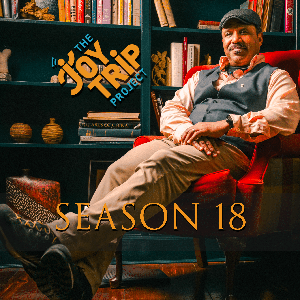
The Joy Trip Project

The Joy Trip Project

Download on the App Store

The Joy Trip Project episodes

  • Jon Jarvis ~ an interview with the 18th Director of the National Park Service
    Hey everybody! It’s January first, 2019. Happy New Year! If you’re anything like me you’re excited to make this year better than the last and if you’re listener to this podcast that means getting into the outdoors. But at the moment of this posting, the United States of America is in the second week of a partial government shutdown that’s expected to last for at least a few weeks longer. In addition to the federal employees who will go throughout this period without a paycheck every national park and all of our national monuments will be closed.
    The reality of a nation without parks got me thinking about an interview I conducted more than a year ago. Jon Jarvis is the former director of the National Park Service. Appointed by president Barack Obama back in 2008, Jarvis served in that position through 2016. And now as a private citizen I asked him to tell me a little bit about his career and how he got started.
     
    Jarvis began as most of us do with a profound love of the outdoors. He went to the College of William and Mary where he earned a degree in biology. After graduation he took a long cross-country road trip and wound up in Washington D.C. where his older brother worked for the National Parks Conservation Association. There Jarvis worked a bunch of manual labor jobs as a mechanic and welder for a local bus company, but he was still looking for a steady gig, maybe in the outdoors.
    "And my brother said, “Did you ever think about working for the Park Service?” And I said no," Jarvis said in our interview. "I was also thinking about going back to grad school at the time and was applying for grad school, but I needed a year off. So I applied for a seasonal job with the park service and got hired at the Bicentennial Information Center in 1976 the nation's bicentennial. And that was 40 years ago. I've worked for them ever since."
    Throughout his career of more than 40 years Jon Jarvis had worked both as a law enforcement officer and a natural resources biologist. He was the superintendents of Mount Rainier National Park in Ashford, Washington, Craters of the Moon National Monument and Preserve in Idaho and Wrangell-St. Elias National Park & Preserve in Alaska. Jarvis finished his tour of duty as the 18th Director of the National Park Service during the Obama administration under Secretaries of the Interior Ken Salazar and Sally Jewell. Now as the executive director of the Institute for Parks, People, and Biodiversity at the University of California at Berkeley he has big plans to lead the conservation movement well into the future.
    Jon Jarvis is the author of the book The Future of Conservation in America: A Chart for Rough Water You can learn more about his work at the Institute For Parks, People and Biodiversity at  parks.berkeley.edu
     
     
    Music in this episode is provided by Jake Shimabukuro and Artlist 


    The Joy Trip Project has made possible thanks to the support of the Next 100 Coalition, a diverse group of environmental leaders dedicated to the preservation of public land and our natural resources through the next century and beyond. Learn more about its members and current projects at Next100Coalition.org
    Thanks for listening. But as always I want to hear from you so please send your questions, comments and criticisms to [email protected]
    30 min
  • Girl Trek ~ Morgan Dixon Aspires to Get One Million Black Women Walking
    Hey everybody! Yeah I know it’s been way too long since the last edition of the Joy Trip Project podcast. As it happens I’ve been crazy busy traveling, writing and yes conducting interviews. But most of the audio I’ve been recording over the last several months has been going toward a series of profiles for Outside Magazine. Check out the May 2018 cover story, which I wrote, called “The New Faces of Adventure”. This wonderful spread edited by Michael Roberts with photographs by Joao Canziani features 12 emerging athletes and activists who in their own words share the stories of their efforts to make outdoor adventure more diverse equitable and inclusive. The May issue of Outside Magazine is  on newsstands now so go out and get a copy. Or hang tight watch for the online edition available on April 20, 2018 at outsideonline.com
    But getting back to the podcast, I was recently inspired by a remarkable post on Facebook from my friend Vanessa Garrison. She and another friend Morgan Dixon appeared at the 2018 TED Conference. As the creators of a women’s empowerment initiative called Girl Trek and they were introduced virtually to the TED stage my non other than Oprah Winfry 
    Oprah: Hi all! I hope you're having a great TED Conference. I wanted to chime in virtually here to introduce you to two women that I think are doing some of the most transformational work on our planet. It's big. I mean it's really big. And it's wise because it's based on the wisdom of nature, that cataclysmic shifts start with just a tiny seed. These two women understand that the world is changed when nations are changed and nations are changed when cities are changed. Cities get changed when communities are changed. And communities are changed when individuals are changed. And when we look at history we know that some of the most potent change makers are, let's be real people, Black women. So let's start with them. Get these movers and shakers, get them talking. Get them dreaming and plotting and oh wow. Oh wow. Wow imagine what's going to come of that. I'd like to introduce you to the seed planners and the co-founders of Girl Trek Morgan Dixon and Vanessa Garrison! 
    So I’m watch this video and Vanessa and Morgan step  out onto the stage. Morgan gives a nod to Oprah and then there’s Vanessa.
    Vanessa Garrison: Now many of you may know us. We Are the co-founders of Girl Trek the largest health organization for black women in America. Our mission is simple: ask black women, 80 percent of whom are over a healthy body weight, to walk outside of their front door every day to establish a life saving habit of walking. In doing so ignite a radical movement in which black women reverse the devastating impacts of chronic disease, reclaim the streets of their neighborhoods, create a new culture of help for their families and stand on the front lines for justice. Today all across America more than a hundred thousand black women are wearing this Girl Trek blue shirt as they move through their communities. A heroic force. 
    JEM: Right out of the gate Venessa lays out the basic strategy that Girl Trek recommends to its leaders and follower how they can make positive changes their lives and the communities in which they live.
    VG: One: to have a bold idea, bigger than anyone is comfortable with. Two: Root d in the cultural traditions of your community and lean heavily on what has come before. Three: Name it. That one thing that everyone is willing to work hard for a ridiculously simple goal that doesn't just benefit the individual but the village around them. And lastly: never ask permission to save your own life. It is our fundamental right as human beings to solve our own problems. 
    JEM: Let’s just say that this video got my creative juices following and I suddenly remembered one of the many interviews sitting on a shelf in my office waiting to be edited. In November 2017 I attended the SHIFT Conference in Jackson Wyoming. I had the rare opportunity to sit with Morgan Dixon to have her share with me the story behind the vision and passion of Girl  Trek.  I’m James Edward Mills and you’re Listening to The Joy Trip Project
    JEM: I'm talking to Morgan Dixon and Welcome to The Joy Trip Project. 
    Morgan Dixon: Thank you. 
    JEM: Well first of all we don't know that for a little while. Tell me what you start. How did you start doing that now? 
    MD: It's an interesting question because the work I'm doing now is an extension of my lifestyle. It's not a business plan so I run a national health organization called Girl Trek. We have 100,000 members. We call (them) Freedom Riders their neighborhood walkers. They walk for better health in groups in bright blue shirts. You've probably seen them in your parks. We're growing to a million. Our mission is to walk to improve our health but also to inspire our daughters to get outside to breathe in fresh air, and then to reclaim the streets of our neighborhoods. Because we know when people are outside neighborhoods look and feel different. And so our goal is to inspire a million black women to walk in the 50 highest need cities in America. And we think that's going to change things pretty fundamentally on many different fronts. And so how do you start walking? Is what you're saying and that's a silly question for me to even ask myself because I've always been walking and black women have always been walking. It certainly isn't innovative in that way. I think what's innovative is, tying walking to new issues of climate change, issues of violence in the streets, a pressing issue of a crisis around health and preventable chronic disease.  And then tying walking to change making, where we really say that when women walk together and survey the needs of their neighborhoods they become the most informed and qualified change makers there. So what happens eventually is women start to create gardens or they see blighted homes and they start to offer help or lots and they and they do murals. They do all sorts of amazing things or they volunteer with the city council or the local park service or Sierra Club or whatever. So it's an amazing thing. I started my career in the outdoors if that's what you would call this. I'm not sure if it's a career in the outdoors, but as a Girl Scout. I was a Girl Scout until the 12th grade Secretly 
    JEM: Secretly? 
    MD: Yeah. My silver award I didn't earn my gold the word because I was too embarrassed when I was a senior in high school like to do to the stuff. But I was a senior when I quit the Girl Scouts. I was a Girl Scout my entire life. And I think it had an impact on me. I really do. 
    JEM: We'll circle back to that. But I'm curious. Can you define for me the need? I mean just in terms of the disparities in women's health particularly African-American women. That's your primary focus in this. Tell me about why walking is going to be such a big benefit to that particular need an African-American. 
    MD: That's interesting. Yeah we do consider ourself a health organization but just as you said it I sort of reject that health is the root cause need Actually. But I will explain. Black women are disproportionately suffering from preventable obesity related disease. Obesity is not the issue though. Inactivity is the issue. Right? 
    And why is inactivity the issue, is then the question you ask. Because that's the question I'm interested in. Obesity is easy to blame. It's easy to shame it's easy to judge. Inactivity is much more interesting to think about and it's actually more true to the problem. So is it a lack of leisure time? Those are labor rights issues. Is it a lack of safety? Because then that is public policy issues. Is it a lack of kind of social acceptance or cohesion or inspiration? Because those are huge issues that have implications of American history for hundreds of years. And so we think it's all of the above. So we name inactivity as our core issue. And 70... God what is this statistic? Two out of three black women get little to no leisure time physical activity. And that shocked me. 
    JEM: That's over percent! 
    DM: Yes. Why are we getting no leisure time physical activity? That's an interesting question. And so for me when we come to conferences or we kind of problem-solve around the outdoor industry or recreation... Like recreation has never been a priority in my hierarchy of needs. It hasn't. And in fact outdoor exercise is one of two things. It is frivolous and a luxury for people who have too much time on their hands or it is labor. It is physical labor. Right? That's what working outside means to me. 
    So changing that narrative has been huge for our organization, because what I know from what I know for sure in the words of momma Oprah what I know for sure is that being outside has been a sanctuary that has saved my life many a days. And so if I can in a very authentic way name precisely what that looks like what it feels like how much it costs all of those things so that I can bring as many women with me. That's what Girl Trek has been about. So when we talk about it in terms of just this very kind of clinical health definition which is not what you did but what I have often done it misses all of that and what I say it we're doing is we are inspiring women to get outside and to walk in the direction of their healthiest most fulfilled life which is different. 
    JEM: Was there a point in time when that was your personal aspiration? Was there a transitional moment what happened that made you decide to find walking?
    MD: Yeah! This is what  Girl Trek is. No no no. Girl trek started with two friends me and Vanessa Garrison and we realized that we were, this life that we were living was a set up for a takedown. It was like a set up for an early grave and we knew it for sure and had evidence because so many of the women we know love and were raised by were ill, depressed and were dying prematurely....
    0 min
  • Alice’s Garden
    It was the summer of 2017 and I was just coming off a major reporting project. I’d spent the better part of a year working on series of stories about the private land owners, farmers and ranchers and their relationship with the natural world. Modern agriculture is such a big deal, because things like soil health and water quality directly impact the nutrition, physical health and wellbeing of people all over the world.  But farms no matter how big or small also have a profound effect on the overall safety and security of nearby  rivers and lakes.
    Across North America watersheds that span hundred, even thousand of miles connect our forests upstream to densely populated cities where urban people depend upon the availability of fresh fruits and vegetables, sustainably raised meat and dairy products and of course safe drinking water. So agriculture was pretty heavy in my thoughts when I reached out to my friend Amy Kober. She’s the director of communications at the nonprofit American Rivers and I was really just checking in to see what kind of initiatives they might be working on in relation to watersheds and farming.
    “Well, it just so happens ,"she said “we’re about to release a new film we produced on the Milwaukee River.” Amy sent me a link to a film called Alice’s Garden. There I could stream it online in advance and I was pretty blown away in the first two minutes of watching it. Milwaukee is about an hour and half from my front door and I had never heard of Alice’s Garden. Located in the heart of downtown this green patch of land is surrounded the urban core. With systems in place to retain rainwater and restore the capacity of the soil to support growing things, Alice’s Garden helps people who live in the neighborhood to experience nature in meaningful ways through the cultivation of fresh vegetables. But what really struck me most was the environmental justice angle of this very cool short film.
    “If we’re going to be honest, the river of Milwaukee and Lake Michigan are places that have been refashioned more for white people with means than for the community I serve on a daily basis,” said Venice Williams, an African-American woman who is the executive director of Alice’s Garden. “I personally love going downtown and I love the riverwalk, but when I look up, there are very few people who look like me. So I think the rivers in this city, if we’re going to be honest, have been some of those places of segregation and divide.”
    It didn’t take long for me to realize that I wanted to learn more about this remarkable place in one of the most urbanized cities in North America. So I made the drive cross-state to have a conversation with Venice Williams at Fondy Farmers Market in heart of the African-American community in Downtown Milwaukee. There just a few blocks away where she and members of her community grow their own vegetables she told me all  about Alice’s Garden.
    Alice's Garden from American Rivers on Vimeo.
    Music this week provided by Low Tree or Ziv Moran
    You can subscribe to this podcast on iTunes, Stitcher, Google Play or wherever you do your downloads. Please write me a review. Good or bad I always appreciate your constructive criticism. And most of all don’t forget to tell your friends! Until next time, take care
    0 min
  • The Delicious Wind – An Interview with Rahawa Haile
    Outside Magazine recently featured a wonderful essay by the writer Rahawa Haile. This young woman from Miami, Florida had successfully through-hiked the Appalachian Trail. Walking solo, she made the journey of 2,179 miles from Georgia to Maine under the power of her own two feet over several months in 2016. In her fascinating story, one passage in particular stood out.
    "Throughout my youth, my grandmother and I took walks in Miami, where I’d hear her say the words tuum nifas," Haile wrote. "It meant a delicious wind, a nourishing wind. These experiences shaped how I viewed movement throughout the natural world. How I view it still. The elements, I thought, could end my hunger."
    Transformational experiences in nature are perhaps the single most compelling reason that anyone would devote months of their lives and thousands of miles walking the great National Scenic trails of North America. Every year trails like the Appalachian, the Continental Divide or the Pacific Crest draw hikers from across the country and around the world to sample the delicious, nourishing winds of the world outside. Many spend these long hikes in quiet reflection of their lives, while others use this time to heal the emotional wounds of their past. In that regard Rahawa Haile was no different. But during the intensely divisive and politically polarizing climate of the 2016 Presidential election she felt the added burdens of race and gender identity in a natural environment populated predominantly by white men.
    The disparities of participation among those who spend time in nature and those who don’t still fall dramatically along the same distinctions of race, gender and class that divide much of our country today. But on her long journey Haile was pleased to discover that she was welcomed and encouraged to become part of the Appalachian Trail community despite hiking while bisexual, female and black.
    This interview with writer and Appalachian Trail through-hiker Rahawa Haile was recorded in a coffee shop in Oakland, California. Sorry about all the ambient noise, but this conversation was definitely worth sharing. Look for a feature story on Haile and the delicious winds of the outdoors in the next issue of the journal Appalachia.
    Music this week by Jake Shimabukuro. Check out his latest album Travels now available on iTunes or at Jake Shimabukuro.com
    29 min
  • To Be Brave ~ An interview with Royal Robbins – The Joy Trip Project
    On Tuesday March 14, 2017 climbing pioneer Royal Robbins died of natural causes at his home in Modesto California. He was 82 years old. A leader in the world of mountaineering he completed the first class VI climb in America on the Northwest Face of Yosemite’s Half Dome and in 1961 he completed an ascent of the Salathé Wall on El Capitan. In a long career that included the founding of a global sports apparel brand that bears his name Royal Robbins was a leader in the outdoor industry and a philanthropic supporter of many organizations that encouraged environmental conservation and getting youth outside.
    In 2009 at the Banff Mountain Film and Book Festival in Alberta, Canada I had the pleasure of meeting Robbins for the first time. He very graciously agreed to an interview on his book To Be Brave, the first in a series of memoirs that recounted his remarkable life of adventure. In this flashback edition of the podcast I am proud to share for the first time this archived conversation with Royal Robbins.
    Music in this edition of the Joy Trip Project by the Ahn Trio
    0 min
  • Campfire Stories ~ An interview with authors Dave & Ilyssa Kyu
    In 2016 the National Park Service celebrated its 100th anniversary. Throughout the year millions of people from around the world traveled across the United States to visit our historic parks and monuments. I know I personally made stops at Yellowstone, the Grand Canyon and Yosemite. It was during this centennial summer that I had the chance to meet two truly amazing people. Dave and Ilyssa Kyu are graphic artists based in Philadelphia. Through the magic of social media I connected with them in a series of Facebook posts and a remarkable project they had funded through Kickstarter. As they were traveling home after a long journey they just happen to make a stop near my home in Madison, Wisconsin. There we met for breakfast at an outdoor café to hear about more about their recent travels.
    "We are just wrapping up a three and half-month trip across the U.S. travel to six national parks," Ilyssa said. " We went to Acadia, Smokey Mountains, Rocky Mountains, Zion, to Yosemite and to Yellowstone. We went to each of these national parks to interview all different types of people to help us with the research for our book Campfire Stories.
    Anytime you mix the national parks with storytelling you’re definitely going to pique my interest. Dave and Ilyssa’s project sparked a wonderful discussion on the importance identity and a sense of place in the continuing efforts to protect and preserve our public lands for future generations.
    "We only started going outdoors as adults," Dave said. "And we where always curious to learn more about these outdoor places where we were starting to spend so much of our vacation time in. We were looking around for a book of campfire stories from these national parks and didn't find it so we thought, why don't we make it!"
    Inspired by camping excursions near their home in Philadelphia these two artists ventured out to find others in their tribe of enthusiasts to share their tales of the wild. From the rocky beaches of Acadia National Park in Maine to the granite cliffs of Yosemite Valley in California they drove thousands of miles in search of stories that profoundly express our collective passion for the majestic beauty of the world outdoors. In the tradition of sharing tales of adventure  around a roaring fire while camped out under the stars or huddled under blankets in a rustic lodge Dave and Ilyssa have gathered together a series of exciting narratives in a new book they call Campfire Stories.
    The new book Campfire Stories will be out soon. Dave and Ilyssa are taking a bit of break from writing as they embark on another great adventure. They recently welcomed the arrival of a baby daughter named Lula June. You can learn more about their project and even pre-order a copy online at http://campfirestoriesbook.com
    30 min
  • This Moment ~ A conversation with Dr. Carolyn Finney
    In March 2016 a group of environmental activists came together to share a vision. Gathered from across the country this eclectic mix of men and women came to Washington D.C. in order to  collaborate on the creation of a plan to protect and preserve the natural spaces of the United States for future generations. As our National Park Service celebrates its 100th anniversary the group aims to make it possible for those in our society least likely to spend time in the outdoors to become passionate stewards of our public land well into the 21st century and beyond. Called the Next 100 Coalition this dynamic assembly of leaders is telling the stories of African-American, Latino, Asian and Native American people of color who have long enjoyed a history and legacy of conservation.
    As a member of the Next 100 Coalition, Dr. Carolyn Finney is helping to define a new vision of conservation that will carry us into the future. In the sincere belief that sustainable land management requires the cooperation and participation of all the American people Dr. Finney has crafted a compelling narrative that details the rich cultural heritage of our past while celebrating the great opportunities we enjoy today to build a brighter tomorrow. In this moment she wants us to realize that now is the time to set aside all that had divided us in the past in order to make a better world for the millions of children who will one day inherit the land we leave behind.
    As a member of the Next 100 Coalition, Dr. Carolyn Finney is helping to define a new vision of conservation that will carry us into the future. In the sincere belief that sustainable land management requires the cooperation and participation of all the American people Dr. Finney has crafted a compelling narrative that details the rich cultural heritage of our past while celebrating the great opportunities we enjoy today to build a brighter tomorrow. In this moment she wants us to realize that now is the time to set aside all that had divided us in the past in order to make a better world for the millions of children who will one day inherit the land we leave behind.
    I had the pleasure of speaking with Dr. Finney recently in Washington D.C. and she shared with me her wonderful vision of the future in an essay called This Moment. Addressing the potential lives of children born eight years ago at the begining of the administration of President Barack Obama, Finney details a series of challenges and opportunities to make proactive change in the decades which still lie before us.
    Dylan Rain Ash-Ostfeld is the son of Jackie Ostfeld, Co-founder/Steering Committee Chair at Outdoors Alliance for Kids and Director, Nearby Nature at Sierra Club
    "What we can do in this moment is work to change the nature of the next moment. What we can do in this moment is to remember, learn, fight, stand and expand who we are and who we might become," she said. "In 2008, 4,247,694 babies were born (in the U.S.). And no matter the color of their hands, they will be reaching for grass, dirt and dreams and we will need all their love and fight and possibility."
    Dr. Finney is the author of the book Black Faces White Spaces: Reimagining the Relationship of African Americans to the Great Outdoors. She is a professor geography at the University of Kentucky and you can follow her work online at CarloynFinney.com
    26 min
  • José In The Arctic
    Sometimes, when we’re talking about environmental conservation it’s difficult to know or even imagine exactly what really mean. That’s especially true when we’re asked care, I mean really care about remote areas thousands of miles away from where we live work and play. One such place is the Arctic National Wildlife Refuge. In a region of Alaska so remote that it is only accessible by small charter airplane the Arctic Refuge is perhaps the most geographically isolated wilderness area in the continental United States. Very few people will ever visit there, but as the home many different plant and animal species including caribou and grizzly bears this remarkable ecosystem on the shores of the Beaufort Sea and the Arctic Ocean is at the forefront of the modern conservation movement. And as a bellwether of the global impacts of climate change the protection of the Arctic Refuge is a major priority for conservation groups like the Sierra Club and many other environmentally focused community outreach organizations.
    José Gonzalez is the founder of Latino Outdoors. His group aims to help members of the Latino community to become engaged in efforts to protect the natural environment. Along with a leader from Outdoor Afro, a group dedicated to helping African American families forge a bond with the natural world,  José and I had the rare opportunity to travel through the Arctic Refuge. Over the span of seven days we paddled more than 50 miles  along the course of the HulaHula river to experience for ourselves the unique beauty of this vast yet fragile natural habitat. In the hopes raising awareness for the importance of this and other distant wilderness areas this trip was organized to help make a connection with emerging communities of color who will one day be called upon to save them.
    The purpose of this trip was to help define a new vision of environmental protection, one that includes the participation of all the American people. That means people of color. As the National Park Service celebrates it’s 100th anniversary in 2016 we look forward to a new century of conservation that is more diverse and inclusive. You can get involved. Just follow the hashtag inclusivevision4next100 on Facebook, Instagram or Twitter.
    This edition of the Joy Trip Project Podcast is part of the New Century Vision Project and was made possible with the support of our partner Choose Outdoors. Find out how you can get connected to our public lands through outdoor recreation at ChooseOutdoors.org. #inclusivevision4next100
    And special thanks to the Sierra Club for making this Joy Trip possible. Learn more about the Arctic National Wildlife Refuge at http://www.wearethearctic.org
    Our theme music is provided by Jake Shimabukuro with aditional tracks from Audioblocks.com.
    Thanks for listening, but you know I want to hear from you. So write to [email protected] with your question comments and criticisms. For now go be joyful and until next time. Take care
    12 min
  • Forget Me Not ~ An interview with Jennifer Lowe-Anker
    If you've been following the news recently you probably heard that there was a startling discovery in the mountains of Tibet. The bodies of climber Alex Lowe and filmmaker David Bridges were discovered near the sight of a tragic 1999 avalanch at the base of Mt Shishapangma. After 17 years the legacy of Alex Lowe is continues through the lives his surviving climbing parnter Conrad Anker, his wife Jennifer and his sons Max, Sam and Issac. In his name the Alex Lowe Foundation works support and improve the lives of indigenous people throughout the Himalayan region as well as raise awareness for the importance of avalanche safety and prevention.
    In memory of Alex Lowe the Joy Trip Project is reposting an interview with Jennifer Lowe-Anker recorded in 2009. Her memoir  Forget Me Not shares the intimate details of her life after having tragically lost her husband, a climber, only to fall in love all over again with another one.
    Have you have ever thought about why you love the things you love most? And not just things, what about people? How do we come to discover those with whom we fall in love? Through the course of our lives I believe we drawn without even realizing it to things, places and people that are important to us, that make us happy. We bring them into our lives and with them comes great joy. But sometimes, actually more often than not, the thing that you love most is what keeps you apart.
    Jenny:
    I think from the beginning I knew Alex was one of those guys that was kind of like a wild bird that you might entice to hold in your hand but you could never really hold on to him. And that was part of his appeal to me.
    JTP:
    Jennifer Lowe-Anker was in love with professional climber Alex Lowe. Each with a passion for the outdoors and the wild scenic places of the world, they built a life together of adventure and travel. But with separate careers, Jenny as fine artist, there were many times when the two were apart for long stretches of time while Alex explored
    Jenny:
    Interestingly enough that’s what I thought of book from the very beginning. I thought this was not going to be the average climbing story. And I’m not going to be doing a biography but what I really wanted was to show people the person that they loved from the most intimate perspective that I could give away of him because there was such an outpouring of grief and love for Alex at his death.
    Jenny:
    Very soon after we got married I decided to leave him and go off in pursuit of a better job because I didn’t like the fact that I wasn’t making good money and I felt like I was spinning my wheels. It was just a situation we were in and I kind of learned from him that time was precious and I wanting to make good use of my time and thinking when we’re together we could do something fun once we made our money and earned it. So I took off and chose to spend a couple of months apart from him working so that we could have a different dream.
    JTP:
    Do you have any idea what it was like for him without you?
    Jenny:
    I certainly do through his letters. He missed me. We missed each other. And we wrote each other a lot. And some of those letters you get to read. He wrote very avidly. I literally have over a thousand letter from Alex through the time we were together.
    Jenny:
    We were together through our letters a lot. He sat down and wrote me nearly every night when were apart. And sometime it was in a journal form and he would spend me like 5 sheets you know over a period of a week or two weeks and little bits of writing that he did everyday to tell me little pieces of what he lived that day and share that with me. And then I would do the same back to him. So we shared the adventures we were having and we shared our caring for each other and concerns and experiencing life.
    JTP:
    What was it like on the occasion that he didn’t come back?
    Jenny:
    It was very devastating. As much as anyone can say , “You know we’re all going to die.” And you know when you fall in love with someone that sort of sick feeling of risk that goes along with falling in love because it’s sort of giving your heart to someone else and the risk is in loosing them. Whether it’s loosing them to someone else or having them go away from you or die, it’s a part of love. It’s a part of life. It’s half of life. I mean we live and we die. We’re born and we die and everybody has to face that.
    JTP:
    Conrad was with him on that particular day. And he was obviously there for you after that. This might be a personal question to ask but how was that transition to go from your husband’s best friend to your new husband.
    Jenny:
    It was very unexpected.
    JTP:
    Was it?
    Jenny:
    It was. You know when Alex died and when you loose someone suddenly like that there’s a period of time when the tragedy is in your conscious mind. So when you’re awake you know about. But your unconscious mind has not excepted it as a reality. And it can take several months for that to actually register. And so every morning when you wake up it’s like the whole think happened again. It’s that panicked feeling in your stomach. It’s like oh my God this really happened. It wasn’t a dream and you face it. And so it was a terrible sort of a desperate time. And because it was an accident that happened suddenly, even though I knew Alex did dangerous thing. And I think that I had grown kind of accustomed to his always coming back and thinking, “Oh he’s going to be safe. He’s going to be safe.” And kind of convincing myself that even though I knew climbing was dangerous that it wouldn’t happen to Alex. And he of course wanted to think that himself, “Oh I’ll be safe.” And we all want to think that. We want to think that when we walk out the door to do anything and we want to think that about our children and everyone we love. But accidents happen as does illness and ultimately we’re going to meet our end one way or another. But the transition was kind of slow. I didn’t really know Conrad that well before Alex died. I had visited his home with Alex and the children in California where his parents live when we had gone to Yosemite and Conrad and Alex would be climbing together. So I kind of just knew him peripherally and through Alex and the story that Alex would tell me about him. And because he lived in California and we lived in Montana I didn’t see him that often. And it was a surprising thing falling in love with Conrad. For both of us it was a surprising thing certainly. But after it happened the transition was actually pretty easy.
    JTP:
    Conrad is now your husband. And you lost tragically one climber and married another one.
    Jenny:
    I know.
    JTP:
    How do you do that?
    Jenny:
    That’s a touch one to answer. I think that when you fall in love with somebody. Maybe you’re not always choosing to do that. I think sometimes that just happens. And I don’t know about you but it seems like that’s what’s happened with me. It’s not like, “I’m going to find someone who’s like this.” But…and I didn’t expect that to happen. In fact when Alex died, I pictured myself alone for a long time and it just didn’t, it just didn’t turn out that way. And I think that it was shocking to some people how soon after his death Conrad and I started seeing each other and a little bit surprising to me the way it evolved and certainly to Conrad. Both of us where kind of just going along a step at a time but there were things that ushered our relationship into uh I think a little bit more serious a relationship and that was the presence of my children. You know it was like I’m not going to get involved with someone unless it’s going to be someone who might be a serious long-term relationship. And right away he was very committed to the children. And he had…obviously he felt a lot of survivor’s guilt after Alex’s death. And the reason he wanted to care for us and help us through our grieving process was his love for Alex and his partner and feeling that commitment to him. But I think he didn’t…I know he didn’t expect to become involved to the extent that he did then to have our lives change that way.
    JTP:
    Now you have three sons. What do you see in Alex in your three boys?
    Jenny:
    Well…I think there’s little bits of Alex in each of them. And I know what Alex would have to hoped to have seen is passion. And I think I see that in each of the boys in different ways for the things that they care about. In their lives and are beginning to pursue. You know they’ve gotten something from Alex, something from myself and something from Conrad, all of them, we’re all an influence on them in some way or another.
    JTP:
    For anyone who reads this book, what do you want them to come away with having learned about you and about Alex?
    Jenny:
    I think just not to let go of hope and the ability to adapt to your situation however grim it might seem. And try to look for the good in life and try to keep going forward with some kind of a purpose to see what’s out there.
    JTP:
    What’s your purpose? What do you hope to accomplish?
    Jenny:
    I think there’re so many worthy things to work toward right now. With the environment is so in need of our help right now. And I think that so many people are in need of being educated for what’s important in the world. We started the Khumbu Climbing School and we’ve started the Magic Yeti Libraries. We have lots of ideas for other things to kind of branch off from those two.
    And with the boys growing up and getting interested in various things. Our youngest Isaac, he wants to be a naturalist. He’s very interested in the natural world and other species of life and the environment. Sam our middle son wants to be a filmmaker. And he has already won two awards on an environmental film that he did about Antarctica. And our oldest Max is here at school as a freshman at Westminster University wants to combine an education in business and environmental studies. And he’s helping with Avalaunch to educated people on the safety in the mountains and avalanche safety....

    14 min

About The Joy Trip Project

From the publisher's feed

Reporting on the business art and culture of the sustainable active lifestyle

More shows like The Joy Trip Project

Wait Wait... Don't Tell Me! by NPR

Wait Wait... Don't Tell Me!

38,643 Listeners

Outside Podcast by Outside

Outside Podcast

2,123 Listeners

How I Built This with Guy Raz by Guy Raz | Vox Media

How I Built This with Guy Raz

30,103 Listeners

Up First from NPR by NPR

Up First from NPR

56,407 Listeners

The Weekly Show with Jon Stewart by Comedy Central

The Weekly Show with Jon Stewart

10,696 Listeners