
Sign up to save your podcasts
Or

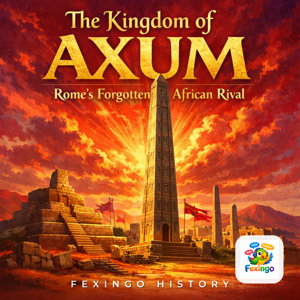


In this episode of Fexingo History, Lucas and Luna explore the remarkable coinage of the Kingdom of Axum, a sophisticated monetary system that made Axum the first African state to mint its own currency on a large scale. Learn how Axumite coins—made of gold, silver, and bronze—became a powerful tool of trade, propaganda, and diplomacy from the 3rd to the 7th century AD. Lucas explains how the coins bear images of kings like Endubis, Wazeba, and Ezana, often with the Ge'ez legend 'basileus' (king), and how they circulated alongside Roman and Sassanid coins in the Red Sea trade. Discover the mystery of the gold 'stater' standard, the rare silver issues, and the enigmatic late coins of King Armah that hint at Axum's decline. Luna asks about the coins' religious symbolism—how Ezana's coins transitioned from the crescent-and-disk of the god Mahrem to the cross of Christianity. The episode also covers the practical side: where coins were minted, how they were used in everyday life, and why Axum abandoned coinage after the 7th century. A fascinating look at how money tells the story of an empire.
#Axum #AxumiteCoinage #Endubis #Wazeba #Ezana #Armah #Ge'ez #basileus #Mahrem #RedSeaTrade #AncientEconomy #Numismatics #EthiopianHistory #AfricanHistory #AncientMoney #History #FexingoHistory #Podcast
Keep every episode free: buymeacoffee.com/fexingo
In this episode, Lucas and Luna explore why Axum's war elephant trade with the Roman Empire collapsed in the 6th century. They examine the ecological impact of centuries of capture, the rise of alternative ivory sources in West Africa, and the changing military needs of both Axum and Rome. The conversation touches on the Monumentum Adulitanum's elephant references, Procopius's observations, the role of the Beja nomads in disrupting trade routes, and the shift from elephant corps to cavalry in Axum's army. A focused look at how resource depletion and shifting geopolitics ended one of antiquity's most remarkable animal trades.
#History #FexingoHistory #Axum #WarElephants #AncientTrade #RomanEmpire #Procopius #MonumentumAdulitanum #Beja #Adulis #ElephantCrisis #IvoryTrade #LoxodontaCyclotis #ElephasMaximus #6thCentury #EastAfrica #AncientEconomy #MilitaryHistory
Keep every episode free: buymeacoffee.com/fexingo
In this episode, Lucas and Luna explore Axum's use of war elephants, focusing on the native African forest elephant and how Axumite kings like Ousanas and Kaleb deployed them in battle. They discuss the Monumentum Adulitanum's mention of elephant hunts, the trade in ivory to Rome, and the tactical advantages of African elephants over Asian ones. The conversation also touches on the decline of the elephant corps as the Sassanids disrupted Red Sea trade and the rise of Islam shifted power dynamics. Listeners will learn about the mahouts of Axum, the logistical challenges of keeping elephants, and how these animals shaped Axum's military reputation from the 3rd to 6th centuries AD.
#Axum #WarElephants #AfricanForestElephant #MonumentumAdulitanum #KingOusanas #KingKaleb #IvoryTrade #RomanEmpire #SassanidPersia #RedSea #HornOfAfrica #Mahouts #Procopius #CosmasIndicopleustes #Adulis #AncientWarfare #History #FexingoHistory
Keep every episode free: buymeacoffee.com/fexingo
Long before Hannibal crossed the Alps, the Kingdom of Axum had its own tradition of war elephants. But unlike the isolated Carthaginian or Seleucid examples, Axum's elephant corps was embedded in a complex web of trade, diplomacy, and military strategy that connected the Red Sea to the Indian Ocean. In this episode, Lucas and Luna explore how Axum's access to African forest elephants shaped its rise as a regional power. They trace the evolution of elephant warfare from the Monumentum Adulitanum, where King Ousanas boasted of taming herds, to the battlefields of Himyar under Kaleb. They discuss the logistical nightmare of keeping elephants fed and watered on campaign, the ivory trade that funded the kingdom's ambitions, and the ultimate decline of the corps as Sassanid and Arab pressures shifted Axum's priorities. Along the way, they unpack the differences between African and Asian elephants, the role of mahouts, and a rare account from the Byzantine historian Procopius describing an elephant charge in Yemen. This is a fresh angle on Axum's military history—one that highlights the kingdom's unique blend of African, Roman, and Indian influences.
#Axum #WarElephants #AfricanHistory #AncientWarfare #HornOfAfrica #ElephantCorps #MonumentumAdulitanum #Kaleb #Ousanas #Procopius #Himyar #IvoryTrade #Mahouts #AncientLogistics #RedSea #Adulis #History #FexingoHistory
Keep every episode free: buymeacoffee.com/fexingo
In this episode of The Kingdom of Axum: Rome's Forgotten African Rival, Lucas and Luna explore the little-known but crucial role of Axum in supplying war elephants to the Roman Empire. They trace how Axumite merchants and kings captured and trained these massive animals, shipping them from the port of Adulis to Roman Red Sea ports, and ultimately to battlefields across the Mediterranean. The discussion covers the capture methods, the specialized ships used for transport, the economics of the ivory and elephant trade, and how this commerce shaped Axum's relationship with Rome. Specific attention is given to the reign of King Zoskales, the Periplus of the Erythraean Sea, and the later decline of the trade due to Roman economic shifts and the rise of Sassanid competition. The episode also touches on the ethical dimensions and the eventual end of Axum's elephant exports as the empire Christianized and turned inward. No prior knowledge required; all context is refreshed naturally.
#Axum #WarElephants #RomanEmpire #Adulis #PeriplusErythraeanSea #Zoskales #IvoryTrade #RedSeaTrade #AfricanHistory #AncientTrade #Ptolemaic #Sassanid #Christianization #AncientWarfare #ElephantHunting #History #FexingoHistory #AncientAfrica
Keep every episode free: buymeacoffee.com/fexingo
In the 6th century, Axum's King Kaleb launched one of the most ambitious engineering projects of the ancient world: rebuilding the great dam of Marib in Yemen. This episode explores how a water management crisis in Himyar drew Axum into a decades-long conflict with local tribes and the Sassanid Empire. We follow the story of the dam's collapse in 542, Axum's attempt to repair it under Abraha, and the diplomatic fallout that led to a Persian invasion. Along the way, we examine the role of the Marib Dam in Sabaean and Himyarite society, Axum's agricultural expertise in irrigation, and how the project's failure may have triggered the 'Year of the Elephant' and the decline of Axumite influence in Arabia. New evidence from satellite imagery and archaeological surveys reveals the scale of Axumite engineering in the highlands of Yemen. This episode draws on inscriptions, Greek histories, and Qur'anic references to piece together one of the great forgotten infrastructural sagas of late antiquity.
#MaribDam #Axum #Himyar #KingKaleb #Abraha #YearOfTheElephant #SassanidEmpire #Yemen #WaterEngineering #Sabaean #ByzantineEmpire #RedSea #AncientInfrastructure #LateAntiquity #EthiopianHistory #Quran #Archaeology #FexingoHistory
Keep every episode free: buymeacoffee.com/fexingo
When the Kingdom of Axum collapsed, its written heritage largely vanished. In this episode, Lucas and Luna explore what little survives of Aksumite literature, from royal inscriptions in Ge'ez and Sabaean to tantalizing fragments of translated Greek works. They discuss the role of the Aksumite church in preserving texts, the fate of the royal library at Aksum, and the legend of the Kebra Nagast — the 14th-century epic that claims Ethiopian origins for the Ark of the Covenant. Along the way, they examine the influence of Syriac monasticism, the translation of the Bible into Ge'ez, and the testimony of Cosmas Indicopleustes, who saw Greek manuscripts in Adulis. The episode also touches on recent archaeological discoveries, including inscribed pottery and the tantalizing possibility of hidden manuscript caches in Ethiopian monasteries. Ultimately, Lucas and Luna reflect on what the loss of Aksumite literature means for our understanding of this once-great empire, and how its legacy endures in oral traditions and later texts.
#AksumiteLiterature #Ge'ez #KebraNagast #CosmasIndicopleustes #Adulis #SyriacMonasticism #EthiopianOrthodox #ArkOfTheCovenant #Manuscripts #OralTradition #Axum #AncientLibrary #EastAfricanHistory #TranslationHistory #Scripture #Archaeology #History #FexingoHistory
Keep every episode free: buymeacoffee.com/fexingo
When the Axumite Empire faced its final decline in the 7th century, a mysterious king named Armah issued one of the most enigmatic gold coins in history. This episode follows the reign of Armah, the last known Axumite ruler to mint coins, during a time of unprecedented crisis: the rise of Islam, the loss of Red Sea trade routes, and the collapse of the kingdom's economy. Lucas and Luna explore what the coinage of Armah reveals about Axum's desperate attempts to maintain diplomatic ties with the Byzantine Empire, the Sassanid Persian occupation of Adulis, and the archaeological debates over whether Armah was the biblical 'Ella Saham' or a different figure. They also discuss the role of the Beja nomads in the kingdom's fragmentation, the mysterious 'Gudit' who may have sacked Aksum, and how the last Axumite coins were found hoarded in Yemen. This is a story of resilience, adaptation, and the end of an era — told through gold, silver, and bronze.
#Axum #Armah #GoldCoin #Numismatics #LateAntiquity #RedSea #Byzantine #Sassanid #Adulis #Beja #Gudit #EllaSaham #7thCentury #AfricanHistory #Coinage #Trade #Archaeology #FexingoHistory
Keep every episode free: buymeacoffee.com/fexingo
When the Adal Sultanate under Ahmad ibn Ibrahim al-Ghazi invaded the Ethiopian highlands in the 1520s, he brought a devastating new weapon: the matchlock musket. This episode explores how the Christian Kingdom of Axum—by then reduced to the highland core of Ethiopia—responded by forging their own firearm corps. We follow the story of the Portuguese military mission that arrived in 1541, bringing 400 matchlockmen under Cristóvão da Gama. Together with Empress Sabla Wengel and the Ethiopian emperor Gelawdewos, they turned the tide at the Battle of Wayna Daga in 1543. We examine the technological adaptation, the role of the Bahr Negash Yeshaq as a firearms-trained governor, and the long-term impact on Ethiopian military culture. This is not a story of simple European superiority, but of African rulers intelligently adopting and integrating gunpowder technology into their ancient military traditions. The episode touches on the broader context of Ottoman-Portuguese rivalry in the Red Sea and how a medieval African kingdom survived the gunpowder revolution through alliance and ingenuity.
#Axum #Ethiopia #Matchlock #AhmadGragn #CristovaoDaGama #BattleOfWaynaDaga #Gelawdewos #SablaWengel #BahrNegashYeshaq #PortugueseEmpire #OttomanEmpire #AdalSultanate #GunpowderRevolution #16thCentury #RedSeaHistory #AfricanMilitaryHistory #FexingoHistory #History
Keep every episode free: buymeacoffee.com/fexingo
In this episode of The Kingdom of Axum: Rome's Forgotten African Rival, Lucas and Luna explore the surprising trade links between the Aksumite Empire and Tang Dynasty China. Through the lens of a single artifact—a Chinese bronze coin found at the ancient port of Adulis—they unravel a web of connections that spanned three continents. Discover how the Periplus of the Erythraean Sea mentioned 'Sêsatai' (China), and how Byzantine gold coins and Chinese silk flowed through Aksumite ports. Learn about the roles of Indian middlemen, the Sassanid control of maritime routes, and the enigmatic Cosmas Indicopleustes, who wrote about silk reaching Ethiopia. This episode also touches on Ge'ez inscriptions that reference 'the land of the Seres' and the political factors that eventually constrained these long-distance exchanges. A fascinating look at how a kingdom in East Africa once sat at the crossroads of the medieval world economy.
#Aksum #Axum #Adulis #TangDynasty #ChinaTrade #Periplus #CosmasIndicopleustes #SilkRoad #IndianOceanTrade #Sassanid #Byzantine #Ge'ez #EastAfrica #RedSea #AncientTrade #History #FexingoHistory #Podcast
Keep every episode free: buymeacoffee.com/fexingo
From the publisher's feed