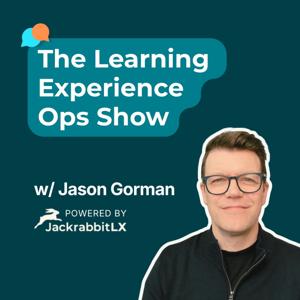
The Learning Experience Ops Show

The Learning Experience Ops Show

By Jackrabbit Learning ExperienceEducation
Download on the App Store

The Learning Experience Ops Show episodes

  • Episode 9: Philosopher in the Loop- Marianna Ganapini on Redesigning AI with Reflection, Not Just Speed
    Summary

    In this conversation, Jason Gorman and Mariana Ganapini delve into the ethical implications of AI, exploring the need for stillness in understanding these issues. They discuss the importance of applied theory in AI governance, the challenges posed by AI in education, and the concept of trust in AI systems. Mariana emphasizes the need for a rights-based approach to responsible AI, highlighting the importance of context in learning and the evolving role of humans in an AI-driven world.

    Takeaways
    • The need for stillness to think through ethical implications of AI.
    • AI's rapid pace makes it difficult to consider ethical issues.
    • Responsible AI aims to create safe and fair machines.
    • Students' reliance on AI tools may hinder their reading skills.
    • Trust in AI involves both reliability and understanding intentions.
    • Evaluation measures for AI outputs are becoming more established.
    • Human roles in learning must be redefined in an AI context.
    • A rights-based approach to AI is essential for ethical governance.
    • The influence of AI on education requires careful consideration.
    • Context is crucial for effective learning experiences.
    • Watch the Full Episode

      Philosopher in the Loop- Marianna Ganapini on Redesigning AI with Reflection, Not Just Speed

      Read the Blog

      Marianna Ganapini on Slowing Down AI to Ask Better Questions

      44 min
    • Episode 8: Governing the AI Shift- Jonathan Thayer on Architecting AI, Agile Governance, and Human-Centered Transformation
      Summary

      In this episode of the Learning Experience Ops show, Jason Gorman interviews Jonathan Thayer, Chief Data and AI Architect at K2 United. They discuss Jonathan's extensive career in e-learning and AI, the challenges and opportunities presented by AI in the workplace, and the importance of agile methodologies in integrating AI into business processes. Jonathan shares insights on the evolving role of AI, the significance of data access, and the need for governance in AI applications. He also emphasizes the importance of hands-on experience with AI and the value of interpersonal communication in navigating the complexities of AI transformation.

      Takeaways
      • AI is rapidly changing the landscape of work, presenting both opportunities and challenges.
      • The creative aspects of work may be significantly impacted by AI.
      • Adopting agile methodologies can enhance project management and adaptability.
      • Citizen developers can leverage AI tools without needing extensive programming knowledge.
      • Monitoring AI performance is essential for ensuring quality and effectiveness.
      • AI can assist in automating both structured and unstructured tasks.
      • Data access is a critical factor in realizing the value of AI.
      • There is no single solution for AI integration; a combination of tools is necessary.
      • Passive observation can provide insights into the effectiveness of AI implementations.
      • Hands-on experience with AI is crucial for understanding its capabilities and limitations.
      • Watch the Full Episode

        Governing the AI Shift- Jonathan Thayer on Architecting AI, Agile Governance, and Human-Centered Transformation

        Read the Blog

        Jon Thayer on Governing AI Without Killing Learning


        45 min
      • Episode 7: Beyond Optimization: Learning in Motion- Jason & James on Adaptive Leadership, AI's Limits & Designing for Human Connection
        Summary

        In this episode of the Learning Experience Operations Show, hosts Jason Gorman and James Altman reflect on their experiences from the previous year and outline their plans for 2026. They discuss the importance of community engagement through events, the challenges of navigating change and overwhelm in the workplace, and the balance between maintaining fundamental practices while embracing experimentation. The conversation also delves into the complexities of business operations, the role of AI, and the necessity of human judgment in decision-making. They emphasize the need for comfort with ambiguity and the creative aspects of entrepreneurship, concluding with a call to action for listeners to engage with their community.


        Takeaways
        • The importance of community engagement through events.
        • Change fatigue is a real challenge for many professionals.
        • Businesses are complex systems, not machines.
        • Innovation and efficiency often conflict with each other.
        • Embracing discomfort is essential in a rapidly changing environment.
        • Comfort with ambiguity can be developed as a skill.
        • Business operations require a creative approach.
        • AI introduces unpredictability that must be managed.
        • No two situations in business are the same.
        • Engaging with the community is vital for growth and learning.
        • Watch the Full Episode

          Beyond Optimization: Learning in Motion- Jason & James on Adaptive Leadership, AI's Limits & Designing for Human Connection


          49 min
        • Episode 6: The Marginally Irresponsible Path- Jen Briselli on Risky Play, Systems Thinking & Redefining What It Means to Learn
          Summary

          In this episode of the Learning Experience Operations Show, host Jason Gorman engages with Jen Briselli, a strategist and educator, to explore the transformative potential of risky play, complexity-informed design, and transdisciplinary collaboration. Jen shares her journey from being a physics teacher to a design strategist, emphasizing the importance of enabling individuals to define their own paths to 'living well.' The conversation delves into the distinctions between teaching and facilitating learning, the role of scaffolding in design, and the challenges organizations face in navigating change. They also discuss the impact of AI on learning and the importance of sensing and responding to the needs of learners in a rapidly evolving landscape.

          Takeaways
          • Jen Briselli emphasizes the importance of enabling individuals to define what 'living well' means for themselves.
          • Facilitation is about creating conditions for learning rather than dictating outcomes.
          • The journey from physics teacher to design strategist highlights the interconnectedness of learning and experience design.
          • Teaching and facilitating learning are distinct but complementary practices.
          • Scaffolding in design should be flexible and adaptable to the needs of the learners.
          • Effective learning experiences require understanding the context and needs of the audience.
          • AI is a tool that can enhance learning but should not replace human interaction and collaboration.
          • Behavior change is a visible metric but should not be the sole focus of learning outcomes.
          • Organizations should prioritize sensing and responding to the needs of their employees.
          • The future of learning will depend on how well we integrate AI into human-centered practices.
          • Watch the Full Episode

            The Marginally Irresponsible Path- Jen Briselli on Risky Play, Systems Thinking & Redefining What It Means to Learn

            Read the Blog

            Jen Briselli on Designing for Learning That Can’t Be Controlled

            1 hr 18 min
          • Episode 5: Bridging Business, Branding, and the Classroom- Ben Zugay on Disney, Startups, and Reinventing Teaching
            Summary

            In this episode, Jason Gorman interviews Dr. Ben Zugay, a business professor and consultant, discussing his journey into education, the importance of an entrepreneurial mindset, and the operational lessons learned from his time at Disney. They explore the challenges faced in modern education, the significance of student engagement, and the impact of AI on teaching and learning. Dr. Zugay emphasizes the need for continuous improvement and relevance in education while maintaining a focus on fundamental principles.

            Takeaways
            • Dr. Zugay started his first business at 14, developing an entrepreneurial mindset early on.
            • His experience at Disney shaped his understanding of presentation and brand in education.
            • Teaching is about continuous assessment and checking for understanding, not just lecturing.
            • Students should leave classes with tangible skills they can apply immediately.
            • The importance of making learning experiences relevant to students' lives.
            • AI presents opportunities for personalized learning but requires an entrepreneurial mindset.
            • Higher education must adapt to teach students how to use AI effectively.
            • Fundamentals of business remain unchanged despite technological advancements.
            • Engagement in learning is crucial; students should not just check boxes.
            • Change in education requires a focus on opportunities rather than challenges.
            • Watch the Full Episode

              Bridging Business, Branding, and the Classroom-  Ben Zugay on Disney, Startups, and Reinventing Teaching

              Read the Blog

              Learning That Respects People: Ben Zugay on Disney, Startups, and Reinventing Teaching

              42 min
            • Episode 4: Data In, Humanity Out- Zach Wagner on Designing AI Tools That Don’t Dehumanize Work
              Summary

              In this episode, Zach Wagner shares his extensive journey in educational technology, discussing his passion for integrating AI into education. He emphasizes the importance of tailoring AI solutions to specific organizational needs and the challenges companies face in implementing AI effectively. Zach outlines the critical steps for integrating AI into workflows, the trade-offs involved, and the tasks that should remain human-driven. He also reflects on the future of education and the skills students will need to thrive in a rapidly changing world.


              Takeaways
              • Zach Wagner has a rich background in educational technology.
              • AI is a transformative force in education.
              • Tailoring AI solutions to specific organizational needs is crucial.
              • Organizations often struggle with effective AI implementation.
              • Involving all stakeholders is key to successful AI integration.
              • Start with simple AI applications and scale from there.
              • The nature of work is changing with AI adoption.
              • Not all tasks should be automated; some require human insight.
              • Organizations need to adapt their workforce for AI.
              • Students must develop resilience and adaptability in their learning.
              • Watch the Full Episode

                Data In, Humanity Out- Zach Wagner on Designing AI Tools That Don’t Dehumanize Work

                Read the Blog

                Building for What Does Not Yet Exist: Zach Wagner on AI, Adaptation, and the Future of Learning Work

                34 min
              • Episode 3: Sycophants & Snipers- Jason & James on AI Flattery, Algorithmic Injustice and The Emotional Pull of Persuasive Tech
                Summary

                In this engaging conversation, Jason Gorman and James Altman discuss various themes surrounding the impact of AI on learning professionals, gender bias in social media algorithms, and the future of the workforce. They share personal experiences, insights from recent forums, and the implications of technology on education and job markets. The discussion highlights the challenges and opportunities presented by AI, emphasizing the need for awareness and adaptation in a rapidly changing landscape.


                Takeaways
                • AI is influencing learning and job markets significantly.
                • Algorithmic bias, particularly against women, is a pressing issue.
                • The future of education will involve more AI integration.
                • Learning professionals need to develop skills to navigate AI's impact.
                • There is a lack of resources for addressing biases in AI.
                • AI can create addiction-like behaviors in users.
                • The workforce is facing a demographic cliff due to retiring baby boomers.
                • Gen Z faces paradoxical job market challenges.
                • Understanding AI's dark patterns is crucial for users.
                • The conversation emphasizes the importance of adapting to technological changes.
                • Watch the Full Episode

                  Sycophants & Snipers- Jason & James on AI Flattery, Algorithmic Injustice and The Emotional Pull of Persuasive Tech

                  40 min
                • Episode 2: Frameworks, Not Toolkits- Brick Maier on Building 350 Courses Without Losing Your Sanity (or Soul)
                  Summary

                  In this conversation, Brick Maier shares his journey from being a classroom teacher to his current role as Director of Enterprise Learning and Development at HeatSpring, an online learning platform focused on renewable energy. He discusses the importance of data-driven approaches in learning design, the integration of various learning modalities, and the impact of AI on assessment and course development. Brick emphasizes the need for a balance between structure and flexibility in learning design and shares insights on the future of learning in an AI-driven world.


                  Takeaways
                  • Brick Maier's journey began as a classroom teacher in Los Angeles.
                  • HeatSpring focuses on renewable energy education and certifications.
                  • Data-driven approaches are essential for measuring learning outcomes.
                  • Quality questions are key to effective learning experiences.
                  • AI has transformed the way assessments are created and utilized.
                  • Balancing structure and flexibility is crucial in course development.
                  • Integrating various learning modalities enhances the learning experience.
                  • The future of learning will be more dynamic and personalized.
                  • Short cycles of iteration are important for testing new concepts.
                  • Curiosity and critical inquiry will be vital for future learners.
                  • Watch the Full Episode

                    Frameworks, Not Toolkits- Brick Maier on Building 350 Courses Without Losing Your Sanity (or Soul)

                    Read the Blog

                    How to create 360 courses without losing your Sanity (or Soul): A Conversation with Brick Maier

                    44 min
                  • Episode 1: The Main Thing- Stephen Hyde on Building Future-Ready Leaders & Keeping Learning Human
                    Summary

                    In this conversation, Stephen Hyde shares his journey into executive education, discussing the importance of leadership, collaborative learning, and the evolving landscape of education. He emphasizes the significance of understanding the needs of learners and organizations, the value of peer learning, and the necessity of adapting to change while preserving core values. Stephen also highlights the importance of variation in learning experiences and the collaborative nature of effective leadership.

                     
                    Takeaways
                    • Stephen's entry into executive education was a happy accident.
                    • Leadership is about listening and understanding the needs of others.
                    • Executive education focuses on lifelong learning and adapting to change.
                    • Peer learning is a crucial component of effective education.
                    • The importance of variation in learning experiences to maintain engagement.
                    • Good ideas can come from anywhere within an organization.
                    • Change is constant, and organizations must adapt to remain relevant.
                    • The how of collaboration is as important as the what of delivery.
                    • Creating a culture of trust and respect enhances teamwork.
                    • Documenting and making explicit what works helps preserve core values.
                    • Watch the Full Episode

                      The Main Thing- Stephen Hyde on Building Future-Ready Leaders & Keeping Learning Human

                      Read the Blog

                      The Main Thing- Stephen Hyde on Building Future-Ready Leaders & Keeping Learning Human

                      36 min
                    • Episode 0: Welcome to The Learning Experience Ops Show by Jason Gorman
                      Summary

                      The LX Ops Show is a platform for discussing the evolving landscape of learning and training, particularly in the context of AI and operational efficiency. Hosts Jason Gorman and James Altman explore the challenges and transformations in the learning experience industry, emphasizing the need for human-centered approaches and the integration of diverse perspectives. The show aims to foster a community around these discussions, providing insights and strategies for professionals in the field.

                      Takeaways
                      • The podcast focuses on conversations with industry professionals.
                      • There is a significant transformation happening in learning and training due to AI.
                      • Organizations face common pain points in learning operations.
                      • AI can accelerate both positive and negative outcomes in learning.
                      • Roles in learning design are evolving to include more operational responsibilities.
                      • The show will feature interviews and discussions on various learning topics.
                      • Diverse perspectives are crucial for innovation in learning design.
                      • The hosts aim to stay current and evolve their expertise.
                      • Understanding the learner is a fundamental goal of the show.
                      • The first subscriber will receive a special acknowledgment.
                      • Watch the Full Episode

                        Welcome to The Learning Ops Show by Jason Gorman

                        18 min

                      About The Learning Experience Ops Show

                      From the publisher's feed

                      The Learning Experience Ops Show is a series of real conversations with the people building and running the systems that make learning work—across higher education, K–12, healthcare, clean energy,…