
Sign up to save your podcasts
Or

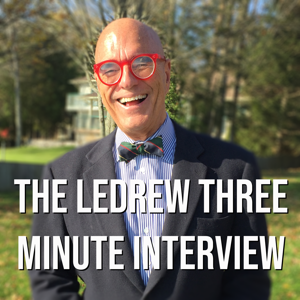


In this episode of The LeDrew Three Minute Interview, Stephen LeDrew speaks with author Jerry Amernic about his book Sleepwoking.
Amernic examines the recent wave of historical re-interpretations in Canada, including controversies surrounding figures like Sir John A. Macdonald, Egerton Ryerson, and Henry Dundas. Across the country, statues have been vandalized, institutions renamed, and historical figures slandered.
Amernic argues that the claims used to justify these changes are based on misinformation or incomplete history.
Why do these narratives spread so easily? And why are governments, universities, and media institutions so quick to accept them?
LeDrew and Amernic discuss the role of social media, activism, and modern political culture in shaping how Canadians understand their past — and why it’s more important than ever to separate fact from fiction.
Three minutes. Direct. Unfiltered.
You can purchase Sleepwoking here - https://www.amazon.ca/dp/1775239942
Hosted on Acast. See acast.com/privacy for more information.
Is Canada honestly doing as well as the Prime Minister says?
In this Friday Rant, Stephen LeDrew takes a hard look at the growing gap between political messaging and everyday reality. While Ottawa insists the country is on the right track, many Canadians are feeling the opposite — especially at the grocery store, at the gas pump, and in their monthly bills.
Canada has the resources, talent, and energy to be thriving. So why does it feel like people are falling behind?
LeDrew argues that the problem isn’t just global pressures — its domestic policy, burgeoning bureaucracy, and a failure to fully develop Canada’s economic potential. At the same time, he raises serious questions about political credibility, including MPs crossing the floor and what that means for public trust.The people of Petrolia are not stupid, like Gladu states.
The conversation then shifts globally — to Iran, U.S. foreign policy, and the role Canada plays in reacting to both. Are Canadians too quick to dismiss uncomfortable realities simply because of who is involved?
This is a blunt, unfiltered take on:
- Rising costs of living in Canada
- Government growth vs economic growth
- Energy, resources, and missed opportunity
- Political trust and shifting loyalties
- Iran, global conflict, and Canada’s response
Whether you agree or not — this is a conversation worth having.
Hosted on Acast. See acast.com/privacy for more information.
Why are politicians saying one thing — and doing the exact opposite?
In this episode of The LeDrew Three Minute Interview, Stephen LeDrew is joined by Dan McTeague, former Liberal MP and one of Canada’s most trusted voices on energy and affordability, for a blunt discussion about political integrity, rising costs, and a growing disconnect between Parliament and the public.
The conversation begins with a controversial floor crossing — a long-time Conservative suddenly aligning with the Liberals, despite previously opposing them. McTeague doesn’t hold back, questioning not just the decision, but what it says about the culture inside Canadian politics.
But this goes deeper than one politician.
As grocery prices climb, gas costs remain high, and the Canadian dollar weakens, many Canadians are asking why a resource-rich country can’t control its own economic destiny. McTeague argues the answer lies in failed policy choices, missed opportunities in energy, and a government increasingly out of touch with reality.
In this interview:
This is a wake-up call — not just about politics, but about where Canada is heading.
Hosted on Acast. See acast.com/privacy for more information.
This is a preview of a 10-minute conversation with former Toronto mayor John Tory.
In this discussion, Stephen LeDrew challenges John Tory on the biggest questions facing Canada’s economy.
Why haven’t we started new pipelines?
Why do projects take years — even decades — to build?
And why does Canada struggle to remove interprovincial trade barriers that hold back economic growth?
Tory argues that one year in government is not enough to judge Prime Minister Mark Carney, while LeDrew pushes back, saying Canada has become a country that studies problems instead of solving them.
This clip is just the first few minutes of a much longer conversation.
👉 Members get the full 10-minute interview, including the debate on:
• Pipelines and national energy policy
• Canada’s regulatory system
• School boards and failing education governance
• Whether Canada’s bureaucracy is blocking economic growth
Hosted on Acast. See acast.com/privacy for more information.
Stephen LeDrew speaks with Catherine Swift, President of the Coalition of Concerned Manufacturers and Businesses of Canada, about whether Canada’s government bureaucracy has grown beyond control.
Swift argues that overregulation, public sector union power, and the steady expansion of government agencies and third-party activist funding are choking economic growth. She explains how past governments reduced the size of the public service, why political will is often lacking, and what it would take to shrink bureaucracy without crippling essential services.
The discussion explores federal and provincial spending, public sector incentives, economic decline relative to other jurisdictions, and the looming risk of fiscal correction if reforms are delayed.
A direct conversation about big government, public sector unions, economic competitiveness, and whether Canada can restore efficiency before external pressures force change.
Hosted on Acast. See acast.com/privacy for more information.
In this episode, Stephen LeDrew speaks with Dr. Michael Bonner about the growing size of government in Canada — and why public trust in institutions appears to be declining.
As federal and provincial bureaucracies expand, Canadians are seeing rising concerns around crime, drug policy, judicial rulings, deportation stays, and the limits of the Charter. Bonner argues that a philosophical shift has taken place in Canada, one that prioritizes individual autonomy without emphasizing civic obligation.
The discussion explores the role of the judiciary, parliamentary supremacy, the use of the notwithstanding clause, and whether courts have expanded their authority beyond interpretation into policymaking.
Are Canadians losing confidence in their institutions? And if so, how does a democracy restore accountability?
A direct conversation about big government, judicial power, public trust, and the future of Canadian democracy.
Hosted on Acast. See acast.com/privacy for more information.
Is Canada finally turning the page on the Disastrous Trudeau Decade?
As spring signals renewal, there are growing signs that the country itself may be entering a new phase — politically, culturally, and economically. From shifting energy policy (including renewed conversations around LNG) to changing public attitudes and visible cracks within the NDP, something is clearly moving beneath the surface.
But is this a true reset… or just a rebrand?
Despite the rhetoric of change, many of the same Trudeau-era cabinet ministers remain in power under Mark Carney. That raises a critical question: can Canada genuinely move forward while keeping the same architects of the decade of disaster in place?
In this episode, Stephen LeDrew breaks down:
There’s also a broader conversation here about national identity, economic priorities, and whether Canadians are ready to reject the politics of the last decade in favour of something more grounded and pragmatic.
Hope may be in the air — but is it lasting?
Hosted on Acast. See acast.com/privacy for more information.
In this episode of The LeDrew Three Minute Interview, Michael Diamond of Upstream Strategy debunks lefty politicians in the growing debate over Doug Ford’s proposal to expand Toronto’s Billy Bishop Airport.
The Ontario Premier has championed the idea of allowing jet aircraft at Toronto’s downtown island airport, a move that could dramatically change how Canadians travel into the country’s financial capital.
Supporters argue the expansion would relieve pressure on Toronto Pearson Airport, which is approaching capacity, while making travel to downtown Toronto faster and more convenient for Canadians flying from cities like Calgary, Vancouver, Edmonton, Winnipeg, Ottawa, Halifax, and Montreal.
Critics worry about noise, urban planning, and provincial intervention in municipal decision-making.
Diamond explains why many global cities operate multiple airports, why Toronto’s infrastructure challenges are growing, and why the province may be willing to step in if city councils can’t get major projects done.
Hosted on Acast. See acast.com/privacy for more information.
In this episode, Stephen LeDrew speaks with Iranian-Canadian activist Mahta Gharaei about the growing unrest inside Iran and the human rights abuses most citizens say are being ignored internationally.
Gharaei discusses how the Iranian regime uses propaganda, internet blackouts, and information control to hide violent crackdowns on protesters. She argues that millions of Iranians want political change and freedom after decades of oppressive dictatorial rule since the Iranian Revolution.
The conversation also examines the role of global media narratives, international institutions, and how Iranian diaspora voices are trying to raise awareness about what is happening on the ground.
A discussion about censorship, protest movements, and whether Iran is approaching a turning point.
Hosted on Acast. See acast.com/privacy for more information.
Stephen LeDrew sits down with Public Provocateur Robin Bredin for a candid discussion about political correctness, “woke” culture, and whether Canada has drifted too far from its traditional values.
Bredin argues that political correctness has evolved into something far more aggressive, reshaping public discourse, media narratives, and national identity. The conversation explores media funding, government influence, cultural guilt, residential school debates, and the broader question of whether Canadians are being pressured into silence.
From Alberta separation to economic strain and social division, this episode challenges viewers to think critically about free speech, historical interpretation, and the direction of the country.
Agree or disagree, this is a conversation the mainstream media often avoids.
Hosted on Acast. See acast.com/privacy for more information.
From the publisher's feed
Hosted on Acast. See acast.com/privacy for more information.
Ranked by our users in the last 21 days

15 Listeners
1 Listeners
124 Listeners
5 Listeners
4 Listeners
7 Listeners

2 Listeners

6 Listeners

15 Listeners
5 Listeners
14 Listeners
33 Listeners

0 Listeners
48 Listeners

7 Listeners