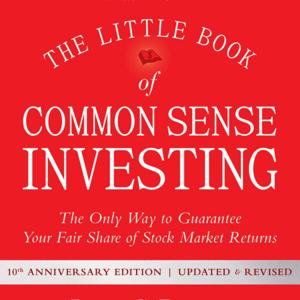
The Little Book of Common Sense Investing in English

The Little Book of Common Sense Investing in English

By Raja BabuArtsBooks
Download on the App Store

The Little Book of Common Sense Investing in English episodes

  • Acknowledgments
    Acknowledgments
    IN WRITING THIS BOOK, I have received incredibly
    wonderful support from the entire (three-person) staff of
    Bogle Financial Markets Research Center, the Vanguard-
    supported unit that began its formal activities at the
    beginning of 2000.
    5 min
  • What Should I Do Now?
    Chapter Eighteen
    What Should I Do Now?
    -
    Funny Money, Serious Money,
    and Investment Strategy
    DEEP DOWN, I REMAIN absolutely confident that the
    vast majority of American families will be well served by
    owning their equity holdings in an all-U.S.
    14 min
  • The Relentless Rules of Humble Arithmetic
    Chapter Seventeen
    “The Relentless Rules
    of Humble Arithmetic”
    -
    Reprise
    IF THE MESSAGE IN this book comes across as confident,
    please understand that it is little more than common
    sense. Even more, please understand that my confidence
    in the index fund is buttressed by the conclusions of many
    of the smartest, most experienced, most successful in-
    vestors in the United States including Warren Buffett,
    Charlie Munger, and Benjamin Graham, along with top
    academics and endowment managers—Nobel Laureates
    Paul Samuelson, William Sharpe, and Daniel Kahneman
    and Princeton’s Burton Malkiel, Yale’s David Swensen,
    Harvard’s Jack Meyer, and MIT’s Andrew Lo.

    20 min
  • What Would Benjamin Graham Have Thought about Indexing?
    Chapter Sixteen
    What Would Benjamin
    Graham Have Thought
    about Indexing?
    -
    A Confirmation from Mr. Buffett
    THE FIRST EDITION OF The Intelligent Investor was pub-
    lished in 1949. It was written by Benjamin Graham, the
    most respected money manager of the era, and coauthor
    (with David Dodd) of Security Analysis, a scholarly tome
    originally published in 1934.
    14 min
  • The Exchange Traded Fund
    Chapter Fifteen
    The Exchange
    Traded Fund
    -
    A Trader to the Cause
    EVEN BEFORE THE RISE of the so-called new paradigm of
    fundamental indexing described in Chapter 14, traditional
    indexing was being challenged by a sort of wolf-in-sheep’s
    clothing, the exchange traded fund (ETF).
    16 min
  • Index Funds That Promise to Beat the Market
    Chapter Fourteen
    Index Funds
    That Promise to Beat
    the Market
    -
    The New Paradigm?
    SINCE THE INCEPTION OF the first index mutual fund in
    1975, indexing—investing in passively managed, broadly
    diversified, low-cost, stock and bond index funds—has
    proved to be both a remarkable artistic success and a re-
    markable commercial success.
    12 min
  • Bond Funds and Money Market Funds
    Chapter Thirteen
    Bond Funds and
    Money Market Funds
    -
    Where Those Relentless Rules
    Are Even More Powerful
    SO FAR, MY DISCUSSION of the index fund (and its hand-
    maiden, low investment costs) has related to the stock
    market and to equity mutual funds.
    13 min
  • Profit from the Majesty of Simplicity
    Chapter Twelve
    Profit from the Majesty
    of Simplicity
    -
    Hold Index Funds That Own
    the Entire Stock Market.
    IF LOW COSTS ARE GOOD (and I don’t think a single an-
    alyst, academic, or industry expert would disagree that
    low costs are good), why wouldn’t it be logical to focus on
    the lowest-cost funds of all—index funds that own the en-
    tire stock market?
    15 min
  • Focus on the Lowest-Cost Funds
    Chapter Eleven ¸
    Focus on the Lowest-
    Cost Funds
    -
    The More the Managers Take,
    the Less the Investors Make.
    WHAT LESSONS HAVE YOU learned in Chapters 8
    through 10? Selecting equity funds based on long-term
    past performance hasn’t been the answer.
    18 min
  • Seeking Advice to Select Funds?
    Chapter Ten
    Seeking Advice to
    Select Funds?
    -
    Look beforeYou Leap.
    THE EVIDENCE PRESENTED in Chapters 8 and 9 teaches
    two lessons: (1) Selecting winning equity funds over the
    long term bears all the potential success of looking for
    the needle in the haystack; and (2) Selecting winning
    funds based on their performance over relatively short-
    term periods in the past is all too likely to lead, if not to
    disaster, at least to disappointment.
    14 min

About The Little Book of Common Sense Investing in English

From the publisher's feed

To Paul A. Samuelson, professor of economics