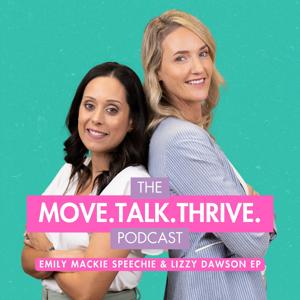
The Move. Talk. Thrive. Podcast

The Move. Talk. Thrive. Podcast

By Emily Mackie Speechie and Lizzy Dawson EPKids & FamilyEducation for Kids
Download on the App Store

The Move. Talk. Thrive. Podcast episodes

  • #22 From Peer to Leader: Navigating the Path to Effective Leadership
    In this episode of the Move Talk Thrive podcast, hosts Emily and Lizzy delve into the journey of leadership. They share their experiences transitioning from new grads to leadership roles and owning their own businesses. They discuss the true essence of leadership, the importance of self-leadership, and practical steps for aspiring leaders.
    Key Topics:
    Defining Leadership: Understanding leadership beyond titles and status.
    Self-Leadership: The importance of leading oneself before leading others.
    Leadership Realities: The sacrifices and rewards of leadership.
    Practical Advice for Aspiring Leaders: Steps to prepare for leadership roles.
    Self-Awareness and Continuous Improvement: The role of self-awareness and ongoing personal development.
    Navigating the Transition: Managing the shift from peer to leader and maintaining professional relationships.
    Resources Mentioned:
    Books:
    Leaders Eat Last by Simon Sinek
    Start With Why by Simon Sinek
    Genius Zones by Lizzy & Emily
    Podcast Episodes:Lorraine Murphy on Image Management (Move Talk Thrive Podcast)
    Webinars & Courses:Lizzy’s Leadership Webinars (check Lizzy's social media for updates)
    Connect With Us:
    Follow Emily on Instagram (emilymackie.speechie) 
    LinkedIn - https://www.linkedin.com/in/emily-mackie-speechie/
    Follow Lizzy on Instagram (lizzydawson_)
    LinkedIn - https://www.linkedin.com/in/lizzy-dawson-13610133/
    Subscribe & Review: If you enjoyed this episode, please subscribe to our podcast and leave us a review on Apple Podcasts or Spotify.
    Thank you for tuning in to Move Talk Thrive! We hope you find these insights valuable as you embark on or continue your leadership journey.
    30 min
  • #21 Mastering Energy Management with Lorraine Murphy
    In this episode, we’re joined by Lorraine Murphy, a mentor, speaker, and author who specialises in energy management, business strategy, and life balance. Lorraine shares her insights on why energy management is crucial, particularly for women, and provides actionable steps to balance masculine and feminine energy, avoid burnout, and maintain strong personal and professional boundaries. Whether you’re an entrepreneur, a health professional, or someone striving for a better work-life balance, Lorraine’s wisdom is invaluable.
     
    Key Points:
     
    The difference between masculine and feminine energy, and how to balance them.
    The importance of creating both intrinsic and extrinsic boundaries.
    Practical steps to manage energy and avoid burnout.
    How to set and maintain boundaries with clients, peers, and family.
    The significance of transitions between work and personal life for energy management.
    Lorraine's energy management pyramid and toolkit for sustainable success
    Practical Energy Tips: Lorraine offers practical tips for managing energy
     
    Resources Mentioned:
    Lorraine Murphy’s Energy Management Toolkit: https://www.lorrainemurphy.com.au/toolkit
    Books by Lorraine Murphy:
    Get Remarkably Organised – Lorraine's most popular book for mastering organisation and productivity. 
    Step Into You – Focuses on personal growth and energy management.
    Available in bookstores, online, and on Spotify as audiobooks.
    The Lorraine Murphy Show Podcast: Available on all major platforms.
    Connect With Us:
    Visit Lorraine’s Website: www.lorrainemurphy.com.au 
    Follow Lorraine on Instagram: @lorrainemurphymentor
    Follow Lizzy on Instagram: @lizzydawson_Visit Lizzy’s Website: www.lizzydawson.com.au
     
    Stay tuned for our next episode as we talk about leadership.
    47 min
  • #20 Unpacking Assessments: A Deep Dive into Allied Health
    In this episode, Lizzy and Em explore the intricacies of assessments within the allied health sector, highlighting the diversity in approaches across disciplines. Lizzy discusses her work in creating a protocol tailored for exercise physiologists, while Em shares her journey in examining various assessment methodologies. They delve into the tension between standardised assessments and more practical, dynamic approaches, emphasising the need for a balanced use of both. The conversation also touches on the impact of cultural backgrounds on assessment accuracy and the value of interdisciplinary learning.
    Key Points:
    Balanced approach: Combining standardised and observational assessments.
    Challenges with standardised tools: Addressing cultural limitations.
    Learning from other industries: Adopting diverse assessment practices.
    Conducting assessments: Tips for working in culturally diverse settings.
    Adult vs. pediatric assessments: Differences in approach and practice.
    Resources Mentioned:
    University of Queensland Research on independent assessments.
    Insights on dynamic vs. standardised assessments.
    Professional resources for allied health practitioners.
    Connect With Us:
    Follow Emily on Instagram (emilymackie.speechie) LinkedIn - https://www.linkedin.com/in/emily-mackie-speechie/Follow Lizzy on Instagram (lizzydawson_)LinkedIn - https://www.linkedin.com/in/lizzy-dawson-13610133/
     
    Stay tuned for our next episode. A special guest from a different industry will discuss their unique assessment strategies.
    46 min
  • #19 Giving Power to our Parents
    In this episode, we focus on how we can empower parents and enhance collaboration to achieve a better therapeutic approach. Drawing from our experiences as two mums who have taken our kids to specialists and therapy, we discuss the differences between medical and therapeutic treatments, highlighting that speech and exercise physiology journeys are often long and require ongoing engagement.
    To alleviate parents' anxiety, education and open communication are crucial. Aligning education with the value of therapy helps parents understand and engage more positively, which in turn helps them talk more positively to their children about therapy.
    For parents whose children are in school and not always present, maintaining engagement can be challenging. Effective strategies include follow-up phone calls, providing fact sheets, using communication books, and sending emails. Being an informed SLP (Speech-Language Pathologist) is key.
    Creating supportive partnerships with parents involves:
    Actively listening
    Working together
    Including parents in decision-making
    Being positive
    Demonstrating empathy
    Conversely, we undermine these partnerships when we:
    Listen as lip service
    Have a preconceived agenda
    Focus on measurement or standardisation
    Focus solely on the diagnosis
    For business owners, marketing can be reframed as education, helping parents understand the value and process of therapy.
    Identifying and effectively engaging with parents involves:
    Listening to understand their concerns and needs
    Implementing practical strategies
    Providing education and ensuring comprehension through asking questions
    Maintaining open and honest conversations
    Lizzy emphasises the importance of these practices in building strong, collaborative relationships with parents.
    For more insights and support, we recommend joining PLA in Emily’s courses or Knowledge Corner or Child Development and Paediatric Programming from Lizzy’s courses. For personalised advice, DM us on Instagram for a 1:1 chat.
     
    Reeder, J., & Morris, J. (2020). Becoming an empowered parent. How do parents successfully take up their role as a collaborative partner in their child’s specialist care? Journal of Child Health Care https://doi.org/10.1177/1367493520910832 [open access]
    Join Emily’s PLA Library for parent explanations for language goals
    https://www.emilymackie.com.au/pla-library
    Join Lizzy’s Course
    https://www.lizzydawson.com.au/knowledgecorner

    33 min
  • #18 Are you an entrepreneur or an intrapreneur? 7 ways you can know.
    In this episode, we explore the concepts of entrepreneurship and intrapreneurship, sharing personal insights and experiences from both of our past experiences. We begin by defining an entrepreneur as someone who sets up businesses, taking on financial risks. In contrast, an intrapreneur is an individual who creates new and innovative products within an established business, utilising the company's resources to bring ideas to life.
    We discuss the importance of both roles in the workplace, highlighting how different personalities and risk profiles complement each other in a team. After completing your new grad years, you might wonder what's next—perhaps opening a business? We encourage removing the curtain and talking frankly about your motivations and goals. Understanding your "why" is crucial.
    For those leaning towards intrapreneurship, we emphasise the benefits of working within a team and using available resources to achieve goals without the heavy struggle entrepreneurs often face. The business carries the risk, so it's essential to prove your innovation is worthy while being mindful of resource management. Focus on making things better, serving others, and setting your team up for success.
    Entrepreneurship can be lonely and burdensome, involving significant risks, the pressure of generating income, and the responsibility of paying others. While the adventure and thrill can be exhilarating, it comes with negative thoughts and challenges. Despite the glamorous social media portrayal of overseas holidays and champagne, entrepreneurs often find themselves answering emails and managing the business.
    We discuss the judgments and questions potential entrepreneurs face: Are you prepared to go all in, back yourself, work hard for minimal pay, take huge risks, learn new skills, and potentially fail? Leadership involves significant sacrifices in time and emotions, so it's crucial to think wisely before deciding. Entrepreneurship offers flexibility but not necessarily freedom, as it requires continuous thinking, creating, and analysing.
    To help you determine whether you are more suited to being an entrepreneur or an intrapreneur, we provide seven key questions to ask yourself:
    Why do you want to start a business? If it's for recognition, reconsider.
    Are you comfortable with enormous risks?
    Are you passionate and a problem solver?
    Do you embrace failure?
    Are you quick to make decisions and confident, even if you fail?
    Can you manage yourself and be accountable without needing feedback?
    Are these traits learned over time, or are they innate for you?
    We'd love to hear your thoughts and experiences on this topic.
     
    Lizzy dawson courses: 
    www.lizzydawson.com.au
     
    Emily’s courses: 
    www.emilymackie.com.au
    29 min
  • #17 Do you squirm in confrontation and conflict? Let’s make it constructive
    In this episode, we dive into the topic of constructive conflict and crucial conversations, exploring how to handle confrontation effectively. Liz shares her insights after reading "The Advantage" by Patrick Lencioni, which reshaped her understanding of conflict.
    First, we define conflict and dispel the myth that conflict is inherently bad. Conflict is essential in the workplace, fostering growth and improvement. We discuss the spectrum of conflict, from artificial harmony to destructive conflict, highlighting the goal of achieving constructive conflict.
    Key elements in handling conflict include character, self-confidence, and trust in those around you. Vulnerability plays a significant role, as does having the right motives—aiming for the best solution for the team and the overarching purpose. It's crucial to receive information from others without fear, avoiding destructive behaviours and not taking offence easily. Remember, nothing is personal, and behaviour often hints at internal struggles both for you and the other person.
    In team settings, giving the benefit of the doubt and thinking the best of your colleagues is vital. Conflict requires practice, and mistakes are part of the learning process. Initially, it may look messy, but real-time conflict practice is essential for improvement. Changing your perspective on conversations and removing personal biases can lead to more effective conflict resolution.
    Emily shares how her workplace handles conflict, emphasising the importance of synergy, as described in Habit 6 of "The 7 Habits of Highly Effective People." This approach goes beyond respectful communication, aiming for win-win outcomes rather than win-lose or lose-win scenarios.
    To learn more about conflict, we recommend listening to Patrick Lencioni's podcasts (Em made a whoopsie on the name in the poddy - sorry Pat), which offer valuable insights. Self-discovery is crucial; examine your reactions in conflict situations and maintain a growth mindset. Journaling about your responses and seeking accountability can help you understand and process your reactions.
    Liz references her learnings from Chet Holmes book ‘The Ultimate Sales Machine’. Liz references Rockafella Habits accidentally so when she is referring to that she is meaning the principles from Chet’s book linked below. She talks about how discussing pain points in meetings is crucial for all parties in a team. 
    Action is necessary—engage in conflict, practice, and repeat. Building new neural pathways and developing a new skill set requires numerous repetitions, but the result is well worth the effort.
     
     
    BOOK: 7 habits of highly effective people by Stephen Covey
    https://rb.gy/sspy9h
     
    BOOK : The Advantage by Patrick Lencioni
    https://rb.gy/fushl5
     
    PODCAST : https://www.tablegroup.com/product/the-advantage/
     
    BOOK: The Ultimate Sales machine (Not rockefeller habits) By Chet Holmes 
    https://rb.gy/rigjo9
     
    Lizzy’s courses
    www.lizzydawson.com.au
     
    Emily’s courses
    www.emilymackie.com.au
    37 min
  • #16 Feeling time poor? Take control of your time
    In this episode, we delve into the importance of effective planning and time management, featuring insights from Liz on quarterly planning. Liz emphasises the need for clear long-term goals, asking yourself where you want to be in five years, one year, and 3 months, and listing the tasks necessary to achieve those goals. We call on exercise goals as an example of commitment to goals, breaking big goals down and creating healthy habits. One common pitfall is the perception of either having too much time or not enough time, which is unproductive. Instead, we should adopt the mindset that we choose how to spend our time: "Time is not my master, I am a master of my time." This approach encourages intentional use of time.
    The glorification of being busy often leads to unproductive behaviour, where we end up running around like headless chickens and abdicating responsibility. Liz advocates for a shift in perspective: viewing your schedule as full rather than busy. Effective planning and goal setting are essential at all levels, especially for management and professional advancement.
    We discuss practical strategies for planning on a weekly, monthly, and quarterly basis. This forward-thinking approach helps reduce the mental load and prevents the chaos of last-minute decisions. Liz suggests outlining the three most important tasks and tackling the one you least want to do first, as this often has the most significant impact and moves the needle forward. This concept, derived from key performance indicators (KPIs) from the 1980s, implies making a substantial, positive change.
    Time blocking is another effective technique, where you allocate specific time slots for different tasks and set deadlines. This helps maintain focus and ensures tasks are completed within a set timeframe. Accountability and self-discipline are crucial for successful time management. Using the carrot-and-stick approach, you can motivate yourself by rewarding accomplishments.
    When feeling overwhelmed, writing everything down can help organize your thoughts and priorities. We also discuss the importance of working in a supportive workplace that encourages healthy planning and goal-setting practices, such as 90-day plans and specific projects for speech therapists. Tools like Clockify can assist in tracking time and improving productivity.
    We recommend several resources for further learning, including "The One Thing" book, Lorraine Murphy's "Get Remarkably Organised," and "Eat That Frog," which offer valuable tips on prioritisation and productivity.
     
     
    Clockify App- Time tracking app
    https://clockify.me/apps
     
    Clockwork Book 
    https://mikemichalowicz.com/clockwork/
     
    The One Thing Book
    https://www.amazon.com.au/ONE-Thing-Surprisingly-Extraordinary-Results/dp/1885167776
     
    Get remarkable organised 
    https://www.lorrainemurphy.com.au/get-remarkably-organised
     
    Eat That Frog
    https://www.amazon.com.au/Eat-That-Frog-Great-Procrastinating/dp/162656941X
     
    Lizzy Dawson courses 
    www.lizzydawson.com.au
     
    Emily Mackie courses 
    www.emiymackie.com.au
    50 min
  • #15 Feeling Stuck in Perfectionism?
    In this episode, we explore the intricate relationship between perfectionism and anxiety, particularly how perfectionism can hold you back, often paralleling imposter syndrome. Liz shares her personal journey through her current stage of growth and the discomfort it brings, including panic attacks following her stroke in 2015. She emphasises the importance of naming and bringing these feelings to light, recognizing that they are not reality but mental health triggers. By separating these thoughts from your identity, you gain power over them.
    We discuss the critical question: "What story are you telling yourself?" In a high-achieving team, it's essential to be aware of who surrounds you and to run your own race. Gifted children often exhibit higher levels of anxiety and perfectionism, which is part of the process of self-understanding. Fear of making mistakes can lead to overly complicated tasks and halted progress, often manifesting as procrastination and spending excessive time on tasks.
    Perfectionism and imposter syndrome are interconnected. Imposter syndrome can lead to perfectionism-driven tendencies, where individuals feel fraudulent and overthink tasks to the point of paralysis. It's crucial to manage these tendencies by being okay with imperfection and understanding that mastery is messy.
    We highlight the impact of perfectionism on parenting, where perfectionist parents may project their anxiety onto their children, blocking their ability to learn. Breaking these generational cycles requires healing and mindful communication. The language we use with children, such as saying "that's perfect" or "great job," can significantly impact their self-perception.
    Solutions and Strategies:
    Trust yourself and recall past achievements.
    Balance evidence-based practices with practical execution.
    Be aware of your thoughts and do not let negative thoughts dictate your behavior.
    In moments of doubt, remind yourself of your goals and the impact you wish to achieve.
    Accept that growth challenges may cause you to shrink back, but perseverance is key.
    Keep things simple and avoid overthinking.
    Surround yourself with positive energy and consider an accountability partner.
    Use templates and systems to keep you on track.
    Seek professional help from a counselor or psychologist if needed.
    Implement and execute your plans, even if it means throwing yourself in the deep end to learn and trust yourself.
    Understand that failure is part of learning and development.
    Be mindful of the language you use to praise yourself and others.
     
    To view Lizzy’s courses 
    www.lizzydawson.com.au
     
    To view Emily’s resources and courses: 
    www.emilymackie.com.au
    39 min
  • #14 How to ask for a payrise? Let’s talk contracts and cash!
    In this episode, we discuss the importance of understanding the unique dynamics of different businesses and industries when considering career progression and salary negotiations. The first step is to have a conversation with your employer about your career goals and workplace expectations. Reflecting on what you want from your workplace and career progression is crucial. 
    Workplace expectations and opportunities can vary significantly. It's essential to identify the expectations, benchmarks, and opportunities within your specific workplace. This includes understanding the difference between billable hours and hours per week, and how many clients you are expected to manage in a typical 38-hour workweek. Additionally, knowing the expectations tied to your wage is vital.
    Many people turn to job search engines like Seek or Indeed to compare salaries. However, it's important to remember that these platforms may not align with industry awards and are not policed for accuracy. It's also crucial to understand whether the listed salaries include superannuation or not. High salaries often come with high expectations, as you need to generate sufficient income for the company. It is crucial to assess the value of all components of positions to make an informed decision.
    From a financial perspective, companies divide money in specific ways, often using a 3-4 ratio. We encourage you to do your research, including looking at company websites, to understand how responsibilities align with pay packets. Salaries are not independent of job responsibilities, and it’s important to recognize this when evaluating your own compensation.
    When asking for a pay rise, resources and PD, consider key factors and common questions. If your job involves driving, for example, that should be factored into your request. Demonstrating your value before asking for a raise is crucial. Business owners are more likely to agree to a pay rise if they can see tangible outcomes from your work. Think about how you can invest in the business and bring more value.
    Adopting a mindset where service comes before money can be beneficial. Ensure that your job description and salary are aligned. If you want a pay rise, you need to go above and beyond your current job description. Be proactive and don't wait until the last minute, as businesses operate on budgets. Having a clear goal in mind and being open to negotiation can help you achieve the salary you desire while maintaining a good relationship with your employer.
    Don't be afraid to talk about money. Developing a healthy money mindset is essential, and we reference Lorraine Murphy's, Mike Michalowicz Denise Duffield Thomas, Bent not Broke and Mel browne work on this topic. Budgeting resources like those from Mel Browne, the Barefoot Investor, and books like "Crucial Conversations" can be very helpful. If you want to earn more money, educate yourself and evaluate your current money habits. Often, spending habits remain the same regardless of income level.
     
    Profit First and Clockwork
    https://mikemichalowicz.com/clockwork/
     
    Melissa Browne
    https://www.melissabrowne.com.au/
     
     
    Bent Not Broke and Gemma Mitchell Finance
    www.bentnotbroke.com.au
     
    The Barefoot Investor
    https://www.barefootinvestor.com/
     
    Lorraine Murphy 
    https://www.lorrainemurphy.com.au/
     
    For Lizzy’s courses
    www.lizzydawson.com.au
     
    For Emily’s courses 
    www.emilymackie.com.au
    53 min
  • #13 Getting sick all the time? Let’s supercharge your immunity!
    Disclaimer: This episode is not medical advice. We are not GPs or doctors; we are sharing our personal experiences and insights.
    In this episode, we delve into the importance of boosting the immune system, drawing on personal stories and experiences. Emily shares insights from her journey raising kids and managing their health, while Liz discusses her experiences with burnout and illness recovery while training for an ironman, running business and working with kids as a paediatric exercise physiologist. We emphasise that immune support is crucial not just in winter but throughout the entire year.
    We discuss the role of exercise in maintaining health, stressing the need for balance. While exercise is beneficial, high-intensity workouts can stress the body. We explore the differences between aerobic and anaerobic exercises, comparing cardio and weight training, and discuss the importance of knowing when to pause exercising if you're feeling unwell. We also highlight smart exercise choices like pilates or stretching.
    Proactive health measures are essential. We underscore the importance of rest and sleep, and discuss dietary tips such as reducing sugar intake and increasing protein to support the immune system. Scheduling "white space" on weekends for relaxation and incorporating monthly remedial massages to counteract long hours at little tables and chairs are also recommended.
    Collaborating with your GP for a comprehensive health plan is crucial, especially for managing recurrent infections. We discuss the use of various health interventions, preventions and teams. 
    We go into our personal preference in natural remedies and supplements. Liz shares her preventative and illness plan from naturopathy to medical plans, while Emily discusses natural immunity-boosting tablets and probiotics for her family. We highlight the significance of gut health, with Liz's experience with antibiotics and their impact on gut health
    We encourage listeners not to accept frequent sickness as normal and to address health issues proactively. Liz shares her experience with low iron levels and distinguishing between physical health issues and mental health symptoms. We emphasise the importance of taking personal responsibility for health management.
    References : 
    Siddiqui, Z.K., Church, H., Jayasuriya, R. et al. Educational interventions for imposter phenomenon in healthcare: a scoping review. BMC Med Educ 24, 43 (2024). https://doi.org/10.1186/s12909-023-04984-w
     
    Emily’s EBook
    https://www.emilymackie.com.au/e-book-at-7-one-time-fee-final
     
    Lizzy’s burnout webinar
    https://www.lizzydawson.com.au/imposter-no-more-replay
     
    https://www.lizzydawson.com.au/offers/zGbVjM5X/checkout
     
    To check out Lizzy’s courses: 
    www.lizzydawson.com.au
     
    To check out Emily’s courses:
    www.emilymackie.com.au
    46 min

About The Move. Talk. Thrive. Podcast

From the publisher's feed

We are child development obsessed, mums, business besties and are here to spill our secrets.