
Sign up to save your podcasts
Or



This episode traces how Quebec moved from a society organized by the Catholic Church to one that legislates state secularism. It opens on a problem of translation: laïcité is a French political concept with no exact English equivalent, distinct from the sociological idea of secularization.
From there it follows the Church's role as "the state of a stateless nation" after the Conquest, the Duplessis years, and the Quiet Revolution of the 1960s, when Sunday Mass attendance collapsed and the state took over the Church's role in schools, hospitals, and welfare.
It asks why historians now contest the "Great Darkness," and why a debate once aimed at the Catholic Church has refocused on Islam and immigration. Guest voices include sociologist of law David Koussens, legal scholar Guillaume Rousseau, author Francis Denis, historian Xavier Gélinas, and sociologist Hicham Tiflati.
Links, Sources, and Information
Bill 21, An Act respecting the laicity of the State (LégisQuébec, English)
Bill 21 bill page and votes, National Assembly of Québec
Michael Gauvreau, The Catholic Origins of Quebec's Quiet Revolution (McGill-Queen's University Press, 2005)
Francis Denis, Une révolution pour rien
Charles Taylor, A Secular Age (Harvard University Press, 2007), referenced in the discussion of "a secular age"
France's Law of 1905 on the separation of Churches and State; the Creil veil affair (1989); the Charlie Hebdo attack (2015); the killings of Samuel Paty (2020) and Dominique Bernard (2023)
Credits
A project of Cardus, a public policy think tank based in Ottawa and Hamilton, Ontario
Narration written by Étienne-Alexandre Beauregard, Lisa Richmond, and Jean-Christophe Jasmin
Hosted by Jean-Christophe Jasmin and Lisa Richmond
Produced by Francis Denis
With gratitude to our interviewees: Francis Denis, Nadia El-Mabrouk, Xavier Gélinas, Julius Grey, David Koussens, Guillaume Lamy, Guillaume Rousseau, Stéphane Sérafin, Charles Taylor, and Hicham Tiflati
This episode follows laïcité from news controversy to the center of Quebec politics. Beginning with the reasonable-accommodations stories of 2006 and the Hérouxville "code of conduct," it examines the Bouchard-Taylor Commission's finding that the province faced a "crisis of perception" rather than a real accommodation crisis.
It tracks the 2007 rise of Mario Dumont's ADQ, the Parti Québécois's Charter of Quebec Values, and the 2019 passage of Bill 21 under the CAQ, through to Bill 9 and the report behind it.
A single question runs throughout: has the place of religion displaced sovereignty as the issue that defines and divides Quebec? The episode closes on the Supreme Court appeal.
Guest voices include lawyer Julius Grey, who argued the Multani and Amselem cases; constitutional scholar Stéphane Sérafin; sociologist of law David Koussens; philosopher Charles Taylor; and political scientist Guillaume Lamy.
Links, Sources, and Information
Bouchard-Taylor Commission, Building the Future: A Time for Reconciliation (2008, English)
Multani v. Commission scolaire Marguerite-Bourgeoys, 2006 SCC 6 (CanLII)
Syndicat Northcrest v. Amselem, 2004 SCC 47 (CanLII)
Bill 21, An Act respecting the laicity of the State (LégisQuébec)
Bill 9, An Act to reinforce the laicity of the State, National Assembly of Québec (passed April 2, 2026); the Pelchat-Rousseau report on the coherence of laïcité (2025)
Guillaume Lamy, Laïcité et valeurs québécoises (2015)
English Montreal School Board, et al. v. Attorney General of Quebec, et al., SCC docket 41231 (heard March 23–26, 2026; decision pending)
Credits
A project of Cardus, a public policy think tank based in Ottawa and Hamilton, Ontario
Narration written by Étienne-Alexandre Beauregard, Lisa Richmond, and Jean-Christophe Jasmin
Hosted by Jean-Christophe Jasmin and Lisa Richmond
Produced by Francis Denis
With gratitude to our interviewees: Francis Denis, Nadia El-Mabrouk, Xavier Gélinas, Julius Grey, David Koussens, Guillaume Lamy, Guillaume Rousseau, Stéphane Sérafin, Charles Taylor, and Hicham Tiflati
This episode maps the debate not as two sides but as four schools of thought. Two support Bill 21 from different premises: universalist republicans, who see laïcité as an Enlightenment defense of neutrality and women's equality, and conservative republicans, who see it as a way to protect Quebec's national identity.
Two oppose it: liberal pluralists, who argue neutrality belongs to institutions and not to individuals, and antiracists, who frame the law as discrimination against minorities, especially Muslim women.
The episode draws out where each position begins, why they talk past one another, and how rarely faith communities themselves are heard. Can the state ever be truly neutral?
Guest voices include computer scientist and laïcité advocate Nadia El-Mabrouk, political scientist Guillaume Lamy, historian Xavier Gélinas, lawyer Julius Grey, sociologist of law David Koussens, and sociologist Hicham Tiflati.
Links, Sources, and Information
Guillaume Lamy, Laïcité et valeurs québécoises (2015), the book on which the episode's four-school framework draws
Mouvement laïque québécois v. Saguenay (City), 2015 SCC 16 (CanLII), cited on atheism as a conviction of conscience
Charles Taylor, Multiculturalism: Examining the Politics of Recognition (Princeton University Press, 1994)
Daniel Baril and the Mouvement laïque québécois; commentary by Janette Bertrand, Jocelyn Maclure, Gérard Bouchard, Mathieu Bock-Côté, Haroun Bouazzi (Québec Solidaire), Sonia Ben Soltane, and Toula Drimonis
Bill 21, An Act respecting the laicity of the State (LégisQuébec)
Credits
A project of Cardus, a public policy think tank based in Ottawa and Hamilton, Ontario
Narration written by Étienne-Alexandre Beauregard, Lisa Richmond, and Jean-Christophe Jasmin
Hosted by Jean-Christophe Jasmin and Lisa Richmond
Produced by Francis Denis
With gratitude to our interviewees: Francis Denis, Nadia El-Mabrouk, Xavier Gélinas, Julius Grey, David Koussens, Guillaume Lamy, Guillaume Rousseau, Stéphane Sérafin, Charles Taylor, and Hicham Tiflati
The final episode sets Quebec's law inside two larger models for managing pluralism: French republicanism, which emphasizes a common culture and the general will, and Anglo liberalism, which emphasizes individual conscience and the recognition of difference.
It traces those models to their Catholic and Protestant roots, to the civil-law and common-law traditions, and to the 2004 Amselem ruling that defined religion as a sincerely held individual belief.
The episode then turns to the constitutional core of the dispute: parliamentary sovereignty versus judicial review, and Quebec's use of the notwithstanding clause, which it did not consent to in 1982.
Is Quebec charting a distinct third way, or a path the rest of Canada will eventually face?
Guest voices include Stéphane Sérafin, Julius Grey, Guillaume Lamy, Guillaume Rousseau, Charles Taylor, David Koussens, Hicham Tiflati, and Xavier Gélinas.
Links, Sources, and Information
Syndicat Northcrest v. Amselem, 2004 SCC 47 (CanLII)
Charles Taylor, "The Politics of Recognition," in Multiculturalism (Princeton University Press, 1994)
John Locke, Two Treatises of Government; Jean-Jacques Rousseau, The Social Contract; Dominique Schnapper on French republican citizenship
Canadian Charter of Rights and Freedoms, s. 33 (notwithstanding clause); the Constitution Act, 1982; the Quebec Act, 1774
English Montreal School Board, et al. v. Attorney General of Quebec, et al., SCC docket 41231 (heard March 23–26, 2026; decision pending)
Bill 21, An Act respecting the laicity of the State (LégisQuébec)
Credits
A project of Cardus, a public policy think tank based in Ottawa and Hamilton, Ontario
Narration written by Étienne-Alexandre Beauregard, Lisa Richmond, and Jean-Christophe Jasmin
Hosted by Jean-Christophe Jasmin and Lisa Richmond
Produced by Francis Denis
With gratitude to our interviewees: Francis Denis, Nadia El-Mabrouk, Xavier Gélinas, Julius Grey, David Koussens, Guillaume Lamy, Guillaume Rousseau, Stéphane Sérafin, Charles Taylor, and Hicham Tiflati
Almost every Canadian has heard of Bill 21. Far fewer know the history, the philosophy, and the constitutional stakes beneath it.
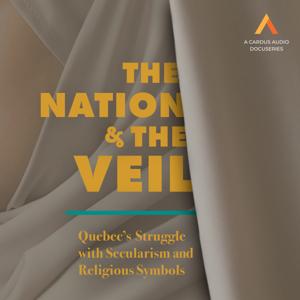
Quebec's Bill 21 bars police officers, judges, public-school teachers, and other public servants in positions of authority from wearing religious symbols on the job. The Nation and the Veil is a four-part audio documentary that goes deep inside the headline. Hosts Lisa Richmond and Jean-Christophe Jasmin of the think tank Cardus trace how a province once run by the Catholic Church became one that legislates state secularism, and they let the people who have shaped the debate speak for themselves.
You will hear from philosopher Charles Taylor, legal scholar Guillaume Rousseau, laïcité activist Nadia El-Mabrouk, civil-liberties lawyer Julius Grey, and other leading scholars, historians, and activists.
The series takes no side. Its aim is to present the strongest version of each position so you can decide for yourself. It arrives as the Supreme Court of Canada weighs Bill 21 and the future of the notwithstanding clause, a ruling with consequences far beyond Quebec.
Four episodes in the series:
Part 1 — History: From Church to State Part 2 — Politics: Has Secularism Replaced Sovereignty as Quebec's Defining Question? Part 3 — Opposing Visions: Four Ways to Think About Pluralism Part 4 — Opposing Models: Can Quebec Find a Third Way?
Subscribe to The Nation and the Veil wherever you listen to podcasts.
Credits
A project of Cardus, a public policy think tank based in Ottawa and Hamilton, Ontario
Narration written by Étienne-Alexandre Beauregard, Lisa Richmond, and Jean-Christophe Jasmin
Hosted by Jean-Christophe Jasmin and Lisa Richmond
Edited and Produced by Francis Denis
With gratitude to our interviewees: Francis Denis, Nadia El-Mabrouk, Xavier Gélinas, Julius Grey, David Koussens, Guillaume Lamy, Guillaume Rousseau, Stéphane Sérafin, Charles Taylor, and Hicham Tiflati
From the publisher's feed