
Sign up to save your podcasts
Or



Hey! I'd love to hear your thoughts, send me a voice note.
In the spring of 1321, a young man from Montaillou gave three different accounts of the same deathbed. Starting from Bernard Benet's file, and correcting what we said about it in Episode 2, Rob looks at how inquisition records were made: oaths, a notary, testimony read back in the witness's own language, question lists built from what inquisitors expected to find, and the fear, bribes and village feuds that pressed on witnesses. We explain why New Cathars logs depositions as inquisitorial sources (class C) even though some treat them as eyewitness evidence (class B), give the court's care its due, and name what we still cannot know. Jesus' words in Mark 4:24 set the measure.
Sources: Jacques Fournier register, confessions of Bernard Benet and Alamande Guilabert (SJSU trans., ed. N. P. Stork); N. P. Stork, notes on Jacques Fournier (SJSU); University of York Doat Project, Toulouse MS 609 translations; Bernard Gui, Inquisitor's Manual (Burr trans., Fordham); A. Sennis, "Questions about the Cathars," in Cathars in Question (2016). Full source ledger available on request.
Hey! I'd love to hear your thoughts, send me a voice note.
Early in the 1300s, the inquisitor Bernard Gui pointed readers to two piles of evidence: the Good Christians' own books and the confessions of converted followers. Seven centuries later, one pile is enormous and the other almost fits on a single shelf. In this episode, Rob walks the shelves by source type: the few Cathar and Cathar-associated texts (the Lyon and Florence manuscripts, the Dublin manuscript, the Secret Supper), Catholic treatises and chronicles, the vast inquisition records (Toulouse MS 609, the Doat transcriptions, the Fournier register), and rare everyday charters. We look at how some Cathar words survived only in their opponents' archives, what historians argue the imbalance means, and what no one can recover. John 20:30-31 then models an honest way to treat an incomplete record.
Sources: Bernard Gui, Inquisitor's Manual (Robinson trans., Fordham); J. van Schaik, "Cathars, Albigensians, and Bogomils," Encyclopaedia Iranica (2006); M. R. Harris, foreword to the Occitan Cathar Ritual (RIALTO ed.); D. Zbíral, Graeco-Latina Brunensia (2015); NASSCAL e-Clavis, Questions of John; C. Bruschi and A. Sennis in A. Sennis (ed.), Cathars in Question (2016); University of York Doat Project, Toulouse MS 609; N. P. Stork, notes on Jacques Fournier (SJSU). Full source ledger available on request.
Hey! I'd love to hear your thoughts, send me a voice note.
BONUS | The Lord's Prayer
The disciples asked, "Lord, teach us to pray," and Jesus answered. In this bonus episode, Rob walks through the Our Father one petition at a time: why it begins with "Our," what "hallowed" means, the Kingdom, the will of God, the puzzling Greek word behind "daily bread," forgiveness, testing, and deliverance from evil. We look at why the familiar doxology is missing from the earliest manuscripts of Matthew, how the Didache told early Christians to pray it three times a day, and why the Lyon Cathar Ritual put the prayer at the heart of the Good Christians' religious life. Then there's a simple seven-day practice, a respectful ask for your pastor, and we close by praying it together in English and in the Syriac Aramaic of the Peshitta. That isn't Jesus' exact speech, but it's an ancient Aramaic Christian voice. Daily Scripture: Matthew 6:14-15.
Sources: Matthew 6:5-15; Luke 11:1-4; James 1:13 (WEB); Didache 8 (trans. via Early Christian Writings); Lyon, Bibliothèque municipale, MS PA 36 (Occitan Cathar Ritual, RIALTO ed., foreword by M. R. Harris); Syriac Peshitta, Matthew 6:9-13. Full source ledger available on request.
Hey! I'd love to hear your thoughts, send me a voice note.
Before 1209, what kind of world did the Good Christians live in? Rob looks at the Occitan language and its vernacular New Testament, a patchwork of counts, viscounts and self-governing towns, a church its own chroniclers called weak, and a religious scene where dissenters and Catholic preachers argued in public. We sort out what is established, what historians still dispute (from the Saint-Félix document to the "tolerant south" picture), and what no one can count, before reading Matthew 18 the way the Cathar ritual did, and then reading the verses before it.
Sources: Council of Lombers (1165) as summarized in Encyclopaedia Iranica; Occitan Cathar Ritual (RIALTO ed.); William of Puylaurens, Chronicle (Sibly trans. summary); Bernard Gui; A. Sennis (ed.), Cathars in Question (2016); Strayer (1971) via general reference.
Hey! I'd love to hear your thoughts, send me a voice note.
The final part of a six-part New Cathars bonus series on the Lyon Ritual. Rob reads Section VI, the rite for a sick believer: the private questions about debts and honesty, the promise, the handing over of the Lord's Prayer at the bedside, the asking of forgiveness, the consoling with hands and the Book, and the rules that follow if the person dies or recovers. The section is read in full in four passages. We flag the reconstructed and unexplained details, bring the Gospel word of the thief on the cross to the sickbed, and conclude the series: why it matters to hear these people in their own words, what we heard (the Lord's Prayer, John's Gospel, confession, forgiveness, and the commandments of Jesus), and where we named real differences. We close in prayer to Christ, the Word made flesh.
Christ first. We listened to what survives; we did not reconstruct a rite for listeners to perform.
Source: Rob Robichaud's independent English working translation of the Lyon Ritual (Lyon, Bibliothèque municipale, MS PA 36), made directly from the medieval Occitan and Latin transcription. Not a critical edition; uncertain and reconstructed passages are flagged on air. Evidence class A: a surviving Cathar-associated text. Section VI transcription as cited in the translation: edited by Marvyn Roy Harris (2005), folios 240c–241d.
This concludes the Lyon Ritual bonus series.
Hey! I'd love to hear your thoughts, send me a voice note.
Part five of a six-part New Cathars bonus series on the Lyon Ritual. Rob reads Section V, a short set of practical rules: praying the Lord's Prayer on the road, at a dangerous bridge or entering a boat; "simple" and "double" prayers; returning property found on the road; and praying before drinking and in company. The section is read in full in three passages. One rule is damaged and is left as a gap, and the uncertain first line is flagged. We close in prayer for faithfulness in small things.
Christ first. We are listening to what survives, not reconstructing a rite for listeners to perform.
Source: Rob Robichaud's independent English working translation of the Lyon Ritual (Lyon, Bibliothèque municipale, MS PA 36), made directly from the medieval Occitan and Latin transcription. Not a critical edition; uncertain and reconstructed passages are flagged on air. Evidence class A: a surviving Cathar-associated text.
Next in the series: Part 6, the Consolamentum for the Sick (final part).
Hey! I'd love to hear your thoughts, send me a voice note.
Part four of a six-part New Cathars bonus series on the Lyon Ritual. Rob reads Section IV, the consolamentum, which the text calls a spiritual baptism by which the Holy Spirit is given through the Prayer and the laying on of hands. The section is read in full in four passages: the elder's scriptural teaching on this baptism; the claimed power to bind and loose and the commandments of the Sermon on the Mount; the call to "hate this world" and the believer's humble answer; and the rite itself. We note that the claim of an unbroken line from the apostles is the ritual's own claim, not independent historical proof, and that several ritual terms are provisional renderings. We close in prayer for the Holy Spirit through Jesus Christ.
Christ first. We are listening to what survives, not reconstructing a rite for listeners to perform.
Source: Rob Robichaud's independent English working translation of the Lyon Ritual (Lyon, Bibliothèque municipale, MS PA 36), made directly from the medieval Occitan and Latin transcription. Not a critical edition; uncertain and reconstructed passages are flagged on air. Evidence class A: a surviving Cathar-associated text.
Next in the series: Part 5, Rules for Prayer and Conduct.
Hey! I'd love to hear your thoughts, send me a voice note.
Part three of a six-part New Cathars bonus series on the Lyon Ritual. Rob reads Section III, the rite in which the Lord's Prayer is formally handed on to a believer. The section is read in full in four passages: the reverent preparation of the table, cloth, and Book; the elder's sermon, a chain of Scripture on God dwelling with his people and the promise of the Comforter; the call to repent and forgive; and the handing over of the Prayer itself. We note the text's own wording of Scripture, flag what is awkward or uncertain, and close in prayer to Christ who taught us to pray.
Christ first. We are listening to what survives, not reconstructing a rite for listeners to perform.
Source: Rob Robichaud's independent English working translation of the Lyon Ritual (Lyon, Bibliothèque municipale, MS PA 36), made directly from the medieval Occitan and Latin transcription. Not a critical edition; uncertain and reconstructed passages are flagged on air. Evidence class A: a surviving Cathar-associated text.
Next in the series: Part 4, the Consolamentum.
Hey! I'd love to hear your thoughts, send me a voice note.
Part two of a six-part New Cathars bonus series on the Lyon Ritual. Rob reads Section II, the Servissi, a confession spoken together in the first person plural, with its repeated plea "Bless us; spare us." The section is read in full in three passages, with short explanations: confession before God and the Church, sins of worldly care and of the tongue, distraction in prayer, and the hard line about "flesh born of corruption" and "the spirit placed in prison," where we name a real difference from the Gospel's "the Word became flesh." We say plainly what we do not know about how often and by whom this was said, and close in prayer to the Father of mercy in the name of Jesus Christ.
Christ first. We are listening to what survives, not reconstructing a rite for listeners to perform.
Source: Rob Robichaud's independent English working translation of the Lyon Ritual (Lyon, Bibliothèque municipale, MS PA 36), made directly from the medieval Occitan and Latin transcription. Not a critical edition; uncertain and reconstructed passages are flagged on air. Evidence class A: a surviving Cathar-associated text.
Next in the series: Part 3, the Transmission of the Prayer.
Hey! I'd love to hear your thoughts, send me a voice note.
Part one of a six-part New Cathars bonus series on the Lyon Ritual, a medieval liturgical text preserved in Lyon, Bibliothèque municipale, MS PA 36 (evidence class A: a surviving Cathar-associated text).
Rob reads Section I from his own independent English working translation (not a critical edition), pausing to explain as he goes: first the opening liturgical phrases (blessing and pardon, the Trinity, and the Lord's Prayer with its "supersubstantial" bread), then the opening of the Gospel of John, chapter 1, verses 1–17, as the manuscript gives it. We note what we know, say plainly what we do not know about who used this book and when, and close in prayer drawn from John 1 and the Lord's Prayer.
Christ first. We are listening to what survives, not reconstructing a rite for listeners to perform.
Next in the series: Section II, the Servissi (a confession service).
From the publisher's feed
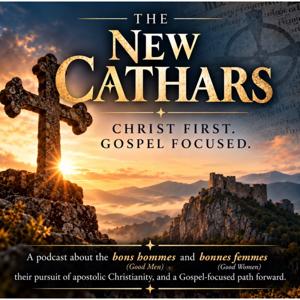
Eight hundred years ago, a Christian movement was driven to extinction. But its questions never disappeared.
The New Cathars explores the history, faith,…
Three times each week, we return to the surviving texts, the Gospel, eyewitness testimony, inquisitorial records, and modern scholarship to separate what we know, what was alleged, what remains disputed, and what may have been lost.
We investigate difficult questions rather than avoiding them. Were the Cathars truly dualists? What did they believe about Jesus, Mary, Scripture, the Old Testament, prayer, materialism, and salvation? What did Rome get right about them? What might their opponents have misunderstood or exaggerated? And where the evidence cannot answer, we are willing to say: we don’t know.
This is also a journey forward. We cannot recreate the eight centuries of theological development that persecution prevented. We can recover what survives, learn from the Good Christians, return continually to the Gospel, and explore what a modern New Cathar movement might become.
Historical. Investigative. Christ first. Gospel focused.
New episodes every Monday, Wednesday, and Friday.