
Sign up to save your podcasts
Or



Hey! I'd love to hear your thoughts, send me a voice note.
"How can they be good people, if they are called heretics?" A young woman in Montaillou asked that in the 1290s, and in this episode Rob follows the question through the surviving Occitan ritual, Catholic chronicles, Bernard Gui's manual, and depositions from Bishop Jacques Fournier's inquisition: a deathbed request, a kneeling greeting, a whispered blessing. We weigh where these very different sources agree, where testimony was bent under pressure, and what we still don't know about Good Women. Then Jesus' words in Mark 10 challenge any movement that turns "good" into a title.
Sources: Occitan Cathar Ritual (Lyon PA 36, RIALTO ed.); Fournier register depositions of Guillemette Clergue, Brune Pourcel, Alamande Guilabert, Guillaume Fort and Bernard Benet (SJSU trans.); Bernard Gui; early 13th-c. chronicle in Raynaldus (Fordham Sourcebook); A. Sennis (2016).
Hey! I'd love to hear your thoughts, send me a voice note.
There's no dramatic conversion story here, no rock bottom and no lightning bolt. In this personal bonus episode, Rob reflects on a lifetime of quiet moments that felt like a second presence in the room, a presence that, as a Christian, he names the Holy Spirit. It's a gentle reflection on solitude, on facing the end of this life with curiosity and hope instead of dread, and on the possibility that we've never really been alone.
Hey! I'd love to hear your thoughts, send me a voice note.
The name most people use for the medieval Good Christians of Languedoc first appears in a hostile sermon written in the Rhineland around 1163. In this opening episode, Rob traces where the word "Cathar" came from, sets it beside the names used in a surviving Occitan ritual and in inquisition testimony (good men, good Christians, the Church of God), and lays out the live scholarly debate over whether "Catharism" was an organized church or a label imposed from outside. We end with Jesus' question in Mark 8 and an honest note on why a modern project calls itself New Cathars.
Sources: Eckbert of Schönau, Sermones contra Catharos (c. 1163); Occitan Cathar Ritual (Lyon PA 36, RIALTO ed.); Bernard Gui, Inquisitor's Manual; Jacques Fournier register (SJSU trans.); Book of the Two Principles; A. Sennis (ed.), Cathars in Question (2016). Full source ledger available on request.
Hey! I'd love to hear your thoughts, send me a voice note.
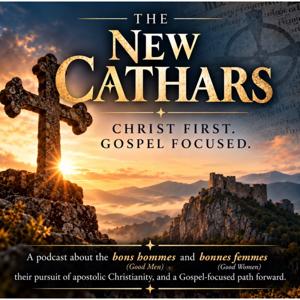
Welcome to New Cathars, a historical, educational, and forward-looking Christian podcast that is Christ first and Gospel focused. Host Rob sets out to recover the medieval Good Christians of southern France through surviving Cathar texts, inquisitorial records, Catholic sources, and modern scholarship, offering history when history can answer, evidence when evidence survives, and "we do not know" when it does not. Year One moves through four quarters, Recover, Investigate, Witness, and Move Forward, with new five-to-eight-minute episodes every Monday, Wednesday, and Friday. Start with Episode 001, "Who Were the Cathars?"
From the publisher's feed
Eight hundred years ago, a Christian movement was driven to extinction. But its questions never disappeared.
The New Cathars explores the history, faith,…
Three times each week, we return to the surviving texts, the Gospel, eyewitness testimony, inquisitorial records, and modern scholarship to separate what we know, what was alleged, what remains disputed, and what may have been lost.
We investigate difficult questions rather than avoiding them. Were the Cathars truly dualists? What did they believe about Jesus, Mary, Scripture, the Old Testament, prayer, materialism, and salvation? What did Rome get right about them? What might their opponents have misunderstood or exaggerated? And where the evidence cannot answer, we are willing to say: we don’t know.
This is also a journey forward. We cannot recreate the eight centuries of theological development that persecution prevented. We can recover what survives, learn from the Good Christians, return continually to the Gospel, and explore what a modern New Cathar movement might become.
Historical. Investigative. Christ first. Gospel focused.
New episodes every Monday, Wednesday, and Friday.