
Sign up to save your podcasts
Or

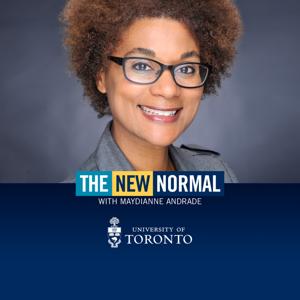


Over the past four months, Maydianne Andrade, vice-dean faculty affairs, equity and success, at the University of Toronto Scarborough and a Canada Research Chair in Integrative Behavioural Ecology, has used her podcast, The New Normal, to explore how the COVID-19 pandemic has affected our daily lives.
But in episode 10 of the podcast, Andrade and producer Lisa Lightbourn discuss how the show took on a life of its own, venturing into reflections on larger problems in society.
"Equity is a big part of my life and my work, but I thought that this show would just be about, I don't know – shopping, how we walk down the sidewalk," Andrade says.
The podcast did indeed cover topics ranging from the awkwardness of grocery-shopping during a pandemic to the challenges of explaining the situation to kids and the joy of spontaneous musical performances on balconies. But it also took on pressing matters of equity and social justice, including the killing of George Floyd and the broader Black Lives Matter movement.
"We're still trying to figure out what a new normal will be, and it's not going back, right?" Lightbourn says in the episode.
"We don't want to go back, necessarily, to this world where people had blinkers on about equity, where we thought about profit more than people," Andrade says. "There's all these different aspects of how we're thinking about people and our neighbours now that we want to continue. We just have to figure out what it looks like as we move through this."
The New Normal is created in collaboration with a University of Toronto Communications team led by Lightbourn. You can listen to the podcast on Spotify or listen on SoundCloud. You can also find it on Apple or listen on Google.
Toronto's streets have seen fewer cars during the pandemic as the city closed some major roads and expanded the cycling network. Now, there more walkers, cyclists and people sitting at café tables.
Is this what a more livable, equitable city looks like?
"Like many cities, Toronto has figured out ways to give people space to move in the outdoors while respecting physical distancing, which involve quieting down the streets to reduce traffic volume and expanding the cycling network," says Professor Maydianne Andrade in episode nine of her podcast, The New Normal.
"ActiveTO encourages people to move in ways that used to feel vulnerable when the city streets were dense with traffic."
In "Quiet Streets," Andrade, a Canada Research Chair in Integrative Behavioural Ecology and the University of Toronto Scarborough's vice-dean of faculty affairs and equity, talks with Shawn Micallef, a lecturer in the Faculty of Arts & Science and the co-owner and senior editor of Spacing magazine, and alumna Léa Ravensbergen. Ravensbergen, who graduated with a PhD in geography and planning in 2019, says that, for some time, "we've been thinking about using our streets differently and imagining our streets differently and having more livable, people-centered approaches to designing our cities."
Will the pandemic help bring about that kind of change more permanently?
"Maybe our movements, our desires to move, need to be more of a central piece in how we design our city and make it a humane place to live," Andrade says.
The New Normal is created in collaboration with a U of T Communications team led by producer Lisa Lightbourn. You can listen to the podcast on Spotify or listen on SoundCloud. You can also find it on Apple or listen on Google.
What can you learn from equity-deserving groups? How to be resilient? How to thrive – even in an environment that doesn't affirm your right to existence?
What are the challenges, achievements and opportunities for the queer community?
These are some of the questions explored by Maydianne Andrade, a Canada Research Chair in Integrative Behavioural Ecology and the University of Toronto Scarborough's vice-dean of faculty affairs and equity, in "Queering The New Normal," episode eight of her podcast, The New Normal.
Andrade's guests this week are:
"What really strikes me from talking to young people is that when we kind of think, 'Oh, things are pretty good now' – they're not coming from, 'Things are pretty good now.' They're coming from, 'Here's how it actually should be,'" Andrade says.
The New Normal is created in collaboration with a University of Toronto Communications team led by producer Lisa Lightbourn. You can listen to the podcast on Spotify or listen on SoundCloud. You can also find it on Apple or listen on Google.
After months of a global pandemic and weeks of protests against anti-Black racism and police brutality, are we at a crossroads? "It feels like we are at a critical moment," says Maydianne Andrade, a Canada Research Chair in Integrative Behavioural Ecology and the University of Toronto Scarborough's vice-dean of faculty affairs and equity. "Will we choose the path that is more challenging but more just?
In episode seven of her podcast, The New Normal, Andrade is joined by Joe Wong, the Ralph and Roz Halbert Professor of Innovation at U of T's Munk School of Global Affairs & Public Policy and the founder and principal investigator for the REACH Alliance. She is also joined by alumna and activist Noura Al-Jizawi, who endured torture in Syria before finding a new home in Canada, helped by the Munk School's Citizen Lab and the Scholars at Risk program. Now a research assistant at Citizen Lab, Al-Jizawi is also an alum of the Reach Alliance.
The New Normal is created in collaboration with a University of Toronto Communications team led by producer Lisa Lightbourn.
You can listen to the podcast on Spotify or listen on SoundCloud. You can also find it on Apple or listen on Google.
The New Normal is created in collaboration with a University of Toronto Communications team led by producer Lisa Lightbourn.
You can listen to the podcast on Spotify or listen on SoundCloud. You can also find it on Apple or listen on Google.
Members of the U of T community who need support are encouraged to contact the Anti-Racism and Cultural Diversity Office and the equity, diversity and inclusion offices at U of T Scarborough and U of T Mississauga.
To learn more about anti-Black racism: City of Toronto anti-Black racism community resources (https://www.toronto.ca/community-people/get-involved/community/toronto-for-all/anti-black-racism-2/) City of Toronto anti-Black racism action plan (https://www.toronto.ca/legdocs/mmis/2017/ex/bgrd/backgroundfile-109127.pdf) Ontario's anti-racism plan (https://www.ontario.ca/page/ontarios-anti-racism-strategic-plan) Broadbent Institute policy proposals to tackle anti-black racism (https://www.broadbentinstitute.ca/bold_policy_proposals_to_tackle_anti_black_racism)
Feeling distressed? Find someone to talk to right now – and if there is an immediate risk, call 911. (https://www.studentlife.utoronto.ca/feeling-distressed)
Students can speak to a trained crisis worker at any hour of the day. U of T My SSP for students: call 1-844-451-9700 or download the app at the Apple App Store or Google Play. Immediate counselling support is available in 35 languages and ongoing support in 146 languages.
Other 24-7 supports available to students include: Good 2 Talk Student Helpline 1-866-925-5454. Professional counselling, information and referrals for mental health, addictions and well-being. (https://good2talk.ca/) Gerstein Crisis Centre 416-929-5200 (http://gersteincentre.org/) Distress Centres of Greater Toronto 416-408-HELP (4357) (https://www.torontodistresscentre.com/408-help-line) The Centre for Addiction and Mental Health at 250 College Street Anishnawbe Health Toronto Mental Health Crisis Line 416-360-0486 (http://aht.ca/)
The following services are available to students on all three campuses: St. George campus: Health and Wellness Centre (416-978-8030), located at Koffler Student Services (https://www.studentlife.utoronto.ca/hwc) U of T Scarborough: Health & Wellness Centre 416-287-7065 (https://www.utsc.utoronto.ca/hwc/health-wellness-centre) U of T Mississauga: Health & Counselling Centre 905-828-5255 (https://www.utm.utoronto.ca/health/mental-health)
Faculty and staff have access to 24-7 support through: The Employee & Family Assistance Program (EFAP), offered through Homewood Health, online and by phone at 1-800-663-1142 (http://benefits.hrandequity.utoronto.ca/efap/)
This episode explores the intergenerational impact and trauma of anti-Black racism and violence through the scholarly perspectives and personal experiences of Andrade, Canada Research Chair in Integrative Behavioural Ecology and the University of Toronto Scarborough's vice-dean of faculty affairs and equity, and her guests: U of T Scarborough Assistant Professor Mark Campbell, of the department of arts, culture and media, an expert in hip hop and the music of Black communities, and Assistant Professor, Teaching Stream, Julius Haag of U of T Mississauga's department of sociology, an expert in policing, youth justice, racialization and criminalization.
"There are 40 different cities where people are violating curfew to demonstrate their protests, you know, and honour the life of George Floyd," Campbell says. "So I'm hoping that this is the moment because I won't see another moment like this in my lifetime."
Hosted by Maydianne Andrade, The New Normal is created in collaboration with a University of Toronto Communications team led by producer Lisa Lightbourn.
Those who need support are encouraged to contact the Anti-Racism and Cultural Diversity Office and the equity, diversity and inclusion offices at U of T Scarborough and U of T Mississauga.
Read more here: https://www.utoronto.ca/news/new-normal-podcast-releases-first-instalment-two-part-episode-anti-black-racism
Subscribe to this podcast on your favourite platform Apple Podcasts: https://pcr.apple.com/id1518270454 Spotify: https://spoti.fi/2MP6HE2 Google Podcasts: https://bit.ly/2BWK5Pz
From the publisher's feed