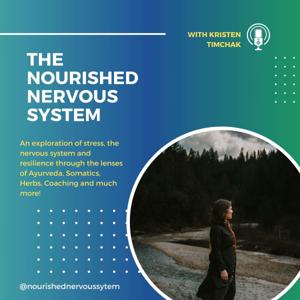
The Nourished Nervous System

The Nourished Nervous System

Download on the App Store

The Nourished Nervous System episodes

  • Making Space: Why I’m Taking a Podcast Sabbatical

    Send us Fan Mail

    This is my final episode before taking a break from the podcast. It’s not a goodbye. It’s a pause, and I want to tell you honestly how I got here.

    What I share in this episode:

    • How the podcast began. The idea was born when my son was about two and a half and I was in my 40s, at a very low point. I had just been diagnosed with Hashimoto’s, my mother had passed away, and we were under financial stress. I knew Ayurveda had been a lifeline for me, and I wanted to share it with others as a net of resilience for when things get hard.
    • Launching on the road. I recorded the first episodes in California, then released them while driving across the country to Maine with my partner, my son, two cats, and a lot of plants. I recorded some early episodes, including my first interview with Abigail Rose Clark, in my in-laws’ basement in Ohio while we looked for a home.
    • Three years later. My son just turned seven, parenting is easier, I’ve moved through waves of grief for my mother, and I’ve done a lot of work on my own health. The podcast has documented that arc, and the practitioners I’ve met along the way have woven a web of wisdom that has shaped my life and my work.
    • Why I’m taking a pause. Even while I loved the episodes I was making, the weekly rhythm had started to feel like a hamster wheel. I wasn’t leaving enough space for the podcast itself or for my other projects. A podcast about pausing and listening to ourselves needed me to honor that too.
    • A break, not a stop. My first thought was that I needed to stop, and that made me sad. Then I realized I can take a break and restructure instead. I don’t need to produce 52 episodes a year. I can go deeper, with different focuses, in a way that is in integrity.
    • Space through an Ayurvedic lens. While working on the Space card for my Oracle deck, I went deeper into this element. Space is vast and infinite, and it’s also the space inside each cell, vein, artery, rib cage, and pelvic bowl. Beyond the space itself is how we relate to it: our boundaries, our containers, and the habit of filling every gap. I explore holding space, taking space, and making space, and being comfortable enough in myself (swastha) to rest in the pause without needing to fill it.

    What I’m working on in the meantime:

    • Live online Somatic Stretch & Shake. Starting in November, every Tuesday at 1:30pm ET on Zoom. The class moves from warming up and stretching, to three rounds of somatic shaking with pauses for integration, to body-led movement, to yin or restorative poses and savasana. Sign up at mynourishednervoussystem.com
    • Embodied Ayurveda. A year-long journey beginning around late winter, meeting once a month for two to three hours. Each session follows a format I created called Learn, Move, Integrate, Share. We learn a seasonally appropriate concept, move with it in the body, take open time to integrate (savasana, journaling, pulling Oracle cards, resting), and come back together to share. Join my email list to hear more.
    • An Ayurveda Oracle Deck. A creative side project I’m having fun with.
    • The Ayurvedic & Somatic Toolkit for the Perimenopause Portal. An on-demand mini course with five workshop-style practices, made for the perimenopause transition but supportive for anyone with a nervous system: mynourishednervoussystem.com/tool-kit

    An invitation:
    When I return, I’d love to shape the podcast around what’s useful and alive for you. If there are topics you’d like me to explore, email me at [email protected]. Thank you to everyone who has reached out over the years to ask a question or share a piece of your story.

    Links & resources:

    • Weekly Somatic Stretch & Shake on Zoom (Tuesdays 1:30pm ET)
    • Join my email list for Embodied Ayurveda updates
    • Ayurvedic & Somatic Toolkit for the Perimenopause Portal
    • Somatic Stretch & Shake on YouTube

    Resources:

    Abhyanga Self Massage Guide

    Weekend Nervous System Reset

    Nourished For Resilience Workbook


    Find me at www.mynourishednervoussystem.com

    and @nourishednervoussytem on Instagram


    26 min
  • Is It Information or Is It the Answer? Feminine Wisdom, Ayurveda & Living Unbound with Serena Arora

    Send us Fan Mail

    Today’s guest is Serena Arora — Ayurvedic health practitioner, yoga therapist, author of Unbound, and founder of Peace Retreat Costa Rica. Serena grew up straddling three worlds — Indian on her father’s side, Chinese on her mother’s side, and born and raised in the West — and has spent decades learning how to embody, not just teach, the practices she studied. Her book Unbound is the answer to the question she gets asked every day: how did you get here?

    This conversation is deep, vulnerable, and full of things worth sitting with.

    What we cover:

    • Serena’s path — from middle school teacher and fitness instructor teaching 40 classes a week, to yoga therapist and Ayurvedic practitioner, to retreat founder in Costa Rica; the long arc of learning to embody rather than just perform wellness
    • Wherever you go, there you are — how changing external environments without internal change is just bypassing; and what it actually means to embody the shift you’re creating on the outside
    • Ayurveda as inherited wisdom — growing up with an Indian father who used food and spice as medicine without knowing it had a name; and the journey to understanding the logic and science behind what she always knew worked
    • Adapting Ayurveda for women — how a system that originated in a male-dominated culture can be reclaimed as medicine for the feminine; and how Serena used her father’s lineage to heal her mother’s
    • The disintegrated feminine — forcing, controlling, pushing, the rigid unsustainable behaviors that women develop under stress and overwhelm; and what it looks like to restore the feminine waters
    • Immigrit — Serena’s coined term for the inherited grit of immigrant parents: the put-your-head-down, one-foot-in-front-of-the-other tenacity that gets things done but can also keep you going through the motions long past the point of aliveness
    • Imma-guilt — the companion to immigrit; the heavy backpack of guilt for failing, disappointing, betraying — and what became possible when Serena set it down
    • Is it information or is it the answer? — a beautiful distinction about the difference between more data and embodied knowing; and the practice of descending from the head into the heart, the gut, and the womb to find what is actually true
    • Swastha — the Ayurvedic concept of being situated in the self; why this is the goal and what happens when we’ve never experienced it.


    Connect with Serena:

    • Website
    • Instagram
    • Free Ayurveda ABCs morning practice
    • Unbound online course + retreat


    Resources:

    Abhyanga Self Massage Guide

    Weekend Nervous System Reset

    Nourished For Resilience Workbook


    Find me at www.mynourishednervoussystem.com

    and @nourishednervoussytem on Instagram


    55 min
  • Slow Medicine as Homecoming: Earth Medicine, Inner Authority & the Seasons of Healing with Beana Bern

    Send us Fan Mail

    Today's guest is Beana, founder of Rootstock — a land-based healing center on 2,000 feet of north-facing hillside in Vermont's Northeast Kingdom, 20 miles from the Canadian border. For eight years, Beana has been building what she describes as a canvas, a sandbox, and a laboratory for learning how to be a person on planet Earth — gathering people around fire, around food, around authenticity and truth-telling, and guiding nearly a thousand people through psilocybin mushroom work in a deeply seasonal, place-based, and earth-centered practice.

    This conversation is one of my favorites. Beana is wise, funny, deeply honest, and completely alive. I am already planning to have her back.

    What we cover:

    • Beana's origin story — the aching hole beneath material success, the colossal failures, the humility that came with them, and the moment she moved onto the land at Rootstock and finally learned to listen
    • Perimenopause as a doorway — a beautiful exchange about how this transition invites women to stop running the treadmill and actually become a person, an animal being, rather than a human doing
    • Slow medicine as homecoming — what this phrase actually means: moving at the speed of nature, even with the chaos; the seasons as metronome and guiding truth; and how tiny homeopathic drops of stillness and slowness create a rewiring — like turning a radio dial out of static and into a melody
    • The industrialization of the psychedelic space — Beana's honest and unflinching perspective on venture capital, pharmaceutical agenda, and power-over paradigms in the booming psychedelic industry, and the fire she is actively keeping burning at Rootstock: internal authority
    • The mushrooms as teachers — not a substance but an earth medicine, an alchemical relationship; what the mushrooms are here to restore in us; and why a heroic dose of anything cannot instill the remembering that sitting on a porch swing in a rainstorm might
    • Microdosing vs. macrodosing — the full spectrum explained; how Beana structures a three-month seasonal microdosing practice (equinox to solstice, with a beginning, middle, and end); and how the practice becomes a mirror for seeing yourself clearly
    • The paradox of suffering — why any practitioner selling a solution that doesn't require you to learn how to metabolize pain is not being all the way honest; and how the work is about learning to suffer beautifully, not eliminating suffering
    • Community as the active ingredient — why accountability and being witnessed may matter more than the medicine itself; and how Beana's own practice of staying visible keeps her honest in her work
    • The resonance between Rootstock's ethos and Ayurveda — being situated in the self as the definition of health; the elemental and seasonal medicine that both traditions share; and why in the end, you are your own greatest teacher

    Beana's programs:

    • Self-guided microdosing course — start today, work at your own pace
    • Guided immersions — three-month containers, small groups of 8–12, four times a year with weekly Zooms and group accountability
    • Website: rootstockretreat.com

    Important note:
    This episode discusses psilocybin and plant medicine in an educational context. Laws around psilocybin vary by location — please research the legal status in your area. This conversation is for educational purposes and is not medical advice.

    Resources:

    Abhyanga Self Massage Guide

    Weekend Nervous System Reset

    Nourished For Resilience Workbook


    Find me at www.mynourishednervoussystem.com

    and @nourishednervoussytem on Instagram


    51 min
  • The Drying Tide: Rasa Dhatu, the Interstitium & What's Really Happening to Your Skin & Joints in Perimenopause

    Send us Fan Mail

    I'm recording this on a rainy fall day in Maine, watching the leaves turn, and finally getting into something I've been sitting with for a while — the deep connection between rasa dhatu, the interstitium, and what is actually happening to our skin and joints in perimenopause. This is one of my favorite topics right now, and I hope you can feel that.

    I'm also sharing some personal news: after much thought, I'm taking a sabbatical from the podcast. Two more interviews and one final episode are coming — and then a period of rest, restructuring, and creating. I'll get into all the whys in that final episode. In the meantime: join my email list to stay connected, and watch for Somatic Stretch & Shake classes on YouTube and an upcoming live online class.

    What I cover:

    • Rasa dhatu — the first of seven Ayurvedic tissue layers, corresponding to plasma, lymph, and interstitial fluid; the living juice of what we've taken in; the foundation that every downstream tissue depends on. 
    • The interstitium — the recently mapped (2018) network of fluid-filled spaces running through the fascial connective tissue of the entire body, discovered accidentally when tiny cameras revealed what had always looked like dry cracks in tissue were actually fluid-filled channels. Now understood as a distinct circulatory system driven by heartbeat, breath, and movement — and potentially corresponding to the Ayurvedic rasavaha srotas and the Chinese medicine meridian system.
    • Hyaluronic acid and the thixotropic property — the body's built-in hydration and lubrication system, which becomes more fluid when moved and more viscous and gel-like when still. Why sitting too long creates that creaky, stiff feeling when you stand — and why movement, vibration, and massage literally return thickened hyaluronic acid to its flowing state.
    • Estrogen, rasa dhatu, and the double depletion of perimenopause — estrogen stimulates hyaluronic acid production and collagen synthesis; as it declines, the skin's ability to hold moisture decreases and the synovial fluid in joints is disrupted. Ayurveda describes this same process as rasa dhatu depletion combined with rising Vata (drying) and the early Pitta surge (burning through rasa). Modern science and ancient wisdom describing the same thing.
    • What I recommend — practical and layered support for rasa dhatu, the interstitium, and perimenopause dryness - listen to learn more!

    Resources mentioned:

    • My Somatic Stretch & Shake classes on YouTube: https://www.youtube.com/playlist?list=PLcNncVGWE4l4
    • The Ayurvedic & Somatic Toolkit for the Perimenopause Portal: mynourishednervoussystem.com/tool-kit
    • Join my email list to stay connected during the sabbatical:   https://the-nourished-nervous-system.kit.com/fe80600c2b

    Research I mention:

    • 2024 paper comparing rasa dhatu with modern understanding of nutrient plasma, lymph, and extracellular fluid-https://zenodo.org/records/18149218
    • 2025 paper in Ayush Dhara connecting modern physiological networks with Ayurvedic srotas descriptions- https://ayushdhara.in/index.php/ayushdhara/article/view/2333
    • Dr. Robert Schleip — fascia researcher on the dynamic, movement-dependent hydration of fascial tissue
    • Radiolab episode on the discovery of the interstitium (highly recommended listening) - https://radiolab.org/podcast/interstitium


    Resources:

    Abhyanga Self Massage Guide

    Weekend Nervous System Reset

    Nourished For Resilience Workbook


    Find me at www.mynourishednervoussystem.com

    and @nourishednervoussytem on Instagram


    35 min
  • Fear Is the Root of Everything: Pathological Neural Networks & Psychosomatic Healing with Andrei Efremov

    Send us Fan Mail

    Today's guest is Andrei Efremov — psychosomatics researcher, author, and founder of the Efremov Method. Originally trained in medicine, psychiatry, and psychotherapy, he now focuses on the neuroscience of fear and the body. His peer-reviewed work proposes that fear-based pathological neural networks can turn stress and emotion into chronic physical symptoms — and that fear may be the foundation of all emotional states. He is the author of Unwiring Pain and Primal Fear: Somatic Echoes.

    This is a genuinely unusual conversation — Andrei's framework is distinctive and doesn't map neatly onto other approaches you may have encountered. I found it fascinating and wanted to share it with you.

    What we cover:

    • Andrei's path from medical school and psychiatry training in Russia to developing his own method — and why none of his formal training prepared him to actually help people heal
    • The concept of pathological neural networks — neural networks created during psychotrauma that generate symptoms in both the mind and the body, drawing their energy from the fear-based emotions stored within them
    • Fear as the root of all emotional states — including positive ones; and why Andrei believes working with different emotions separately (grief, guilt, depression) misses the underlying driver
    • Why you can't talk or command yourself out of real hypnosis — and what his approach does instead to eliminate fear-based neural networks rather than simply managing them
    • The psychosomatic component of disease — why lab results, ultrasounds, and MRIs can show objective findings that are nonetheless driven by psychological neural networks, and what happens when we treat only the physical symptom
    • The connectome — ultra-thin neural fibers connecting the brain to every organ and cell in the body, influencing whether cellular function increases or decreases, and why chronic medication can sometimes work against this system
    • What complete healing actually looks like — Andrei's observation that when a pathological neural network is fully eliminated, people sometimes have no memory of the symptoms at all, as though they never existed
    • Fear and inflammation — the vicious loop between stored fear and systemic inflammation, and why this matters for autoimmune conditions

    Andrei's books:

    • Unwiring Pain 
    • Primal Fear: Somatic Echoes 

    Connect with Andrei:

    • Website
    • Multiple Micro Hypnosis E - Book

    Resources:

    Abhyanga Self Massage Guide

    Weekend Nervous System Reset

    Nourished For Resilience Workbook


    Find me at www.mynourishednervoussystem.com

    and @nourishednervoussytem on Instagram


    40 min
  • Brain Retraining for Menopause: Nervous System, Neuroplasticity & the ReNew Program with Natalie Riven

    Send us Fan Mail

    Today's guest is Natalie Rivans — co-CEO of ReOrigin, certified menopause coach, somatic practitioner, and mindfulness teacher. Natalie shares her story with us: years as a Metropolitan Police officer in London, living with undiagnosed ADHD, overriding her body's signals in a high-pressure environment, and eventually experiencing a complete physical collapse with chronic pain, digestive issues, and debilitating symptoms that no specialist could explain. Her turning point came sitting in a car overlooking the sea, listening to a podcast about neuroplasticity. That moment led her to ReOrigin — and eventually to becoming its co-CEO and co-creating ReNew, a menopause program that has produced remarkable pilot results.

    What I love most about Natalie is that she brings both the lived experience and the science. And she is deeply, genuinely compassionate about what women are moving through.

    What we cover:

    • Natalie's story — from Metropolitan Police officer to chronic illness to complete collapse, the thousands of pounds spent on specialists, the spreadsheet tracking symptoms, and the moment sitting by the sea that changed everything
    • What brain retraining actually is — a structured way of working with neuroplasticity to recognize and interrupt automatic patterns that keep the brain and nervous system in a heightened, protective state; it is not toxic positivity or positive thinking, it is deliberate, repetitive, embodied change
    • Neuroplasticity explained accessibly — the brain's natural ability to adapt and change through experience and repetition; like learning to drive, new neural pathways are built gradually through practice
    • The nervous system as common thread — why so many chronic conditions (fatigue, pain, anxiety, digestive issues) share nervous system dysregulation as a component, and why the brain-gut connection is central to all of it
    • The window of tolerance — how prolonged stress and trauma narrow our capacity, making small demands feel enormous, and how pacing, titration, and pendulation at ReOrigin help gradually widen that window
    • Menopause and the brain — how estrogen and progesterone interact with receptors throughout the brain, not just the reproductive system; why the limbic system becomes more reactive during the transition; and what is actually happening physiologically during a hot flash
    • Limbic loops — the repeated cycles in which a sensation or thought triggers an automatic emotional response (the sleep example is particularly recognizable), and how ReNew helps women identify these without self-blame
    • The ReNew program — education, neuroplasticity, somatic practices, sleep support, mindset and self-compassion, movement, community, and body kindness; built from thousands of peer-reviewed studies
    • The pilot results — by day 90: 77% of participants described overall wellbeing as good (vs 13% at baseline); 80% improvement in sleep; depression lowered by 80%; anxiety lowered by 83%
    • Perimenopause as threshold — a beautiful closing exchange about how this transition is not an ending but a doorway into a more authentic version of ourselves, and why being in the body matters so much right now

    Connect with Natalie & ReOrigin:

    • ReOrigin
    • ReNew menopause program
    • Instagram

    Resources:

    Abhyanga Self Massage Guide

    Weekend Nervous System Reset

    Nourished For Resilience Workbook


    Find me at www.mynourishednervoussystem.com

    and @nourishednervoussytem on Instagram


    41 min
  • The Stories We Live Inside: Nervous System, Human Design & The Unexpected Story with Shannon Presson

    Send us Fan Mail

    Today I'm joined by Shannon Presson — author of The Unexpected Story, which includes a healing fable called "Lumina's Journey" and a reader guide called the Dragonfly Path. Shannon spent 20 years as a corporate event planner before a disruptive menopause transition cracked her open and led her into coaching and writing. Her work sits at the intersection of story, nervous system, and what it means to find your way back to yourself.

    This conversation went so many places I didn't expect — and I loved every one of them.

    What we cover:

    • Shannon's origin story — two decades in corporate event planning, a disruptive menopause transition, and how following what she couldn't explain led her to write The Unexpected Story
    • Brain vs. body wisdom — how the brain deletes, distorts, and generalizes reality, and why the heart and gut offer a more grounded, truthful signal
    • How survival-mode storytelling keeps us contracted — the stories we tell ourselves that once protected us and now keep us small, stuck, and separate from what's actually possible
    • Fables as healing tools — why indirect story (like the fable "Lumina's Journey") can reach places that direct teaching cannot
    • Empaths and borrowed emotions — how highly sensitive people absorb others' emotional states and how to begin distinguishing what is yours from what you've taken on
    • Human design — defined vs. open centers, energy types (projectors vs. generators), and what this framework reveals about nervous system needs and how we're designed to give and receive energy
    • Reframing stuckness as winter — why the composting, fallow, apparently unproductive season is not a failure but a necessary part of becoming
    • Ancestral and cultural narratives — the stories that aren't even ours but live in our bodies and shape our sense of belonging
    • Perimenopause as threshold — including the astrological context of Chiron and Saturn returns, and why this time of life is a doorway into deeper sovereignty rather than a decline
    • Shannon's noticing practice: Identify a repeated story you tell — about yourself, your life, a relationship — and ask: What do I get from telling this story? Not as self-criticism, but as genuine curiosity. The answer is often illuminating.

    Shannon's book & work:

    • The Unexpected Story (includes "Lumina's Journey" fable + Dragonfly Path reader guide): [insert link]
    • Website: theunexpectedstory.com
    • Free gift: [insert link from end of episode]


    Resources:

    Abhyanga Self Massage Guide

    Weekend Nervous System Reset

    Nourished For Resilience Workbook


    Find me at www.mynourishednervoussystem.com

    and @nourishednervoussytem on Instagram


    1 hr 2 min
  • The Harvest Season: Finding the Fullness of Perimenopause

    Send us Fan Mail

    This one came straight from the heart — no notes, no plan, just something I had been wanting to say for a couple of weeks.

    I'm coming off a deeply nourishing retreat at Limina Renewal Center in Searsport, Maine — three days of Ayurvedic bodywork, classes, ocean air, and beautiful people — and I settled into this episode with something I've been sitting with all September: the idea that perimenopause corresponds not just with transition and difficulty, but with harvest, abundance, and fullness.

    What we explore:

    • The Ayurvedic seasons of life — childhood as kapha (spring, building, unctuous), pitta as the long summer of life (fire, flowering, fruiting, doing), and vata as fall and winter (lighter, drier, subtler, quieter). Perimenopause is late summer — technically still pitta season, but feeling the shift toward fall.
    • Late summer as perimenopause season — the variable weather, the hot days followed by cool ones, the storms and the sunshine. Sound familiar?
    • The fullness of this time that we forget — the tomatoes still ripening, the dahlias blooming, the harvest happening even as some things are dying back. This is also a time of bounty: decades of experience, all the women we've been, the wisdom we're stepping into.
    • The messy garden as a metaphor for a life — it doesn't look the way we planned. There are weeds. But if we pull back and really look, there are still flowers. There is still so much growing. And the non-traditional path has fruited in ways we might not have expected.
    • The virgin archetype — not the uninitiated woman, but the woman who is whole unto herself — like a virgin forest or virgin wool. The archetype that lives between mother and crone. Coming into that wholeness even in the midst of still mothering, still building, still doing.
    • Being with what is — a practice Chandra Cantor spoke about in an earlier episode. How can we see the wholeness of what actually is — weeds and flowers both — without needing it to be perfect or what we imagined?
    • Creating our own rites of passage — our culture offers none for this transition. But we can offer them to ourselves.

    Guided meditation: The Fullness of All You've Been
    I close the episode with a spontaneous guided practice — a gentle time-travel meditation that visits the child, the teenager, the young adult, and the current self, gathers all those versions together, and finally glimpses the version of you stepping through the perimenopause portal to the other side. 

    Previously mentioned:

    • Erik Jackson — digestion episode
    • Chandra Cantor — "being with what is" episode 
    • Limina Renewal Center, Searsport, Maine: liminarenewal.com

    Resources:

    Abhyanga Self Massage Guide

    Weekend Nervous System Reset

    Nourished For Resilience Workbook


    Find me at www.mynourishednervoussystem.com

    and @nourishednervoussytem on Instagram


    27 min
  • Dark and Tender: Filming Black Male Tenderness & Challenging the Black Brute Narrative with Aaron Johnson

    Send us Fan Mail

    Today I'm joined by Aaron Johnson — public speaker, facilitator, filmmaker, and touch activist whose work centers on the emotional and relational lives of Black men. Aaron is the founder of The Chronically UnderTouched Project — the CUT Project — and the director of Dark and Tender, an 18-minute documentary that follows ten Black men during a retreat on Whidbey Island, Washington. It has been called one of the most quietly revolutionary pieces of film in the healing space right now.

    Aaron's work begins with a simple and devastating observation: that Black men in America are among the most chronically touch-deprived people in our culture — and that this deprivation has profound consequences for mental health, emotional regulation, nervous system health, and the capacity for genuine connection and community. The CUT Project exists to change that.

    What we cover:

    • The Black brute archetype — the deeply entrenched cultural narrative of Black men as dangerous, aggressive, and hypersexualized, how it has been constructed and maintained, and what it costs Black men to live inside it
    • Making Dark and Tender — what it took for Aaron, as both director and facilitator, to create the conditions of genuine safety that allowed ten Black men to be soft, tender, and vulnerable on camera — and why that safety was everything
    • The retreat  — what actually happened in the room: men tucking each other in, holding hands, singing, walking barefoot on the earth together, and the extraordinary range of men who showed up — different ages, economic backgrounds, sexualities, and life experiences
    • Why diversity within the group was essential — how having a 24-year-old and a 77-year-old, cis and queer and trans men, men from very different economic circumstances, all in the same space together was not incidental but deeply intentional
    • Why this footage matters — how seeing tender Black masculinity documented and made visible begins to create an alternative to the Black brute narrative in our cultural imagination, and why representation at this level is genuinely transformative
    • The ripple effects — how the film is already moving through the world, the conversations it is opening, the permission it is giving, and why Aaron believes the impact will continue to spread
    • Listening as the first hug — Aaron's understanding of what genuine attunement and presence offer, and why being truly heard is itself a form of touch
    • The resonance between Aaron's work and the nervous system — what chronic touch deprivation does to a body, and what happens physiologically when that deprivation begins to be addressed

    Watch 9 minute preview of Dark and Tender:
    cutproject.org/tender

    Aaron's invitation:
    If this conversation moved you, share the film. Let someone see it who needs to. That is how the ripple spreads.

    Connect with Aaron:

    • The CUT Project: cutproject.org
    • Instagram Cut Project
    • Instagram Dark and Tender Film

    Resources:

    Abhyanga Self Massage Guide

    Weekend Nervous System Reset

    Nourished For Resilience Workbook


    Find me at www.mynourishednervoussystem.com

    and @nourishednervoussytem on Instagram


    54 min
  • Why You've Stopped Feeling Like Yourself: Hormones, Nervous System,Midlife and Your Skin with Dr. Natalya Borakowski

    Send us Fan Mail

    Today's guest is Dr. Natalya Borakowski — a physician with nearly 20 years of experience in women's health and cosmetic dermatology, founder of Desert Bloom Skincare, and creator of Unveil You, a platform dedicated to helping women understand the biological, emotional, and cultural forces shaping how they feel about themselves in midlife. Dr. Natalya combines science, psychology, and compassionate education to help women move from burnout, self-criticism, and overwhelm toward self-trust, vitality, and genuine confidence.

    What I love about this conversation is that it goes to the root. So much of the conversation around women's health in midlife focuses on what to do — what to take, what to put on your skin, how to optimize. Dr. Natalya asks a different question: what is actually happening underneath?

    What we cover:

    • Why high-functioning women often live in chronic survival mode without realizing it — what this looks like from the outside, why it is so easy to miss, and why the women who seem to have it most together are often the ones most in need of support
    • Why so many women suddenly stop feeling like themselves during perimenopause — the intersection of hormonal transition and nervous system overload, and why this combination creates such a profound sense of disconnection from identity
    • Wellness as performance pressure — the difference between true nourishment and wellness becoming another item on the to-do list, another standard to meet, another way to feel like we're failing
    • Whether aesthetic medicine and wellness can become unhealthy coping mechanisms — an honest, nuanced conversation about where genuine support ends and external fixing begins
    • What healing actually looks like beyond supplements, skincare, and optimization — rebuilding self-trust, emotional safety, and internal regulation as the real foundation of midlife vitality
    • The pendulum between beauty extremes in midlife — a refreshing and non-judgmental conversation about the two poles women often feel pulled between: the "fixed" approach of dye, filler, and cosmetic intervention on one side, and the "natural" approach of gray hair and bare skin on the other. Dr. Natalya's perspective is that neither is right or wrong — what matters is whether the choice is coming from a place of self-expression and genuine desire, or from fear, shame, and the need for external validation. Judge neither. Ask only: is this coming from love or from fear?
    • The resonance between Dr. Natalya's work and Ayurveda — the understanding that true beauty and vitality come from nourishing the inside, that ojas is what we're actually seeking, and that a settled nervous system is the beginning of everything


    Connect with Dr. Natalya:

    • Free Gift 
    • Unveil You platform
    • Instagram Dr. Natalya
    • Instagram Unveil You

    Resources:

    Abhyanga Self Massage Guide

    Weekend Nervous System Reset

    Nourished For Resilience Workbook


    Find me at www.mynourishednervoussystem.com

    and @nourishednervoussytem on Instagram


    48 min

About The Nourished Nervous System

From the publisher's feed

An exploration of  stress, the nervous system, and resilience through the lenses of Ayurveda, Somatic Practice, Herbs, Neural Plasticity and much more!   

More shows like The Nourished Nervous System

Living Myth by Michael Meade

Living Myth

1,027 Listeners

We Can Do Hard Things by Treat Media and Glennon Doyle

We Can Do Hard Things

41,347 Listeners