
Sign up to save your podcasts
Or



Today, all your content headlines have to do double duty:
Making headlines shareable through social media?
What’s that about?
Well, if your content page headlines aren’t gaining significant traction through social media, you’re missing the boat.
Today, all your content headlines have to do double duty:
First, they have to work on the content page itself. The page headline has to compel attention, hook the reader, and drive readers into the body of the content.
Second…your headlines have to be shareable through social media.
They have to be able to stand alone, away from your page, and jump out the crowd in Twitter streams, on Facebook pages, on Reddit, in RSS feeds and elsewhere. In other words, your headline alone should make people want to share both the headline and a link to your full page or post.
You want to maximize shareability because social media exposure can bring you a ton of immediate traffic, extend your reach to a larger audience, and maybe generate some new inbound links as well.
So how to you do this?
How do you write a content headline that works on your page or post, but also works well in isolation…on Facebook, Google+ or elsewhere?
These are just three of many ways to make your content headlines more shareable.
Above all, it’s important to recognize that the craft of headline writing is changing fast. The proliferation of site pages and blog posts have a lot to do with this. As does the explosion of social media, and the massive adoption of content via smartphones.
The bottom line is that you now have to write better headlines in order to get noticed, compel attention, drive readership, and build loyalty among your readers.
You don’t want to seek out any old clients. You want to pursue the very best clients.
One of the most important things you can do as a business owner is to get ruthlessly honest about who you work best with, and for whom you are the best fit.
What this means:
You need to know your criteria for an excellent client fit.
And that won’t be the same as mine, or as any other business owner.
It also means that you have to be willing to often say no. Which can be really. damn. hard.
And initially, this can seem impossible if you’re in a position where cash flow is an issue.
Everything in your business will change when you commit to letting go of clients/projects that cause you to feel resentful.
You have a lot more control over your business than you think you do.
It all starts with the clients you work with. Without clients (or customers), you don’t have a business.
So what kind of customers do you want to have?
What matters to you in your business? How do you want to feel during and after your projects? And how do you want others to feel when they work with you?
Get clear on who aligns best with what you’ve got to offer, and start saying NO to anything less. You owe it to your business and to your clients. This is you moving into a bigger leadership role, and making space for great.
So, who is a perfect fit for you?
Imagine you’re getting dressed for a client meeting. Would you scan your wardrobe and choose the perfectly pressed outfit or the wrinkled shirt and pants that’s been soaking in your dirty hamper?
You’d likely choose clean clothes because you want to make the best impression possible.
And while we don’t judge – other people do.
The same rule applies in the digital realm: you want to represent your brand in a way that is modern and clean.
Let’s look at the benefits of regularly updating a website and how it could impact how people perceive your brand!
Your business is important to you – and you probably want it to be important to other people too. An outdated or hard-to-navigate website can turn clients off before they even know who you are.
If your website looks or feels outdated, your prospects will turn away and not look back. So, how do you instantly captivate potential customers?
Easy: keep your website up-to-date by using safe web practices and custom web design!
The top 6 things to focus on when updating a website are:
Ultimately, there are two reasons to keep updating your coaching consulting or small business website.
First, you need to look current. You can’t afford for your site to look old. It’s bad branding.
Secondly, you need to build on a platform that allows you to connect seamlessly with your audience.
You can achieve success if you really WANT it.
There's no magic pill or secret comes down to hard work and dedication. But if you're willing to put in the effort, success is within reach.
In this podcast, learn about people who have achieved success in their field and what it takes to reach the top.
I'll share their stories of struggle and perseverance, and offer advice on what it takes to achieve your goals.
So if you're ready to succeed, listen to this podcast and find out how.
The Real You is Hiding Underneath the Vanity Persona You Use to Get Validation and Approval.
Let me preface this by saying I am a big fan of social media as a business tool for coaches, consultants and small business owners, or for any other kind of solopreneur.
The smart use of social media can be a great way to connect with people in your industry and reach out to potential customers, clients or partners.
However…
The smart use of social media involves achieving absolute clarity over how you use it when you use it and how much time you spend using it.
To take an extreme example, you can quite easily spend hundreds of hours on Instagram, Facebook and LinkedIn, build up a list of 10,000 followers, friends and connections, and then derive zero benefits from your efforts.
As I watch my Instagram feed, and see some people posting dozens of times a day, I sometimes ask myself, “Why? Why is he posting so much? What’s his strategy? What benefit is he deriving from all this time spent on Insta? What is his ROI?”
That’s the first thing. Create a social media strategy for yourself.
Decide on why you are using it. Set some goals. Then spend your time achieving those goals. Also, keep track of the time you spend on social media, and make sure you are getting a good ROI.
Now let’s talk about lunch.
Imagine having lunch with a supplier, peer or old client. Or an existing client. Or a possible, future client. You spend a couple of hours over your meal. That’s 160 minutes of face time and talk time.
A little talk about family stuff. A little moaning about the economy. A then some talk about what you are doing, the clients you have, the kind of work you are picking up, the kind of work you hope to be doing soon.
Maybe at about minute 89, your lunch guest says something like, “Hey, I should hook you up with my pal Frank. He’s the marketing manager over at Xyz busines, and I know he’s looking for the kind of expertise you offer. I’ll get you guys together.”
That took 89 minutes.
How long would it take you on Twitter, Facebook or Linkedin?
Regardless of the time spent, consider the power of the referral. An introduction through LinkedIn is very nice. But it has nothing like the power of someone saying, “Frank, you should talk to Prosper. I have known him for years and the other day we were having lunch, and he was talking about this new SEO service he is offering.”
Put simply, a real-world referral is infinitely more powerful and effective than a virtual referral through social media.
How come? Because of the relative power or the connections you make.
You may well have 10,000 connections through social media. But these are vague, misty, fleeting, ethereal and essentially very weak connections. These people don’t really know you. They have no reason to go out of their way to help you. They’re not your real friends. They don’t care about you.
But when you get to know someone over the years, and have lunch each month, and hear about how their kids are doing at school, that creates a very strong connection.
Make a note of how much time you spend on social media each week.
6 hours, maybe?
That’s three lunches.
Which would be the better use of your time?
For most of us I think the answer is to do both. Just don’t get so tied up with social media that you forget the power of real-life, personal relationships.
Do coaches, consultants and small business owners really have to become local celebrities?
Don’t Focus on Being Momentarily Popular. Focus on Being Missed When You’re Gone.
Not being you will destroy you. and you will never be satisfied.
The way to have a successful business is to focus on being of value to your clients, not on being momentarily popular.
In this podcast, I talk about how social media can be a trap of vanity metrics and how you can avoid it by creating content that is actually valuable to your target audience.
The reason most people are unhappy is that their priorities are wrong.
See, most people prize gadgets, appearances, and the attention of others over what makes them feel truly alive.
Their lives revolve around other people and the validations/affirmations other people give.
Unfortunately, these people are usually the least qualified to pass judgement on your life.
If you want stop focusing on popularity, you can finally focus on creating good, true, noble work that truly helps people.
You can evolve from an insecure “influencer” to someone people will actually miss when you’re gone.
I received a really nice email from a reader of mine:
“Do you know you come across as such a warm person? Is that what you are really like? I love getting e-mails from you.”
I’ve fought hard — against myself, the world, and even the people around me — to become a warm, kind person. The kind of person people actually miss when I’m gone, who look forward to seeing me.
I’ve been able to build a business that's profitable and enjoyable doing this, but more importantly, I’m able to wake up each day happy to be me — something I could not have honestly said for most of my life.
Don’t focus on being popular. Focus on helping others, and being missed when you’re gone.
The ingredients for success are different for each and every person.
What motivates you? Understanding that is key
Does it really matter what motivates you to be an entrepreneur?
Actually, it does.
Entrepreneurship is a grind, so whatever you can hold onto to give you motivation is key for getting through difficult times.
In the meantime, check out some tips for entrepreneurs, and don’t forget that your journey will not be an overnight one.
Keep your eyes on the prize and remember why you took this path, to begin with.
Persistence will pay off eventually, as long as you remember what you’re fighting for.
Stop handing in second rate work!
When I’m busy with other work, I sometimes outsource copywriting work to other , coaches or consultants in that field.
Working with project partners, I often have to read the copy submitted to my partners by their freelance copywriters.
Here’s the shocker…
More often than not, most freelance copywriters, coaches or consultants hand in garbage.
These are good, professional copywriters, all capable of producing outstanding work.
But the work they submit is rubbish.
Maybe the opening is weak. Maybe the flow just doesn’t work. Maybe there are factual errors, or spelling errors. Maybe part of the offer description from the brief is missing. Maybe the headline is just plain wrong.
Or maybe it’s not terrible, but clearly in need of some more polish, with a second or third draft required.
Do you think I’m joking? I’m not. I see this again and again. In fact, I see unfinished, unpolished copy more often than I see well-crafted, error-free copy.
The bottom line is – most freelance copywriters fail to hand in their best work.
This is insane, because you will be judged by what you send in to your clients. And it is immensely frustrating for your clients, because they often know what you are capable of, and don’t understand why you would send in anything less than your best.
Maybe you think, “Hey Prosper, sometimes we send in a draft just to get feedback before we move on to the final draft.”
That may sound like a reasonable excuse, but I think it’s just that – an excuse.
If you have questions you need to ask your client, ask them. But don’t send them a weak draft, in the hope that they’ll help you make it better. You are meant to be the expert.
That’s what they are paying you for.
Work for fewer clients and spend longer on each job, so you can hand in your best work every time. And as you build your reputation as a coach, consultant or small business owner who always submits great work, you’ll be able to charge higher fees.
Fewer clients. Better quality. Higher fees.
Doesn’t that make more sense?
And believe me, with so many entrepreneurs submitting second-rate, unfinished copy, there is a huge opportunity to brand yourself as the freelancer who always delivers his or her best work.
First, figure out what you love to do. Then figure out how to make money doing it.
Coaches, consultants, and small business owners, receive all kinds of good advice about how to make a decent living.
This is all good stuff.
But it won’t help you much if you don’t love what you’re doing.
And if you do love what you are doing, all those other elements will fall into place more easily.
So, before you leap into your next venture, ask yourself the question,
“Do I love doing this?”
If you don’t, pause for a moment and ask yourself this question:
“If I had followed the path of what I loved to do back when I was 22, what would I be doing now?”
Whatever the answer, perhaps you could start doing that now.
When you love what you do for a living, everything changes.
There is a need for a strong strategy and clear limits.
One of the great challenges of Digital marketing is to make sure your time and resources are being used effectively.
It’s all too easy to put a huge amount of energy into social media, across multiple sites, and then scratch your head and wonder whether your hard work actually made a significant difference.
Social media activity is always open-ended. There are always more sites you could become active on, and there is no limit to the time you can spend on the sites where you are already engaged.
Hence the need for a strong strategy and clear limits.
If you work for B2C companies, it can be tough to set those limits. And that’s why, even if you don’t have B2B clients, I suggest you create a social media strategy for an imaginary B2B client. Just as an exercise.
For B2B it is somehow easier to set limits.
Let’s imagine you are working for a company in the food services industry that specialises in selling frozen goods to independent restaurants and bars.
How might you help them with social media?
Here are some options I might explore:
– Look for vertical social media sites which serve restaurant and bar owners etc.
– Search for and join relevant groups on LinkedIn and Facebook.
– Create an account on Twitter and engage prospects, thought leaders, food journalists and other influencers.
– Create a geolocation based campaign to implement at hospitality services trade shows and other relevant events.
– Reach out to restaurants and offer to sponsor local, geolocation based deals and offers.
That will do for now.
Each option is fairly clearly defined. Each has a specific purpose. Each is looking to engage with a specific group of people.
It’s this kind of clarity you want to apply to any social media work, especially for B2C clients.
What you want to avoid is goals that sound like this: “Reach out to as many new prospects as possible.” Or, “Use social media to better establish our brand.”
These are very open-ended goals. There are no boundaries or limits. You could spend forever on them, and probably with a very poor ROI.
One way or another, whether you do my B2B exercise or not, create social media strategies and campaigns that address a specific audience, for a particular purpose, within a specified time frame.
Do that, and you’ll be able to apply resources where they matter most, and measure the results you achieve.
Above all, avoid vague, open-ended strategies and campaigns that will be a drain on your time and unlikely to achieve tangible results.
From the publisher's feed
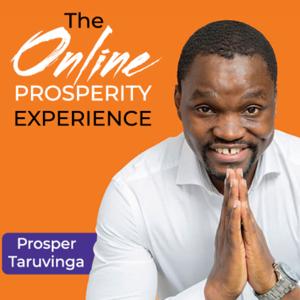
Unlock the secrets to explosive growth in your business with Prosper Taruvinga's game-changing Digital Marketing Strategies and actionable tactics that you can implement today.
Don't miss out on this exclusive opportunity to take your marketing game to the next level - subscribe to the podcast now!
Prosper has helped more than 50 000 people from over 10 countries to create meaningful businesses that are profitable and enjoyable.
Are you looking for more customers? Are you looking to take your business to the next level, develop stronger relationships with your employees, clients or suppliers, improve your finances or get people liking you before you try to sell them something?
The Online Prosperity Experience gives you access to Prosper’s proven Online Prosperity Blueprint. This is a 4 Step Marketing Strategy designed to help you accomplish your goals.
Whether you’re looking for insight into how to build a bigger business or position yourself as the go-to person in your category, you have access to all the tactics used by celebrities like David Hughes as well as (literally) over 450 small businesses and counting.
With an extensive selection of episodes featuring insightful lessons from Prosper, interviews with some of the most successful people in the world and never-before-released audio content from deep within the archives, you’ll find you can learn a great deal while listening during your morning commute or daily workout.
As Prosper says, “I am the guy you call when you are tired of thinking small”
Get started today by choosing an episode that resonates with where you are right now and enables you to take your business to the next level.