
Sign up to save your podcasts
Or



Most people think autism is a straight line—from “low functioning” to “high functioning.”
But that’s not how it works.
In this video, I break down what the autism spectrum ACTUALLY looks like in a way that’s simple, clear, and easy to explain to others. If you’ve ever struggled to explain autism—or felt like people misunderstand it—this will help.
Huge shoutout to @devilspotato33 for the video idea 🙌
We cover:
Whether you’re autistic, know someone who is, or just want to understand better—this video is for you.
If this helped, like the video so more people can see it 👍
And drop your questions in the comments—I might turn yours into the next video.
#autism #autismawareness #actuallyautistic #neurodiversity #autismspectrum #mentalhealth #autismacceptance #neurodivergent #education #autism101
Why does socializing feel so exhausting… even when you enjoy it?
A common misconception about autism is that autistic people just don’t like being around others. But that’s not always true.
In this video, I break down the real reason socializing can be so draining—especially for autistic people—and why it has less to do with introversion, and more to do with something called masking.
I’m actually an extrovert. I enjoy conversations and being around people. But for years, I couldn’t understand why I would feel completely drained afterward.
It turns out, it wasn’t socializing itself—it was the constant mental effort of performative socializing.
We’ll cover:
If you’ve ever felt exhausted after talking to people, this might explain why.
What if there was ONE word that could explain so many struggles with autism?
That word is proprioception — your body’s ability to know where it is in space.
In this video, I break down:
For years, I thought I was just awkward or uncoordinated. Learning about proprioception completely changed how I understood myself.
If you’ve ever:
…this video might explain why.
👍 Subscribe for more videos on autism, sensory processing, and real-life experiences.
#autism #proprioception #sensoryprocessing #autismawareness #stimming #neurodivergent
The conversation delves into the topic of autistic burnout, exploring its causes, symptoms, and impact on individuals. It also discusses the challenges of recognizing and addressing burnout, differentiating it from depression, and strategies for dealing with burnout. Additionally, it highlights the issue of overlooking burnout in students and the importance of awareness and support in educational settings.
Takeaways
The podcast episode delves into the impact of autism in school environments, highlighting the challenges faced by autistic students and the interventions and support provided by schools. It emphasizes the importance of understanding autism better to reduce the struggle for students and uphold their individuality and humanity.
Takeaways
The podcast episode delves into the topic of autism, addressing stereotypes, the neurodevelopmental nature of autism, common myths, lived experiences, the role of teachers in special education, and language and identity in autism. It emphasizes the need for understanding and acceptance of individuals with autism, highlighting the importance of empathy and support.
Takeaways
Chapters
From the publisher's feed
What happens when the student becomes the teacher—and the system looks very different from both sides?
The Other Side of the Desk is a podcast about disability,…
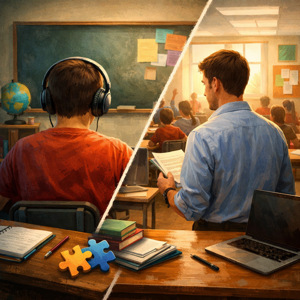
This show explores autism, neurodiversity, special education, and mental health through real conversations, lived experience, and an educator’s lens. It’s not about fixing people—it’s about understanding them. From navigating school as a neurodivergent student, to unpacking IEPs, accommodations, burnout, and belonging, each episode bridges the gap between policy and humanity.
Whether you’re an educator, parent, aide, student, or someone navigating disability yourself, this podcast offers insight, empathy, and perspective from both sides of the desk.
🎧 Honest conversations.
📚 Education with lived experience.
🧠 Disability without the stereotypes.
Because real inclusion starts when we listen.
Ranked by our users in the last 21 days