
Sign up to save your podcasts
Or

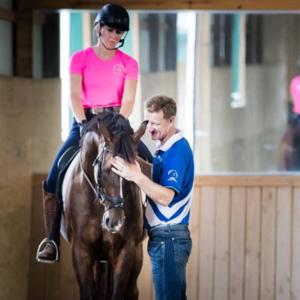


When a rider in the Gold Program Base Camp huddle said she was going round and round a 20-meter circle thinking "soft, soft, I want to get this horse soft," Brett Parbery stopped her with five words: take the word soft out of the picture.
In this episode, Nat Foxon puts that Parberyism to Brett, and it unpacks into a full framework for what riders should be thinking about instead.
Why "soft" and "light" live in the same vague category — feelings you can chase forever and never be happy with.
How dressage is actually a sport built around developing collection, not softness in the hand.
What "yield" and "draw" really mean as tangible, yes-or-no training checks, and how they produce the softness riders are chasing as a byproduct rather than a target.
The supermarket tangent analogy that explains how chasing a feeling drags you off your plan.
The controversy around connection, roundness, and behind-the-vertical — and why the sport needs to explain it better.
Where Brett thinks the word "softness" could genuinely be useful: in the bending joints of the hind legs.
And why balance is the hardest thing for a rider to feel, but the one that makes everything else look easy.
00:00 The Parberyism: "Take the word soft out of the picture"
00:22 Context — the Base Camp huddle where a rider was chasing "soft" on a 20-meter circle
00:48 Why "soft" and "light" live in the same vague category
02:07 Dressage is about developing collection, not softness in the hand
05:37 Softness as a reflection of the rider — and why it can be taken too far
06:09 Suppleness, response to aids, and a more tangible feeling to chase
07:18 The supermarket analogy: how chasing a feeling drags you onto a tangent
10:46 Yield and draw — what they actually mean
12:55 How yield and draw produce the softness riders are chasing
14:50 The controversy around connection, roundness, and behind the vertical
17:45 Softness redefined: the bending joints of the hind legs
19:11 Balance — the hardest thing to feel, the one that makes it look easy
20:36 Homework: yield, draw, responsiveness, and balance
Mentioned: Gold Program, Base Camp huddle, shoulder fore, shoulder-in, travers, half-pass, yield and draw, collection, impulsion, half-halts, throughness, behind the vertical, Performance Riders (performanceriders.com)
Mount St John Freestyle was 17 at Aachen. Verdades was 17 in his last season. So when Linda writes in about her rising 15 year old FEI mare, who has a joint supplement and not much else, the real question is what the next five years could look like.
Laura Graves joins Nat Foxon to answer it, and it turns into a full map of how she keeps horses in work: the crisis she is always trying to head off, why she wants her vet to see the horse on a bad day rather than a good one, where steroids still earn their place alongside IRAP, A2M and stem cells, the farrier as the foundation the whole thing sits on, and the one line item she would cut first if money got tight.
Plus the training side, because Laura's view is that dressage done properly should be adding years to a horse's career rather than taking them off.
Mentioned: Mount St John Freestyle, Verdades, Aachen, Platinum Performance, Adequan, Legend, IRAP, Arthrimed, A2M, stem cell therapy
This episode focuses on how being a good horseperson means looking beyond performance and recognising what your horse needs, rather than simply chasing results or being seen as a “hero” in the saddle.
Brett Parbery and Nat Foxon discuss the balance of goals and plans, with adjusting to your horse on the day, and how that gets even more difficult on competition day.
Ready to map out your best eventing season yet? In this special workshop episode, join legendary five-star eventer Boyd Martin, Olympic gold medalist Peter Wylde, top Australian dressage coach Brett Parbery, and eventing pro Lillian Heard Wood for a deep-dive into building your 2026 eventing plan. You’ll hear Boyd’s honest take on goal setting (for both rider and horse), the importance of rideability, balancing ambition with reality, and why detailed planning and flexibility are the backbone of every successful season. Peter shares show jumping secrets for eventers, Brett unpacks the dressage fundamentals that underpin all phases, and Lillian gives practical advice on structuring your training—even when facilities or confidence are limited. This episode is packed with actionable strategies, candid stories, and the kind of coaching wisdom you won’t find anywhere else. Whether you’re moving up a level, starting out with an off-track Thoroughbred, or chasing your next big breakthrough, you’ll come away inspired—and equipped—to make every ride count. Join the Boyd Martin Eventing Program at www.performanceriders.com/boyd
Join Nat Foxon and a panel of world-class experts—Olympian Laura Graves, coach Brett Parbery, and performance psychologist Jonah Oliver—for a dynamic workshop on mapping out your best year in dressage. In this episode, you’ll learn how to: - Reflect on your past year to fuel real progress - Craft a bold, meaningful vision for your riding and life - Build structure and set measurable, motivating goals - Focus on what matters most, even under pressure - Harness the power of community and support Whether your “Olympics” is a national event or a local club day, this episode will help you reverse-engineer your goals and create a blueprint for success, enjoyment, and growth in 2026. You can work with Laura and the team in the 2026 Gold Program, find out more at www.performanceriders.com/2026gold
Grand Prix Judge Kristen Closson inspired this topic, from her month working with the riders in the Performance Riders Gold Program. Brett Parbery and Nat Foxon discuss what connection really is, how riders are often confused and chasing the wrong feeling, and homework we can all do to improve our feel. Download the free Performance Riders App to use our fun (and super helpful!) AI training tool with Brett.
JJ Tate joins Brett Parbery and Nat Foxon to discuss the idea that 'dressage serves the horse'. Download the Performance Riders app for more free training!
Fresh off the plane from the US working with world number one eventing rider Boyd Martin, Brett Parbery discusses with Nat Foxon the Boyd-ism 'Every champion started as a beginner who refused to quit'. Download the Performance Riders app for free training inspiration and our app-exclusive Weekly Hack training segment.
Brett Parbery and Nat Foxon launch into Brett's 'no filter era' with a conversation about how he would prefer to watch a well-ridden palomino pony than a poorly trained fancy imported warmblood, any day! Find out about working with Brett and Nat to upgrade your dressage training, at www.performanceriders.com
From the publisher's feed