
Sign up to save your podcasts
Or



“Singularities Make Me Nervous” is from Larry Niven’s collection Convergent Series.
After exploring the space near a blackhole, astronaut George Cox returns to his apartment to confront...himself! This is no surprise to him, as Cox has traveled back in time in before in the same repeating loop. His younger self, however, is unsure how to handle the situation—until the pair conspire a scam that could make them millions.
Mind Webs was a 1970's series out of WHA Radio in Wisconsin that featured weekly short stories of science fiction by some of the genre's best writers. The music, sound cues and occasional character voices along with the performance of Michael Hansen, the reader, resulted in better than most fully dramatized productions of the period. Around 150 shows were aired between 1976 and 1984 varying in length, but most were about 30 minutes.
“My Object All Sublime” by Poul Anderson is a sly little story within a story. It begins with a chance encounter, then we hear a stranger telling a story of time travel that seems entirely farfetched… until it isn’t. It’s a great little gem from the June 1961 issue of Galaxy and one of Michael Hanson’s better productions. Highly recommended!
Mind Webs was a 1970's series out of WHA Radio in Wisconsin that featured weekly short stories of science fiction by some of the genre's best writers. The music, sound cues and occasional character voices along with the performance of Michael Hansen, the reader, resulted in better than most fully dramatized productions of the period. Around 150 shows were aired between 1976 and 1984 varying in length, but most were about 30 minutes.
“History Lesson” first appeared in the May, 1949 issue of Startling Stories.
This is a fun little story that is split neatly into two narratives.
The first part of the story is told from the perspective of a tribe of nomadic humans of the 30th century, in a future where Earth has entered a final ice age.
The second part of the story is told from the perspective of a race of Venusian reptiles who have evolved into intelligent beings capable of space travel in the 5,000 years since the cooling of the Sun.
The effort of the latter to understand the former is what makes this story so fun. Micheal Hanson really outdid himself this time with the voices and special effects. It’s a great listen.
Mind Webs was a 1970's series out of WHA Radio in Wisconsin that featured weekly short stories of science fiction by some of the genre's best writers. The music, sound cues and occasional character voices along with the performance of Michael Hansen, the reader, resulted in better than most fully dramatized productions of the period. Around 150 shows were aired between 1976 and 1984 varying in length, but most were about 30 minutes.
Jack Williamson was referred to as "The Dean of Science Fiction." His first published story was "The Metal Man," in AMAZING STORIES, December, 1928. The illustration above is by Frank R. Paul. Even at the age of 20 Williamson's writing had a professional polish, and a narrative drive that propelled the story. Williamson was an amazing story himself; self-educated in his early years, he went on to get a doctorate and to be a college professor. He died in 2006 at age 98.
Read more about The Metal Man right here or check out a scanned print copy here.
The Metal Man begins as a narration by Russell, the best friend of the title character:
“The Metal Man stands in a dark, dusty corner of the Tyburn College Museum. Just who is responsible for the figure being moved there, or why it was done, I do not know. To the casual eye it looks to be merely an ordinary life-size statue. The visitor who gives it a closer view…”
Mind Webs was a 1970's series out of WHA Radio in Wisconsin that featured weekly short stories of science fiction by some of the genre's best writers. The music, sound cues and occasional character voices along with the performance of Michael Hansen, the reader, resulted in better than most fully dramatized productions of the period. Around 150 shows were aired between 1976 and 1984 varying in length, but most were about 30 minutes.
Dick later wrote this about the story:
Here was my first story on the topic of: Am I a human? Or am I just programmed to believe I am human? When you consider that I wrote this back in 1953, it was, if I may say so, a pretty damn good new idea in sf. Of course, by now I’ve done it to death. But the theme still preoccupies me. It’s an important theme because it forces us to ask: What is a human? And — what isn’t.
Mind Webs was a 1970's series out of WHA Radio in Wisconsin that featured weekly short stories of science fiction by some of the genre's best writers. The music, sound cues and occasional character voices along with the performance of Michael Hansen, the reader, resulted in better than most fully dramatized productions of the period. Around 150 shows were aired between 1976 and 1984 varying in length, but most were about 30 minutes.
Isaac Asimov called “The Last Question” his favorite short story.
Why is it my favorite? For one thing I got the idea all at once and didn't have to fiddle with it; and I wrote it in white-heat and scarcely had to change a word. This sort of thing endears any story to any writer. Then, too, it has had the strangest effect on my readers. Frequently someone writes to ask me if I can give them the name of a story, which they think I may have written, and tell them where to find it. They don't remember the title but when they describe the story it is invariably 'The Last Question'. This has reached the point where I recently received a long-distance phone call from a desperate man who began, "Dr. Asimov, there's a story I think you wrote, whose title I can't remember—" at which point I interrupted to tell him it was 'The Last Question' and when I described the plot it proved to be indeed the story he was after. I left him convinced I could read minds at a distance of a thousand miles.
Mind Webs was a 1970's series out of WHA Radio in Wisconsin that featured weekly short stories of science fiction by some of the genre's best writers. The music, sound cues and occasional character voices along with the performance of Michael Hansen, the reader, resulted in better than most fully dramatized productions of the period. Around 150 shows were aired between 1976 and 1984 varying in length, but most were about 30 minutes.
Mind Webs was a 1970's series out of WHA Radio in Wisconsin that featured weekly short stories of science fiction by some of the genre's best writers. The music, sound cues and occasional character voices along with the performance of Michael Hansen, the reader, resulted in better than most fully dramatized productions of the period. Around 150 shows were aired between 1976 and 1984 varying in length, but most were about 30 minutes.
I feel like this might be the perfect story for Michael Hansen to read (although he’s such a wonderful narrator that I think you could say that about many stories) … Ray Bradbury’s “Kaleidoscope” is a chilling story about a group of space-suited men thrown into the void by an exploding ship. They have radio contact but no hope of rescue.
Mind Webs was a 1970's series out of WHA Radio in Wisconsin that featured weekly short stories of science fiction by some of the genre's best writers. The music, sound cues and occasional character voices along with the performance of Michael Hansen, the reader, resulted in better than most fully dramatized productions of the period. Around 150 shows were aired between 1976 and 1984 varying in length, but most were about 30 minutes.
This is one of the rare double-story episodes. The first, “Harrison Bergeron” by Kurt Vonnegut Jr., is a great example of how Hansen incorporated guest voices to superb effect. The second, “The Haunted Spacesuit” by Arthur C. Clarke, is just a great story that Hansen brings to life superby.
Cast Members:
* Curtis Arnall as Buck Rogers
* Adele Ronson as Wilma Deering
* Edgar Stehli as Dr. Huer
* Elaine Melchior as Ardala
* Bill Shelley as Killer Kane
* Jack Roseleigh as Black Barney
Producer/Director: Jack JohnstoneAnnouncers: Paul Douglas and Fred UttalWriters: Dick Calkins, Joe Cross, Jack Johnstone, Albert MillerSponsors: Cocomalt, Cream of Wheat, Kellogg's, and Popsicles
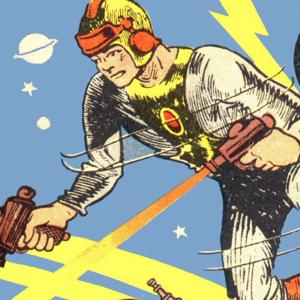
Few fictional characters have had such a profound and prolonged impact on American culture as Buck Rogers.
He first appeared in 1928 as Anthony Rogers in Philip Francis Nowlan’s novella Armageddon 2419 A. D. in Amazing Stories. We've briefly talked about that amazing August issue, which also included Doc Smith's Skylark of Space.
The story caught the attention of National Newspaper Syndicate’s John F. Dille, who contracted Nowlan to adapt the character into a comic strip, changing “Anthony” to “Buck.”
In 1932, the radio program premiered, making it the first science fiction program on radio. Initially broadcasted as a fifteen-minute show on CBS on a Monday through Thursday schedule, the show stayed on the air for the next fifteen years with varying schedules.
Now, thanks to Archive.org, you can travel back to 1932 and follow the adventures of “Buck and Wilma and all their fascinating friends and mysterious enemies in the super-scientific 25th century” (as stated in the show’s introduction).
Buck Rogers is largely credited with bringing into popular culture the concept of space exploration, not to mention ray guns and robots. Ray Bradbury may have stated it best in his introduction to The Collected Works of Buck Rogers in the 25th Century, when discussing its comic strip form:
There you are, waiting, trembling, in fevers; so full of life that if you were a volcano you’d come up in someone’s cornfield and bury the silo. There you are, as afternoon slides toward warm dusk, eyes shut, listening…
And there’s the sound, whistling through the air, crashing along the shingles, sliding down the roof, falling to the porch. You fling the door wide. You bend to touch that incredible newspaper with a hot hand. Buck Rogers had just been born. And you a single wise small boy, are there alone to welcome him to a world he will help change forever.
From the publisher's feed
201 Listeners