
Sign up to save your podcasts
Or

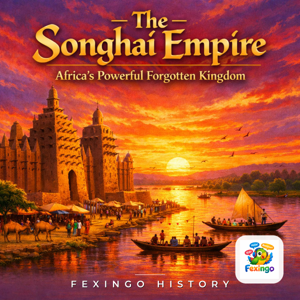


The Songhai Empire is often told through its sultans and generals, but what about the women who shaped its politics, religion, and daily life? This episode of Fexingo History dives into the overlooked roles of royal women in Songhai, from the influential queen mother who brokered peace in a civil war to the female scholars who taught at Sankore and the women who managed the vast agricultural estates along the Niger River. Drawing on the Tarikh al-Sudan and oral traditions, Lucas and Luna explore how women like the Gao princess who married a Moroccan pasha, the wives and daughters of Askia Dawud who ran diplomatic networks, and the ordinary women who sustained the empire's economy. They discuss the legal status of women under Songhai's Malikite law, the mysterious 'koyam' title that may have belonged to a female official, and the women-led resistance after the Saadian invasion. This is a side of Songhai history that rarely gets told — intimate, surprising, and crucial to understanding how the empire actually worked.
#SonghaiEmpire #WestAfricanHistory #WomenInHistory #AskiaDawud #TarikhAlSudan #SankoreMadrasa #Gao #Timbuktu #NigerRiver #MalikiteLaw #QueenMothers #FemaleScholars #OralTradition #SaadianInvasion #DendiResistance #Koyam #History #FexingoHistory
Keep every episode free: buymeacoffee.com/fexingo
This episode explores the reign of Askia Musa, the Songhai emperor who faced the rising tide of the Fulani jihad in the early 16th century. We discuss his efforts to suppress the early jihad led by the charismatic cleric Karamoko Alfa, the Battle of Talwan, and how Songhai's military responded to the religiously charged rebellion. Along the way, we touch on Musa's background as a general under Askia Muhammad, his consolidation of power after a disputed succession, and the long-term impact of the jihad that would eventually topple the empire. We also look at the role of the Torodbe clerics and the growing influence of Islam in West Africa during this period.
#SonghaiEmpire #AskiaMusa #FulaniJihad #KaramokoAlfa #BattleOfTalwan #Torodbe #WestAfrica #16thCentury #IslamWestAfrica #Jihad #Sahel #Gao #NigerRiver #AskiaMuhammad #History #FexingoHistory #AfricanHistory #Empire
Keep every episode free: buymeacoffee.com/fexingo
As the Songhai Empire expanded under Askia Muhammad, one province refused to yield: Kebbi. In this episode, Lucas and Luna explore the Kanta rebellion of the early 16th century, a sustained insurgency that exposed the limits of Songhai's military might. We meet Muhammad Kanta, the Kebbi commander who repeatedly routed imperial forces and held the Niger's western flank. Drawing on the Tarikh al-Sudan and Leo Africanus's accounts, we examine how Kanta exploited Songhai's overextended supply lines, the role of cavalry and riverine tactics, and why Kebbi remained unassimilated even under Askia Dawud. The episode also touches on the Kanta's legacy as a symbol of resistance in Hausa oral tradition, the economic toll of the rebellion on trans-Saharan trade, and how the conflict foreshadowed later fractures that would weaken Songhai before the Moroccan invasion. A focused look at a lesser-known but pivotal challenge to imperial rule in the Sahel.
#SonghaiEmpire #KantaRebellion #MuhammadKanta #Kebbi #AskiaMuhammad #TarikhAlSudan #LeoAfricanus #WestAfricanHistory #Sahel #NigerRiver #Hausa #Cavalry #TransSaharanTrade #Resistance #16thCentury #AfricanEmpires #History #FexingoHistory
Keep every episode free: buymeacoffee.com/fexingo
After Askia Dawud's long reign, Songhai faced a succession crisis that brought Askia al-Hajj to power in 1582. A devout but inexperienced ruler, al-Hajj inherited an empire at its peak — yet within six years he would be overthrown, setting the stage for the Moroccan invasion of 1591. This episode explores al-Hajj's brief reign: his religious patronage, his failed military campaigns against the Fulani and Mossi, and the internal fractures that weakened Songhai when it needed strength most. Using the Tarikh al-Sudan as our guide, Lucas and Luna examine how al-Hajj's reliance on the farari and his neglect of the kanta commanders alienated key allies. They also discuss al-Hajj's construction projects in Gao and Timbuktu, his relationship with the Sankore scholars, and the little-known revolt of the Sorko fishermen that foreshadowed the empire's collapse. A story of piety, ambition, and the slow unraveling of a golden age.
#SonghaiEmpire #AskiaAlHajj #TarikhAlSudan #Gao #Timbuktu #Sahel #WestAfrica #Sankore #Farari #Kanta #Sorko #Mossi #Fulani #MoroccanInvasion #Dendi #History #FexingoHistory #AfricanHistory
Keep every episode free: buymeacoffee.com/fexingo
In this episode, we explore the remarkable engineering feat of Askia Dawud's canal system in the Kala region of Songhai. Built around 1550 CE, this 10-kilometer channel diverted water from the Niger River to transform arid floodplains into fertile farmland. We discuss the technical challenges, the role of Sorko laborers, and how this project boosted Songhai's economy and population. We also touch on the broader context of West African hydraulic engineering, comparing it to contemporary projects in the Mali Empire and elsewhere. This is a story of innovation, state power, and human ingenuity in the Sahel.
#SonghaiEmpire #AskiaDawud #Canal #Kala #NigerRiver #Sorko #WestAfrica #Irrigation #AgriculturalRevolution #HydraulicEngineering #Sahel #16thCentury #Timbuktu #Gao #FexingoHistory #History #Podcast #AhmadBaba
Keep every episode free: buymeacoffee.com/fexingo
In this episode, Lucas and Luna explore Songhai's economic backbone: the copper and salt trade that made the empire a Sahelian powerhouse. They dive into the role of the Taghaza salt mines—where slabs of salt were traded ounce-for-ounce with gold—and the copper crosses from Takedda that served as currency across West Africa. Lucas explains how Askia Muhammad regulated these trades, the brutal conditions at Taghaza described by Leo Africanus, and how the Moroccan invasion of 1591 was partly driven by control of these resources. The conversation also covers the social impact of the trans-Saharan slave trade, which Songhai both participated in and regulated, and how economic decline after Tondibi led to the empire's fragmentation. Listeners will learn about the Wangara merchants who connected the Sahel to Mediterranean markets, and the little-known copper currency called mitqal. This episode offers a fresh angle on Songhai's economy, focusing on the material goods that literally shaped its power.
#SonghaiEmpire #TaghazaSalt #TakeddaCopper #TransSaharanTrade #AskiaMuhammad #LeoAfricanus #SahelHistory #WestAfrica #WangaraMerchants #MitqalCurrency #SlaveTrade #GoldSaltTrade #MoroccanInvasion #TarikhAlSudan #EconomicHistory #PrecolonialAfrica #FexingoHistory #History
Keep every episode free: buymeacoffee.com/fexingo
In this episode, Lucas and Luna dive into a pivotal chapter of Songhai's expansion: Askia Muhammad's campaigns against the Mossi kingdoms south of the Niger bend. Drawing on oral traditions and the Tarikh al-Sudan, they explore why the Mossi resisted Songhai rule, the brutal sieges of the early 1490s, and the diplomatic aftermath that saw Mossi princes sent to Gao. Lucas explains how the Mossi cavalry challenged Songhai's river-based power, and how the conflict shaped the empire's southern frontier for generations. Listeners will learn about the roles of the Yatenga and Ouagadougou kingdoms, the impact on trans-Saharan trade routes, and the long-term cultural exchange between Songhai and the Mossi states. A nuanced look at empire-building through the lens of one of its toughest adversaries.
#SonghaiEmpire #AskiaMuhammad #MossiKingdoms #TarikhAlSudan #WestAfrica #Gao #Yatenga #Ouagadougou #NigerBend #TransSaharanTrade #Cavalry #Siege #EmpireBuilding #OralTradition #History #FexingoHistory #WestAfricanHistory #AskiaDynasty
Keep every episode free: buymeacoffee.com/fexingo
In the early 16th century, Askia Muhammad overhauled Songhai's legal system, blending Islamic law with local customs. This episode explores the creation of a cadre of qadis, the establishment of appellate courts in Gao and Timbuktu, and the influence of scholars like al-Maghili. We discuss how these reforms centralized power, resolved disputes over land and trade, and left a lasting legacy in the Sahel.
#SonghaiEmpire #AskiaMuhammad #Qadis #IslamicLaw #LegalReforms #Gao #Timbuktu #alMaghili #Sahel #WestAfrica #History #FexingoHistory #JudicialSystem #AppellateCourts #LandDisputes #Trade #TarikhAlSudan #LeoAfricanus
Keep every episode free: buymeacoffee.com/fexingo
We're back with Lucas and Luna to explore a surprisingly overlooked engine of the Songhai Empire's prosperity: its currency. In the golden age of Askia Dawud (r. 1549–1582), Songhai didn't just control trade routes — it minted its own copper coins, the *kabara*, and managed a complex monetary system that stretched from the salt mines of Taghaza to the kola forests of the south. We walk through the archaeology of these coins, the theory behind state-issued currency in a pre-colonial African empire, and how the *farari* tax collectors enforced standards. We also compare it to the cowrie-shell economy and look at why Askia Dawud's successors couldn't maintain the system after the Moroccan invasion. Specifics include the *Tarikh al-Sudan* accounts of price controls, the role of Timbuktu's *qadis* in verifying weights, and the practical challenges of keeping copper flowing across the Sahel.
#SonghaiEmpire #AskiaDawud #AfricanCurrency #Kabara #TarikhAlSudan #Farari #Timbuktu #Gao #Taghaza #CowrieShells #SahelTrade #CopperCoinage #16thCentury #WestAfrica #NigerRiver #Numismatics #History #FexingoHistory
Keep every episode free: buymeacoffee.com/fexingo
In this episode, Lucas and Luna dive into one of the most ambitious engineering projects of the Songhai Empire: the great canal built under Askia Dawud in the Kala region. Drawing on the Tarikh al-Sudan, they explore how the canal transformed the Niger River's floodplain into a controlled irrigation system, boosting agricultural surplus and centralizing power. They discuss the role of the Sorko fishermen in construction, the political implications of controlling water, and how the canal connected to the farari intelligence network. The episode also touches on the canal's eventual siltation after the Saadian invasion and what remains today. A story of ingenuity, labor, and the quiet power of infrastructure in empire-building.
#SonghaiEmpire #AskiaDawud #NigerRiver #Kala #TarikhAlSudan #Sorko #Farari #Canal #Irrigation #Agriculture #WestAfrica #EmpireBuilding #Infrastructure #Engineering #Sahel #16thCentury #History #FexingoHistory
Keep every episode free: buymeacoffee.com/fexingo
From the publisher's feed