
Sign up to save your podcasts
Or

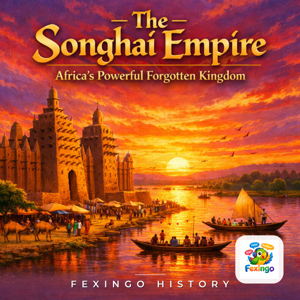


This episode takes you to the banks of the Niger River to explore Gao, the heart of the Songhai Empire. From its origins as a small trading port to its golden age under Askia Muhammad, we uncover the city's remarkable monuments—most notably the towering mud-brick Tomb of Askia Muhammad, a UNESCO World Heritage site built after his legendary Hajj. Learn how the city's architecture reflected Islamic influences and Songhai power, and how the Niger River fueled its economy. But Gao's glory didn't last: after the Saadian invasion of 1591, the capital was abandoned and fell into ruin. We also discuss the role of oral tradition and the Timbuktu manuscripts in preserving Gao's memory. Lucas and Luna walk through the history of a city that once ruled the Sahel, from its founding by the Dia dynasty to its final decline. Along the way, they touch on the Askia dynasty, trans-Saharan trade, and the cultural legacy of Songhai architecture.
#Gao #SonghaiEmpire #AskiaMuhammad #TombOfAskia #NigerRiver #Sahel #WestAfrica #UNESCO #Architecture #Hajj #SonniAli #TarikhAlSudan #Timbuktu #MudBrick #TransSaharanTrade #OralTradition #FexingoHistory #History
Keep every episode free: buymeacoffee.com/fexingo
Most histories of the Songhai Empire focus on its land armies and trans-Saharan trade, but the empire's real strategic backbone may have been its river fleet. In this episode, we explore the Sorko boatmen—the Niger's indigenous shipbuilders and warriors—who formed the core of Songhai's naval power. We examine how the fari-mondio (admiral) commanded flotillas of war canoes that patrolled the bend of the Niger, transported troops for campaigns against the Mossi and Fulani, and suppressed rebellions like the Kanta uprising. Discover the construction of the massive dugout canoes, some capable of carrying 30 soldiers, and how the navy facilitated the empire's control over riverine trade and communication. We also discuss the decline of the fleet after the Moroccan invasion of 1591 and the dispersal of the Sorko communities. This episode sheds light on a neglected aspect of Songhai's military and economic might.
#SonghaiNavy #NigerRiver #Sorko #FariMondio #AskiaMuhammad #KantaRebellion #WestAfrica #RiverineWarfare #AfricanMilitaryHistory #CanoeFleet #Gao #Timbuktu #SonghaiEmpire #PrecolonialAfrica #NavalHistory #NigerBend #History #FexingoHistory
Keep every episode free: buymeacoffee.com/fexingo
In this episode, Lucas and Luna travel back to the origins of the Songhai people, long before the great Askia Muhammad. They explore the little-known Dia dynasty, which ruled from the ancient city of Kukiya along the Niger River, and its gradual conversion to Islam through trade with North Africa. Then they trace the rise of the Sunni dynasty, culminating in the powerful and controversial Sonni Ali—the warrior-king who expanded Songhai into a regional force, clashed with the Tuareg and the Moors, and laid the groundwork for the empire that the Askias would inherit. Drawing on the Tarikh al-Sudan and Tarikh al-Fattash, they discuss Sonni Ali's brutal methods, his reputation as both a tyrant and a unifier, and the murky transition to Askia Muhammad's reign. This episode fills in the missing centuries of Songhai's story, revealing the foundations of one of Africa's greatest empires.
#SonghaiEmpire #DiaDynasty #SunniDynasty #SonniAli #Kukiya #Gao #TarikhAlSudan #TarikhAlFattash #WestAfrica #NigerRiver #AfricanHistory #PreAskiaSonghai #Sahel #Timbuktu #IslamInAfrica #MedievalAfrica #FexingoHistory #History
Keep every episode free: buymeacoffee.com/fexingo
In the early 16th century, the Songhai Empire under Askia Muhammad was the dominant power in West Africa, controlling the gold and salt trades. Meanwhile, Portuguese explorers were charting the African coast, seeking the source of Mali's legendary gold. In 1495, Askia Muhammad sent an ambassador named al-Hajj to the court of King Manuel I of Portugal, initiating a brief diplomatic exchange. This episode explores what each side hoped to gain—Songhai sought firearms and allies against the Mossi; Portugal wanted gold and an inland route to the spice trade. We examine the letters exchanged, the gifts sent (including a giraffe!), and why the alliance never materialized. Lucas and Luna also discuss how Songhai's isolation from Atlantic trade contributed to its vulnerability to Moroccan invasion decades later. Finally, a reflection on what might have been if Songhai had embraced broader global connections.
#SonghaiEmpire #AskiaMuhammad #PortugueseExploration #WestAfrica #DiogoCão #ManuelI #TransSaharanTrade #GoldTrade #AfricanDiplomacy #FexingoHistory #Timbuktu #Sankore #History #MedievalAfrica #AtlanticHistory #DiplomaticHistory #Giraffe #MaliEmpire
Keep every episode free: buymeacoffee.com/fexingo
After the catastrophic defeat at Tondibi in 1591, the Songhai Empire did not vanish overnight. This episode follows the remarkable resistance led by Askia Nuh, who retreated south to the Dendi region and waged a guerilla war against Moroccan occupiers for nearly two decades. We explore how Nuh re-established a shadow court, disrupted Moroccan supply lines, and kept the Songhai flame alive until internal divisions and superior Moroccan firepower finally overwhelmed his kingdom. Along the way, we examine the role of the Niger River as a defensive barrier, the shifting alliances with local communities, and the legacy of this forgotten struggle that shaped the Sahel for generations.
#Songhai #AskiaNuh #Dendi #MoroccanInvasion #Tondibi #GuerillaWar #WestAfrica #Sahel #NigerRiver #Resistance #1591 #JudarPasha #TarikhAlSudan #AlSaadi #Gao #LastStand #History #FexingoHistory
Keep every episode free: buymeacoffee.com/fexingo
In 1495, Askia Muhammad—the first emperor of the Songhai Empire—set out from Gao on a pilgrimage to Mecca. This episode of Fexingo History follows his journey across the Sahara with a retinue of thousands and a fortune in gold. Drawing on the Tarikh al-Sudan and Leo Africanus, we explore how the Hajj transformed Songhai's religious and political identity. Learn about Askia Muhammad's audience with the Sharif of Mecca, his investiture as 'Caliph of the Sudan,' and the scholars he brought back to Timbuktu. We also contrast his devout Islam with Sonni Ali's pragmatic skepticism, and examine how the pilgrimage integrated Songhai into the global Islamic community, paving the way for the empire's golden age of scholarship and trade.
#SonghaiEmpire #AskiaMuhammad #Hajj #Mecca #TarikhAlSudan #LeoAfricanus #Gao #Timbuktu #SaharanTrade #IslamInAfrica #WestAfricanHistory #CaliphOfTheSudan #SharifOfMecca #Pilgrimage #1490s #15thCentury #History #FexingoHistory
Keep every episode free: buymeacoffee.com/fexingo
Askia Muhammad didn't just conquer an empire — he needed a new set of laws to rule it. Enter Muhammad al-Maghili, a fiery North African jurist who arrived in Gao around 1498 and helped reshape Songhai's legal foundations. In this episode, Lucas and Luna explore al-Maghili's controversial career: his earlier role in the expulsion of Jews from the Tuat oasis, his harsh critique of Sonni Ali's rule, the famous questions Askia Muhammad posed to him, and the surviving legal text 'The Obligations of Princes' that became a blueprint for Islamic governance in West Africa. They also discuss how al-Maghili's legacy reverberated — from the Timbuktu scholars who debated his fatwas to the Saadian sultans who consulted his works. Along the way, we touch on the tension between royal authority and religious law, the role of the qadi in Songhai, and why al-Maghili is sometimes called the 'patron saint' of West African Islam. A deep dive into the man who gave Songhai its Islamic soul.
#SonghaiEmpire #AlMaghili #AskiaMuhammad #IslamicLaw #WestAfrica #ObligationsOfPrinces #Timbuktu #Gao #Tuat #Fatwa #Qadi #TarikhAlSudan #LeoAfricanus #SonniAli #Sahel #MedievalAfrica #History #FexingoHistory
Keep every episode free: buymeacoffee.com/fexingo
In this episode of Fexingo History, Lucas and Luna explore the agricultural and engineering marvels of the Songhai Empire under Askia Dawud, focusing on the construction of the Great Canal of Kala. This massive irrigation project transformed the Niger floodplain, turning arid land into fertile fields and sustaining the empire's growing population. Discover how the Sorko people, masters of water management, collaborated with the emperor to dig a canal over 4 kilometers long, diverting the Niger's waters to create a network of channels. Learn about the farari, the empire's provincial governors, who managed the labor and resources for this monumental task. We also examine the canal's impact on trade, food security, and the environment, drawing on accounts from the Tarikh al-Sudan and al-Sa'di. This episode reveals how Songhai's rulers invested in infrastructure to build a lasting legacy, long before the Moroccan invasion. Join us for a deep dive into one of Africa's forgotten engineering feats.
#SonghaiEmpire #AskiaDawud #GreatCanal #Kala #NigerRiver #Sorko #Farari #Irrigation #Agriculture #WestAfrica #Sahel #Timbuktu #Gao #TarikhAlSudan #AlSadi #Engineering #History #FexingoHistory
Keep every episode free: buymeacoffee.com/fexingo
In this episode, Lucas and Luna explore the economic backbone of the Songhai Empire: the trans-Saharan trade networks that connected West Africa to the Mediterranean and beyond. They discuss the crucial role of gold from the Bambuk and Bure fields, the salt mines of Taghaza and Taoudenni, and the bustling markets of Gao and Timbuktu. Lucas explains how Songhai sultans like Askia Muhammad and Askia Dawud managed trade routes, imposed taxes, and regulated currency—including cowrie shells and copper mitqals. The conversation touches on the importance of the Niger River as a highway for goods, the legendary wealth that drew the Saadian invasion, and the everyday realities for merchants traveling the Sahara. Specifics include the tariff rates recorded in the Tarikh al-Sudan, the role of Wangara traders, and the impact of Moroccan firearms on trade dynamics. This episode provides a vivid picture of how Songhai's economy functioned at its peak.
#SonghaiEmpire #TransSaharanTrade #Gold #Salt #NigerRiver #Gao #Timbuktu #Taghaza #AskiaMuhammad #AskiaDawud #TarikhAlSudan #Wangara #CowrieShells #Mitqal #Sahel #WestAfricanHistory #History #FexingoHistory
Keep every episode free: buymeacoffee.com/fexingo
The Songhai Empire is often told through its sultans and generals, but what about the women who shaped its politics, religion, and daily life? This episode of Fexingo History dives into the overlooked roles of royal women in Songhai, from the influential queen mother who brokered peace in a civil war to the female scholars who taught at Sankore and the women who managed the vast agricultural estates along the Niger River. Drawing on the Tarikh al-Sudan and oral traditions, Lucas and Luna explore how women like the Gao princess who married a Moroccan pasha, the wives and daughters of Askia Dawud who ran diplomatic networks, and the ordinary women who sustained the empire's economy. They discuss the legal status of women under Songhai's Malikite law, the mysterious 'koyam' title that may have belonged to a female official, and the women-led resistance after the Saadian invasion. This is a side of Songhai history that rarely gets told — intimate, surprising, and crucial to understanding how the empire actually worked.
#SonghaiEmpire #WestAfricanHistory #WomenInHistory #AskiaDawud #TarikhAlSudan #SankoreMadrasa #Gao #Timbuktu #NigerRiver #MalikiteLaw #QueenMothers #FemaleScholars #OralTradition #SaadianInvasion #DendiResistance #Koyam #History #FexingoHistory
Keep every episode free: buymeacoffee.com/fexingo
From the publisher's feed