
Sign up to save your podcasts
Or

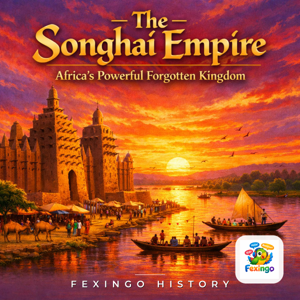


In 1591, the Saadian army of Judar Pasha conquered Timbuktu, but one man refused to bow. Ahmed Baba, the city's greatest scholar, was arrested and marched 2,000 miles to Marrakech, where he spent years under house arrest. This episode follows the intellectual resistance of a man whose students included the jurist Al-Maghili and whose library held thousands of manuscripts. We explore the power of scholarship in Songhai, the Saadian occupation's assault on learning, and Ahmed Baba's eventual return to Timbuktu, where he rebuilt the city's scholarly tradition. We also discuss the Tarikh al-Sudan and Tarikh al-Fattash, chronicles that preserved Songhai's history against the tide of empire. A story of resilience, knowledge, and the fight to keep a civilization's memory alive.
#AhmedBaba #Timbuktu #SonghaiEmpire #SaadianInvasion #JudarPasha #TarikhAlSudan #TarikhAlFattash #AlMaghili #Marrakech #Scholarship #IntellectualResistance #WestAfrica #Sankore #History #FexingoHistory #Podcast #AfricanHistory #16thCentury
Keep every episode free: buymeacoffee.com/fexingo
This episode dives into the gold trade that underpinned Songhai's wealth and power, focusing on the legendary goldfields of Bambuk and Bure. Lucas and Luna explore how gold flowed from the senegambian and upper Niger regions through Songhai's trade networks, the role of the dyula merchants, the silent trade with Wangara miners, and the political control mechanisms the Askia dynasty used to manage this precious resource. They also touch on the environmental and social impacts of gold mining, the connection to the trans-Saharan trade, and how gold shaped Songhai's conflicts with the Saadian Empire. The conversation draws on historical accounts from al-Bakri, Ibn Battuta, and the Tarikh al-Sudan, offering a nuanced look at an economic pillar rarely discussed in depth. Listeners will learn about the specific mines, trade routes, and the often-mythologized practices surrounding West African gold.
#SonghaiEmpire #GoldTrade #Bambuk #Bure #Wangara #Dyula #TransSaharanTrade #AskiaMuhammad #Saadian #TarikhAlSudan #WestAfrica #NigerRiver #SilentTrade #AlBakri #IbnBattuta #MedievalAfrica #History #FexingoHistory
Keep every episode free: buymeacoffee.com/fexingo
In this episode, Lucas and Luna explore how the Songhai Empire managed its most vital resource — the Niger River — and developed sophisticated systems to prevent famine. They discuss the role of the fari-mondio, the empire's chief administrator who oversaw grain storage and distribution, and the network of state-controlled granaries known as kore. Learn about the ingenious irrigation techniques used along the Niger floodplains, including the falo system of dikes and canals, and how Askia Muhammad's reforms after his pilgrimage improved agricultural output. The episode also covers the devastating famine of 1582 under Askia Dawud, which exposed cracks in the system, and the long-term environmental challenges that contributed to the empire's decline. Tune in for a deep dive into the unsung story of Songhai's agricultural backbone — the farmers and engineers who fed an empire.
#SonghaiEmpire #NigerRiver #AskiaMuhammad #AskiaDawud #fari-mondio #kore #falo #irrigation #famine #WestAfrica #Sahel #agriculture #grainStorage #environmentalHistory #16thCentury #FexingoHistory #History #AfricanHistory
Keep every episode free: buymeacoffee.com/fexingo
In 1591, the mighty Songhai Empire faced its final reckoning at the Battle of Tondibi, where a small Saadian army armed with arquebuses shattered the farari cavalry and brought down a dynasty. This episode follows the battle's dramatic course, from the Saadian invasion across the Sahara to the desperate Songhai defense and the empire's subsequent collapse into the Dendi successor state. We explore the strategic miscalculations of Askia Ishaq II, the role of the Sorko fishermen in the riverine resistance, and the lasting consequences of gunpowder technology in the Sahel. Along the way, we examine the Tarikh al-Sudan's account and the fates of key figures like Judar Pasha and the exiled Askia Muhammad Bano. A story of courage, catastrophe, and the end of an era in West African history.
#SonghaiEmpire #BattleOfTondibi #AskiaIshaqII #JudarPasha #SaadianInvasion #WestAfricanHistory #GunpowderEmpires #TarikhAlSudan #NigerRiver #Gao #Dendi #SorkoFishermen #FarariCavalry #SahelHistory #16thCentury #MilitaryHistory #History #FexingoHistory
Keep every episode free: buymeacoffee.com/fexingo
When you think of Songhai, you probably imagine camel caravans crossing the Sahara or cavalry thundering across the Sahel. But this episode of Fexingo History takes you onto the Niger River itself. Lucas and Luna explore the Songhai navy—a fleet of war canoes crewed by Sorko fishermen that patrolled over a thousand miles of inland waterways. Learn how the Sorko, long before the empire, evolved from river hunters into the backbone of Songhai's naval power. Discover the role of the 'hiyo' war canoes, the strategic use of river islands as naval bases, and how Askia Muhammad leveraged this fleet to subdue the rebellious Kebbi kingdom and the Mossi states. We discuss the famous Battle of Koli-Koli in 1499, where Songhai's river forces ambushed the Mossi, turning the Niger into a highway for conquest. We also examine the navy's decline under Askia Dawud and its final futile stand against the Saadian invasion at Tondibi. This episode reveals a forgotten dimension of Songhai's military might: a navy that ruled the greatest river of West Africa.
#SonghaiNavy #NigerRiver #Sorko #AskiaMuhammad #BattleOfKoliKoli #Kebbi #Mossi #AskiaDawud #Tondibi #Saadian #WestAfrica #NavalHistory #WarCanoes #Hiyo #RiverWarfare #SonghaiEmpire #FexingoHistory #History
Keep every episode free: buymeacoffee.com/fexingo
Long before the fall of Gao, Timbuktu was a city of books. In this episode, Lucas and Luna explore the legendary libraries of Songhai — not the Sankore Madrasa, but the private book collections that turned Timbuktu into a center of global learning. They follow the story of a single manuscript: a 16th-century copy of al-Maghili's legal writings, annotated by the great scholar Ahmed Baba himself. Lucas explains how the trans-Saharan book trade brought works from as far as Baghdad and Andalusia, how Timbuktu's scholars built personal libraries of thousands of volumes, and how the city's book culture survived — and then didn't survive — the Saadian invasion in 1591. Along the way, they meet the librarian Mahmud Kati, whose Tarikh al-Fattash became a priceless source; hear about a book that was ransomed for salt; and grapple with the tragedy of what was lost when Judar Pasha's men used priceless manuscripts as packing paper. This episode is a love letter to the written word in the Sahel.
#Timbuktu #AhmedBaba #SonghaiLibraries #TransSaharanBookTrade #TarikhAlFattash #MahmudKati #BookCulture #SahelHistory #Manuscript #AlMaghili #JudarPasha #SaadianInvasion #WestAfricanHistory #SonghaiEmpire #AfricanLibraries #History #FexingoHistory #LostKnowledge
Keep every episode free: buymeacoffee.com/fexingo
This episode reveals the Koyam, Songhai's secret police force that kept Askia Dawud's empire stable for decades. Operating from the capital Gao, these agents monitored provincial governors, military commanders, and even members of the royal family. We explore how the Koyam used a network of informants, written reports, and swift reprisals to suppress dissent before it could grow. Drawing on the Tarikh al-Sudan and other chronicles, Lucas and Luna discuss the Koyam's origins under Askia Muhammad, their expansion under Dawud, and their role in uncovering the conspiracy of Askia el-Hadj in 1586. They also examine the Koyam's methods—how they gathered intelligence, maintained loyalty through rewards and fear, and what happened to them after the Saadian invasion of 1591. The conversation touches on the balance between security and tyranny, comparing the Koyam to other historical secret police forces like the Ottoman janissaries and the Mughal intelligence network.
#Koyam #SonghaiEmpire #AskiaDawud #TarikhAlSudan #Gao #SecretPolice #WestAfrica #Sahel #AskiaMuhammad #JudarPasha #Tondibi #Surveillance #Intelligence #Empire #History #FexingoHistory #Podcast #16thCentury
Keep every episode free: buymeacoffee.com/fexingo
Lucas and Luna explore the role of the farari—Songhai's elite slave soldier corps—in the empire's final decades. Learn how Askia Dawud maintained a formidable army of war captives, and how the system unraveled under his successors. The episode covers the farari training in the Niger floodplains, their loyalty to the Askia over regional nobles, and their catastrophic defeat at the Battle of Tondibi in 1591. It also examines the controversial decision by Askia Ishaq II to deploy untrained slaves against Saadian arquebusiers, a choice that doomed Songhai. Lucas draws on the Tarikh al-Sudan and Leo Africanus to paint a vivid picture of these soldiers' lives—from their capture in Mossi and Hausa raids to their final stand at Gao. The conversation raises a haunting question: could Songhai have survived if it had modernized its army instead of relying on slave levies?
#SonghaiEmpire #Farari #SlaveSoldiers #BattleOfTondibi #AskiaDawud #AskiaIshaqII #SaadianInvasion #JudarPasha #TarikhAlSudan #LeoAfricanus #NigerRiver #Gao #Mossi #Hausa #WestAfrica #MilitaryHistory #History #FexingoHistory
Keep every episode free: buymeacoffee.com/fexingo
In this episode, Lucas and Luna explore the little-known story of Jewish communities in the Songhai Empire during the reign of Askia Muhammad Toure. While Askia Muhammad has been remembered for his Islamic reforms and his pilgrimage to Mecca, his court in Gao also included Jewish advisors who served as diplomats, merchants, and interpreters. Drawing on the Tarikh al-Sudan, Jewish chronicles from North Africa, and accounts by Leo Africanus, they examine the role of the Jewish diaspora from Tlemcen and the Maghreb in the trans-Saharan trade and their integration into Songhai's multicultural society. Lucas explains how the Askia's policy of religious tolerance, rooted in Maliki jurisprudence, allowed Jewish communities to thrive in Timbuktu and Gao, even as they were being persecuted in Spain and Portugal. The episode touches on the legal status of dhimmis in West Africa, the fall of the empire under the Saadian invasion, and the eventual disappearance of Jewish life from the region. Listeners come away with a nuanced view of Songhai as a complex, cosmopolitan state where faith and commerce intersected.
#SonghaiEmpire #AskiaMuhammad #JewsInAfrica #Timbuktu #Gao #TarikhAlSudan #TransSaharanTrade #JewishDiaspora #LeoAfricanus #Tlemcen #Maghreb #Maliki #Dhimmi #ReligiousTolerance #Sahel #WestAfricanHistory #History #FexingoHistory
Keep every episode free: buymeacoffee.com/fexingo
In this episode of Fexingo History, Lucas and Luna explore the Battle of Tondibi (1591), the catastrophic clash that ended the Songhai Empire. They delve into the little-known role of the empire's slave soldiers—captives trained as elite cavalry and infantry—who fought for the Askia against the Saadian invasion. Learn how Songhai's reliance on slave soldiers created both military strength and fatal vulnerabilities, and how the battle's aftermath reshaped West African power dynamics. Along the way, they discuss the arquebus-wielding Saadians, the Niger River's strategic role, and the legacy of Askia Ishaq II's desperate defense. This episode draws on accounts from the Tarikh al-Sudan and the Tarikh al-Fattash to reveal a turning point often overlooked in standard narratives.
#SonghaiEmpire #BattleOfTondibi #SlaveSoldiers #AskiaIshaqII #SaadianDynasty #JudarPasha #TarikhAlSudan #WestAfricanHistory #MilitaryHistory #NigerRiver #Gao #Timbuktu #AfricanEmpires #EarlyModernWarfare #Colonialism #FexingoHistory #History #AfricanHistory
Keep every episode free: buymeacoffee.com/fexingo
From the publisher's feed