
Sign up to save your podcasts
Or

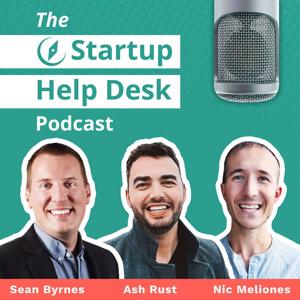


In this episode we talk about getting started. Founding a company means you are constantly learning to do new things, like hiring and selling. How do you handle these new situations where you have no experience? How do you avoid mistakes? We are here to help! In this episode we answer questions including:
All of these questions were submitted by listeners just like you. You can submit questions for us to answer on our website TheStartupHelpdesk.com or on X/Twitter @thestartuphd - we'd love to hear from you!
Your hosts:
Reminder: this is not legal advice or investment advice.
Q1: How is AI changing the nature of work?
AI has transformed daily workflows across every part of the startup journey. From first drafts of sales and marketing copy, to deep research using tools like ChatGPT and Perplexity, it's become the first step for many creative processes. Internal tooling has gotten faster with tools like Replit and Cursor, while product discovery now often starts with AI instead of Amazon. Whether it’s coding, devOps, or customer discovery, AI gives founders leverage.
Q2: How do you stay ahead of how fast AI is changing today?
The key is to stay focused on your customer. While tech shifts rapidly, true customer pain changes slowly. Solve real, urgent problems—and use AI tools along the way to stay nimble. It’s totally fine to use APIs like OpenAI’s or wrap an existing model. The winning strategy? Build something valuable today, and keep evolving it with your users.
Q3: Will my data advantage still be an advantage in the future?
"Proprietary data" is losing its edge. Even Bloomberg's private GPT underperformed public models. Unless your data is restricted, hyper-niche, or massive, it's probably not a moat. What matters more is how well you deliver value to users—accuracy, speed, experience, and reliability. That’s your real advantage.
Q4: Can AI really replace employees for me?
It’s not about replacing people—it’s about hiring the right combination of people and AI. Founders need to build the muscle of managing both. The real opportunity is in learning when to hire a human, and when to "hire" an AI tool. Treat AI as an employee that never sleeps, but still needs thoughtful management. We are already seeing plenty of instances where founders are using AI to replace content marketing teams. Furthermore, there is a trend towards smaller engineering teams, with engineers using AI tools to complement and accelerate their efforts.
In this episode we talk about getting started. Founding a company means you are constantly learning to do new things, like hiring and selling. How do you handle these new situations where you have no experience? How do you avoid mistakes? We are here to help! In this episode we answer questions including:
All of these questions were submitted by listeners just like you. You can submit questions for us to answer on our website TheStartupHelpdesk.com or on X/Twitter @thestartuphd - we'd love to hear from you!
Your hosts:
Reminder: this is not legal advice or investment advice.
Q1: How do I find a co-founder?
Q2: How do I sell my first customers before my product is ready?
Q3: How do I hire my first salesperson?
Tune into the full episode to learn how to navigate these challenging "getting started" moments!
In this episode we talk about process. Big companies have a lot of process, but startups have very little. How much process is enough for your startup? When do you have too little, or too much? We are here to help! In this episode we answer questions including:
All of these questions were submitted by listeners just like you. You can submit questions for us to answer on our website TheStartupHelpdesk.com or on X/Twitter @thestartuphd - we'd love to hear from you!
Your hosts:
Reminder: this is not legal advice or investment advice.
Q1: When is the right time to introduce process?
Too little process leads to chaos. Too much process slows you down. So how do you strike the right balance? The key is to avoid predictable failures – like running out of money, missing legal obligations, or failing to talk to enough customers. You should introduce process selectively to prevent these known risks.
Some processes will naturally emerge as your startup grows. Instead of forcing structure too early, focus on where process adds real value, such as:
- Goal setting (weekly, monthly, quarterly).
- Standardized specs for software to maintain quality.
- Clear rules for custom sales requests to avoid overpromising.
The bottom line: don't create process for process's sake. Evolve it intentionally as your startup grows.
Q2: What if a sales employee refuses to follow our processes?
High performing salespeople often bend the rules. Should you let them? It depends.
What really matters: are they selling the right value proposition? If they are delivering strong sales results without misleading customers or breaking pricing rules, flexibility can be beneficial.
What's not OK: selling things that don't exist. Overpromising features. Ignoring pricing guidelines.
How to handle it: give feedback and set clear boundaries. If you allow flexibility, let them know that you are basing it on performance. If the performance drops, that flexibility disappears.
Bonus tip: you might actually learn from this sales employee! Great salespeople often find better ways to sell – listen and refine your processes accordingly.
Q3: How do I know if we are using too much process?
Warning signs:
- Your velocity feels slow and your team struggles to keep up with opportunities.
- Customers are moving faster than your product development.
- You're spending more time on approvals and red tape than executing.
The right amount of process should be invisible – it makes work easier, not harder. If process is slowing you down, cut back.
A common trap: founders who hire product managers from large companies often end up with too much process. If your team feels like they are drowning in structure, it's time to simplify.
In this episode we talk about employee problems. If you have employees, some of them will create problems that you will have to solve. How do you solve employee problems without firing someone? When do you have to fire someone? We are here to help! In this episode we answer questions including:
All of these questions were submitted by listeners just like you. You can submit questions for us to answer on our website TheStartupHelpdesk.com or on X/Twitter @thestartuphd - we'd love to hear from you!
Your hosts:
Reminder: this is not legal advice or investment advice.
Q1: How do I handle an underperforming co-founder?
Here are our actionable tips:
Q2: What can I do about an employee who is chronically late?
There are two distinct perspectives to consider:
We had to settle this one through a tie-breaker decision! Be firm. Small adjustments are acceptable, but don’t compromise the ability to collaborate. All work is collaborative. Your team has to work together to achieve goals.
Q3: What if you suspect an employee has a second job?
1: Outcomes matter more than effort. Are they meeting their goals?
2: Consider the cost of losing them vs. the value they bring to your startup.
3: Reiterate that team meetings and collaborative efforts are non-negotiable.
The key takeaway is this: ignoring problems sets a precedent that affects company culture. Company culture matters.
In this episode we talk about giving up. Startup companies are hard, and at some point you need to ask whether it's worth grinding or just moving onto something new. When do you stay the course, and when do you give up? We are here to help! In this episode we answer questions including:
All of these questions were submitted by listeners just like you. You can submit questions for us to answer on our website TheStartupHelpdesk.com or on X/Twitter @thestartuphd - we'd love to hear from you!
Your hosts:
Reminder: this is not legal advice or investment advice.
Q1. Should you keep pursuing a goal that is out of reach?
We shared varied perspectives on this one!
Goals are meant to guide progress. Sometimes it is necessary to adjust them to stay relevant and motivating. Adjusting a goal can ensure that you keep your team’s focus on achievable and impactful results, rather than unattainable targets that may demotivate your team.
However, is is important to not create a culture where you habitually lower goals. This can incentivize the wrong behaviors. People will realize that it takes less effort to campaign to reduce the target when compared to the amount of work it takes to reach the goal. Thus, there are plenty of reasons to leave an ambitious goal unchanged – there are benefits to falling short of a goal.
If you fall short of a goal, conduct a retrospective on what went wrong and implement changes to avoid repeating the same mistakes.
Q2. How long should you keep trying if the business is flat?
Deciding to give up on your startup is a personal and often emotional choice, but there are key signals to consider:
- Team members or co-founders are leaving.
- Customers are disengaged and growth has plateaued.
- You feel increasing opportunity costs for staying with the venture.
- The company is running out of cash without a clear path to sustainability.
- There are no viable options to sell the business.
Founders often face the question of whether to persevere or pivot. While icons of persistence may inspire founders to keep going, not all startups are destined to succeed. If critical signals point to insurmountable challenges, it may be time to move on and apply lessons learned to the next venture.
Q3. What happens when co-founders can't work together anymore?
Disagreements or misalignment with a co-founder can harm the company’s growth and morale. Before making the decisions to separate, attempt to address the root causes of conflict and realign expectations.
However, if the relationship has been toxic for an extended period of time and is unresolvable, parting ways may be the best choice for your company’s future. We are not attorneys and this is not legal advice, so please consult your attorneys when parting ways with your co-founder. Ensure the separation process is clean and legal to avoid future disputes. A parting co-founder that retains large amounts of equity or board rights could impede the company’s long-term success, so consult with legal experts to protect the business.
In this episode we dive into annual planning. All companies need annual plans, but most companies don't know how to build great plans. What does a great plan look like? How do you make sure your team believes in your plan? We are here to help! In this episode we answer questions including:
All of these questions were submitted by listeners just like you. You can submit questions for us to answer on our website TheStartupHelpdesk.com or on X/Twitter @thestartuphd - we'd love to hear from you!
Your hosts:
Reminder: this is not legal advice or investment advice.
Q1: What should be part of an annual plan?
Revenue is the centerpiece of startup annual planning. Goals that directly tie to revenue include: Distribution, Engagement, and Churn.
Other goals that correspond to revenue include:
- Product milestones, particularly those that correspond to features customers want.
- Launch dates.
- Runway and budget.
- Hiring.
Most importantly – all these lower level goals should clearly impact the higher level goals like revenue – so don’t agree on a launch date for a new feature if you do not also expect it to drive a meaningful increase in revenue.
Before you start your annual planning, make sure to align your goals with the reality facing your startup.
- For a pre-revenue startup: the goal is to start growing.
- For a startup that has validated demand: the goal is to accelerate growth.
- For a startup that recognizes that something critical is not working: the goal is to validate that next major hypothesis.
Q2: How do I get my team bought into my plan?
Ambitious goals require better performance across multiple teams. You need them to work together instead of pointing fingers.
Start with an objective evaluation of your metrics. How’s your pipeline? How are your conversions? Anything that is not performing well enough needs to improve, regardless of function.
This is where great communication and leadership ability really shines. An ambitious goal requires that you convince others to do great work. Telling people to do the work is easy. However, motivating people to want to do the work is a different story entirely. You need to galvanize all teams around a big goal.
Consider different ways to deliver your motivating message. For example, if both teams need to improve performance in order to achieve your goal (which is likely), then craft a plan that focuses on ambitious targets where you are going to “test assumptions” about ways you can unlock even greater performance. Testing an assumption can unify folks around a common goal instead of pointing fingers.
Q3: How aggressive should our annual goals be?
Investors invest in growth. 3x growth is an accurate benchmark for what investors expect for a startup. However, the business needs to grow on its own; you can’t always push it. If that growth is not possible, you might just not be a venture-backable company. Depending on your industry, you might have different goals. Talk to your investors!
As an alternative, set a realistic goal: get profitable.
- Cut costs.
- Raise prices.
- Focus on your most engaged customers.
That way, you don’t need to raise or at least you won’t need to raise urgently.
In this episode we dive into competitive advantages. Everyone knows they need them, but what are they? How can you have competitive advantages when you are just starting out? What happens if you lose them? We are here to help! In this episode we answer questions including:
All of these questions were submitted by listeners just like you. You can submit questions for us to answer on our website TheStartupHelpdesk.com or on X/Twitter @thestartuphd - we'd love to hear from you!
Your hosts:
Reminder: this is not legal advice or investment advice.
Q1: What competitive advantages can you have when you first start?
Competitive advantages evolve over time. However, some may appear on day 1. For example, a founder with deep technical expertise can offer a unique product. Furthermore, a founder with an established brand can bring an existing audience to sell to. Having an existing distribution channel – and brand name early customers to provide social proof – helps fortify an early distribution advantage.
While these advantages are helpful, the key is to continuously understand your customers and validate their needs.
Q2: What happens if we lose our competitive advantage?
Advantages are often short-lived, especially as your competition learns from you and copies your advantage.
A competitive advantage offers a head start, but the goal is to transform that head start into ongoing customer engagement and product development that solve your customers' problems and exceeds their expectations. Thus, an enduring advantage comes from constantly "talking to users" and building products they love.
Building a talented and committed team is also key. If you can keep talented folks working at your company longer than the competition, that is an advantage.
Q3: How can we turn one advantage into many?
Your product being the "best" is rarely enough. Founders must stay tuned into their customers' needs while understanding why prospects choose the competition. If people are buying solutions to address their problems, that's already good news! Now you need to understand how to assure that customers consider your startup during the buying decision.
Test new approaches to better communicate the value that your product provides prospective customers. At the same time, complete "postmortems" with lost prospects to understand why they chose your competitor.
The more time you spend talking to customers (prospective buyers, existing buyers, and those that you lost to the competition), the faster you can unlock new advantages.
In this episode we dive into raising extensions and bridge rounds. Many companies are looking to these as ways to extend their runway, but they can be complicated. How do you go about raising these kinds of rounds? We are here to help! In this episode we answer questions including:
All of these questions were submitted by listeners just like you. You can submit questions for us to answer on our website TheStartupHelpdesk.com or on X/Twitter @thestartuphd - we'd love to hear from you!
Your hosts:
Reminder: this is not legal advice or investment advice.
Q0: What is the difference between an Extension and a Bridge round?
Extensions and bridge rounds are the same: you’re raising a smaller amount before the next priced round, instead of an actual priced round. There are 2 reasons to do it: a position of strength or weakness. Weakness is the most common situation and you will see people use the term "bridge round" more often here. The term "extension" sounds better, so you should always use that.
When pursuing this type of round, usually you have not grown as fast you would like and thus need more time to hit the milestone needed for the next round. That time requires a little more money.
When pursuing an extension from a position of strength: you have grown very quickly, your existing investors are desperate to add more to their investment and you only need a relatively small amount to skip the next round completely.
Q1: How do I talk to my investors about an Extension?
You really don’t want this to be the first time they hear the news. Make sure you send regular monthly updates to your investors. This makes a huge difference in investors' willingness to help. Make a basic plan first, with the projections and expected outcomes: the extension should prepare you for a great priced round or liquidity event. Then, contact your friendliest folks first and build momentum.
Investors say "no" via email all the time to founders. It is important to break through the noise. Call your investors or meet them in-person to ask for their participation in the extension.
Q2: What happens if one of my investors won't participate?
This is a very common problem. Close the yeses now. A SAFE is one of the more common funding methods for this type of round. Then, you have to decouple the dependencies. Does this investor have real concerns and obstacles? Does this investor just not have the cash to allocate to the extension?
If you cannot get this investor to participate in the round, start rallying new investors. Consider alternatives such as crowdfunding, too.
Q3: How much should you raise for an Extension?
What's your next milestone? Agree on that first. Then: how much cash do you need to reach your next milestone?
Aiming for 12+ months of runway is not a bad way to frame it, but milestones are more important. Is there a critical revenue milestone that you are approaching? Is there a key growth milestone that this extension can help you achieve? Investors want their cash to be fuel for reaching major milestones. Identify the right milestone, and map out how much cash you need to reach it. With that number in hand, remember that you almost always need more funding than you think to reach a given milestone.
In this episode we dive into category creation and what it takes to win in a new category. Many startups are building products unlike anything that has existed before, but how do you build a category around it? How do you let people know it even exists? We are here to help! In this episode we answer questions including:
Sean Byrnes has co-founded, scaled, and sold multiple startups and has invested in and advised countless others. "Category creation" has been central to Sean's ability to go from 0 to 1 and beyond. Ash and Nic put Sean on the hot seat to unlock winning strategies around category creation.
All of these questions were submitted by listeners just like you. You can submit questions for us to answer on our website TheStartupHelpdesk.com or on X/Twitter @thestartuphd - we'd love to hear from you!
Your hosts:
Reminder: this is not legal advice or investment advice.
Q0: What is category creation?
If you are selling something where there was nothing like it before, it’s category creation. This differs from a "replacement": selling a product that replaces something else (a product, person, role).
Q1: How do you anticipate the need for a new category?
Category creation starts with problems. You may observe old problems that go from small to huge (SaaS). Another way for opportunities to emerge is from problems that arise through new technologies, markets, or changes (mobile apps).
“What kinds of problems are increasing in pain but now may be solvable given this shift?” These opportunities all start with inflection points: something needs to change to disrupt the status quo.
Creating new categories is usually not the best approach. Even if it is, it often takes years before people recognize that the category exists.
Q2: How do you educate the market that your new category exists?
While replacement products are all about competitive advantages, category creation is all about education.
Most of the education is not about your product. Instead, educate your prospective customers that it’s possible to solve the problem! You just want everyone to know that solutions exist. Teach people what to look for in solutions: give them criteria and teach them how to evaluate.
With “education” as a central component of your strategy, you still need to stay true to your classic startup principles: validate that people have a need, show them a clear use case, and generate proof that prospective customers want it badly.
Q3: How do you maintain a competitive advantage as your category grows?
First mover advantage is a fantasy. You would much rather be second or third. If you do create a category, there are a few advantages you can build up:
- Premium customer logos.
- Create your own conferences.
- Prime positioning with analysts/industry coverage.
- Defining the industry standard.
Treat customers like co-researchers on this emerging frontier. Earned and owned media builds trust and buy-in.
Lightning Round
How do you validate demand for this type of startup? Is it different in any way than the classic methods that startups should take?
What’s more important: a crystal ball type of ability to anticipate a new category of opportunity or the ability to iterate quickly when an opportunity presents itself?
In this episode we dive into new kinds of Venture Capital firms and what they offer startups. Many startups seek venture funding, but most funds look the same. What can new types of funds offer? When are they a good fit for you? We are here to help! In this episode we answer questions including:
We also hear details on Sterling Road and Near Horizon, two new kinds of venture firms started by our own Ash and Sean!
All of these questions were submitted by listeners just like you. You can submit questions for us to answer on our website TheStartupHelpdesk.com or on X/Twitter @thestartuphd - we'd love to hear from you!
Your hosts:
Reminder: this is not legal advice or investment advice.
Q1: How involved should a typical VC be?
For a typical investor, they should not be involved much at all. Many VCs don’t have experience operating a startup, thus, their advice can be distracting. Nonetheless, it is important to keep them regularly tuned in via monthly status updates.
For investors that have built and led startups, their help can be significantly more meaningful. With Sterling Road, Ash provides regular cadence coaching to help your startup at the earliest stages. This also includes hiring intros, customer intros, community access, and fundraising help.
Sean explains that Near Horizon gets as involved as possible, but they aren’t the CEO. You need a CEO with vision and deep knowledge of the space; Near Horizon is the booster rocket to make them better. They support the CEO with a wide range of founder-centric efforts, but fundraising and hiring remain the CEO’s responsibility.
Q2: What’s more important the founders or the market?
You need both! The table stakes for a startup:
1: The market: it needs to be a huge problem with a lot of potential buyers.
2: The founders: impressive founder with a history of success and resilience is key. The founder will make or break the company.
3: Proof: then you need a great idea, evidence that it might work, a demo, and a bunch of customer discovery.
Great founders can build businesses in small markets, but not venture-backable businesses. Weak founders can show traction in big markets but will struggle to scale. Investors are looking for a unicorn, and that is very rare. Most investors review hundreds if not thousands of startups for every one investment.
Q3: What are examples of an “unfair advantage” that a startup can have?
Ash explained that Sterling Road prizes advantages in tech, network effects, and user experience (usually based on tech, otherwise a competitor could easily copy it).
Sean emphasized that Near Horizon looks for founders with unfair advantages in distribution. You need a way to reach your customers that isn’t paid advertising.
Other nice-to-haves include:
Hiring - having a network of amazing people who want to join your team.
Customer rolodex - knowing the first dozen or so buyers.
Lightning Round
From the publisher's feed
Answers to your questions about starting and building companies. Your hosts are Sean Byrnes, Ash Rust and Nic Meliones, all experienced founders who have built companies themselves and coached…