
Sign up to save your podcasts
Or



The relationship you have with yourself impacts every other relationship in your life. In this episode of The Stories We Tell Ourselves, Dr. Scott explores what it means to build a healthier, stronger relationship with yourself, and why self-awareness, self-acceptance, and self-compassion are essential parts of that process. He looks at the thoughts, emotions, fears, and internal scripts that often run quietly in the background and influence how we see ourselves, the choices we make, and how we show up with others.
Building a better relationship with yourself also means learning to become your own advocate. Dr. Scott discusses the connection between codependency, self-abandonment, boundaries, and self-trust, along with practical ways to begin noticing your inner dialogue without automatically believing or obeying it. Rather than being driven by judgment, criticism, or shame, we can learn to approach ourselves with greater curiosity and compassion.
Ultimately, building a healthy relationship with yourself is not something you accomplish once, it is a lifetime pursuit. It is the ongoing practice of knowing yourself, accepting yourself, protecting what matters, keeping promises to yourself, and learning to embrace your strengths, limitations, vulnerabilities, and imperfections as part of what it means to be human.
Codependency isn’t a character flaw — it’s a survival strategy your nervous system learned. In this episode, we discuss the two paths every relationship offers: the path of safety, where we abandon ourselves to keep the peace, and the path of self-expression, where we risk disappointing others to stay true to who we are. We explore where this pattern comes from, why it’s so hard to break, and five practical steps to start choosing yourself again — without losing your relationships in the process.
In this episode, I discuss leadership. Specifically, emotional regulation, qualities that define great leaders, how anxiety can shape leadership, and why influencing the emotional climate of the people around us matters more than we often realize. I also highlight the concept of differentiation and explore how systems theory and Dialectical Behavioral Therapy (DBT) can help us regulate emotions, respond thoughtfully under pressure, and make healthier, more intentional decisions.
In this episode, I expand on several recent social media posts that resonated with listeners and clients.
What does it mean to hold our convictions with both confidence and humility? How can we prioritize connection over the need to convince others that we're right? I discuss the importance of maintaining relationships even when perspectives differ.
I also take a closer look at anxiety, reframing it not always as something to eliminate, but sometimes as an important signal that we're living outside of our values. When we listen to that inner alarm, it can guide us back toward greater alignment and authenticity.
I also explore congruence and integration, accepting all parts of ourselves, including the aspects we'd rather avoid, so that we can live more fully as who we truly are.
Finally, I unpack anger as a healthy, secondary emotion, inviting us to look beneath it to the sadness, hurt, grief, or pain that often lies underneath.
In this episode, I answer the following questions:
“How do I know if I’m being abused? My husband of 31 years is cold and emotionally disconnected and blames me for everything. I may be discarded by a covert narcissist. What is the best thing to do? How do I leave someone who hates me but will not let me free?”
“My previous relationship was traumatic, abusive and left me doubting that I won’t ever trust again. And as a result, I constantly look for red flags in my new relationship, but I’ve yet to see any red flags from her. How can I fully relax and just enjoy the relationship without being paranoid that she will cause me pain?”
“How do you navigate the world of dating when the very things that attract someone to you inevitably become the same things that overwhelm them and cause the relationship to end. Do I dim my light? Do I ease their insecurities? It feels like an endless cycle of failure.”
In this episode I answer the following questions:
In this episode, I answer the following questions:
"How do I get better at communicating with my partner?"
"How do you unlearn patterns that once kept you safe? How do you listen to your intuition without second-guessing?"
"How do I break the cycle of still feeling that my opinions are not as valid as someone else’s, that surely I am not “smart enough, funny enough, relevant enough, pretty enough, fit enough…” How do I stop questioning myself and begin living in my own truth?"
From the publisher's feed
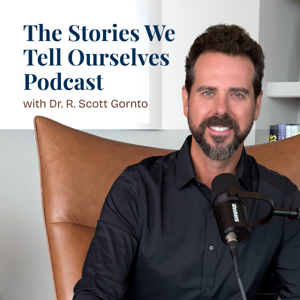
The Stories We Tell Ourselves Podcast is hosted by Dr. R. Scott Gornto, a psychotherapist, counselor, and peak performance coach in private practice based in Dallas, Texas, who works with…
Drawing from more than 25 years and 45,000 hours of clinical experience in psychotherapy, neuroscience, psychology, and the behavioral sciences, Dr. Scott offers practical wisdom on emotions, relationships, trauma, addiction, neuroscience, spirituality, and personal growth.
Through honest conversations and real questions from listeners, Dr. Scott explores the stories, beliefs, fears, emotional patterns, and behaviors that shape the way we experience ourselves and the people around us. His work centers on helping people think more clearly, relate more deeply, love more intentionally, and lead more effectively.