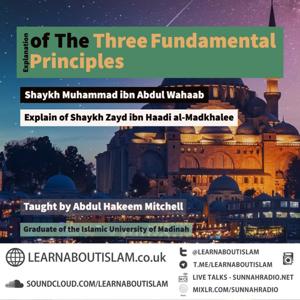
The Three Fundamental Principles – Ustādh Abdul Hakeem Mitchell

The Three Fundamental Principles – Ustādh Abdul Hakeem Mitchell

By Learn About IslamReligion & SpiritualityIslam
Download on the App Store

The Three Fundamental Principles – Ustādh Abdul Hakeem Mitchell episodes

  • Lesson 20 – The Three Fundamental Principles – Ustādh Abdul Hakeem Mitchell – The Second Principle: Defining Islām
    Thalāthat al-Uṣūl (The Three Fundamental Principles) by Shaykh al-Islām Muḥammad ibn ʿAbd al-Wahhāb (raḥimahullāh), with the explanation of Shaykh Zayd ibn Hādī al-Madkhalī (raḥimahullāh), taught by Ustādh Abdul Hakeem Mitchell (hafidhahullāh)

    • The proofs for the types of worship: whoever calls upon another deity with Allāh has no proof (al-Muʾminūn 23:117)

    • Whoever turns away from worshipping Allāh out of arrogance is under the threat of punishment

    • Unable to refute the call, the people of falsehood attack the caller

    • The second principle: Islām is submitting to Allāh with Tawḥīd, yielding to Him in obedience, and freeing oneself from shirk and its people

    • Opposing the people of shirk, who neglect the rights of Allāh

    • Encouragement to perform Ḥajj while one is able

    Streamed LIVE from the Salafi Centre of Manchester's South Manchester lesson at the Phil Martin Centre, Moss Side, on 28/9/23
    1 hr 7 min
  • Lesson 19 – The Three Fundamental Principles – Ustādh Abdul Hakeem Mitchell – Types of Worship: Tawakkul to Nadhr
    Thalāthat al-Uṣūl (The Three Fundamental Principles) by Shaykh al-Islām Muḥammad ibn ʿAbd al-Wahhāb (raḥimahullāh), with the explanation of Shaykh Zayd ibn Hādī al-Madkhalī (raḥimahullāh), taught by Ustādh Abdul Hakeem Mitchell (hafidhahullāh)

    • Tawakkul: entrusting every affair to Allāh, especially what none but He can bring about

    • Raghbah, rahbah, khushūʿ and khashyah; the heart is the place of hope and fear

    • Inābah and istiʿānah: seeking the means while asking Allāh for help

    • Istighāthah from the created, living or dead, for what only Allāh can do, such as children or provision, is shirk

    • "Some of My servants woke up believing in Me and some disbelieving": attributing rain to the stars

    • Sacrificing for other than Allāh is shirk; the conditional vow is disliked, and the one who makes it is called miserly

    Streamed LIVE from the Salafi Centre of Manchester's South Manchester lesson at the Phil Martin Centre, Moss Side, on 21/9/23

    1 hr 1 min
  • Lesson 18 – The Three Fundamental Principles – Ustādh Abdul Hakeem Mitchell – Types of Worship: Duʿāʾ and Khawf
    Thalāthat al-Uṣūl (The Three Fundamental Principles) by Shaykh al-Islām Muḥammad ibn ʿAbd al-Wahhāb (raḥimahullāh), with the explanation of Shaykh Zayd ibn Hādī al-Madkhalī (raḥimahullāh), taught by Ustādh Abdul Hakeem Mitchell (hafidhahullāh)

    • Duʿāʾ, from the most important forms of worship: the duʿāʾ of worship and the duʿāʾ of asking

    • Worship with one's wealth, one's body, or both

    • There is no Tawḥīd without freeing oneself from shirk; love for Allāh's sake goes with hatred for His sake

    • Duʿāʾ is on the tongue and limbs, while khawf is in the heart; īmān is belief, statement and action, and it increases and decreases

    • The callers to shirk use fear to frighten people into shirk

    • The kinds of fear: the fear that is shirk, fear of people that leads to leaving obligations, and natural fear

    Streamed LIVE from the Salafi Centre of Manchester's South Manchester lesson at the Phil Martin Centre, Moss Side, on 14/9/23
    32 min
  • Lesson 17 – The Three Fundamental Principles – Ustādh Abdul Hakeem Mitchell – Revision on Resuming
    Thalāthat al-Uṣūl (The Three Fundamental Principles) by Shaykh al-Islām Muḥammad ibn ʿAbd al-Wahhāb (raḥimahullāh), with the explanation of Shaykh Zayd ibn Hādī al-Madkhalī (raḥimahullāh), taught by Ustādh Abdul Hakeem Mitchell (hafidhahullāh)

    • The Thursday lessons resume after a long break with a revision of the main points

    • Shaykh Zayd on why no student of knowledge can do without this text, and the books to study after it

    • "Know, may Allāh have mercy on you": encouragement to learn and to pay attention

    • Knowing Allāh as the Creator and Provider, the only One deserving worship, with His names and attributes

    • Calling others to the truth and enjoining good and forbidding evil, the mark of this Ummah, with patience

    • al-Bukhārī's chapter "Knowledge comes before speech and action"

    Recorded at the Salafi Centre of Manchester's South Manchester lesson on 7/9/23
    28 min
  • Lesson 16 – The Three Fundamental Principles – Ustādh Abdul Hakeem Mitchell – Islām, Īmān and Iḥsān (cont.)
    Thalāthat al-Uṣūl (The Three Fundamental Principles) by Shaykh al-Islām Muḥammad ibn ʿAbd al-Wahhāb (raḥimahullāh), with the explanation of Shaykh Zayd ibn Hādī al-Madkhalī (raḥimahullāh), taught by Ustādh Abdul Hakeem Mitchell (hafidhahullāh)

    • Shaykh Zayd's questions on the pillars: the meaning, benefits and fruits of each

    • The shahādah negates everything worshipped besides Allāh and affirms all worship for Him alone

    • Tawḥīd attaches the heart to Allāh, not to creation that is itself in need, and brings happiness in both abodes

    • Fasting: "Whoever does not leave false speech and acting upon it, Allāh has no need of his leaving food and drink"; the intention

    • Belief in the books, the Tawrāh, the Ṣuḥuf of Ibrāhīm, the Injīl and the Qurʾān, and in the messengers

    • Iḥsān: worshipping Allāh as if you see Him, and if not, knowing that He sees you

    Recorded at the Salafi Centre of Manchester's South Manchester lesson
    1 hr 15 min
  • Lesson 15 – The Three Fundamental Principles – Ustādh Abdul Hakeem Mitchell – Islām, Īmān and Iḥsān
    Thalāthat al-Uṣūl (The Three Fundamental Principles) by Shaykh al-Islām Muḥammad ibn ʿAbd al-Wahhāb (raḥimahullāh), with the explanation of Shaykh Zayd ibn Hādī al-Madkhalī (raḥimahullāh), taught by Ustādh Abdul Hakeem Mitchell (hafidhahullāh)

    • Shaykh al-Islām Ibn Taymiyyah's definition of worship

    • The types of worship Allāh commanded: Islām, Īmān and Iḥsān, the levels of the religion

    • The Ḥadīth of Jibrīl and the signs of the Hour: barefoot shepherds competing in tall buildings

    • Tawḥīd in knowledge and affirmation, and Tawḥīd in intent and request

    • Islām makes the blood, wealth and honour of the Muslim sacred, bringing security and tranquillity

    • Its fruits: Paradise, safety from the Fire and seeing the Face of Allāh

    Recorded at the Salafi Centre of Manchester's South Manchester lesson
    30 min
  • Lesson 14 – The Three Fundamental Principles – Ustādh Abdul Hakeem Mitchell – The Lord Is the One Worshipped
    Thalāthat al-Uṣūl (The Three Fundamental Principles) by Shaykh al-Islām Muḥammad ibn ʿAbd al-Wahhāb (raḥimahullāh), with the explanation of Shaykh Zayd ibn Hādī al-Madkhalī (raḥimahullāh), taught by Ustādh Abdul Hakeem Mitchell (hafidhahullāh)

    • "O mankind, worship your Lord who created you" (al-Baqarah 2:21–22): the address is to all mankind, Arab and non-Arab, male and female

    • The Prophet ﷺ was sent to all of mankind

    • Gratitude for being created and for blessings we cannot count is shown by worshipping Him alone

    • Tawḥīd is not a vehicle for revolutionary methods against the rulers

    • "So that you may attain taqwā": obeying His commands and keeping away from His prohibitions

    • The earth spread out, the sky as a canopy, and rain as the means of our provision

    Recorded at the Salafi Centre of Manchester's South Manchester lesson
    29 min
  • Lesson 13 – The Three Fundamental Principles – Ustādh Abdul Hakeem Mitchell – His Signs and Creations
    Thalāthat al-Uṣūl (The Three Fundamental Principles) by Shaykh al-Islām Muḥammad ibn ʿAbd al-Wahhāb (raḥimahullāh), with the explanation of Shaykh Zayd ibn Hādī al-Madkhalī (raḥimahullāh), taught by Ustādh Abdul Hakeem Mitchell (hafidhahullāh)

    • The author's questions: who is your Lord, and how did you come to know Him?

    • He is known by His signs, the night and day and the sun and moon, and His creations, the seven heavens and earths (Fuṣṣilat 41:37)

    • The night and day as a sign for whoever wishes to remember or to give thanks (al-Furqān 25:62)

    • Do not prostrate to the sun or the moon, but to Allāh who created them

    • The creation of the heavens and the earth: "Come, willingly or unwillingly" (Fuṣṣilat 41:11)

    • The creation and the command belong to Allāh (al-Aʿrāf 7:54); the greatest command is Tawḥīd

    • The last lesson before Ramaḍān

    Streamed LIVE from the Salafi Centre of Manchester's South Manchester lesson at the Phil Martin Centre, Moss Side, on 16/3/23
    41 min
  • Lesson 12 – The Three Fundamental Principles – Ustādh Abdul Hakeem Mitchell – The First Principle: Knowing Allāh
    Thalāthat al-Uṣūl (The Three Fundamental Principles) by Shaykh al-Islām Muḥammad ibn ʿAbd al-Wahhāb (raḥimahullāh), with the explanation of Shaykh Zayd ibn Hādī al-Madkhalī (raḥimahullāh), taught by Ustādh Abdul Hakeem Mitchell (hafidhahullāh)

    • Recap: knowing the Lord, the religion of Islām with its proofs, and the Prophet ﷺ

    • Allāh's general nurturing of all creation, believer and disbeliever, and His specific care and support for the believers

    • The blessing of being created in the best form (at-Tīn 95:4)

    • "He is the One I worship, and I worship none besides Him": the meaning of lā ilāha illallāh

    • Allāh gave mankind the ability and the choice to obey and to leave disobedience

    • Everything created is proof of the Creator and that He alone deserves worship

    Streamed LIVE from the Salafi Centre of Manchester's South Manchester lesson at the Phil Martin Centre, Moss Side, on 9/3/23
    52 min
  • Lesson 11 – The Three Fundamental Principles – Ustādh Abdul Hakeem Mitchell – The Three Principles
    Thalāthat al-Uṣūl (The Three Fundamental Principles) by Shaykh al-Islām Muḥammad ibn ʿAbd al-Wahhāb (raḥimahullāh), with the explanation of Shaykh Zayd ibn Hādī al-Madkhalī (raḥimahullāh), taught by Ustādh Abdul Hakeem Mitchell (hafidhahullāh)

    • The main text begins: "If it is said to you, what are the three principles..."

    • Knowing your Lord: He nurtures all of creation, and nothing in creation is independent of Him

    • His nurturing is of two kinds, general and specific

    • "Freedom of religion" misunderstood: whoever dies upon other than Islām is of the people of the Fire

    • Distinguishing truth from falsehood is from the greatest forms of jihād

    • The Prophet ﷺ called in secret until he was commanded to proclaim openly, "I am a clear warner to you"

    Streamed LIVE from the Salafi Centre of Manchester's South Manchester lesson at the Phil Martin Centre, Moss Side, on 2/3/23
    58 min

About The Three Fundamental Principles – Ustādh Abdul Hakeem Mitchell

From the publisher's feed

Thalāthat al-Uṣūl, The Three Fundamental Principles (by Shaykh al-Islām Muḥammad ibn ʿAbd al-Wahhāb (raḥimahullāh), with the explanation of Shaykh Zayd ibn Hādī al-Madkhalī (raḥimahullāh)), taught by…