
Sign up to save your podcasts
Or



In this episode, I talk about body image, aesthetics, and athletic performance in dance—and what happens when people judge a dancer’s body based on the size or shape of her legs.
I share why strength training matters for dancers, how it can support technique and performance, and why building strength shouldn’t be about shaming someone or making every body look the same. A dancer’s appearance, self-confidence, and physical abilities can all be part of the conversation without being treated as the same thing.
What if dancing until 8 a.m. didn’t have to completely destroy your sleep?
In this episode, I explain how you can slightly adjust your sleep schedule so that those late-night salsa parties begin to feel more like morning parties. Instead of forcing your body to stay awake through what it thinks is the middle of the night, you can strategically shift your schedule before and during the festival.
I break down what I mean by “turning the evening party into your morning party” and how this approach can help you dance later, sleep longer, recover better, and enjoy the entire festival without feeling completely destroyed.
Your feet are the foundation of almost everything you do—but modern shoes, stiff soles, arch supports, and years of underusing the muscles of the foot can slowly make that foundation weaker.
The problem is, it doesn’t stop at your feet.
Weak feet can be part of a much bigger chain involving your ankles, hips, glutes, balance, posture, and the way your entire body produces and absorbs force. For dancers, that can affect everything from stability and control to pain and performance. But the same principles matter far beyond the dance floor.
In this episode, I break down why our feet and hips become weak, how our shoes and daily habits contribute to the problem, and what we can actually do to rebuild strength from the ground up.
I also explain how these concepts fit into The Unbreakable Dancer, my online program designed to help dancers understand their bodies, address the weaknesses that are holding them back, and build a stronger, more resilient body for both dance and everyday life.
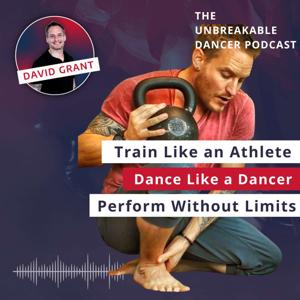
Dance is one of the most athletic things we can do—but most dancers still aren’t training like athletes.
In this episode, I break down what it really means to train like an athlete so you can dance like a dancer.
It’s not about simply doing more. It’s about figuring out what your body is missing.
If you’re doing a ton of Pilates, great—but maybe you need more strength. If you’re already lifting heavy and getting stronger, maybe you need more work on stability, control, and the smaller muscles that support the bigger ones.
Maybe your weak link is flexibility. Maybe it’s mobility. Maybe it’s strength, stability, recovery, or simply the way you’re moving.
The goal is to identify that weak link and train it.
Because your dancing can only progress as far as your body allows it to.
The dance world continues to become more athletic, more demanding, and more impressive—but our training has to evolve with it.
And right now, the biggest thing holding dancing back might unfortunately be the dancers themselves.
It’s time to start treating dancers like the athletes they are.
Train like an athlete. Dance like a dancer.
Chronic shoulder pain is NOT a prerequisite of dance.
Far too many dancers are living with shoulder pain, instability, tightness, clicking, weakness, or even recovering from surgery and assuming it’s just “part of the lifestyle.” It’s not.
In this podcast, I break down why shoulder pain develops in dancers, the biggest mistakes I see being made in both training and rehab, and what we can actually do to prevent injuries before they happen.
Whether you currently have shoulder pain, have already undergone shoulder surgery, are trying to avoid surgery altogether, or simply want to keep your body healthy long term while continuing to dance at a high level, this episode is for you.
I also explain my 5 Pillar Concept:
• Movement
• Mobility
• Strength
• Flexibility
• Lifestyle
Because true recovery and injury prevention isn’t about one magic exercise or one treatment. It’s about understanding how the entire system works together.
The goal is simple:
Dance more. Hurt less. Perform better.
But there’s also a price to pay if we don’t start taking better care of our bodies.
One of my clients said it perfectly: “I’m training like a pro with the body of an amateur.”
And the truth is, even many professional dancers are guilty of this. They live with chronic pain, tightness, injuries, and fatigue, and they start to believe it’s just part of the game.
But it’s not normal.
In this episode, I talk about why the demands of the modern dance scene are increasing, why so many dancers are breaking down, and why strength, mobility, flexibility, and recovery need to become part of the culture.
This is also exactly why I created The Unbreakable Dancer — to help dancers train smarter, prevent injuries, fix chronic pain, and build bodies that can actually keep up with the way they love to dance.
We dive into the leap from El Salvador to New York City—chasing a dream while living the reality. From dancing at a high level to working as a barista just to get by, Javier shares the raw, unfiltered side of the journey, including some hilarious and unforgettable stories along the way. This episode goes beyond dance—it’s about resilience, identity, and what it really takes to build a life from the ground up.
I first came across Alexi Ruiz (Alexi Style Official) during a musicality workshop—and within the first 15 seconds, I knew I was watching someone operating at a completely different level.
Coming from a background in Human Performance and Injury Prevention, I’ve been trained to break down what makes a great coach or teacher versus an average one. It’s not just about knowledge—it’s about how you communicate, how you make people understand movement, and how you transfer skill.
Alexi does that at a master level.
This conversation was less of an interview and more of two people getting lost in the weeds—in the best way possible. We talk about his journey, Japan, learning Japanese, my time living in Egypt, emotional growth, boarding schools, and just life as a whole.
No script. No structure. Just a real, honest conversation.
Hope you enjoy it.
Chronic pain isn’t random.
It’s not something that just “shows up” one day without reason—and it’s definitely not something you fix by chasing symptoms.
In this episode, I break down the 5 pillars of chronic pain—the exact framework I use with clients, athletes, and dancers to not only reduce pain, but actually understand where it’s coming from and how to fix it long-term.
These five pillars are:
1. Movement
Most people either don’t move enough—or they move poorly. Bad mechanics, compensation patterns, and lack of awareness slowly overload the system. Over time, that turns into pain.
2. Mobility (Soft Tissue Work)
Mobility, in this context, isn’t stretching—it’s what’s happening in your tissue.
From foam rolling to Gua Sha, IASTM, cupping, and manual therapy—this is about improving how your tissue slides and glides. When tissue becomes stiff, sticky, and restricted, movement becomes inefficient and painful.
3. Strength
You either don’t have enough strength, you have too much in the wrong places, or—most commonly—there’s an imbalance.
Your body doesn’t care how strong you are globally. It cares how balanced you are locally.
4. Flexibility
Same problem, different angle.
Too stiff, too loose, or completely imbalanced.
When one side is doing all the work and the other isn’t pulling its weight, your body turns into a constant tug-of-war.
Think Navy SEALs vs toddlers.
That’s not a fair fight—and your nervous system knows it.
5. Lifestyle
Lifestyle sits on top of everything.
Sleep, stress, recovery, and daily habits all feed directly into the other four pillars.
But there’s one piece I see all the time:
People trying to numb the problem instead of fixing it.
Medication has its place—but if all you’re doing is blocking pain signals without addressing the cause, you’re just delaying the inevitable.
It’s like taking your car to the mechanic because the check engine light is on…
…and instead of fixing the issue, they just unplug the light.
The problem didn’t go away.
You just can’t see it anymore.
And eventually, it catches up.
If you’re dealing with chronic pain—or you feel like you’ve tried everything and nothing sticks—this episode will give you a completely different way to look at your body, your movement, and your recovery.
This is where you stop chasing pain…
…and start fixing the system.
Ready to take this further?
Join The Unbreakable Dancer—my complete program designed to help you fix chronic pain, prevent injuries, and optimize your body for performance.
Inside, you’ll get a structured training program, mobility system, and flexibility plan so you can finally learn how to take care of your body the right way.
This isn’t about doing more.
It’s about working smarter.
And when you have the capacity—like champions do—you can do both.
Start moving better, feeling better, and performing at your highest level.
Link below.
unbreakabledancer.com
Foot pain. Ankle pain. Lower-leg pain.
Plantar fasciitis, Achilles issues, “bad arches,” bunions, mystery pain that just won’t go away.
If you’ve ever been told:
this episode is for you.
In this solo episode of The Unbreakable Dancer Podcast, I break down why most advice around foot and lower-leg pain is outdated, incomplete, or flat-out wrong, and why so many dancers, athletes, and active humans stay stuck in a cycle of pain despite doing “everything right.”
We dive into:
• The two tiny bones you’ve probably never heard of—but should
The sesamoid bones play a massive role in foot mechanics, force transfer, and pain patterns. When they’re ignored, misunderstood, or overloaded incorrectly, the entire lower leg can suffer.
• Why wearing heels isn’t actually the root problem
This might surprise a lot of people—especially dancers—but heels themselves are rarely the villain. The real issue is what isn’t being trained, restored, or prepared around them.
• Why arch supports often make things worse, not better
Supporting a structure that’s meant to adapt, move, and load is a short-term fix that often creates long-term weakness. We talk about why “support” can quietly steal strength from your feet.
• How foot pain is rarely just a foot problem
Lower-leg pain is often a coordination, loading, and nervous-system issue—not a structural defect. When you zoom out, the solution becomes clearer.
• A surprising lesson from the UFC and Brazilian Jiu-Jitsu
I finish the episode with a story about Royce Gracie, one of the most undersized fighters in early UFC history, and why he intentionally trained on a trampoline.
What does bouncing on an unstable surface have to do with foot health, resilience, and performance?
A lot more than you think.
This episode isn’t about quick fixes, gimmicks, or blaming shoes, surfaces, or anatomy.
It’s about building feet that can adapt, respond, and stay strong—so you can dance longer, train harder, and move without fear.
This podcast is educational, but it’s also a window into how I approach chronic pain, injury prevention, and performance inside The Unbreakable Dancer program.
If you want to understand your body instead of fighting it—this is where it starts.
Listen, learn, and start making your feet unbreakable.
From the publisher's feed
How Dancers can become and stay Unbreakable