
Sign up to save your podcasts
Or



According to research, bias is a habit that begins to take shape at an early age. As we form our own social identities surrounding things like ethnicity, race, sexual orientation, religion, and gender, we start to identify as members of a specific group of people. These identities in many ways can shape how we see and treat others — and how others see and treat us.
At the University of Wisconsin–Madison, Dr. William Cox, Dr. Patricia Devine, and their colleagues developed the bias habit-breaking intervention, an evidence-based approach which builds on more than 30 years of scientific research on prejudice, stereotyping, and bias, and has been proven to reduce bias in people’s attitudes and behavior long-term. Dr. Cox is the Principal Investigator of the Stereotyping and Bias Research (SABR) Lab in the Department of Psychology at the University of Wisconsin–Madison, and the founder of Inequity Agents of Change, a 501(c)(3) dedicated to reducing bias, creating inclusion, and promoting equity. In this conversation,
Dr. Cox explains how bias impacts the mind. He then provides proven strategies for reducing bias, and identifies common approaches such as color-blindness that people often take to address bias that often create more bias rather than less.
Topics covered with timestamps:
2:44 – Why a scientific, evidence-based approach is the best method for reducing bias.
7:29 – The origins of “bias as a habit” and a summary of the bias habit-breaking intervention model.
13:30 – How stereotypes can create and guide our expectations about others.
17:13 – People in society are often penalized if they violate the stereotypes we hold for them.
20:04 – Once a stereotype is a habit of mind, even if we experience that it’s wrong 75% of the time, confirmation bias causes us to give more credit to our stereotype than to the contrary evidence.
28:44 – Perspective taking as a strategy for reducing bias.
36:18 – How untested assumptions can reinforce stereotypes and cause them to self-perpetuate.
38:57 – Stereotype replacement as a strategy for reducing bias.
42:20 – Considering situational explanations as a strategy for reducing bias.
46:14 – Broadening your media input as a strategy for reducing bias.
51:23 – Colorblindness, ignoring group status, believing in personal objectivity, and stereotype suppression fail as approaches to reduce bias and create more bias rather than less.
57:03 – The importance of speaking up when you see bias occurring.
1:00 – Proven results and findings in attitude and behavior change caused by the science-based habit breaking intervention approach for bias reduction.
What happens to a person's mind when you lock them in a cage no bigger than a parking space? When they’re constantly exposed to dehumanizing, unsanitary, loud, and violent conditions? When red-flags continuously signal their mental decline, but no one cares or tries to help? On this episode of the DEI Podcast, we’re joined by Madison Kemker, an attorney with the Uptown People’s Law Center in Chicago, and one of Notre Dame Law School’s Thomas L. Shaffer public interest fellows. Madison discusses her experiences witnessing the state of mental health services in Illinois prisons. Madison also discusses her advocacy work in Rasho v. Jeffries, a class action lawsuit against the Illinois Department of Corrections alleging that the quality of mental health services in Illinois state prisons is so poor that it violates the Eighth Amendment’s prohibition on cruel and unusual punishment. Madison then talks about the public interest path in law school, and how the legacy of Notre Dame calls all of us to be advocates for civil and human rights.Click here to read about the Rasho v. Jeffries litigation and what is being done to address the mental health crisis in Illinois prisons.
“Innocent people should not be in prison.” (Anna McGinn, Notre Dame Law School ‘22).
Exoneration justice is the tireless effort to free innocent people imprisoned after being wrongfully convicted of crimes, and to provide them with rehabilitative services. Jessa Webber and Anna McGinn, Notre Dame Law School’s Bank of America Foundation Fellows, have dedicated their legal careers to this work.
This episode of the DEI Podcast is part-one of a three-part series on public interest law. We talk with Jessa and Anna to explore the systemic problems that have led to a backlog of wrongful convictions disproportionately of people of color and members of the LGBTQ community, what anti-racist efforts look like to reduce the frequency of wrongful convictions on the front end, and how exoneration justice is helping create a fair and equitable justice system for everyone. Jessa and Anna also discuss the public interest path in law school, and how the Bank of America Foundation Fellowship is making public interest work after law school possible.
Click here to read about one of Anna’s clients who was recently freed from prison after spending nearly 25 years behind bars for a crime he did not commit.
Have you ever felt like an imposter? Unqualified for the job, less intelligent than your classmates, or undeserving of your accomplishments, and that somehow you managed to convince others you were more capable than you really are? In this episode of the DEI Podcast, we’re joined by Dr. Kevin Cokley, a psychologist at the University of Michigan who studies the imposter phenomenon. Dr. Cokley researches the relationship between imposter feelings, mental health, and academic outcomes among students from underrepresented communities. Listen as he discusses his research and experience with imposter feelings, and how we can learn to use these feelings as a motivation rather than a limitation in our daily lives.
What do DEI efforts look like in the sports and entertainment industry? How do mandates like the NFL's Rooney rule impact diversity and inclusion at the highest levels of leadership? And what priorities should minorities looking to break into sports and entertainment consider?
On this episode of the DEI Podcast, we revisit a conversation with Black alumni leaders in the sports and entertainment industry from last month's “Staying in the Game,” sports and entertainment panel hosted by the Notre Dame Black Law Students Association. Panelists included:
Max Siegel ’86, ’92 J.D., CEO of USA Track & Field
Mickey Carter ’92 J.D., Executive Vice President, U.S. Networks Distribution for Paramount Global,
Ndidi Massay ’93 J.D., Vice President of Workplace Culture & Diversity Initiatives for CBS Sports
Raghib “Rocket” Ismail ’94 B.A., former NFL wide receiver
Jonathan Beane, Senior Vice President and Chief Diversity & Inclusion Officer for the NFL
The panel was moderated by Jackie Wilson ’07 J.D., Chief DEI Officer for the Brooklyn Nets.
What does it mean to be part of an inclusive law school community? On this inaugural episode of the DEI Podcast, Marisa Simon, Director of Admissions at Notre Dame Law School, describes the inclusive environment at Notre Dame Law School, which the Admissions office seeks to further when considering applicants for admission. Marisa walks us through the various aspects of the Law School application, and explains the importance of authenticity. We discuss recent changes to the application aimed at fostering greater inclusion, and hear Marisa's candid advice on how to prepare a successful application.
From the publisher's feed
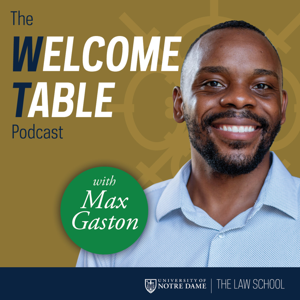
Inspired by the old Negro spiritual that became an anthem of faith-driven activism and a call for justice and belonging during the civil rights movement, The Welcome Table symbolizes an…
This podcast brings together inspiring individuals to explore the critical issues shaping law, justice, and belonging in our communities today.
Through thought-provoking conversations, host Max Gaston, Director of Dignity, Solidarity, and Subsidiarity at Notre Dame Law School, fosters understanding, challenges assumptions, and illuminates the intersections of fairness, dignity, and solidarity in our workplaces, institutions, legal system, and daily lives.
Rooted in a deep respect for identity and experience, The Welcome Table is more than just a podcast—it’s an open invitation. A call to pull up a chair, listen, and take part in conversations that shape our shared humanity.