Most people think they go to therapy for advice. But what if the thing that makes therapy work is feeling safe enough to actually be seen?
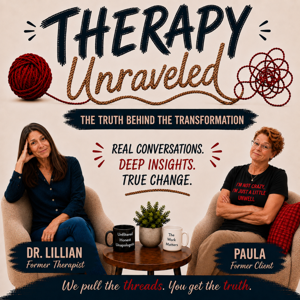
In this episode of Therapy Unraveled, Paula and Lillian explore what they call the “secret sauce” of therapy: the relationship itself. Paula shares how safety, consistency, nonjudgment, boundaries, and being truly listened to helped her move from seeing therapy as an authority-based process to experiencing it as a partnership. Lillian explains why a therapist’s grounded presence matters, how boundaries can actually create safety, and why healing gets deeper when clients feel emotionally safe enough to be honest, messy, angry, vulnerable, and fully human.
Therapy can include skills, insight, trauma work, and practical tools. But underneath all of that is something harder to measure and impossible to fake: the relationship.
In this episode of Therapy Unraveled, Paula and Lillian talk about the role safety plays in the therapy room and why the therapeutic relationship can become the foundation for real change.
Paula reflects on how she first saw therapists as authority figures, more like doctors or professors, and how that shifted over time into something more collaborative. She describes what helped her feel safe enough to open up: Lillian’s calm presence, consistency, lack of judgment, willingness to be human, and the predictability of simply showing up.
Lillian explains why therapists have to manage their own nervous systems, stay present, and create space for clients to be messy without being shamed. They also talk about what happens when clients come in angry, overwhelmed, or reactive, and how naming what is happening, setting boundaries, and repairing conflict can actually strengthen the relationship.
For Paula, one of the most important lessons was learning that conflict did not automatically mean abandonment. She could be angry, struggle, need reassurance, or hear a boundary and still return to a relationship that remained intact. Over time, that safety helped her practice healthier ways of relating both to other people and to herself.
IN THIS EPISODE, WE TALK ABOUT
• Why the therapeutic relationship matters
• The difference between authority and partnership in therapy
• Why emotional safety has to come before deeper work
• How a therapist’s calm presence can help regulate the room
• Why consistency and predictability build trust
• The role of therapist self-disclosure and human connection
• How boundaries can create safety instead of distance
• What therapists can do when they feel reactive
• Why conflict does not have to mean abandonment
• How repair can become part of healing
• How a safe therapeutic relationship can teach healthier relationship patterns
1. Safety is not an extra in therapy. It is part of the foundation.
2. A strong therapeutic relationship is collaborative, not hierarchical.
3. Boundaries can feel uncomfortable and still be part of a safe relationship.
4. Conflict in therapy does not automatically mean the relationship is over.
5. Repairing ruptures can teach clients that connection can survive hard moments.
6. Feeling safe enough to be honest makes deeper therapeutic work possible.
Most clients do not just need advice. They need a space where they can feel safe enough to be fully honest, fully human, and still remain in a relationship.
Email us! [email protected]