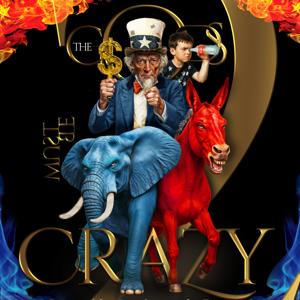
The Gods Must Be Crazy Podcast: A Satirical-Scholarly Autopsy of American Capitalism's Death Sprint-Dispatches from the Chinese AI Century's Frontline
00:00 Introduction: Saji Madapat on The Brand Called You
00:58 Roots of Rebellion: Growing Up in "God's Own Country"
02:24 The Tiger Ride Begins: From Mumbai to Y2K "Cyber Coolie"
04:11 The 2008 Turning Point: Victim of Financial Engineering
06:08 Hunter vs. Farmer: A Contrarian Worldview
08:08 Giving Back: Bridging Ancient Gods & Business Strategy
10:06 The Role of Humor in Geopolitics
11:42 Cyclical History: What Roosevelts & Theyyam Gods Teach Us
13:38 From the Cradle of Communism to the Catacombs of Capitalism
16:10 The Chinese AI Century & The 2049 Vision
18:27 Myth as History: The Ultimate Management Case Studies
20:07 Surviving the AI Era: Unlearn, Create, & Tell Stories
Confession of a “Monkey-Trapped” Prodigal Son: Why I Left Wall Street for a 5,000-Year-Old Startup
🐒 The monkey won’t release the banana.
The corporate slave won’t release the salary.
They called me crazy for leaving the Big 4.
Crazier for choosing Theyyam over Tesla.
Now watch who’s laughing.
The Confession That Changes Everything
I spent 30 years as a “financial termite” inside global capitalism—earning seven figures and advising Fortune-10 leaders.
Then I came home.
Not with more wealth,
But with a question that refused to leave me:
If corporations die in 18 years, but Theyyam has survived 5,000… who failed—me, or the system that trained me?
The Journey of a Prodigal Son
I was born in Marxist Kerala, where capitalism was a sin and money was considered filthy.
Then liberalisation hit.
99% literacy in “God’s Own Country” quietly created an army of “cyber coolies” for Silicon Valley.
I became one of them.
And nobody told me it was a trap.
Wall Street taught me to multiply money.
Theyyam taught me to multiply meaning.
When a Kerala son walks out of the golden cage of global capitalism and into Theyyam’s sacred flames, the world doesn’t need to listen because he “succeeded”.
It needs to listen because, for the first time, he failed in the right way.
Act I: From Marxist Classrooms to Fortune-10 Boardrooms
My “ordinary world” was a paradox: democratically elected communists, 99% literacy, and almost no industry.
From there, I rode the early waves of liberalisation:
Y2K turned Indian engineers into cyber-coolies for Western systems.
I moved from Kerala to Mumbai, then to the U.S., advising leaders across 40+ countries.
I learned how incentives, not intelligence, truly run the world.
On paper, it was a textbook success story.
Inside, something was rotting.
Act II: The Monkey Trap (At 18:20 in the interview)
A monkey grips a banana through a small hole in a coconut.
The only way out is to release the banana.
But the monkey won’t. Trapped by its own attachment.
For 30 years, I was that monkey.
The Fortune-10 salary was my banana.
The title, the status, the airline miles—they became my prison bars.
Then reality intruded:
Cambodia’s killing fields.
The 2008 financial collapse.
The “bottom of the pyramid”: billions living on roughly $2 a day.
Those experiences taught me more economics than any Ivy League syllabus and forced new questions:
Why do Indian women holding 25,000 tons of gold understand value better than central banks?
Why do farmers (East) outperform hunters (West) over 5,000-year timelines?
Why do camels (quiet, resilient businesses) outlive unicorns (over-funded fantasies)?
Act III: Returning to Kerala & Theyyam (At 22:40 in the interview)
I didn’t come back to Kerala defeated.
I came back awake.
Theyyam isn’t a dance. It’s a 5,000-year-old startup.
It has survived empires, religious shifts, colonialism, globalisation, even Silicon Valley’s arrival—because Theyyam multiplies meaning, not money.
Now I’m trying to reverse-engineer this resilience (At 18:20 in the interview):
Documenting 200+ unique Theyyams, building 8K visual archives, VR temples, and digital experiences.
We keep asking how AI will “save” us.
But it may be ancient wisdom that saves AI ethics, not the other way around.
Key Revelations
• How Y2K quietly created a new global worker class
• Why 25,000 tons of gold in Indian homes is a decentralised monetary policy
• Why corporate lifespan ≈ 18 years vs. Theyyam ≈ 5,000 years matters
• East vs West as farmer vs hunter mindset—and how that shapes geopolitics
• Why building camels beats chasing unicorns
Who Is This Tiger Rider?
I’m a former Fortune 10 advisor with experience across 40+ countries.
I’ve documented 200+ Theyyam performances with a personal investment of $500K+.
I’ve been honoured with cultural awards, written 12 books in 18 languages, and published dozens of papers on economics, geopolitics, strategy, and cultural resilience.
My mission now is simple:
To use AI, VR, and storytelling to reverse-engineer 5,000 years of cultural resilience and show that ancient systems routinely outlast modern ones.
If You Want to Go Deeper
🔗 RELATED CONTENT:
Read the book Wall Street's lawyers are definitely not concerned about:
► 📚 The Gods Must Be Crazy! https://www.amazon.com/dp/B0FFX51PL3
📺 The Playlist: https://youtube.com/playlist?list=PLcA7B8zy3sQbgU81qw2UNsR7ztFgbp-zT&si=q_YBwegceW8LSFwB
📢 Join the conversation: https://www.theyyam.us/podcast
🌐 Strategic consulting: https://www.theyyam.us/about
LinkedIn: https://www.linkedin.com/in/goodtogreat/
Sometimes, the most radical strategy isn’t to ride the tiger harder.
It’s to climb off, walk back into the forest, and listen to the drums that never stopped calling your name.
#TigerRider #AshutoshGarg #TheBrandCalledYou #TheyyamKerala #IndianDiaspora #CapitalismCritique #Geopolitics #CulturalPreservation #SacredWarrior #ProdigalSon