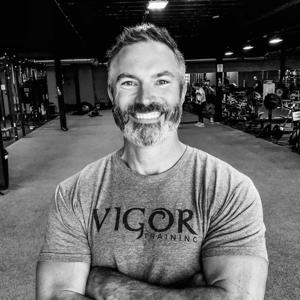
Tom Nikkola | VIGOR Training

Tom Nikkola | VIGOR Training

By Tom Nikkola | VIGOR TrainingHealth & FitnessNutritionMental HealthFitness
Download on the App Store

Tom Nikkola | VIGOR Training episodes

  • How much weight? How many reps?
    Somewhere between what your ego would have you do, and your body wants to do, there's a middle ground of enough weight to make progress, and not so much that you’re going to get hurt.
    As long as you work within the boundaries I set in whichever VIGOR Training program you follow, which includes your sets, rep ranges, and rest periods, you will make progress as long as you remain consistent.
    How much weight should I use or reps should I do?
    For most training sessions, each set of each exercise has a target rep number. For example, it might be “Back squats for 4 sets of 10 reps.”
    Unless I specifically say, "You must hit 10 reps," use the rep range I highlight in the app.
    In the case of a 10-rep target, the range is 6-10. If you can't get 6 reps, the weight is too heavy. When you're able to get 10 reps on all sets, increase the weight the next training session. In this way, your goal is to either get more reps with the same weight as last week, or use more weight, even if you’re at the lower end of your rep range. 
    All that said, the first week of a new block of training often requires a little guesswork. By the second week, you should know how much to use. By the third week, you'll probably be increasing the weight on that specific exercise.
    Because the app stores all of your previously logged training sessions, you can easily look back at what you've done, and strive to do more the next time. Some sessions you might get just one more rep per set. Others, you'll be able to bump up the weight significantly.
    How many warm-up sets should I do?
    For the first exercise of any major muscle group, I recommend anywhere from one to four warm-up sets. The heavier the weight you use, the more warm-up sets you should use. 
    Warm-up sets don't get entered into the app.
    Should I use the same weight for all sets, or increase the weight through the sets?
    "Pyramiding" your sets means that you increase or decrease your weight, while also decreasing or increasing your reps. 
    It's one of many methods for designing training plans. If I use this method, I'll be clear about it in the instructions.
    Most of the time, I expect that you’re using the same weight for all working sets.
    Putting these together...
    Using the back squat example again, let's say your working set weight is 225 lbs.
    You warm up with just the bar for a set of 5-10. Then, you do a set of 5 with 135 lbs. And another set of 3-5 with 185 lbs. After a little rest, you do your first working set with 225 lbs. for 10 reps. Your second set, you get 10 again. Then, on your third and fourth sets, you get 8 and 9.
    You'd stay with that same weight the next week, assuming the training session is the same, and go for 10 reps on all four sets. After that, you'd bump up the weight.
    5 min
  • What is the purpose of tempo in your training?
    In terms of your training, I believe tempo is one of the most important concepts you need to wrap your head around.
    Tempo is the speed with which you move the bar, dumbbells, plates, or your body during a repetition. Tempo:
    reduces the risk of injury
    allows for greater stress on the muscles with less stress on your connective tissue
    controls one of the variables in your training to ensure you progress from week-to-week
    Tempo measures the speed of your repetition in four parts:
    Eccentric – movement with gravity
    Pause
    Concentric – movement against gravity
    Pause
    For most of your training blocks, I don't vary your tempo much. When I don't call it out for a specific movement, I usually expect you're using a tempo of 2010.
    Two seconds on the eccentric (lowering the bar on bench, descending toward the floor on squats, allowing the bar to rise on pulldowns), no rest, one second on the concentric (pressing the bar toward the ceiling, standing back up, pulling the bar down).
    By using at least a two-second count on the eccentric, it forces you to maintain control throughout the whole range of motion.
    ALWAYS REMAIN IN CONTROL OF THE MOVEMENT.
    Look around at the gym and you'll see people swinging, jerking, or flailing weights up and down, thinking that they'll get stronger simply because they're using more weight.
    To the contrary, they'll probably end up injured. At best, their ego will get bigger but their body won't get stronger.
    Focusing on tempo every session keeps your ego in check, keeps you in control of the movement, overloads your muscles better, and in the end, gets you better results.
    Remember, if I ever happened upon you while you're in the middle of a set, I should be able to say "FREEZE" and you could immediately stop in whatever position you were at that moment. If you couldn't do that, you wouldn't be in control.
    4 min
  • What is the purpose of tempo in your training?

    In terms of your training, I believe tempo is one of the most important concepts you need to wrap your head around.


    Tempo is the speed with which you move the bar, dumbbells, plates, or your body during a repetition. Tempo:


    * reduces the risk of injury* allows for greater stress on the muscles with less stress on your connective tissue* controls one of the variables in your training to ensure you progress from week-to-week


    Tempo measures the speed of your repetition in four parts:


    * Eccentric – movement with gravity* Pause* Concentric – movement against gravity* Pause


    For most of your training blocks, I don't vary your tempo much. When I don't call it out for a specific movement, I usually expect you're using a tempo of 2010.


    Two seconds on the eccentric (lowering the bar on bench, descending toward the floor on squats, allowing the bar to rise on pulldowns), no rest, one second on the concentric (pressing the bar toward the ceiling, standing back up, pulling the bar down).


    By using at least a two-second count on the eccentric, it forces you to maintain control throughout the whole range of motion.


    ALWAYS REMAIN IN CONTROL OF THE MOVEMENT.


    Look around at the gym and you'll see people swinging, jerking, or flailing weights up and down, thinking that they'll get stronger simply because they're using more weight.


    To the contrary, they'll probably end up injured. At best, their ego will get bigger but their body won't get stronger.


    Focusing on tempo every session keeps your ego in check, keeps you in control of the movement, overloads your muscles better, and in the end, gets you better results.


    Remember, if I ever happened upon you while you're in the middle of a set, I should be able to say "FREEZE" and you could immediately stop in whatever position you were at that moment. If you couldn't do that, you wouldn't be in control.


    4 min
  • What is the purpose of tempo in your training?
    In terms of your training, I believe tempo is one of the most important concepts you need to wrap your head around.
    Tempo is the speed with which you move the bar, dumbbells, plates, or your body during a repetition. Tempo:
    reduces the risk of injuryallows for greater stress on the muscles with less stress on your connective tissuecontrols one of the variables in your training to ensure you progress from week-to-week
    Tempo measures the speed of your repetition in four parts:
    Eccentric – movement with gravityPauseConcentric – movement against gravityPause
    For most of your training blocks, I don't vary your tempo much. When I don't call it out for a specific movement, I usually expect you're using a tempo of 2010.
    Two seconds on the eccentric (lowering the bar on bench, descending toward the floor on squats, allowing the bar to rise on pulldowns), no rest, one second on the concentric (pressing the bar toward the ceiling, standing back up, pulling the bar down).
    By using at least a two-second count on the eccentric, it forces you to maintain control throughout the whole range of motion.
    ALWAYS REMAIN IN CONTROL OF THE MOVEMENT.
    Look around at the gym and you'll see people swinging, jerking, or flailing weights up and down, thinking that they'll get stronger simply because they're using more weight.
    To the contrary, they'll probably end up injured. At best, their ego will get bigger but their body won't get stronger.
    Focusing on tempo every session keeps your ego in check, keeps you in control of the movement, overloads your muscles better, and in the end, gets you better results.
    Remember, if I ever happened upon you while you're in the middle of a set, I should be able to say "FREEZE" and you could immediately stop in whatever position you were at that moment. If you couldn't do that, you wouldn't be in control.
    4 min
  • Don’t Lose Muscle
    I have a number of guidelines for VIGOR Training, but just one rule:
    Don't Lose Muscle!
    Muscle loss contributes to:
    insulin resistance and diabetesloss of strengthreduced metabolic rateflabby arms and squishy legsloss of joint integrity
    Research shows that as you age, a lack of lean mass is worse for longevity and quality-of-life than being too fat.
    I'm not trying to convince you to look like a jacked-up meathead. This is about health, fitness, and longevity. You should strive to build enough muscle that people believe you spend more time at the gym than at a fast food restaurant, though.
    So, if the rule is "Don't Lose Muscle," what causes muscle loss?
    Excessive endurance training. Calorie restriction. Insufficient dietary protein. Lack of sleep. Chronic stress. Hormone imbalances.
    Don't get me wrong...I'm not saying it's okay to be fat as long as you have enough muscle. Excessive body fat is still bad for your health and longevity.
    But if you try to get rid of the extra body fat by following a calorie and protein-restricted diet and doing a ton of cardio, you're headed for trouble.
    Anyway, this is the lens through which I view all nutrition, exercise, supplementation, and lifestyle choices. I hope, over time, you will too.
    If a diet, exercise, lifestyle, or supplement choice has the potential to cause accelerated muscle loss, it's a non-starter for me.
    If you'd like to read a little more on the importance of muscle, check out my article 7 Body and Mind Benefits of Building Muscle. 
    I try to simplify the process of getting and staying fit, while inspiring you to put in the work necessary to make it happen. Following the rule of "don't lose muscle" is a great place to start.
    4 min
  • Don’t Lose Muscle

    I have a number of guidelines for VIGOR Training, but just one rule:


    Don't Lose Muscle!


    Muscle loss contributes to:


    * insulin resistance and diabetes* loss of strength* reduced metabolic rate* flabby arms and squishy legs* loss of joint integrity


    Research shows that as you age, a lack of lean mass is worse for longevity and quality-of-life than being too fat.


    I'm not trying to convince you to look like a jacked-up meathead. This is about health, fitness, and longevity. You should strive to build enough muscle that people believe you spend more time at the gym than at a fast food restaurant, though.


    So, if the rule is "Don't Lose Muscle," what causes muscle loss?


    Excessive endurance training. Calorie restriction. Insufficient dietary protein. Lack of sleep. Chronic stress. Hormone imbalances.


    Don't get me wrong...I'm not saying it's okay to be fat as long as you have enough muscle. Excessive body fat is still bad for your health and longevity.


    But if you try to get rid of the extra body fat by following a calorie and protein-restricted diet and doing a ton of cardio, you're headed for trouble.


    Anyway, this is the lens through which I view all nutrition, exercise, supplementation, and lifestyle choices. I hope, over time, you will too.


    If a diet, exercise, lifestyle, or supplement choice has the potential to cause accelerated muscle loss, it's a non-starter for me.


    If you'd like to read a little more on the importance of muscle, check out my article 7 Body and Mind Benefits of Building Muscle. 


    I try to simplify the process of getting and staying fit, while inspiring you to put in the work necessary to make it happen. Following the rule of "don't lose muscle" is a great place to start.


    4 min
  • Don’t Lose Muscle
    I have a number of guidelines for VIGOR Training, but just one rule:
    Don't Lose Muscle!
    Muscle loss contributes to:
    insulin resistance and diabetesloss of strengthreduced metabolic rateflabby arms and squishy legsloss of joint integrity
    Research shows that as you age, a lack of lean mass is worse for longevity and quality-of-life than being too fat.
    I'm not trying to convince you to look like a jacked-up meathead. This is about health, fitness, and longevity. You should strive to build enough muscle that people believe you spend more time at the gym than at a fast food restaurant, though.
    So, if the rule is "Don't Lose Muscle," what causes muscle loss?
    Excessive endurance training. Calorie restriction. Insufficient dietary protein. Lack of sleep. Chronic stress. Hormone imbalances.
    Don't get me wrong...I'm not saying it's okay to be fat as long as you have enough muscle. Excessive body fat is still bad for your health and longevity.
    But if you try to get rid of the extra body fat by following a calorie and protein-restricted diet and doing a ton of cardio, you're headed for trouble.
    Anyway, this is the lens through which I view all nutrition, exercise, supplementation, and lifestyle choices. I hope, over time, you will too.
    If a diet, exercise, lifestyle, or supplement choice has the potential to cause accelerated muscle loss, it's a non-starter for me.
    If you'd like to read a little more on the importance of muscle, check out my article 7 Body and Mind Benefits of Building Muscle. 
    I try to simplify the process of getting and staying fit, while inspiring you to put in the work necessary to make it happen. Following the rule of "don't lose muscle" is a great place to start.
    4 min
  • The Best Adaptogens For Health and Fitness
    What are adaptogens? How do you use them? Do they actually work?
    They are a standard part of traditional medicine. However, in North America, they often get dismissed as a useful tool for supporting your health.
    In this article, I explain what they are, how they work, and review some of the health benefits of adaptogens. I also highlight some of the best adaptogens for you to start with.
    Read also: The Best Multivitamins For Men and Women.
    Don't Be Misled or Misleading
    As you'll see, adaptogens can be helpful for almost everyone. But they're not magic.
    I'm tired of people making exaggerated claims about supplements, essential oils, and other health products. Though these natural products can help to support your health, they don't work if your nutrition, exercise, and lifestyle choices are a disaster.
    As I say in my lectures:
    Hopes, wishes, prayers, supplements, essential oils, or medications won't fix a lifestyle-related disease until you fix your lifestyle.
    Many of the health problems people face today, including stress, low libido, low testosterone, diabetes, metabolic syndrome, etc. are the result of poor nutrition, lifestyle, and exercise (or lack of it) choices.
    An adaptogen will have little to no effect if:
    you lack sleep
    you don't get to the gym and workout
    you hang around with energy-sucking, pessimistic people
    you don't eat enough protein to support your body's recovery needs
    Just taking a supplement, essential oil, or adaptogen isn't going to fix the problem.
    At a minimum, you need to be consistent with The 3 Pillars of VIGOR. Then, in terms of supplements, start with The Foundational Five before investing in adaptogens.
    If you're not willing to tackle that stuff first, don't waste your time and money on adaptogens. And please...don't get suckered into buying something from someone who's selling you a solution to your problems that's just a pill or powder. Especially if they don't follow the fundamental health habits above themselves.
    Assuming you have those habits in place, using adaptogens each day is a great way to further support your health, so let's keep going and find out why, and then which ones to use.
    What are Adaptogens?
    Adaptogens help your body maintain metabolic balance. For example, if you feel overly excited or anxious, an adaptogen may have a calming effect. In you feel low or down, it could have an excitatory effect.
    For those familiar with Chinese and Ayurvedic medicine, adaptogens are nothing new. For those who’ve grown up with conventional, Western medicine, they might sound too good to be true.
    The main problem with them becoming accepted in the West is their general, rather than specific effect on the body, and difficulty in pinpointing exactly how they work.
    Like essential oils or hemp oil, adaptogens contain dozens of compounds that act together in an entourage effect.
    When you take one of those compounds out of the whole, it doesn't always have the same effect as leaving it with the other compounds. Western doctors and scientists often want to isolate individual compounds to test their effects, and end up seeing minimal effect compared to the combination in the body. Then, they shrug them off as ineffective. 
    With all that said, there is now plenty of convincing research supporting the health benefits of adaptogens. So, any doctor who shrugs them off today isn't keeping up with the research.
    How Adaptogens Work
    In 1998, the American Food and Drug Administration (FDA) defined an adaptogen as a new kind of metabolic regulator that has proved to help in environmental adaptation and to prevent external harm.
    Liao L, et al
    Brekhman’s and Dardymov’s 1969 definition is easier to understand. They said plant-originated adaptogens:
    Reduce harm caused by stressed states, such as fatigue, infection, and depression
    Have a stimulating or excitatory effect on the body

    33 min
  • The Best Adaptogens For Health and Fitness

    What are adaptogens? How do you use them? Do they actually work?


    They are a standard part of traditional medicine. However, in North America, they often get dismissed as a useful tool for supporting your health.


    In this article, I explain what they are, how they work, and review some of the health benefits of adaptogens. I also highlight some of the best adaptogens for you to start with.


    Don't Be Misled or Misleading


    As you'll see, adaptogens can be helpful for almost everyone. But they're not magic.


    I'm tired of people making exaggerated claims about supplements, essential oils, and other health products. Though these natural products can help to support your health, they don't work if your nutrition, exercise, and lifestyle choices are a disaster.


    As I say in one of my Tom Nikkola 365 messages:


    Subscribe to Tom Nikkola 365 to get quick tips like this every day.


    Many of the health problems people face today, including stress, low libido, low testosterone, diabetes, metabolic syndrome, etc. are the result of poor nutrition, lifestyle, and exercise (or lack of it) choices.


    An adaptogen will have little to no effect if:


    * you lack sleep* you don't get to the gym and workout* you hang around with energy-sucking, pessimistic people* you don't eat enough protein to support your body's recovery needs


    Just taking a supplement, essential oil, or adaptogen isn't going to fix the problem.


    At a minimum, you need to be consistent with The First 3 Habits of VIGOR(ESS) Health. Then, in terms of supplements, start with The Foundational Five before investing in adaptogens.


    If you're not willing to tackle that stuff first, don't waste your time and money on adaptogens. And please...don't get suckered into buying something from someone who's selling you a solution to your problems that's just a pill or powder. Especially if they don't follow the fundamental health habits above themselves.


    Assuming you have those habits in place, using adaptogens each day is a great way to further support your health, so let's keep going and find out why, and then which ones to use.


    What are Adaptogens?


    Adaptogens help your body maintain metabolic balance. For example, if you feel overly excited or anxious, an adaptogen may have a calming effect. In you feel low or down, it could have an excitatory effect.


    For those familiar with Chinese and Ayurvedic medicine, adaptogens are nothing new. For those who’ve grown up with conventional, Western medicine, they might sound too good to be true.


    39 min
  • The Best Adaptogens For Health and Fitness
    What are adaptogens? How do you use them? Do they actually work?
    They are a standard part of traditional medicine. However, in North America, they often get dismissed as a useful tool for supporting your health.
    In this article, I explain what they are, how they work, and review some of the health benefits of adaptogens. I also highlight some of the best adaptogens for you to start with.
    Read also: The Best Multivitamins For Men and Women.
    Don't Be Misled or Misleading
    As you'll see, adaptogens can be helpful for almost everyone. But they're not magic.
    I'm tired of people making exaggerated claims about supplements, essential oils, and other health products. Though these natural products can help to support your health, they don't work if your nutrition, exercise, and lifestyle choices are a disaster.
    As I say in my lectures:
    Hopes, wishes, prayers, supplements, essential oils, or medications won't fix a lifestyle-related disease until you fix your lifestyle.
    Many of the health problems people face today, including stress, low libido, low testosterone, diabetes, metabolic syndrome, etc. are the result of poor nutrition, lifestyle, and exercise (or lack of it) choices.
    An adaptogen will have little to no effect if:
    you lack sleepyou don't get to the gym and workoutyou hang around with energy-sucking, pessimistic peopleyou don't eat enough protein to support your body's recovery needs
    Just taking a supplement, essential oil, or adaptogen isn't going to fix the problem.
    At a minimum, you need to be consistent with The First 3 Habits of VIGOR(ESS) Health. Then, in terms of supplements, start with The Foundational Five before investing in adaptogens.
    If you're not willing to tackle that stuff first, don't waste your time and money on adaptogens. And please...don't get suckered into buying something from someone who's selling you a solution to your problems that's just a pill or powder. Especially if they don't follow the fundamental health habits above themselves.
    Assuming you have those habits in place, using adaptogens each day is a great way to further support your health, so let's keep going and find out why, and then which ones to use.
    What are Adaptogens?
    Adaptogens help your body maintain metabolic balance. For example, if you feel overly excited or anxious, an adaptogen may have a calming effect. In you feel low or down, it could have an excitatory effect.
    For those familiar with Chinese and Ayurvedic medicine, adaptogens are nothing new. For those who’ve grown up with conventional, Western medicine, they might sound too good to be true.
    The main problem with them becoming accepted in the West is their general, rather than specific effect on the body, and difficulty in pinpointing exactly how they work.
    Like essential oils or hemp oil, adaptogens contain dozens of compounds that act together in an entourage effect.
    When you take one of those compounds out of the whole, it doesn't always have the same effect as leaving it with the other compounds. Western doctors and scientists often want to isolate individual compounds to test their effects, and end up seeing minimal effect compared to the combination in the body. Then, they shrug them off as ineffective. 
    With all that said, there is now plenty of convincing research supporting the health benefits of adaptogens. So, any doctor who shrugs them off today isn't keeping up with the research.
    How Adaptogens Work
    In 1998, the American Food and Drug Administration (FDA) defined an adaptogen as a new kind of metabolic regulator that has proved to help in environmental adaptation and to prevent external harm.Liao L, et al
    Brekhman’s and Dardymov’s 1969 definition is easier to understand. They said plant-originated adaptogens:
    Reduce harm caused by stressed states, such as fatigue, infection, and depressionHave a stimulating or excitatory effect on the bodyStimulate without side effects like insomn...
    33 min

About Tom Nikkola | VIGOR Training

From the publisher's feed

Tune into the audio version of my written articles found at tomnikkola.com, read by yours truly. I candidly cover health and fitness,…