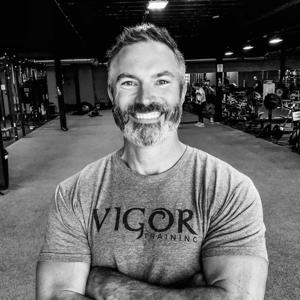
Tom Nikkola | VIGOR Training

Tom Nikkola | VIGOR Training

By Tom Nikkola | VIGOR TrainingHealth & FitnessNutritionMental HealthFitness
Download on the App Store

Tom Nikkola | VIGOR Training episodes

  • 5 Ways Your Feelings Fail You (And Keep You From Living Up To Your Potential)
    Your feelings are not your friend if you want a future filled with good fortune and fulfillment. Said another way...follow your feelings and you're f'd.
    Most of us aren't aware of how many decisions we make each day, based on how we feel in the moment.
    Do you hit the snooze button or get out of bed right away? Order your coffee black, or get a coffee-flavored milk shake? Go to the gym after work, or negotiate with yourself about how you feel, and then drive home?
    We make dozens, if not hundreds of little decisions every day. Each decision itself might seem insignificant. But, when you add them up over a month, year, or a lifetime, those little decisions shape your life and legacy.
    If you're not conscious of the choices you make, you'll default to how you feel at the moment. You won't make the logical choice. You'll make the choice that (temporarily) feels good.
    If you want to suck the marrow out of life, rather than just having things suck, take charge of your choices, no matter how you feel when you make them.
    Ever notice how fast fear and self-doubt take over your head and you start making up excuses for why you shouldn’t say something or do something? We hold ourselves back in the smallest, most mundane moments every day, and that impacts everything. If you break this habit of hesitating and you find the courage to “take some kind of action,” you’ll be astonished by how fast your life changes.Mel Robbins, The 5 Second Rule
    Sometimes it's helpful to talk about your feelings, such as when you feel sad from the loss of someone, hurt because a friend stabbed you in the back, or angry after someone disrespected your spouse or your child.
    But those are the rare circumstances where feelings steer you in the right direction. Most of the time, feelings cause you to trade short-term comfort for long-term success and fulfillment.
    Your feelings fail you. Here are five reasons how...
    1. Your Feelings Make You Act Like a Child
    Think back to being a kid. Did you ever feel like cleaning up your room, taking a shower, brushing your teeth, or eating your vegetables?
    I bet there were many times when your parents asked you to do something, and you put up a fuss because you didn't feel like doing what they asked you to do.
    Sometimes, they probably even raised their voices or threatened consequences if you didn’t do what you were supposed to do.
    Parents have to hold their kids accountable to doing the stuff they don't feel like doing, or they won't do it.
    The desire to do what you feel like doing never goes away. Even as an adult, you'll be tempted. But grown-ups don't think or behave like kids do.
    Grown-up: to grow toward or arrive at full stature or physical or mental maturity; to stop thinking or behaving in a childish way Merriam-Webster
    Children think and behave based on how they feel.
    Grown-ups set their feelings aside, and do whatever needs to be done to move closer to their goals.
    A parent has the authority with their kids to get them to do something, even when they don’t feel like it.
    As a grown-up, you need to parent yourself. You need to make yourself do what you don’t feel like doing.
    You don’t get a participation ribbon or a gold star for getting up on time, eating a healthy breakfast, going to the gym, or being kind to your spouse. I know it’s popular to post about that stuff, and then hashtag it #adulting.
    But, grown-ups don’t need a pat on the back to do what grown-ups are supposed to do. Sometimes you just need to suck it up and do it.
    It doesn’t matter if you’re tired, scared, nervous, or feel like you don't have the skills. You're a grown-up, so you do what needs to be done.
    Guys need to man up, and ladies often need to woman up.
    Follow your feelings and you'll make choices like a child. The world needs more grown ups, not just "legal adults."
    2. Your Feelings Trick You Into Staying the Same
    Except for the few number of non-negotiable activit...
    17 min
  • Coffee: Is it good for you?


    Confused about coffee? Some people still say it is bad for you but is it? Or are their opinions outdated? This is my perspective.


    Article Shortcuts* The Birth of the "Coffee Is Bad For You" Myth* Where the First Coffee Came From* Coffee Brewing Methods* Spilling the Beans About Coffee's Health Benefits* Coffee and Physical Performance* Coffee and Weight Management* Coffee, Insulin Resistance and Diabetes* Coffee and Cardiovascular Disease* Coffee and Cancer* Coffee and Liver Health* Coffee, Cognitive Function, and the Nervous System* Coffee and Bone Health* Coffee and Gut Health* Final Sips


    The Birth of the "Coffee Is Bad For You" Myth


    The year was 1992. In sports, the Blue Jays won the World Series, the Redskins won the Super Bowl, and Andre Agassi and Steffi Graf won at Wimbledon.


    In entertainment, Tom Hanks yelled, “There’s no crying in baseball!” while Jack Nicholson scorned, “You can’t handle the truth!”


    In politics Bill Clinton was Man of the Year, explaining “I didn’t inhale.”


    And in the world of coffee, health advocates warned the public of the problems coffee could cause. As Dr. Tony Chou said,


    The recent decline in caffeine and coffee consumption reflects the widespread awareness of the debate about possible adverse effects of caffeine on health.Dr. Tony Chou, Western Journal of Medicine, 1992


    Fortunately, Starbuck’s didn’t listen. By 1992, they'd grown to 165 coffee shops and went public on the stock exchange. That same year, John Sylvan and Peter Dragone founded Keurig.


    1992 was a long time ago. Like those who still want Zubaz to stay in fashion, some people still hold onto the beliefs about coffee that were common back then.


    Times marches on. Research accumulates. Thinking evolves. Beliefs change.


    Coffee Or Die


    Coincidentally, I’m wearing a Black Rifle Coffee Company t-shirt that says, “Coffee or Die” as I write this article.


    Vanessa and I love coffee.


    We love the delightful aroma, the unique and flavorful taste (well, at least most dark roasts; not so much the light roasts or medium roasts), and even the warmth of the cup as we begin each day.


    I don’t love it enough to die for it, though. And if I believed it was detrimental to my health, I’d give it up right away.


    I started writing this article to find out what was bad about coffee; to see if there were reasons to stop drinking it.


    However, the more papers I read and reviewed (many of which you’ll find in the references section at the end), the more I realized that it’s seriously good for you.


    Coincidentally, I’m wearing a Black Rifl...
    27 min
  • How to Use Critical Thinking with Essential Oils Cynics
    Unless you've been living without internet, you know essential oils have exploded in popularity. Though millions love their oils, there are still some cynics or skeptics.
    Vanessa and I get a message from someone almost weekly, wondering about our thoughts on a new post, from someone hellbent on scaring people away from essential oils.
    The internet is a great venue for skeptics, cynics, or haters to invoke fear and anger about virtually any topic. They often leave their readers utterly confused about what's fact, and what is opinion.
    For those who are new to essential oils, or are on the fence about whether or not to try them, these emotionally-charged posts often create fear and doubt.
    For me, the situation is nothing new. I've seen the same pattern play out about nutritional supplements, diets, exercise, and many other health-related topics.
    The adoption of any new idea or paradigm shift always attracts detractors, not just health-related stuff.
    Remember, people ridiculed the idea that the earth was round, that the Wright Brothers could fly, and that Facebook would be anything more than a college-based website.
    Over the past ten years, essential oil use in America has gone through a significant paradigm shift. Along with millions of promoters, essential oils have also attracted many naysayers.
    So, with all the messages and questions we receive about the latest alarmist's article, I found that it wasn't a great use of time to reply to each one, one-at-a-time. I decided to summarize my answer in a single post to refer them to, as well as to help those who wonder but don't ask.
    I will not debate every point people make against essential oils, especially those that are just nonsense. I simply want to dispel some myths, correct some misinformation, and help you think a little differently.
    I could have written similar articles over the years on high-dose vitamin D, low-carb or high-protein diets, CrossFit, or Bulletproof Coffee™, when each of those ideas gained popularity, as well as opposition. Today, they're pretty much accepted as healthy and beneficial.
    In full disclosure, my wife and I are distributors of essential oils. Our passion for health and fitness, and relentless pursuit of exercise, nutrition, and lifestyle options to improve our own health and others’, led Vanessa to essential oils in 2014. Not only did we realize the potential for our health, but Vanessa also saw the opportunity to build a business promoting them. It grew so fast that I resigned from my Senior Director role at a major fitness company a year later, and joined her.
    I point this out because someone might say I'm biased based on my affiliation with the company we promote. From my point of view, we wouldn't represent the company or promote essential oils if they weren't effective, as we've built our career and reputations around delivering quality health and fitness content and education. One point of view would be to dismiss this article because of my bias. Another would be to realize I believe in them enough to be biased about them in the first place. You can decide for yourself.
    The Four Stages of Idea Acceptance
    History has a way of repeating itself. What we've seen with essential oils, we've seen with any new paradigm shift.
    Adoption of a new idea or paradigm is a four-stage process, described in Virus of the Mind by Richard Brodie:
    Complacency/Marginalization: Early on, most people shrug off the new idea. Actually, when Vanessa got started with essential oils in January of 2014, I gave it little attention myself. I said, "I'm glad you found something you're interested in, but I doubt they work very well, because I haven't heard of them." I pretty much blew them off, which is something I'm embarrassed to admit today. It wasn't very manly.
    Ridicule: Often, when others don't understand a new idea, they laugh at it or mock it. Because it contradicts their beliefs,
    22 min
  • How to Use Critical Thinking with Essential Oils Cynics
    Unless you've been living without internet, you know essential oils have exploded in popularity. Though millions love their oils, there are still some cynics or skeptics.
    Vanessa and I get a message from someone almost weekly, wondering about our thoughts on a new post, from someone hellbent on scaring people away from essential oils.
    The internet is a great venue for skeptics, cynics, or haters to invoke fear and anger about virtually any topic. They often leave their readers utterly confused about what's fact, and what is opinion.
    For those who are new to essential oils, or are on the fence about whether or not to try them, these emotionally-charged posts often create fear and doubt.
    For me, the situation is nothing new. I've seen the same pattern play out about nutritional supplements, diets, exercise, and many other health-related topics.
    The adoption of any new idea or paradigm shift always attracts detractors, not just health-related stuff.
    Remember, people ridiculed the idea that the earth was round, that the Wright Brothers could fly, and that Facebook would be anything more than a college-based website.
    Over the past ten years, essential oil use in America has gone through a significant paradigm shift. Along with millions of promoters, essential oils have also attracted many naysayers.
    So, with all the messages and questions we receive about the latest alarmist's article, I found that it wasn't a great use of time to reply to each one, one-at-a-time. I decided to summarize my answer in a single post to refer them to, as well as to help those who wonder but don't ask.
    I will not debate every point people make against essential oils, especially those that are just nonsense. I simply want to dispel some myths, correct some misinformation, and help you think a little differently.
    I could have written similar articles over the years on high-dose vitamin D, low-carb or high-protein diets, CrossFit, or Bulletproof Coffee™, when each of those ideas gained popularity, as well as opposition. Today, they're pretty much accepted as healthy and beneficial.
    In full disclosure, my wife and I are distributors of essential oils. Our passion for health and fitness, and relentless pursuit of exercise, nutrition, and lifestyle options to improve our own health and others’, led Vanessa to essential oils in 2014. Not only did we realize the potential for our health, but Vanessa also saw the opportunity to build a business promoting them. It grew so fast that I resigned from my Senior Director role at a major fitness company a year later, and joined her.
    I point this out because someone might say I'm biased based on my affiliation with the company we promote. From my point of view, we wouldn't represent the company or promote essential oils if they weren't effective, as we've built our career and reputations around delivering quality health and fitness content and education. One point of view would be to dismiss this article because of my bias. Another would be to realize I believe in them enough to be biased about them in the first place. You can decide for yourself.
    The Four Stages of Idea Acceptance
    History has a way of repeating itself. What we've seen with essential oils, we've seen with any new paradigm shift.
    Adoption of a new idea or paradigm is a four-stage process, described in Virus of the Mind by Richard Brodie:
    Complacency/Marginalization: Early on, most people shrug off the new idea. Actually, when Vanessa got started with essential oils in January of 2014, I gave it little attention myself. I said, "I'm glad you found something you're interested in, but I doubt they work very well, because I haven't heard of them." I pretty much blew them off, which is something I'm embarrassed to admit today. It wasn't very manly.Ridicule: Often, when others don't understand a new idea, they laugh at it or mock it. Because it contradicts their beliefs,
    22 min
  • The Nonnegotiable Approach to Succeeding at Fitness (and Life)
    Each day, the average adult makes 35,000 different decisions. A few decisions can be life-changing. Most are insignificant. Many decisions don't change your life in a moment, but over time can lead you far off the path you desire for your life.
    For example:
    Your alarm beeps at 5:30 am. Your bed is warm and the pillow is soft. It’s dark and quiet. One more hour of sleep would feel so good. Plus, sleep is good for you, right? You could get your workout in tomorrow instead. Do you go back to sleep, or get up and go to the gym?
    You’ve showered and gotten ready for the day. It’s time for breakfast, before you head off to work. You know you’ll feel better later if you cook up some eggs and bacon, or make a low-carb protein shake. But, you can have a bowl of cereal ready in about 30 seconds instead of cooking for ten minutes. And the cereal is already out for the kids, anyway. It’s convenient and tastes pretty good too. What do you do?
    You get to work, and one of your co-workers brought coffee and donuts for another co-worker’s birthday. It wasn’t part of the plan, but it’s free food, and it’s a “special occasion.” Do you eat the donuts, or just drink the coffee?
    Situations like these situations play out everyday. Unless you have a full supply of willpower, you'll often choose the pleasures of the moment, and feel guilty later because you shortchanged your future.
    I’d like to propose a different perspective on this age-old situation of "I know what to do. I just don't do it."
    First, I need to set the stage with an understanding of willpower and decision fatigue.
    Willpower and Decision Fatigue
    Short-term comfort and pleasure is pretty tempting. In each of the examples above, you need a certain amount of willpower to ignore temptation.
    Willpower: control exerted to do something or restrain impulses
    Willpower is the mental energy needed to do what needs to be done, or to avoid what shouldn’t be done.
    Because willpower requires mental effort and energy, you need a reserve of mental energy to exercise willpower. Decision-making is the biggest drain on that mental energy.
    Roy Baumeister and John Tierney, in their book Willpower – Rediscovering the Greatest Human Strength, describe decision fatigue as “the deteriorating quality of decisions made by an individual after a long session of decision making.”
    In essence, the more decisions you make, the less willpower you'll have. The more willpower you use, the more likely it is that you’ll make poor decisions.
    Can you see why it's a bad idea to schedule an important meeting at the end of the workday, or why you should never make important marital or family decisions late at night?
    As the day goes on, and you’re faced with family, work, financial, and fitness decisions, you make lower and lower-quality decisions.
    An exhausting day at work, followed by a half hour trying to pick out the perfect outfit for dinner, will make it really hard to choose wisely from the restaurant menu.
    Or, if you don't go out, just answering the question “What’s for dinner?” can be an overwhelming decision to answer. So you probably end up ordering pizza instead.
    How to Conserve Your Willpower
    Each day, you begin with a certain level of willpower. If you wake up tired from the day before, you won't have a fully recharged willpower battery. That doesn't mean you get a "hall pass" from good decision making. You are still responsible for every decision you make. You just need to conserve your willpower for decisions that are most important.
    It’s like when your cell phone battery gets low and you don't have a charger handy. You use your phone for just the essentials. You might also turn off notifications, stop apps that run in the background, and turn down the screen brightness. You save your battery for only what's most important.
    You can do the same thing with your willpower battery. To conserve willpower, you can:
    Make fewer decisions
    16 min
  • The Nonnegotiable Approach to Succeeding at Fitness (and Life)
    Each day, the average adult makes 35,000 different decisions. A few decisions can be life-changing. Most are insignificant. Many decisions don't change your life in a moment, but over time can lead you far off the path you desire for your life.
    For example:
    Your alarm beeps at 5:30 am. Your bed is warm and the pillow is soft. It’s dark and quiet. One more hour of sleep would feel so good. Plus, sleep is good for you, right? You could get your workout in tomorrow instead. Do you go back to sleep, or get up and go to the gym?
    You’ve showered and gotten ready for the day. It’s time for breakfast, before you head off to work. You know you’ll feel better later if you cook up some eggs and bacon, or make a low-carb protein shake. But, you can have a bowl of cereal ready in about 30 seconds instead of cooking for ten minutes. And the cereal is already out for the kids, anyway. It’s convenient and tastes pretty good too. What do you do?
    You get to work, and one of your co-workers brought coffee and donuts for another co-worker’s birthday. It wasn’t part of the plan, but it’s free food, and it’s a “special occasion.” Do you eat the donuts, or just drink the coffee?
    Situations like these situations play out everyday. Unless you have a full supply of willpower, you'll often choose the pleasures of the moment, and feel guilty later because you shortchanged your future.
    I’d like to propose a different perspective on this age-old situation of "I know what to do. I just don't do it."
    First, I need to set the stage with an understanding of willpower and decision fatigue.
    Willpower and Decision Fatigue
    Short-term comfort and pleasure is pretty tempting. In each of the examples above, you need a certain amount of willpower to ignore temptation.
    Willpower: control exerted to do something or restrain impulses
    Willpower is the mental energy needed to do what needs to be done, or to avoid what shouldn’t be done.
    Because willpower requires mental effort and energy, you need a reserve of mental energy to exercise willpower. Decision-making is the biggest drain on that mental energy.
    Roy Baumeister and John Tierney, in their book Willpower – Rediscovering the Greatest Human Strength, describe decision fatigue as “the deteriorating quality of decisions made by an individual after a long session of decision making.”
    In essence, the more decisions you make, the less willpower you'll have. The more willpower you use, the more likely it is that you’ll make poor decisions.
    Can you see why it's a bad idea to schedule an important meeting at the end of the workday, or why you should never make important marital or family decisions late at night?
    As the day goes on, and you’re faced with family, work, financial, and fitness decisions, you make lower and lower-quality decisions.
    An exhausting day at work, followed by a half hour trying to pick out the perfect outfit for dinner, will make it really hard to choose wisely from the restaurant menu.
    Or, if you don't go out, just answering the question “What’s for dinner?” can be an overwhelming decision to answer. So you probably end up ordering pizza instead.
    How to Conserve Your Willpower
    Each day, you begin with a certain level of willpower. If you wake up tired from the day before, you won't have a fully recharged willpower battery. That doesn't mean you get a "hall pass" from good decision making. You are still responsible for every decision you make. You just need to conserve your willpower for decisions that are most important.
    It’s like when your cell phone battery gets low and you don't have a charger handy. You use your phone for just the essentials. You might also turn off notifications, stop apps that run in the background, and turn down the screen brightness. You save your battery for only what's most important.
    You can do the same thing with your willpower battery. To conserve willpower, you can:
    16 min
  • Man Up by Scott Schuler: What I Learned. Why You Need to Read It
    What does it mean to "man up?" For that matter, what does it mean to be a man? 
    I'm not referring to a male, or a guy, or some other generic or biologic definition. I'm talking about a MAN!
    How should he think? Behave? Treat a lady? Lead in business? Set an example as a father? Care for and protect his wife? Walk with the Lord? Those are some super-deep questions.
    I've reflected a lot on these questions in recent years.
    During some moments of reflection, I feel sad because it's so rare to see the virtues of manliness displayed today. I worry our boys didn't see enough of me living out those virtues as they grew up, especially because now that they're out of the house, they won't be exposed to them as often as I wish they would be.
    In other moments of reflection, I feel nervous about what the future might look like, without enough men who live out their responsibility of being men, and what it might mean to the women who would like to depend on them (no offense to those ladies who feel they don't need a man).
    You might read this and think, "Big deal, Tom. Times are changing. Every generation is different."
    They are certainly changing, but some things are critical to the fabric of a thriving society. Even Biblical. And the virtues of manhood have always been a cornerstone of the health of society.
    That's not to say that the virtues of womanhood aren't just as important. They are. The issue, though, is that too few men are Manning Up today.
    A Man's Man...A Book...A Movement
    Scott Schuler is one of the "Manliest Men" I know.
    He's a "speak softly, but carry a big stick" kind of guy. Scott is deeply passionate, finds peace in the woods, and could probably go toe-to-toe with Ragnar himself (the old Minnesota Vikings mascot, or the one portrayed on The Vikings TV show).
    Scott even sports an epic beard...not the nicely manicured, ready for GQ kind of beard...but the kind that would make a Minnesota black bear question whether the beast in front of him would be something to mess with.
    But then, when you sit with him, Scott is soft-spoken, caring, compassionate, and tender-hearted.
    Scott saw this same issue I mentioned above: Men not stepping up as men as much anymore. He couldn't keep his thoughts to himself anymore, so he wrote Man Up: It's Hard to Resist a Bad Boy...Even More So a Good Man!
    Even if you never meet him, you'll know Scott after reading it. He's the same guy in his book as he is in person, right down to his use of uncommonly used words, such as ornery, crappy, assiduity, and testicles to make a point.
    As you can imagine, you'll find the book not only informative, but pretty funny in parts, too.
    My goal is to tease you with just enough to leave you feeling like you learned something, but wanting more, so you order Man Up.
    I'd love to see Man Up become an immediate New York Time's bestseller, so order a copy for every guy in your family, and some of your friends, too. I pre-ordered 20 copies myself.
    Instead of just sharing my opinion of Man Up, I want to share a few of the many insights I took away (there were many more that I'm not addressing here). I've mixed in a lot of my own perspective, so whenever I'm directly quoting Scott Schuler, I've made the text blue and italics. That way I don't have to keep writing, "Scott said."
    With that, I want to mix in a little Scott Schuler, and a little bit of me as I summarize some of the topics I highlighted as I read Man Up.
    To Man Up is to Take Responsibility
    A man knows he's entitled to little, and responsible for much. He needs to stand on his own two feet.
    There's nothing wrong with leaning on mom and dad for wisdom and guidance, but if a man has to depend on them, well, that's not really manning up.
    A man doesn't need his mommy (or his wife) to pay his bills, make him food, buy him stuff, or help coddle him when he feels bad.
    He also takes ownership of the problems around him,

    17 min
  • Man Up by Scott Schuler: What I Learned. Why You Need to Read It
    What does it mean to "man up?" For that matter, what does it mean to be a man? 
    I'm not referring to a male, or a guy, or some other generic or biologic definition. I'm talking about a MAN!
    How should he think? Behave? Treat a lady? Lead in business? Set an example as a father? Care for and protect his wife? Walk with the Lord? Those are some super-deep questions.
    I've reflected a lot on these questions in recent years.
    During some moments of reflection, I feel sad because it's so rare to see the virtues of manliness displayed today. I worry our boys didn't see enough of me living out those virtues as they grew up, especially because now that they're out of the house, they won't be exposed to them as often as I wish they would be.
    In other moments of reflection, I feel nervous about what the future might look like, without enough men who live out their responsibility of being men, and what it might mean to the women who would like to depend on them (no offense to those ladies who feel they don't need a man).
    You might read this and think, "Big deal, Tom. Times are changing. Every generation is different."
    They are certainly changing, but some things are critical to the fabric of a thriving society. Even Biblical. And the virtues of manhood have always been a cornerstone of the health of society.
    That's not to say that the virtues of womanhood aren't just as important. They are. The issue, though, is that too few men are Manning Up today.
    A Man's Man...A Book...A Movement
    Scott Schuler is one of the "Manliest Men" I know.
    He's a "speak softly, but carry a big stick" kind of guy. Scott is deeply passionate, finds peace in the woods, and could probably go toe-to-toe with Ragnar himself (the old Minnesota Vikings mascot, or the one portrayed on The Vikings TV show).
    Scott even sports an epic beard...not the nicely manicured, ready for GQ kind of beard...but the kind that would make a Minnesota black bear question whether the beast in front of him would be something to mess with.
    But then, when you sit with him, Scott is soft-spoken, caring, compassionate, and tender-hearted.
    Scott saw this same issue I mentioned above: Men not stepping up as men as much anymore. He couldn't keep his thoughts to himself anymore, so he wrote Man Up: It's Hard to Resist a Bad Boy...Even More So a Good Man!
    Even if you never meet him, you'll know Scott after reading it. He's the same guy in his book as he is in person, right down to his use of uncommonly used words, such as ornery, crappy, assiduity, and testicles to make a point.
    As you can imagine, you'll find the book not only informative, but pretty funny in parts, too.
    My goal is to tease you with just enough to leave you feeling like you learned something, but wanting more, so you order Man Up.
    I'd love to see Man Up become an immediate New York Time's bestseller, so order a copy for every guy in your family, and some of your friends, too. I pre-ordered 20 copies myself.
    Instead of just sharing my opinion of Man Up, I want to share a few of the many insights I took away (there were many more that I'm not addressing here). I've mixed in a lot of my own perspective, so whenever I'm directly quoting Scott Schuler, I've made the text blue and italics. That way I don't have to keep writing, "Scott said."
    With that, I want to mix in a little Scott Schuler, and a little bit of me as I summarize some of the topics I highlighted as I read Man Up.
    To Man Up is to Take Responsibility
    A man knows he's entitled to little, and responsible for much. He needs to stand on his own two feet.
    There's nothing wrong with leaning on mom and dad for wisdom and guidance, but if a man has to depend on them, well, that's not really manning up.
    A man doesn't need his mommy (or his wife) to pay his bills, make him food, buy him stuff, or help coddle him when he feels bad.
    He also takes ownership of the problems around him,
    17 min
  • High-Quality Multivitamin: What To Look For


    What is the easiest and fastest way to dramatically improve your nutrient intake? A high-quality multivitamin.


    But what is a high-quality multivitamin? Or put another way, how can you pick out low-quality multivitamins, so you don’t waste your money on them?


    I know what it takes to build a quality supplement, and I know how supplement companies cut corners too.


    I ran a nutritional supplement brand for one of the top fitness companies in the United States for several years. During that time, I designed a line that was “bulletproof” in quality and efficacy. I trained and educated the company's fitness professionals, and kept my eyes on new research to ensure the supplements stayed leading-edge.


    I also worked for a year with one of the most-respected nutritional products manufacturers in the world. I designed and formulated products, and have been “behind the scenes” in the supplement manufacturing world.


    I understand how some companies can cut corners in the quality of their products to drive up margins, or to sell products at highly-inflated prices.


    In this article, I’ll share with you why (in my opinion) almost everyone needs to take a high-quality multivitamin. You'll also understand why a high-quality multivitamin is the first of my "Foundational Five," the five supplements I recommend for every nutrition program.


    Why You Need a Multivitamin


    When I refer to a “multivitamin,” I’m really talking about a multi-vitamin, multi-mineral supplement, or a supplement that includes most, if not all, of your essential micronutrients.


    Micronutrient: essential vitamin or mineral that must be consumed through diet or supplementation to maintain normal cellular and molecular function.


    If you don’t use a multivitamin today, here’s three reasons why I believe you need to start.


    1. Vegetables and Fruit Contain Fewer Nutrients


    Vegetables and fruit are not nearly as nutrient-dense as they once were. Farming today creates produce that grows bigger and faster, and is more resistant to pests and climate challenges.


    Unfortunately, these super-sized vegetables and fruit lack the nutrient-density of their smaller, more fragile ancestors. On top of that, soil has been depleted of nutrients over the past several decades. Since the soil is less nutritious, the plants that grow in it get less nutrition, too.


    Research shows that today’s produce has less protein, calcium, phosphorus, iron, riboflavin, vitamin C, magnesium, zinc, vitamin B6, vitamin E, and vitamin A than in the mid -1900s.


    As one study put it, you’d need to eat eight oranges today to get the same amount of vitamin A that a single orange contained when our grandparents were young.


    2. Today’s Lifestyle Demands More Vitamins and Minerals


    We encounter more oxidative stress, emotional and physical stress, pollution and other toxins than ever. We also get less sleep, movement, and time outdoors, which hampers your ability to recover from those stresses.


    Vitamins and minerals play important roles in helping us deal with these stressors, and in helping us maintain normal metabolic function.


    3. The Average Meal is Calorie-Rich and Nutrient-Poor


    Since you’re reading this article, I suspect you eat healthier than the average person.


    Even so,
    21 min

About Tom Nikkola | VIGOR Training

From the publisher's feed

Tune into the audio version of my written articles found at tomnikkola.com, read by yours truly. I candidly cover health and fitness,…