
Sign up to save your podcasts
Or



In 2023, around 6.8 million people in the UK were in severely insecure work – little over a firth of the working population. Work Foundation Director Ben Harrison dials in from London to discuss the issue.
Ben tells Jan and Paul about how the Work Foundation works as it tries to influence policy across the UK. He covers issues of flexible working, how economic changes in recent years have affected working patterns, and the effects of the Covid 19 pandemic.
What are decent and insecure work? How does the Work Foundation’s Insecure Work Index function, and what does it tell us? Are particular groups and parts of the country more affected by insecure work? What responsibilities do employers have towards their employees during times of financial hardship?
Discover more about the Work Foundation’s research and activities on insecure work here: https://www.lancaster.ac.uk/work-foundation/our-work/insecure-work/
Dr Joanne Larty joins Jan and Paul to enlighten them on her work with businesses in Cumbria on sharing best sustainability practice.
Through Project INSPIRE, Joanne and her team are speaking to pioneering companies across Cumbria to discover how they are tackling sustainability challenges, how it ties into the history and landscape of the county, and how their practices can be spread.
What issues do business face? How can they move to a new way of operating? And, most importantly to Paul, how do you really pronounce Furness, and why does everyone get it wrong?
Discover more about Joanne’s work here: https://www.lancaster.ac.uk/lums/people/joanne-larty
Read more about Project Inspire here: https://doc.your-brochure-online.co.uk/Lancaster-University_FiftyFourDegrees_Issue_19/14/
Matt Healey talks Jan and Paul through his journey from an outdoor education professional to becoming a PhD researcher looking at our connections with nature.
The UK has the lowest connection with nature in Europe, and Matt’s work encompasses how we each appreciate nature in our everyday lives, the importance of considering nature from a non-human-centric perspective, the value of nature, and the importance of connecting with nature from a young age.
Plus, find out how connected to nature are Jan and Paul?
Read more of Matt’s work on ‘Taming the Green Monster’ here: https://doc.your-brochure-online.co.uk/Lancaster-University_FiftyFourDegrees_Issue_17/47/
Professor Alona Armstrong returns to give Jan and Paul a whirlwind tour of the work that takes place across the Lancaster Environment Centre and the Energy Lancaster research centre.
Discover the work of Energy Lancaster here: https://www.lancaster.ac.uk/energy-lancaster/
And find out about the research taking place in Lancaster Environment Centre here: https://www.lancaster.ac.uk/lec/research/
Energy Lancaster Director Professor Alona Armstrong takes Jan and Paul on a wonderful journey into the world of solar power, which continues to outperform predictions for its output and effectiveness.
How many solar parks are there in the UK (clue, it’s not seven or 300)? How can solar parks affect biodiversity? How long do solar plants last? How do floating solar farms work? How many homes can a solar plant power? And did Paul really do the maths to answer that question so quickly in his head?
All these questions and more will be answered – and we discuss if you could wear solar powered clothes?
Discover the work of Energy Lancaster here: https://www.lancaster.ac.uk/energy-lancaster/
And find out more about Alona’s research here: https://www.lancaster.ac.uk/energy-lancaster/about-us/people/alona-armstrong
Pentland Centre Research Associate Lauren Thornton wants to talk to us about trust.
Specifically trust frameworks and trust affordances – explaining how and where people can trust data, and to what extent; why different people will trust different things – and the challenges of building trust with the right audience.
How does this all fit with sustainability data – especially given the uncertainty over how sustainability can be achieved, and that some people will try to twist data for their own means; and what is translucent reporting, and why might it be better than transparency?
Plus, Jan uses the word ‘groovy’ in a totally non-ironic sense.
Discover more about Lauren’s work here: https://www.lancaster.ac.uk/lums/people/lauren-thornton
Dr Di Wang dials in from Sydney, Australia, to talk to Jan and Paul about his work on sustainability reporting and materiality.
Di talks about his experience of interviewing more than 200 businesses on their understanding of materiality – a concept that underpins reporting and which will be explained in the podcast. He explains why companies take part in greenhushing – and explains why he thinks the practice is only likely to increase. He also introduces us to the concept of brownwashing.
And Paul's brainwashing is complete, as the word ‘benchmarking’ comes into his head unprompted.
Find out more about Di’s work and research interests here: https://www.lancaster.ac.uk/lums/people/di-wang
And you can see Di’s paper on Sustainability Reporting and Materiality here: https://papers.ssrn.com/sol3/papers.cfm?abstract_id=4687038
What is leadership? And what makes a good leader?
Dr Marian Iszatt-White heads to the studio to talk with Jan and Paul about her perspective on leadership and management – as well as her time working in the oil industry.
Marian discusses what authentic leadership is – and why we should or should not be authentic; how leaders address sustainability issues; where stewardship and accountability fit in; and the importance of teaching on how future leaders can be shaped by programmes such as Lancaster’s MBA.
Find out more about Marian’s work here: https://www.lancaster.ac.uk/lums/people/marian-iszatt-white
What are wicked problems? How about clumsy solutions? And where does post-normal science fit in?
In tackling issues such as climate change, scientists and researchers face complicated scenarios that are not easily explicable, with problems that are not always solvable in a clean fashion. Jan explains the development of post-normal science as a way of addressing huge modern (wicked) problems such as climate change, how there is not always a definitive answer to every question, and why uncertain (clumsy) solutions are better than none at all.
Why is being uncertain a good sign? Why do we all need to be open to changing our minds? If we don’t rely on facts for solutions, does this lead to a post-Truth future? Do we need to involve more people from beyond science in drafting solutions? Can a solution to a wicked problem ever be permanent? We cover all these questions, and more.
Find out more about the Cynefin Framework here: https://thecynefin.co/about-us/about-cynefin-framework/
Paul’s head is going to explode as another new word to the English language is introduced to the podcast.
Law PhD researcher Camilo Cornejo Martinez returns to talk to Jan and Paul about the importance of both local and global attitudes, actions and policies towards climate change.
Discover more about Camilo’s work here: https://www.lancaster.ac.uk/law/people/camilo-cornejo-martinez
From the publisher's feed
Sustainability is a key consideration for any contemporary business, from biodiversity to modern slavery, seabeds to factory floors. Transforming Tomorrow guides you through the complex, ever-changing and often exciting (yes, really!!) world of sustainability in business.
Alongside members of the Pentland Centre, international research experts, and business leaders, we cover the theory and practice of mainstreaming sustainability into purposeful business strategy and performance.
Whether you are leading change in your business, or just want to know more about how space weather, human trafficking or architecture may influence the future of sustainability, Transforming Tomorrow is the show for you.
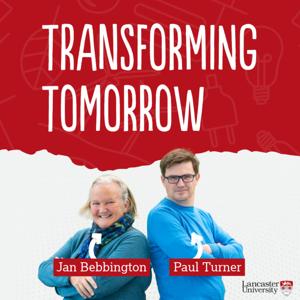
Taking you through it all, hosts Jan and Paul bring insight, perspective, and more than occasional disagreement to their topics.
Professor Jan Bebbington is the Director of the Pentland Centre for Sustainability in Business at Lancaster University. Jan is an expert on accounting, benchmarking (to her co-host’s annoyance), and how business and sustainability intersect. She loves nature and wants to protect it – and hopes she can change the world (ideally for the better). She is also motivated to address inequality wherever it is found and especially to eliminate forced, bonded or child labour. Transforming Tomorrow is one small step on that quest.
Paul Turner is a former sports journalist who now works promoting the research activities in Lancaster University Management School – a poacher turned gamekeeper as his former colleagues would have it. He has always been interested in nature and the natural environment – it comes from growing up in Cumbria – and has been a vocal proponent of the work of the Pentland Centre since joining Lancaster University. He does not like rankings and benchmarking, and is not afraid to say so.
Join us every Monday to uncover new insights and become a little more inspired that you can make a difference in sustainability.