
Sign up to save your podcasts
Or



What do big companies do to positively contribute to sustainability efforts, and to wider society? What does your employer do? Is it enough, and could they do more?
Brands and brand values send messages and have their own sustainability identities, so it’s time to look at how this affects their actions.
Kaeisha Gibson, Head of Corporate Responsibility at Pentland Brands, discusses how brands including Speedo, Canterbury, Endura, Mitre, and more, approach their strategies towards sustainability.
The conversation focuses in on the Berghaus outdoor gear brand and its B-Corp certification, which demonstrates their determination to be a positive influence on the world and do no harm.
Learn why Berghaus pursued B-Corp status, what they do to maintain that certification, how they challenge themselves to improve, the plans for other brands under the Pentland banner to follow the Berghaus lead, and how old Jan’s Berghaus rucksack is.
Plus, after Jan uses the word ‘groovy’ once again without irony, does Kaeisha have the power to have her fired? And does Paul really only wear branded clothing?
Find out more about Berghaus’s B-Corp certification here: https://www.berghaus.com/positive-business/bcorp.list
The battle between good and evil comes to Transforming Tomorrow. What is good? What does ‘good’ mean in the context of how you do business?
We look at how companies can balance profit with doing right in the world, why it doesn’t necessarily take as long as you think to move to a new way of thinking and working, and whether the world needs to be in crisis to force corporations to act.
Professor Steve Kempster explains his work on Good Dividends, and how he has worked with businesses to see how they work and if they can change it for the better.
Discover what a Benefit Corporation is, how purpose-led businesses perform against their competitors, and whether Steve has hope for the future.
Plus, Steve sets out to change our understanding of Adam Smith – and contemplates if he would be the kind of person to give you a High Five – and Paul becomes self-conscious about his eyebrows.
Find out more about Steve and his work here: https://www.lancaster.ac.uk/pentland/about/meet-the-team/steve-kempster
Discover the Good Growth programme featuring Good Dividends here: https://www.lancaster.ac.uk/business/good-growth-burnley/
Put on your activism boots and join us on a journey from the Antarctic to Sweden and the Arctic, China, Lancaster and many places in between.
We find out the differences between being an activist and an academic, how you go from being one to the other, and how experience as an activist gives you unique and invaluable insights for research.
Frida Bengtsson describes her journey from growing up in a family where Greenpeace was an important presence, to being lead of the organisation’s Global Oceans campaign, before becoming a PhD researcher at the Stockholm Resilience Centre.
Frida’s work now looks at ocean governance and transhipment (and we will definitely find out what that means), introducing Jan and Paul to a world where understanding vessel ownership leads to murky waters, where regulations in the middle of the seas can be a maelstrom of confusion, and where we consider the ethics behind a fish finger sandwich.
What happens on fishing boats that stay at sea for months at a time? What is it like meeting with an organisation as an academic when you last met them while working for Greenpeace?
And why does Jan send Frida pictures of ships in every port she visits?
Discover more about Frida and her work at the Stockholm Resilience Centre here: https://www.stockholmresilience.org/meet-our-team/staff/2021-06-01-bengtsson.html
And read about Frida’s new paper on reefers and transshipment here: https://www.stockholmresilience.org/reefers
Episode Transcript
We’re blasting off into space! Find out all you need to know to mine an asteroid – though be warned, it’s not that simple.
Discover which laws you have to follow beyond Earth’s atmosphere, how we get to asteroids in the first place, and what this might mean for life here and millions of miles away.
Dr Craig Jones joins Jan and Paul for an astronomical start to the new series. He specialises in asteroid mining and the myriad issues that arise when it comes to considering how it could be done, and what the practice could mean for sustainability.
The discussion covers potential harm to the ozone layer, how space junk could damage satellites and our oceans, and if all this is a pathway to building a back-up colony should Earth fail.
And what does William of Orange have to do with asteroid mining rights?
Read more about Craig's asteroid mining research in Fifty Four Degrees: https://doc.your-brochure-online.co.uk/Lancaster-University_FiftyFourDegrees_Issue_22/30/
And discover more about Craig’s work here: https://www.lancaster.ac.uk/lums/people/craig-jones
Episode Transcript
What are externalities? How does the EU have environmental effects beyond its borders? What is justice?
We bring Season One of Transforming Tomorrow to a close with Jan answering some of the questions that have come up during previous episodes.
Jan explains externalities, and how (not when) they can be internalised; why it is important to know about the EU’s impacts; and the many elements to justice.
Plus, a sneak peek at what is coming up in Season Two.
Find details on the Frontiers of Justice book Jan mentions here: https://www.hup.harvard.edu/books/9780674024106)
And the paper on justice and earth systems is here: https://www.nature.com/articles/s41893-023-01064-1
What is ‘future normal’? How will the world look years from now? How will businesses operate? How could they make your children proud? And how does sustainability fit into all this?
Professor Nick Barter, from Griffith University, takes Jan and Paul through the origins of the phrase from his time working with industry while completing his PhD with Jan at the University of St Andrews.
Covering topics from corporate direction-setting and vision to culture and language, learning from nature, and enabling others, Nick talks to us about how companies can change to be part of a world they want to live in.
Find out more about Future Normal here: https://futurenormal.net/
Like evaluations? Does anyone? It’s time to change your mind and learn about creative evaluation.
Jan and Paul welcome Dr Elisavet Christou and Violet Owen to enlighten them.
Co-authors of the Little Book of Creative Evaluation, they explain what Creative Evaluation is, and how it can be used across many disciplines.
Elisavet and Violet discuss their EViD tool, which helps people with their evaluation processes; the value of hearing from different voices; the importance of design; and why evaluation is so much more than a tick-box exercise.
Jan gets to talk benchmarking again. And is Paul right to be worried that the team are secretly being evaluated the whole time?
Check out the Little Book of Creative Evaluation here: https://creativeevaluation.uk/
And read a little more about the work here: https://doc.your-brochure-online.co.uk/Lancaster-University_FiftyFourDegrees_Issue_20/34/
How can executives change their operations and attitudes – from nature restoration to modern slavery – to be more sustainable and responsible? How hard is it to get people to accept the difficulty of the task.
Linden Edgell – Inquisitor, Collaborator and Explorer extraordinaire – joins Jan and Paul from Perth, Australia, among her 150 mango trees to answer these and other questions.
Linden is ERM’s Global Sustainability Director and is a member of the Pentland Centre’s Advisory Board. She has worked in government and latterly in consulting, where she is seeking to bring about change in corporate behaviour.
What developments has she seen over the decades? How do companies balance profit, sustainability and longevity? Can you walk and chew gum?
Increase your knowledge of salmon tenfold as we look at the environmental impacts of a major industry.
Farmed salmon is the UK’s biggest food export – and Dr Josi Fernandes is obsessed!
Josi joins Jan and Paul to talk about her work looking at salmon farming practices and sustainability in the UK and how her research in the area all started over a conversation in the pub.
We discover what Josi has learned from speaking with salmon farmers, processors and retailers – though not everyone wanted to talk.
We take in the differences between farmed and wild salmon; how farmed salmon came to be such a big market; the industrial scale of production; potential futures for the industry; and whether anyone in the studio eats salmon in the first place.
Find out more about Josi’s research here: https://www.lancaster.ac.uk/lums/people/josiane-fernandes2
You can discover Paul Greenberg’s Four Fish book here: https://www.paulgreenberg.org/books/four-fish/
And see more on Mark Kurlansky’s Salmon book here: https://www.markkurlansky.com/books/salmon-a-fish-the-earth-and-the-history-of-their-common-fate/
Do investors really care about sustainability, or is it all about the money? If they do care, what powers do they have to make companies change their ways?
Jan and Paul welcome Professor Mark Shackleton to discuss the world of finance and how it intersects with sustainability.
They discover why the King can’t enter the City of London without permission; how data can be used to influence ‘green’ investing; and how shareholders can instigate change.
Among discussions of ethics and politics, they find the time to talk about physics and Paul’s strange childhood fascination with global stock exchanges.
Find out more about Mark’s research here: https://www.lancaster.ac.uk/lums/people/mark-shackleton
From the publisher's feed
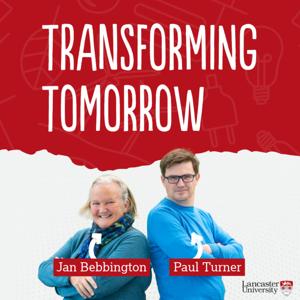
Sustainability is a key consideration for any contemporary business, from biodiversity to modern slavery, seabeds to factory floors. Transforming Tomorrow guides you through the complex, ever-changing and often exciting (yes, really!!) world of sustainability in business.
Alongside members of the Pentland Centre, international research experts, and business leaders, we cover the theory and practice of mainstreaming sustainability into purposeful business strategy and performance.
Whether you are leading change in your business, or just want to know more about how space weather, human trafficking or architecture may influence the future of sustainability, Transforming Tomorrow is the show for you.
Taking you through it all, hosts Jan and Paul bring insight, perspective, and more than occasional disagreement to their topics.
Professor Jan Bebbington is the Director of the Pentland Centre for Sustainability in Business at Lancaster University. Jan is an expert on accounting, benchmarking (to her co-host’s annoyance), and how business and sustainability intersect. She loves nature and wants to protect it – and hopes she can change the world (ideally for the better). She is also motivated to address inequality wherever it is found and especially to eliminate forced, bonded or child labour. Transforming Tomorrow is one small step on that quest.
Paul Turner is a former sports journalist who now works promoting the research activities in Lancaster University Management School – a poacher turned gamekeeper as his former colleagues would have it. He has always been interested in nature and the natural environment – it comes from growing up in Cumbria – and has been a vocal proponent of the work of the Pentland Centre since joining Lancaster University. He does not like rankings and benchmarking, and is not afraid to say so.
Join us every Monday to uncover new insights and become a little more inspired that you can make a difference in sustainability.