
Sign up to save your podcasts
Or

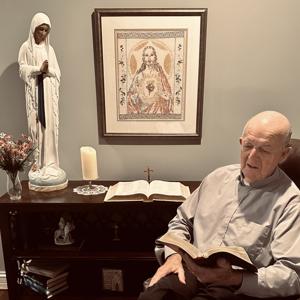


On Monday of the Tenth Week in Ordinary Time our Church invites us to reflect on a Scripture passage from the beginning of the book of Joshua (1:1–18), entitled "Joshua, called by God, encourages the tribes to unity". Our treasure for today, which follows, is from a letter to the Romans by Saint Ignatius of Antioch, bishop and martyr.
Saint Ignatius of Antioch (c. 35–107 AD) was one of the earliest Christian bishops and a disciple of the Apostles, traditionally believed to have known Saint John the Apostle. He is best known for the letters he wrote while being taken to Rome for martyrdom, where he encouraged Christians to remain united in faith and loyal to their bishops. Ignatius made some of the earliest and clearest statements about the Church as "Catholic," the authority of bishops, and the Real Presence of Christ in the Eucharist. His writings provide invaluable testimony to what the earliest Christians believed and practiced, helping to confirm key Catholic teachings on Church unity, apostolic authority, the Eucharist, and the importance of remaining faithful to Christ even in the face of persecution. He is revered as one of the most important witnesses to the faith of the early Church.
The primary purpose of Saint Ignatius in writing his Letter to the Romans was to beg the Christians in Rome not to interfere with his impending martyrdom. As he was being taken to Rome to be executed for his faith, Ignatius feared that influential Roman Christians might try to obtain his release. Instead, he urged them to allow him to die for Christ, seeing martyrdom as the fullest imitation of Jesus and the completion of his discipleship. He wrote with remarkable humility and longing, expressing his desire to be united completely with Christ through his sacrifice. At the same time, the letter serves as a powerful witness to the early Christian understanding of martyrdom, love of Christ above earthly life, and the hope of eternal union with God.
Our first reading from Joshua (1:1–18) teaches that God faithfully raises up Joshua to lead His people after the death of Moses and assures him of His constant presence. God calls Joshua to be strong, courageous, and faithful to His law, while the people pledge their support and obedience. The passage teaches that success in fulfilling God's mission comes through trust in God, fidelity to His word, and unity among His people. When leaders and communities work together under God's guidance, they are strengthened to accomplish the tasks He sets before them.
Today, on the Solemnity of Corpus Christi, The Most Holy Body and Blood of Christ, our Church invites us to read and reflect on a passage from the book of Exodus (24:1-11) entitled "They saw God, and they ate and drank". Our treasure, which follows is from a work by Saint Thomas Aquinas, priest.
The Catholic Church celebrates the Solemnity of Corpus Christi (Latin for "Body of Christ") to give special honor to the Real Presence of Jesus Christ in the Eucharist. While the institution of the Eucharist is commemorated during Holy Week on Holy Thursday, that celebration occurs in the midst of the Church's remembrance of Christ's Passion and death. Corpus Christi was established to provide a joyful feast focused entirely on the gift of the Eucharist itself—Christ's Body, Blood, Soul, and Divinity given to His Church.
Corpus Christi is a doctrinal feast established for three purposes: 1) to give God collective thanks for Christ's abiding presence with us in the Eucharist and to honor Him there; 2) to instruct the people in the Mystery, Faith and devotion surrounding the Eucharist, and 3) to teach us to appreciate and make use of the great gift of the Eucharist, both as a Sacrament and as a sacrifice.
Saint Thomas was born about the year 1225 into the family of the Count of Aquino. He first studied at the Monastery of Monte Casino and later at the University of Naples. Afterwards he joined the Friars Preachers and completed his studies at Paris and Cologne, his instructor being Saint Albert the Great. Becoming himself a teacher, he wrote many learned volumes and was especially renowned for his philosophical and theological studies. Saint Thomas died near Terracina on March 7, 1274. He was canonized in 1323 and made a Doctor of the Church in 1567.
In "O Precious and Wonderful Banquet," which is our "treasure" today, Saint Thomas reflects on the great gift of the Eucharist, teaching that at the Last Supper Christ gave His Body and Blood as spiritual food for His people and as a lasting memorial of His saving sacrifice. Aquinas emphasizes that the Eucharist strengthens believers with grace, deepens their union with Christ, fosters unity within the Church, and offers a foretaste of the heavenly banquet that awaits the faithful in eternal life. The central lesson is that the Eucharist is the Church's most precious treasure, through which Christ remains truly present with His people and nourishes them on their journey to God.
Our first reading from Exodus 24:1–11, "They saw God, and they ate and drank," teaches that God desires to enter into a covenant relationship with His people and invites them into communion with Him. After accepting God's covenant, Moses and the elders of Israel share a sacred meal in God's presence, a sign of peace, fellowship, and divine blessing. For Christians, this event foreshadows the deeper communion offered through Christ in the Eucharist, where God draws His people into an intimate relationship with Himself and nourishes them with His grace.
On Saturday of the Ninth Week in Ordinary Time our Church invites us to read and reflect on a passage from the book of Job (42:7-17) entitled "Job is justified by God and his enemies are refuted". Our treasure, which follows, is from the Exposition on John by Saint Thomas Aquinas, priest.
Saint Thomas was born about the year 1225 into the family of the Count of Aquino. He first studied at the Monastery of Monte Casino and later at the University of Naples. Afterwards he joined the Friars Preachers and completed his studies at Paris and Cologne, his instructor being Saint Albert the Great. Becoming himself a teacher, he wrote many learned volumes and was especially renowned for his philosophical and theological studies. Saint Thomas died near Terracina on March 7, 1274.
He was canonized in 1323 and made a Doctor of the Church in 1567. In 1965, the Second Vatican Council taught that seminarians should learn "under the guidance of Saint Thomas," to "illuminate the mysteries of salvation as completely as possible."
The Exposition on the Gospel of John is considered one of Thomas's greatest scriptural works because it combines careful analysis of the Gospel text with the insights of earlier Church Fathers. Aquinas explains the meaning of John's Gospel verse by verse, focusing especially on the divinity of Christ, the mystery of the Trinity, grace, faith, the sacraments, and eternal life. His goal was not merely academic study but helping Christians grow in understanding and love of God.
In our "treasure" today entitled "The Way to Come to True Life," from his Exposition on John, Saint Thomas teaches that Jesus Christ is the source of true and eternal life, and that people come to this life by believing in Him, following His teachings, and living in union with God. Aquinas explains that worldly goods and achievements can never fully satisfy the human heart; only Christ can lead us to the fullness of life for which we were created. The central lesson is that faith in Jesus, nourished by God's grace and expressed through a life of love and obedience, is the path that leads from spiritual darkness to the abundant and everlasting life God desires for us.
The main take-away from our first reading (Job 42:7–17) is that God vindicates Job's faithfulness and corrects those who wrongly judged him. Although Job suffered greatly, he remained sincere in seeking God, and in the end God reveals that Job's friends did not speak rightly about Him. After Job prays for them, God restores his fortunes and blesses him abundantly. The passage teaches that God sees the truth of a person's heart, that suffering is not necessarily a punishment for sin, and that faith, humility, forgiveness, and trust in God will ultimately be rewarded according to His wisdom and justice.
Today, June 5, as our Church celebrates the Memorial of Saint Boniface, bishop and martyr, we are invited to reflect on a passage from the book of Revelation (7:9-17) entitled "A vision of a great multitude of the elect". Our treasure, which follows, is from a letter by Saint Boniface, bishop and martyr.
Saint Boniface (c. 675–754) was an English monk, bishop, and missionary who is best known as the "Apostle of Germany" for his work evangelizing the Germanic peoples and strengthening the Church throughout central Europe. He founded monasteries, reformed Church practices, established dioceses, and helped unite local churches more closely with the Pope and the Church in Rome. Boniface is especially remembered for his courage in preaching the Gospel, symbolized by his cutting down of a sacred pagan oak tree to demonstrate the power of the Christian God. His contribution to the Catholic Church was not the creation of new doctrines but the faithful teaching, organization, and defense of the Christian faith, helping lay a strong foundation for the growth of Catholicism in Europe. He was martyred while preaching the Gospel and is honored as a model of missionary zeal, courage, and fidelity to Christ.
In our "treasure today from Saint Boniface entitled "The Careful Shepherd Watches Over Christ's Flock," he teaches that those entrusted with leadership in the Church—especially bishops, priests, and missionaries—have a sacred responsibility to care for God's people with vigilance, courage, and selfless love. He emphasizes that a true shepherd must faithfully preach the Gospel, protect the faithful from error, encourage them in times of difficulty, and be willing to endure hardship for the sake of Christ. The central lesson is that Christian leaders are called to imitate Christ, the Good Shepherd, by placing the spiritual well-being of others above their own comfort and remaining steadfast in faith and service.
The main takeaway from our first reading from Revelation 7:9–17 is that God's plan of salvation is open to people from every nation, race, and language who remain faithful to Him. The great multitude stands before God and the Lamb in worship, having come through trials and suffering while trusting in Christ. This vision offers hope and encouragement, reminding believers that faithfulness leads to eternal joy, where God will protect them, provide for them, and wipe away every tear, ending all suffering forever.
On Thursday of the Ninth Week in Ordinary Time our Church invites us to read and reflect on a passage from the book of Job (38:1-30) entitled "God confounds Job". Our treasure, which follows, is from the Moral Reflections on Job by Saint Gregory the Great, pope.
Doctor of the Church; born at Rome about 540; died 12 March 604. Saint Gregory is certainly one of the most notable figures in Ecclesiastical History. He has exercised in many respects a momentous influence on the doctrine, the organization, and the discipline of the Catholic Church. To him we must look for an explanation of the religious situation of the Middle Ages; indeed, if no account were taken of his work, the evolution of the form of medieval Christianity would be almost inexplicable. And further, in so far as the modern Catholic system is a legitimate development of medieval Catholicism, of this too Gregory may not unreasonably be termed the Father. Almost all the leading principles of the later Catholicism are found at any rate in germ, in Gregory the Great.
The Moral Reflections on Job is a commentary on the Book of Job by Saint Gregory the Great, written between 578 and 595. It began when Saint Gregory was at the court of Emperor Tiberius II in Constantinople but finished only several years after he had returned to Rome. It is Saint Gregory's major work, filling some 35 books or 6 volumes.
In our "treasure", "The Church moves forward like the advancing dawn," Pope Gregory I teaches that the Church grows steadily in holiness and understanding of God, just as the dawn gradually becomes brighter until full daylight. Individual Christians and the Church as a whole are continually being transformed by God's grace, moving from weakness and imperfection toward greater faith, virtue, and union with Christ. The key lesson is that spiritual growth is usually gradual rather than instant; God patiently leads His people forward, increasing their knowledge, love, and holiness throughout their lives until they reach the fullness of His glory.
In our first reading from Job 38:1–30 God reminds Job of the vast difference between divine wisdom and human understanding. Through a series of questions about the creation and governance of the universe, God shows that His knowledge and power extend far beyond what any person can comprehend. The passage teaches humility and trust: even when we do not understand why suffering occurs or why God permits certain events, we can have confidence that God's wisdom is greater than our own and that He lovingly governs all creation according to His perfect plan.
Today, June 3, as our Church commemorates the Memorial of Charles Lwanga and Companions, Martyrs, we first read and reflect on a passage from the book of Revelation (7:9-17) entitled "A vision of great multitude of the elect". Our treasure, which follows, is from the homily at the canonization of the martyrs of Uganda by Pope Paul VI.
Owing to religious hatred, many faithful Christians were killed in Uganda by king Mwanga during the year 1885–87. Some of them had enjoyed the good graces of the king at his court, and some were even related to him.
Today, together with the whole Church, we honor twenty-two Ugandan martyrs. They are the first martyrs of Sub-Saharan Africa and true witnesses of the Christian faith. Charles Lwanga, a catechist and a young leader, and his twenty-one companions, adhering steadfastly to the Catholic faith, were put to death in 1886 with a group of Catholic and Anglican royal pages, some by sword, others by burning, because they would not accede to the king's unreasonable demands. King Mwanga, who despised the Christian religion, gave orders that all the Christian pages in his service be laid upon a mat, bound, placed onto a pyre and burnt. This took place at Namugongo, just outside Kampala.
Pope Paul VI teaches in our "treasure" that the martyrdom of the Ugandan martyrs is not only a story of suffering and death, but a powerful sign that Christianity had taken deep root in Africa and was bringing new spiritual life to the Church. Their courage, fidelity to Christ, and willingness to die rather than abandon their faith show that holiness belongs to every people and culture. In this homily, "The Glory of the Martyrs—a Sign of Rebirth," Pope Paul VI reminds us that the witness of the martyrs strengthens the Church, inspires believers to live faithfully, and reveals how God can bring renewal, hope, and new life even through persecution and sacrifice.
The important thing to remember from our first reading from the Book of Revelation is that God's salvation is meant for people of every nation, race, and language who remain faithful to Him. These faithful ones, purified through suffering and steadfast in their trust in Christ, now stand before God in joy, worship, and peace. The passage offers hope and reassurance: God does not forget those who endure hardship for Him—He gathers them into His presence, wipes away every tear, and gives them eternal life, comfort, and protection.
Today, June 3, as our Church commemorates the Memorial of Marcellinus and Peter, Martyrs, we first read and reflect on a letter of the Apostle Paul to the Romans (8:18-39) entitled "Nothing is able to separate us from the love of God which comes through Jesus Christ". Our treasure, which follows, is from the exhortation to Martyrdom by Origen, priest.
Our Church celebrates the memorial of Saints Marcellinus and Peter to honor their faithful witness to Christ, their courage in martyrdom, and the truth that eternal life is worth more than earthly safety. Marcellinus, a priest, and Peter, an exorcist, were martyred in Rome during the persecution of Christians under the emperor Diocletian around the year 304. According to Christian tradition, they remained steadfast in faith, converted others even while imprisoned, and accepted death rather than deny Christ.
The Church celebrates martyrs like Marcellinus and Peter not because they sought death, but because they reveal what Christian discipleship looks like when tested to its limit: unwavering trust in Christ, love stronger than fear, and hope in the resurrection. Their witness invites Catholics today to practice a quieter form of martyrdom — daily faithfulness, moral courage, sacrifice, and steadfast love in ordinary life.
In his Exhortation to Martyrdom, today's "treasure, Origen reminds Christians that suffering endured for Christ is never meaningless or endured alone. Those who remain faithful in trials, persecution, sacrifice, or hardship share in Christ's own sufferings, and therefore will also share in his strength, consolation, and glory. The important lesson is that Christian suffering, when united to Jesus with trust and perseverance, becomes a path not to despair, but to deeper communion with Christ and hope in God's promised victory.
The main takeaway from Paul's teaching in Romans is that God's love for us in Christ is steadfast, powerful, and unshakable. No suffering, fear, failure, hardship, persecution, or even death can destroy the bond God has created with those who trust in Him. Paul encourages Christians to live with confidence and hope, knowing that in every circumstance God remains faithful, present, and victorious through Jesus Christ.
Today, June 1, as our Church celebrates the Memorial of Justin, Martyr, we are invited to first read and reflect on a reading from the second letter of the apostle Paul to the Corinthians (4:7—5:8) entitled "The power of God is made manifest in our sufferings. Our treasure, which follows, is from the Acts of the martyrdom of Saint Justin and his companions.
Saint Justin, philosopher and martyr, was born of pagan parents at Flavia Neapolis in Samaria, at the beginning of the second century. Following his conversion to the faith, he wrote many works in defense of religion, of which we have only two: the "Apology" and the "Dialogue with Trypho". He also opened a school at Rome in which public debates were held. Justin was martyred along with several companions during the reign of Marcus Aurelius around the year 165.
Justin was tried, together with six friends (two of them slaves educated by him; Euelpistus and Hierax), by the urban prefect Junius Rusticus, and was beheaded. Though the precise year of his death is uncertain, it can reasonably be dated by the prefectoral term of Rusticus (who governed from 162-168).
The important thing to remember from our treasure today from "I Have Accepted the True Doctrines of the Christians" is Saint Justin Martyr's unwavering commitment to truth and faith in Jesus Christ, even when faced with death. Justin teaches that authentic Christian belief is not something to be hidden, compromised, or abandoned under pressure. He and his companions calmly profess that they have found the truth in Christianity and are willing to suffer martyrdom rather than deny it. Their witness reminds Christians that faith requires courage, conviction, and trust that fidelity to Christ is worth more than earthly security or approval.
In our first reading, Saint Paul teaches that Christian suffering is not meaningless or a sign of God's absence. Paul explains that human weakness, hardship, and trials can become places where Christ's strength, grace, and presence are most clearly revealed. Instead of relying only on ourselves, suffering teaches us to depend on God, who comforts, sustains, and works through our limitations. For Christians, difficulties can become opportunities to grow in faith, perseverance, humility, and deeper union with Christ.
Today, on the Solemnity of Trinity Sunday, our Church invites us to read and reflect on the first letter of the apostle Pasul to the Corinthians (2:1-16) entitled "The great Mystery of God's will". Our treasure, which follows is from the first letter to Serapion by Saint Athanasius, bishop.
The Catholic Church celebrates Trinity Sunday to honor and reflect on the central mystery of the Christian faith: that there is one God in three divine Persons — Father, Son, and Holy Spirit. This mystery is at the heart of everything Christians believe: the Father creates, the Son redeems, and the Holy Spirit sanctifies, yet all three are one God, equal in divinity and united in love.
The Church places Trinity Sunday immediately after Pentecost because, after celebrating the saving works of Christ and the coming of the Holy Spirit, the liturgical year turns to contemplate the deeper reality these events reveal — the inner life of God Himself. Unlike feasts that celebrate a particular event (such as Christmas or Easter), Trinity Sunday celebrates a doctrine and mystery: who God is in His eternal nature.
The solemnity also serves a catechetical purpose. The doctrine of the Trinity is profound and can be difficult to grasp, so the Church sets aside a special day to help the faithful meditate on the God into whose life they were baptized: "in the name of the Father, and of the Son, and of the Holy Spirit" (Matthew 28:19). In short, Trinity Sunday reminds Catholics that the Christian life begins, unfolds, and reaches its fulfillment in communion with the Triune God.
Saint Athanasius was born at Alexandria in 295. He accompanied Alexander to the Council of Nicaea and succeeded him as Bishop of Alexandria. He fought courageously against the Arian heresy. The Arian heresy taught that Jesus was not divine. For this he suffered many hardships and was exiled several times. His writings are outstanding in their explanation and defense of the true teachings of the faith. Saint Athanasius is a Doctor of the Church. He died in 373.
The third article of the Nicene Creed simply states, "We believe in the Holy Spirit." Such a brief statement would lead one to believe that fourth century pneumatology (a branch of theology dedicated to the study of the Holy Spirit) was under-developed. However, Athanasius presents a well-developed theology of the Holy Spirit. His reputation as the champion of Nicene Trinitarianism is secured with his On the Incarnation of the Word and Letters to Bishop Serapion. Athanasius' Trinitarian theology does not appear in a vacuum, but was developed to answer challenges to the apostolic tradition as stated in the Rule of Faith. The wide acceptance of Athanasius' work by his contemporaries suggests that he articulated and clarified a received Trinitarian theology.
Athanasius teaches us in today's "treasure" that the Father, Son, and Holy Spirit are perfectly united as one God, not three separate beings acting independently. Just as light, its radiance, and the grace that flows from it cannot be divided, everything God gives—life, truth, holiness, and salvation—comes from the Father through the Son in the Holy Spirit. In this letter to Serapion, Saint Athanasius defends the full divinity of the Holy Spirit and shows that the entire Trinity works together in creation and redemption. Catholics are meant to understand that when we encounter God's grace, we are encountering the loving action of the whole Trinity.
In the first reading, in his first letter to the Corinthians (2:1-16), Paul teaches that God's deepest wisdom and plan of salvation are not discovered through human intelligence, power, or worldly reasoning, but are revealed through Jesus Christ and made known by the Holy Spirit. Paul reminds the Corinthians that he preached not with impressive arguments but with the simple message of Christ I crucified. True understanding of God's will comes from the Spirit, who enables believers to grasp the gifts and truths God freely offers. In short, human wisdom alone cannot comprehend God's mystery; faith and openness to the Holy Spirit are necessary to understand the mind of Christ.
From the publisher's feed