
Sign up to save your podcasts
Or

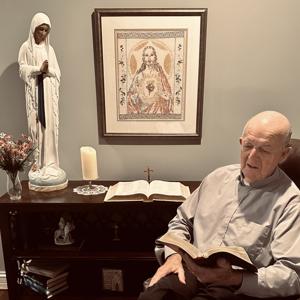


You will notice changes have been made to the introduction of my daily recording. The format is more concise and intended to help you better understand the meaning of the material being presented. I pray you find these upgrades helpful.
Today, April 29, as our Church celebrates the Memorial of Catherine of Siena, Virgin and Doctor, we are invited to first reflect on a passage from the first letter of the apostle Paul to the Corinthians (7:25-40), entitled "Christian chastity". Our treasure, which follows, is from the Dialogue On Divine Providence by Saint Catherine of Siena.
Saint Catherine was born at Siena in 1347. While still a young girl, she sought the way of perfection and entered the Third Order of Saint Dominic. On fire with love of God and neighbor, she is renowned for her profound holiness, mystical experiences, and influential role in both religious and political affairs.
Catherine was a Dominican tertiary, known for her ascetic lifestyle, visions, and the power of her writing, especially her letters and "Dialogue of Divine Providence". In it she presents a dialogue between a soul who "rises up" to God and God himself. Contemporaries of Catherine are united in asserting that much of the book was dictated while Catherine was in ecstasy. Catherine also played a crucial role in mediating peace between warring Italian city-states and persuading the Pope to return to Rome.
Our treasure today from Saint Catherine of Siena's dialogue "I Tasted and I Saw" teaches that a true, living knowledge of God comes not just from thinking about Him, but from personally experiencing His love through prayer, trust, and surrender. The phrase expresses how the soul "tastes" God's goodness interiorly and comes to "see" the truth more clearly through that experience. The main takeaway is that as a person grows in love, humility, and self-giving, they encounter God more deeply, and this transforms their understanding, strengthens their faith, and draws them into closer union with Him.
The main takeaway from today's first reading as described in Saint Paul's First Epistle to the Corinthians (7:25–40) is that love for God should guide a person's life choices above all else. Saint Paul teaches that both marriage and remaining unmarried are good, but he encourages a freedom of heart—especially in difficult or uncertain times—so that one can be more fully devoted to the Lord. The emphasis is not on strict rules, but on choosing the way of life that best fosters faithful love, undivided commitment to God, and thoughtful concern.
The primary teaching of Book of Revelation 14:1–13 is a call to steadfast faithfulness in the face of trial, grounded in the certainty of God's ultimate justice and reward.
The vision begins with the Lamb, Jesus Christ, standing victorious with His faithful followers—symbolizing those who belong entirely to Him and have remained pure in their allegiance. In contrast to those who follow evil, these are marked by fidelity and truth.
The passage then presents three angelic messages: a universal call to worship God alone; a proclamation that the forces of evil (symbolized by "Babylon") will fall; and a solemn warning that those who give themselves over to evil and false worship will face judgment. This sharp contrast highlights the consequences of one's allegiance—either to God or to the corrupt powers opposed to Him.
The reading concludes with encouragement: those who remain faithful, even unto death, are blessed. Their suffering is not in vain, and they will find rest and reward with God.
In essence, the passage teaches that believers must endure with faith and integrity, trusting that God will vindicate them, judge evil, and bring His faithful into eternal rest.
You will notice changes have been made to the introduction of my daily recording. The format is more concise and intended to help you better understand the meaning of the material being presented. I pray you find these upgrades helpful.
On Monday of the Fourth Week of Easter our Church invites us to first read and reflect on a passage from the book of Revelation (13:1-18) entitled "The two beasts". Our treasure, which follows, is from the book On the Holy Spirit by Saint Basil the Great, bishop.
Saint Basil the Great was a fourth century Church Father and a Doctor of the Church. Because of the majesty and keenness of his eloquence, he is honored as "the revealer of heavenly things" and "the Great". He was an early Roman Christian prelate who served as Bishop of Caesarea in Cappadocia from 370 until his death in 379..
The most significant teaching of Basil the Great is his clear vision that the Christian life is a life of transformation through the Holy Spirit, lived in communion with others through charity, humility, and disciplined prayer.
The primary message of today's treasure, "The Spirit gives life" in On the Holy Spirit, by Basil the Great is that the Holy Spirit is truly divine because He is the source of spiritual life itself. Basil emphasizes that the Spirit is not a lesser power or a created force, but God who actively gives life—raising the soul from sin, renewing it, and enabling it to share in the life of God.
Drawing on Scripture, especially the teaching of Jesus Christ, Basil explains that just as the Father is the origin of life and the Son reveals and restores it, the Spirit is the one who applies that life within us. Through the Spirit, believers are sanctified, enlightened, and transformed; without the Spirit, there is no true holiness or participation in divine life.
In essence, Basil's message is both doctrinal and experiential: the Spirit's role in giving life proves His full divinity, and at the same time reveals that the Christian life itself is entirely dependent on the Spirit's ongoing presence and action within the soul.
Today's first reading from Revelation (13:1–18) contains a sober warning about the rise of evil powers that oppose God and seek to deceive humanity, calling believers to steadfast faith and discernment.
In this passage, Jesus Christ is contrasted indirectly with two "beasts": one from the sea and one from the earth. These symbolize oppressive political power and false religious or ideological influence. Together, they work under the authority of the dragon (Satan) to demand worship, manipulate truth, and draw people away from God. The famous "mark of the beast" represents allegiance—showing how worldly systems can pressure people to conform in order to participate in society.
The core message is not meant to provoke fear or speculation, but clarity: evil can appear powerful, organized, and even convincing, yet it is ultimately counterfeit and temporary. Christians are called to recognize deception, resist compromising their faith for security or acceptance, and remain loyal to Christ even under pressure.
In short, Revelation 13 teaches that discipleship requires perseverance and wisdom—faithfulness to God in the face of powerful cultural, political, or spiritual forces that seek to replace Him.
You will notice changes have been made to the introduction of my daily recording. The format is more concise and intended to help you better understand the meaning of the material being presented. I pray you find these upgrades helpful.
On the Fourth Sunday of Easter our Church invites us to first read and reflect on a passage from the book of Revelation (12;1-17) entitled "The sign of the woman". Our treasure, which follows is from a homily on the Gospels by Saint Gregory the Great, pope.
Saint Gregory was born at Rome around the year 540 is certainly one of the most notable figures in Ecclesiastical History. He rose through various public offices to the prefecture which he renounced. He entered the monastic life and, once ordained deacon, he discharged the duties of the legate at Constantinople. On September 3, 590 he was elevated to the Chair of Saint Peter and he proved to be a true shepherd by carrying out his office, helping the poor, spreading and strengthening the faith. He wrote extensively on moral and theological subjects.
Today's treasure, "Christ the Good Shepherd", from a sermon by Saint Gregory, is a call to pastors—and by extension all Christian leaders—to imitate Jesus Christ in genuine, self-sacrificial care for others. Gregory contrasts true shepherds with "hirelings": the true shepherd knows his flock, loves them personally, protects them from spiritual danger, and is willing to lay down his life for them, while the hireling serves only for personal gain and abandons the flock when trials come.
His sermon insists that authentic Christian leadership is measured by love expressed in sacrifice: to be a shepherd after Christ's heart is to live not for oneself, but for the salvation of others.
The primary teaching of today's first reading from the Book of Revelation (12:1–17) is that God's saving plan unfolds amid intense spiritual conflict, but His victory is assured. The vision of the "woman clothed with the sun" symbolizes God's people (often understood as Israel fulfilled in the Church, and also seen in a Marian sense), who bring forth the Messiah. The dragon represents Satan, who opposes Christ and seeks to destroy both Him and His followers. Though the dragon is powerful and continues to wage war against the faithful, he is ultimately defeated by God's intervention. The passage emphasizes that believers will face persecution, but they are protected by God and called to persevere in faith and obedience. The central message is one of hope: despite ongoing spiritual battle, God's purposes prevail, and those who remain faithful share in Christ's victory.
Today, April 25, as our church celebrates the Feast of Mark, Evangelist, our Church invites us to first read and reflect on a passage from the letter of the apostle Paul to the Ephesians (4:1-16), entitled "The various graces for the different ministries in the one body of Christ". Our treasure, which follows, is from the treatise Against Heresies by Saint Irenaeus, bishop.
Saint Mark, a cousin of Barnabas, accompanied Saint Paul, on his first missionary, journey, and later, went with him to Rome. He was a disciple of Saint Peter, whose teaching was the basis for Mark's Gospel, the earliest and shortest of the four Gospels. Writing with urgency and simplicity, he presents Jesus as the suffering Son of God whose actions reveal His authority and mission. Mark's Gospel emphasizes discipleship—showing both the struggles and the call to follow Christ faithfully, especially through suffering. Closely associated with Saint Peter, Mark is believed to reflect Peter's firsthand preaching, giving his account a vivid and direct character. His legacy is a powerful, action-centered witness to who Jesus is and what it means to follow Him. Mark is said to be the founder of the church of Alexandria.
"Preaching Truth," taken from Against Heresies by Saint Irenaeus teaches that the truth of the Gospel is faithfully preserved and proclaimed through the apostolic tradition of the Church. Irenaeus emphasizes that the apostles first received the message directly from Christ, then handed it on in preaching and in written form, ensuring that the same truth is accessible to all. This authentic teaching is safeguarded in the Church through the succession of bishops, standing in continuity with the apostles. The reading highlights that the Gospel preached by evangelists like Mark is not a private or invented message, but the reliable, unified, and life-giving truth entrusted to the Church for all generations.
The main teaching of Ephesians 4:1–16 is a call to live out the unity and maturity that come from life in Christ. Paul the Apostle urges believers to live with humility, patience, and love, preserving the unity of the Spirit as one body with one faith and one Lord. At the same time, Christ gives different gifts and roles within the Church—such as apostles, pastors, and teachers—to build up the community. The goal is that all grow together into spiritual maturity, no longer divided or easily misled, but firmly rooted in truth and united in love, becoming more and more like Christ.
You will notice changes have been made to the introduction of my daily recording. The format is more concise and intended to help you better understand the meaning of the material being presented. I pray you find these upgrades helpful.
On Friday of the Third Week of Easter our Church invites us to first read and reflect on a passage from the book of Revelation (10:1-11) entitled "The call of the seer is renewed". Our treasure, which follows, is from a sermon by Saint Ephrem, deacon.
Saint Ephrem was born in the city of Nisibis in approximately 306. After Saint Ephrem received baptism he began to consider the salvation of his soul more seriously. He embraced an ascetic lifestyle under the direction of an elder, who gave him permission to live as a hermit. Around 338 A.D. Saint Ephrem left his solitude and moved to Edessa in present-day Turkey. He was ordained a deacon and became a voluminous author. He was known for sermons which combined articulate expressions of Catholic orthodoxy with urgent and fruitful calls to repentance.
His primary contribution to the teachings of the Catholic Church was his unique and powerful way of expressing theology through poetry and hymnody, making the mysteries of the faith both deeply understandable and spiritually transformative. Rather than writing in abstract, technical language, Ephrem taught through rich biblical imagery, symbolism, and song, helping the faithful grasp profound truths about Christ, the Incarnation, and salvation.
In today's first reading from the book of Revelation (10:1–11) we are taught that God's word is both sweet and demanding: it brings truth, hope, and salvation, yet also calls for sacrifice and perseverance in proclaiming it. When John eats the scroll, sweet in his mouth but bitter in his stomach, it shows that receiving God's message is a joy, but living it and sharing it can involve hardship. For Catholics, the passage is a call to accept God's word fully and to courageously witness to it, even when it is difficult or costly.
You will notice changes have been made to the introduction of my daily recording. The format is more concise and intended to help you better understand the meaning of the material being presented. I pray you find these upgrades helpful.
On Thursday of the Third Week of Easter our Church invites us to first read and reflect on a passage from the book of Revelation (9:13-21) entitled "The plague of war". Our treasure, which follows, is from the treatise Against Heresies by Saint Irenaeus, bishop.
Saint Irenaeus was a late second century Greek bishop noted for his role in guiding and expanding Christian communities in the southern regions of present-day France and, more widely, for the development of Christian theology.
Saint Irenaeus is remembered for his defense of apostolic Christianity against early heresies, especially Gnosticism. He is best known for teaching that the true faith is handed down publicly through the bishops in continuity with the apostles, emphasizing the "rule of faith" as the Church's safeguard of truth. In his major work Against Heresies, he also developed a deeply influential theology of salvation history, showing how God patiently educates humanity across time and brings it to fulfillment in Christ. Irenaeus is additionally remembered for his beautiful image of Christ "recapitulating" humanity—restoring and renewing human life by uniting it to Himself. His legacy is that of a foundational witness to Church unity, apostolic tradition, and the coherence of God's saving plan in Christ.
St. Irenaeus might also be the first doctor of the Church to die as a martyr. St. Irenaeus is known mainly for his clear and systematic teaching of the Christian faith because he considered the role of a bishop primarily as a teacher. He was particularly interested in apostolic succession, and he produced one of the earliest lists of the first bishops, going back to the time of the Apostles.
Saint Irenaeus was the last known living connection with the apostles. He is the earliest surviving witness to regard all four of the canonical gospels as essential.
In today's recording Saint Irenaeus helps us better understand that the Eucharist is truly the Body and Blood of Christ and therefore a real guarantee of the resurrection of our own bodies. Against the Gnostics, who denied the goodness of the material world and the flesh, Irenaeus insists that because Christ truly became flesh and gives that same flesh as Eucharist, our physical bodies are not disposable but destined for glory. When we receive the Eucharist, we are united to the risen Christ in a way that nourishes not only the soul but also affirms and prepares our bodies for resurrection. In this way, the Eucharist is both a present communion with Christ and a "pledge" that God will raise our bodies, transforming them into incorruptible life with Him.
We learn in today's first reading (Revelation 9:13–21) that God continues to call humanity to repentance even in the face of severe judgment, yet many still harden their hearts. The vision of the destructive army shows the consequences of persistent sin and refusal to turn back to God, but even these events are meant as warnings rather than final destruction. For Catholics, the passage emphasizes the urgency of conversion: God is patient and gives repeated opportunities to repent, but human freedom means people can still choose to cling to sin, with serious spiritual consequences.
You will notice changes have been made to the introduction of my daily recording. The format is more concise and intended to help you better understand the meaning of the material being presented. I pray you find these upgrades helpful.
On Wednesday of the Third Week of Easter our Church invites us to first read and reflect on a passage from the book of Revelation (9: 1-12) entitled "The plague of locusts". Our treasure, which follows is from the first apology in defense of Christians by Saint Justin, martyr.
Saint Justin, known posthumously as Justin Martyr was born around A.D. 90–100 into a Greek family, in the city known today as Nablus near the ancient biblical city of Shechem, in Samaria, Palestine.
Saint Justin is best known as one of the earliest and most important Christian apologists, a philosopher who defended the faith using reason and explained it to the Roman world. Writing in the 2nd century, he showed how Christianity fulfilled the deepest truths sought by Greek philosophy and gave one of the earliest detailed descriptions of the Mass. He ultimately sealed his witness with his life, being martyred for refusing to renounce Christ, and is remembered for helping the Church clearly articulate and defend its beliefs in a hostile culture.
The "First Apology" by Saint Justin Martyr is addressed to the Roman emperor, explaining that Christians are not criminals but rational people who worship the true God and live moral lives. In it, Justin argues that Christian beliefs are consistent with reason, shows how Christ fulfills what philosophers sought, and describes Christian worship—especially the Eucharist—to correct misunderstandings. Its main purpose is to seek justice for Christians and to present the faith clearly and persuasively to a skeptical pagan world.
In today's first reading (Revelation 9:1–12) we are taught that when people persistently reject God, He may allow spiritual darkness and suffering—symbolized by the tormenting locusts—to afflict them as a consequence and a warning. Yet even this judgment is limited and purposeful, meant to prompt repentance rather than destroy completely. For Catholics, the message is to take sin seriously, remain under God's protection, and respond to His warnings with conversion, recognizing that turning away from Him leads to real spiritual harm.
You will notice changes have been made to the introduction of my daily recording. The format is more concise and intended to help you better understand the meaning of the material being presented. I pray you find these upgrades helpful.
On Tuesday of the Third Week of Easter our Church invites us to first read and reflect on a passage from the book of Revelation (8:1-13) entitled "The seven angels punish the earth". Our treasure, which follows, is from a sermon by Saint Augustine, bishop.
Saint Augustine was born at Tagaste in Africa in 354. He was unsettled and restlessly searched for the truth until he was converted to the faith in Milan and baptized by Ambrose. Returning to his homeland, he embraced an ascetic life and subsequently was elected bishop of Hippo. For thirty-four years he guided his flock, instructing it with sermons and many writings.
Saint Augustine is perhaps the most significant Christian thinker after St. Paul. He adapted Classical teaching and created a powerful theological system of lasting influence. He also shaped the practice of biblical exegesis and helped lay the foundation for much of medieval and modern Christian thought.
The legacy of Saint Augustine of Hippo is immense, shaping both Catholic theology and Western thought as a whole. He is best known for his profound writings—especially Confessions and City of God—which explore the human heart's restless search for God, the reality of sin and grace, and the meaning of history. Augustine clarified key doctrines such as original sin, divine grace, and the necessity of God's mercy for salvation, deeply influencing the Church's teaching for centuries. His integration of faith and reason helped lay the intellectual foundation for medieval theology, while his personal, introspective style opened a new way of understanding the spiritual life. In short, his legacy is that of a master teacher who showed that the journey to God is both deeply personal and firmly grounded in truth.
Saint Augustine is a preeminent Catholic Doctor of the Church. His most important teachings shape not only Western theology but the entire intellectual tradition of the Church. His thought deeply influenced later figures such as Saint Thomas Aquinas and remains foundational in Catholic doctrine. He died in 430.
The main message of Saint Augustine's sermon today is that the Eucharist both signifies and creates the unity of the Church. He teaches that in receiving the Body and Blood of Christ, believers are not only nourished individually but are also made into one body in Christ. Therefore, Christians must live in real charity and unity with one another, because what they receive sacramentally, they are called to become in daily life—one in Christ, without division.
In today's first reading (Revelation 8:1–13) we learn that God listens to the prayers of His people and responds in ways that both judge sin and call the world to repentance. The silence in heaven highlights the gravity of divine action, while the trumpet judgments represent partial, warning signs meant to awaken hearts rather than bring total destruction. For Catholics, this passage underscores that prayer truly matters, that God's justice is real, and that His warnings are acts of mercy inviting conversion before final judgment.
You will notice changes have been made to the introduction of my daily recording. The format is more concise and intended to help you better understand the meaning of the material being presented. I pray you find these upgrades helpful.
On Monday of the Third Week of Easter our Church invites us to first read and reflect on a passage from the book of Revelation (7:1-17) entitled "The great multitude of those marked with the seal of God". Our treasure, which follows, is from a commentary on the first letter of Peter by Saint Bede, priest.
Saint Bede was an early eighth century English monk and an author and scholar. Saint Bede, trained by Saint Benedict, is one of the few saints honored as such during his lifetime. His writings were filled with such faith and learning that, even while he was still alive, a church Council ordered them to be read publicly in the churches. He is best known for his work, the "Ecclesial History of the English People", a source vital to the history of the conversion to Christianity of the Anglo-Saxon tribes.
Today's recording of Saint Bede's commentary on the First Epistle of Peter offers a thorough, line-by-line interpretation, making it a valuable resource for understanding the epistle. The commentary is best known for its clear, pastoral explanation of how Christians are called to live as faithful witnesses in the midst of suffering and a hostile world. Drawing on his deep knowledge of Scripture and the Church Fathers, Bede emphasizes themes such as hope in Christ, holiness of life, humility, and perseverance under trial, showing that suffering unites believers more closely to Christ. His work is especially valued for making complex theological ideas accessible and for encouraging ordinary Christians to see their daily struggles as part of their journey toward salvation.
In today's reading from the book of Revelation (7:1–17), the main teaching is that God protects and saves those who belong to Him, even in the midst of trials. The sealing of the servants signifies that the faithful are marked as God's own, while the vision of the great multitude shows people from every nation sharing in eternal joy because they remained faithful and were purified through suffering. For Catholics, the message is one of hope and perseverance: remain faithful through hardships, trust in God's protection, and look forward to the promise of eternal life with Him, where every tear will be wiped away.
From the publisher's feed