
Sign up to save your podcasts
Or

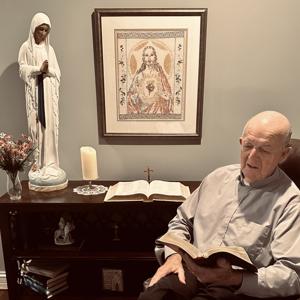


You will notice changes have been made to the introduction of my daily recording. The format is more concise and intended to help you better understand the meaning of the material being presented. I pray you find these upgrades helpful.
On Saturday of the Second Week of Easter our Church invites us to first read and reflect on a passage from the book of Revelation (5:1-14) entitled "The vision of the Lamb". Our treasure, which follows, is from the constitution on the Sacred Liturgy of the Second Vatican Council.
The constitution on the Sacred Liturgy establishes the principle of greater participation by the laity in the celebration of mass and authorizes significant changes in the texts, forms, and language used in the celebration of mass and the administration of the sacraments.
The recording explains that purpose of the constitution is to renew and deepen the Church's liturgical life so that all the faithful can participate more fully, consciously, and actively in the worship of God.
It teaches that the liturgy—especially the Eucharist—is the "source and summit" of the Christian life, and it seeks to foster a more fruitful encounter with Christ by promoting clearer rites, greater use of Scripture, and appropriate adaptation to different cultures while preserving the Church's sacred traditions. Ultimately, its purpose is to draw believers into deeper union with God and to strengthen the Church's mission in the world through vibrant, living worship.
In today's first reading from the Book of Revelation (5:1–14) we Catholics are shown that Jesus Christ alone is worthy to open the scroll because of His sacrifice—He redeems humanity through His death and resurrection. The central takeaway is that Christ's victory is the foundation of all hope: He is both the slain Lamb and the triumphant King. This passage calls Catholics to place their trust fully in Him, to recognize the immense value of His saving work, and to join in the worship of heaven, giving Him praise, honor, and glory with all creation.
You will notice changes have been made to the introduction of my daily recording. The format is more concise and intended to help you better understand the meaning of the material being presented. I pray you find these upgrades helpful.
On Friday of the Second Week of Easter our Church invites us to first read and reflect on a passage from the book of Revelation (4: 1-11) entitled "The vision of God". Our treasure, which follows, is from a sermon by Saint Theodore the Studite.
Saint Theodore of Studite, was an eight century Byzantine Greek monk and abbot of the Stoudios Monastery in Constantinople. He played a major role in the revivals both of Byzantine monasticism and of classical literary genres in Byzantium. He died as a martyr and is the patron saint of soldiers, the recovery of lost items, and of Brindisi, Italy.
The important take-a-way from today's recording from Saint Theodore is that Christ's Resurrection is not just something to remember, but presents a new life we are meant to live now. Because Jesus is risen, Christians are called to turn away from sin and live in a renewed way—marked by obedience, purity, and perseverance. The joy of Easter should be visible in how we think, act, and endure difficulties, showing that we truly share in the risen life of Christ each day.
In today's reading from the Book of Revelation (4:1–11) we Catholics are given a powerful glimpse of heaven as a place of unceasing worship centered entirely on God. The vision of the throne, the twenty-four elders, and the living creatures proclaiming "Holy, holy, holy" reveals that God alone is worthy of all glory, honor, and praise. The main takeaway is that earthly worship—especially the Mass—is a participation in this heavenly liturgy, where we join the angels and saints in adoration. It also reminds us to live with humility and surrender, like the elders who cast down their crowns, recognizing that everything we have is a gift from God and should be offered back to Him in praise.
Saint Gaudentius was Bishop of Brescia in northern Italy and was a theologian and author of many letters and sermons. Saint Gaudentius was consecrated by Saint Ambrose in 387 and remained as bishop of Brescia until 410. A record of the discourse given by Gaudentius on the occasion of his consecration is preserved.
Saint Gaudentius is best known as a faithful bishop, gifted preacher, and defender of orthodox Catholic teaching during a time when the Church was still clarifying key doctrines.
His most important contribution to the Church lies in his homilies (sermons), which provide clear, pastoral explanations of Christian doctrine—especially on the Eucharist, the Paschal Mystery, and the unity of the Church. Gaudentius emphasized how Christ's death and resurrection are made present in the liturgy, helping the faithful understand that the sacraments are not merely symbolic but truly effective signs of grace.
He also played a role in defending the true divinity of Christ, standing in continuity with the teachings affirmed at the Council of Nicaea, during a period when Arianism still caused confusion. His teaching reinforced that Jesus is fully God and fully man—central to Catholic belief.
Pastorally, Gaudentius is remembered for his deeply scriptural and accessible preaching, aimed at strengthening ordinary Christians in faith and moral life. His writings helped bridge theological truth and daily Christian living, making him an important voice among the early Church Fathers, even if less widely known than figures like Saint Augustine of Hippo.
In short, Saint Gaudentius' legacy is his clear, faithful transmission of apostolic teaching through preaching, especially regarding the sacraments and the mystery of Christ—helping shape how the Church understands and lives its faith.
On Wednesday of the Second Week of Easter our Church invites us to first read and reflect on a passage from the book of Revelation (2:12-29) entitled "To the churches at Pergamum and Thyatira". Our treasure, which follows, is from a sermon by Saint Leo the Great, pope.
Saint Leo became pope in the year 440. Saint Leo was a Roman aristocrat, and was the first pope to have been called "the Great". Saint Leo is known as one of the best administrative popes of the ancient Church. His work branched into many areas of the church, indicative of his notion of the pope's total responsibility for the flock of Christ. In the 96 sermons which have come down to us, we find Leo stressing the virtues of almsgiving, fasting, and prayer, and expounding Catholic doctrine with clarity and conciseness, particularly the dogma of the Incarnation. Leo is perhaps best known for having met Attila the Hun in 452 and having persuaded him to turn back from his invasion of Italy.
Saint Leo the Great's primary contribution to the teachings of the Catholic Church was his clear articulation of the two natures of Christ—fully divine and fully human—united in one person. In his famous Tome of Leo, he explained that Jesus Christ possesses both natures without confusion or division, a teaching that was affirmed by the bishops at the Council of Chalcedon and became a cornerstone of Catholic Christology. Leo also strengthened the understanding of the authority of the Bishop of Rome as successor of Saint Peter the Apostle, helping shape the doctrine of the papacy while safeguarding the Church's teaching about who Christ truly is.
The Book of Revelation, also called the Apocalypse of John, is the final book of the New Testament and is written in a highly symbolic, visionary style. Traditionally attributed to St. John while in exile on the island of Patmos, it presents a series of dramatic visions involving heavenly worship, letters to seven churches, cosmic conflict, persecution, judgment, and ultimate renewal. Its imagery—beasts, seals, trumpets, bowls, angels, and a radiant heavenly city—draws deeply on Old Testament prophetic language, especially from Daniel, Ezekiel, Isaiah, and Exodus. Rather than being a coded timetable of future events, Revelation is best understood as an apocalyptic work meant to encourage suffering believers, assuring them that history is not chaotic but guided by God's providence and sovereignty.
In chapter 2:12–29 from the Book of Revelation, Christ addresses the churches in Pergamum and Thyatira, warning about the danger of compromising with sin while living in a corrupt culture. Pergamum is praised for remaining faithful in a hostile environment but criticized for tolerating false teachings that lead to moral compromise, while Thyatira is commended for love and service yet strongly rebuked for allowing sinful practices and false prophecy to spread within the community. The message for Catholics is that faithfulness requires both holding firmly to true belief and rejecting moral compromise, because genuine love for Christ must be expressed through holy living; those who remain faithful are promised a share in Christ's victory and eternal life.
On Tuesday of the Second Week of Easter our Church invites us to first read and reflect on a passage from the beginning of the book of Revelation (2:1-11) entitled "To the churches at Ephesus and Smyrna". Our treasure, which follows, is from a book addressed to Monimus by Saint Fulgentius of Ruspe.
Saint Fulgentius was a follower of Saint Augustine's ideal of life and a student of Saint Augustine's theological teachings. Saint Fulgentius was a north African Christian prelate who served as Bishop of Ruspe and was a theological writer in modern-day, Tunisia, during the fifth and sixth century who defended orthodoxy against Arianism. He is known for his "heroic sanctity".
Saint Fulgentius' primary contribution to the teachings of the Catholic Church was his clear and forceful defense of orthodox doctrine on grace and salvation, especially against semi-Pelagianism. Drawing heavily from Saint Augustine of Hippo, he taught that salvation is entirely the work of God's grace—freely given and not earned by human effort—while still affirming the necessity of human cooperation with that grace. His writings helped preserve and transmit Augustine's theology to later generations, particularly emphasizing the absolute necessity of grace, the reality of original sin, and the Church's role in salvation.
From the work addressed to Monimus by Saint Fulgentius, Catholics should take away a clear and steady confidence in God's saving grace: Fulgentius teaches that salvation is entirely a gift from God, not something we can earn on our own, and that even our ability to believe, repent, and persevere comes from God's mercy working within us. At the same time, he affirms that we must freely cooperate with this grace through faith, humility, and perseverance. The key lesson is that Catholics are called to live with both deep trust in God's initiative and faithful response to His grace, recognizing that all good begins with God but still requires our willing participation.
The Book of Revelation, also called the Apocalypse of John, is the final book of the New Testament and is written in a highly symbolic, visionary style. Traditionally attributed to St. John while in exile on the island of Patmos, it presents a series of dramatic visions involving heavenly worship, letters to seven churches, cosmic conflict, persecution, judgment, and ultimate renewal. Its imagery—beasts, seals, trumpets, bowls, angels, and a radiant heavenly city—draws deeply on Old Testament prophetic language, especially from Daniel, Ezekiel, Isaiah, and Exodus. Rather than being a coded timetable of future events, Revelation is best understood as an apocalyptic work meant to encourage suffering believers, assuring them that history is not chaotic but guided by God's providence and sovereignty.
In chapter 2:1–11 of Revelation, Christ speaks to the churches in Ephesus and Smyrna, offering a message that still applies today: Ephesus is praised for holding to true teaching but warned that it has lost its "first love," showing that faith must be rooted in a real, living love for Christ, not just correct beliefs; Smyrna, on the other hand, is praised for remaining faithful amid suffering and persecution, reminding believers that trials, when endured with trust in Christ, lead to spiritual victory. Together, these messages teach that authentic Christian life requires both deep love for Christ and faithful perseverance through suffering, which lead to eternal life.
On Monday of the Second Week of Easter our Church invites us to first read and reflect on a passage from the beginning of the book of Revelation (1:1-20) entitled "John's vision of the Son of Man". Our treasure, which follows, is from an ancient Easter homily by Pseudo-Chrysostom.
Pseudo-Chrysostom refers to a collection of writings falsely attributed to Saint John Chrysostom (347-407 CE). These works are not actually written by John Chrysostom himself, but were attributed to him either by mistake or intentionally. The term "Pseudo-Chrysostom" is used to designate the authors of these spurious works.
Saint John Chrysostom was an important, fourth century, Early Church Father who served as Archbishop of Constantinople. He is known for his preaching and public speaking, and for his denunciation of abuse of authority of both ecclesiastical and political leaders. He was among the most prolific authors in the early Christian church. The word 'Chrysostom' means 'golden-mounted'. This name was given to him after he died because all his sermons were eloquent and lovely to hear.
The Book of Revelation, also called the Apocalypse of John, is the final book of the New Testament and is written in a highly symbolic, visionary style. Traditionally attributed to St. John while in exile on the island of Patmos, it presents a series of dramatic visions involving heavenly worship, letters to seven churches, cosmic conflict, persecution, judgment, and ultimate renewal. Its imagery—beasts, seals, trumpets, bowls, angels, and a radiant heavenly city—draws deeply on Old Testament prophetic language, especially from Daniel, Ezekiel, Isaiah, and Exodus. Rather than being a coded timetable of future events, Revelation is best understood as an apocalyptic work meant to encourage suffering believers, assuring them that history is not chaotic but guided by God's providence and sovereignty.
The primary message of Revelation is one of hope and perseverance: Jesus Christ, the slain yet risen Lamb, reigns as Lord of history and will definitively triumph over evil. The book calls Christians to faithful witness, moral vigilance, and courage amid trials, reminding them that earthly powers are temporary and that true allegiance belongs to God alone. Its climax is not destruction but renewal—the defeat of sin and death, the final judgment, and the vision of the new heaven and new earth where God dwells with His people and wipes away every tear. At its heart, Revelation proclaims that no suffering endured for Christ is in vain and that faithful endurance leads to eternal glory.
On Sunday within the Octave of Easter our Church invites us to first read and reflect on a passage from the first letter of the apostle Paul to the Colossians (3:1-17) entitled "Your new life in Christ". Our treasure, which follows, is from a sermon by Saint Augustine, bishop.
Saint Augustine was born at Tagaste in Africa in 354. He was unsettled and restlessly searched for the truth until he was converted to the faith in Milan and baptized by Ambrose. Returning to his homeland, he embraced an ascetic life and subsequently was elected bishop of Hippo. For thirty-four years he guided his flock, instructing it with sermons and many writings.
Saint Augustine is perhaps the most significant Christian thinker after St. Paul. He adapted Classical teaching and created a powerful theological system of lasting influence. He also shaped the practice of biblical exegesis and helped lay the foundation for much of medieval and modern Christian thought.
Saint Augustine of Hippo made his primary contribution to the teachings of the Catholic Church by deeply explaining the relationship between God's grace and human salvation. In response to errors such as Pelagianism, he taught that humanity, wounded by sin, cannot save itself but is restored through the grace of God working within us. Augustine clarified the Church's understanding of original sin, divine grace, and the need for God's initiative in conversion, while also shaping Christian thought on the Trinity, the Church, and the inner life of the soul. His writings—especially the Confessions and The City of God—became foundational for Western Christian theology and continue to guide the Church's understanding of sin, grace, and redemption.
He fought bravely against the errors of his time and explained the Faith carefully and cogently through his writings. He is a preeminent Catholic Doctor of the Church. His most important teachings shape not only Western theology but the entire intellectual tradition of the Church. His thought deeply influenced later figures such as Saint Thomas Aquinas and remains foundational in Catholic doctrine. He died in 430.
Saint Paul's letter is addressed to a congregation at Colossae in the Lycus Valley in Asia Minor, east of Ephesus. At the time of writing, Paul had not visited there, the letter says. The community had apparently been established by Epaphras of Colossae. Problems, however, had arisen, brought on by teachers who emphasized Christ's relation to the universe (cosmos). Their teachings stressed angels; "principalities and powers", which related to astral powers and cultic practices and rules about food and drink and ascetical disciplines. These teachings, Paul insists, detract from the person and work of Christ for salvation as set forth magnificently in a hymnic passage and reiterated throughout the letter. Such teachings are but "shadows"; Christ is "reality".
The principal message of the Epistle to the Colossians is that Jesus Christ is supreme over all creation and the source of our complete salvation, and therefore believers must live fully united to Him.
The letter emphasizes that:
· Christ is preeminent—He is the image of the invisible God, through whom and for whom all things were created, and the head of the Church.
· Fullness is found in Christ alone—believers do not need additional spiritual systems or practices to be saved.
· Union with Christ transforms life—through His death and resurrection, Christians die to sin and are raised to a new way of living.
· This new life must be visible—expressed in holiness, charity, humility, and right relationships.
In essence, the message is that since Christ is Lord of all and dwells in believers, they are called to center their entire lives on Him and live accordingly in holiness and love.
On Saturday within the Octave of Easter our Church invites us to first read and reflect on a passage from the beginning of the first letter of Saint Peter (4:12---5:14) entitled "Exhortations to the elders and to the faithful". Our treasure, which follows, is from the Jerusalem Catechesis.
The Jerusalem Catechesis, also known as the Catechetical Lectures of Saint Cyril of Jerusalem, are a series of 23 lectures given by the bishop of Jerusalem, the grandfather of catechisms, written about the year 350. These lectures were delivered to catechumens and newly baptized Christians, providing instruction on the Christian faith and sacraments. It was Saint Cyril who fostered the development of Jerusalem as the "holy city", a pilgrimage center for all Christendom.
The central teaching of the Catechetical Lectures is that the Christian life is a transformative journey into the mystery of salvation through right belief (orthodoxy) and full participation in the sacraments, especially Baptism, Confirmation, and the Eucharist.
Saint Cyril's catechesis are directed to those preparing for initiation, and he emphasizes that:
· Faith must be rightly formed—the Creed safeguards the truth about God, Christ, and salvation.
· The sacraments truly communicate grace—not merely symbols, they bring about what they signify, especially new life in Baptism and real communion with Christ in the Eucharist.
· Conversion is both moral and mystical—the believer must renounce sin and live a new life in Christ.
In essence, the teaching is that through sound doctrine and sacramental participation, the believer is initiated into the divine life and becomes fully united with Christ and His Church.
The first letter of Saint Peter begins with an address by Peter to Christian communities located in five provinces of Asia Minor, including areas evangelized by Paul. Christians there are encouraged to remain faithful to their standards of belief and conduct despite threats of persecution. Numerous allusions in the letter suggest that the churches addressed were largely of Gentile composition, though considerable use is made of the Old Testament.
The central teaching of the First Letter of Saint Peter is that Christians, as "sojourners and exiles" in the world, are called to live in steadfast hope, holiness, and faithful endurance amid suffering by keeping their eyes fixed on the saving work of Jesus Christ.
Saint Peter encourages believers who are experiencing trials and persecution to remain faithful, because suffering for Christ is not meaningless but shares in Christ's own paschal suffering and leads to glory. The letter emphasizes a new identity rooted in baptism: Christians are a chosen people, a royal priesthood, and a holy nation called to proclaim God's mercy through lives of moral integrity, mutual love, and humble submission to God's will.
On Friday within the Octave of Easter our Church invites us to first read and reflect on a passage from the beginning of the first letter of Saint Peter (3:18---4:11) entitled "Awaiting the Lord's coming". Our treasure, which follows, is from the Jerusalem Catechesis.
The Jerusalem Catechesis, also known as the Catechetical Lectures of Saint Cyril of Jerusalem, are a series of 23 lectures given by the bishop of Jerusalem, the grandfather of catechisms, written about the year 350. These lectures were delivered to catechumens and newly baptized Christians, providing instruction on the Christian faith and sacraments. It was Saint Cyril who fostered the development of Jerusalem as the "holy city", a pilgrimage center for all Christendom.
The central teaching of the Catechetical Lectures is that the Christian life is a transformative journey into the mystery of salvation through right belief (orthodoxy) and full participation in the sacraments, especially Baptism, Confirmation, and the Eucharist.
Saint Cyril's catechesis are directed to those preparing for initiation, and he emphasizes that:
· Faith must be rightly formed—the Creed safeguards the truth about God, Christ, and salvation.
· The sacraments truly communicate grace—not merely symbols, they bring about what they signify, especially new life in Baptism and real communion with Christ in the Eucharist.
· Conversion is both moral and mystical—the believer must renounce sin and live a new life in Christ.
In essence, the teaching is that through sound doctrine and sacramental participation, the believer is initiated into the divine life and becomes fully united with Christ and His Church.
The first letter of Saint Peter begins with an address by Peter to Christian communities located in five provinces of Asia Minor, including areas evangelized by Paul. Christians there are encouraged to remain faithful to their standards of belief and conduct despite threats of persecution. Numerous allusions in the letter suggest that the churches addressed were largely of Gentile composition, though considerable use is made of the Old Testament.
The central teaching of the First Letter of Saint Peter is that Christians, as "sojourners and exiles" in the world, are called to live in steadfast hope, holiness, and faithful endurance amid suffering by keeping their eyes fixed on the saving work of Jesus Christ.
Saint Peter encourages believers who are experiencing trials and persecution to remain faithful, because suffering for Christ is not meaningless but shares in Christ's own paschal suffering and leads to glory. The letter emphasizes a new identity rooted in baptism: Christians are a chosen people, a royal priesthood, and a holy nation called to proclaim God's mercy through lives of moral integrity, mutual love, and humble submission to God's will.
On Thursday within the Octave of Easter our Church invites us to first read and reflect on a passage from the beginning of the first letter of Saint Peter (3:1-17) entitled "The imitation of Christ". Our treasure, which follows, is from the Jerusalem Catechesis.
The Jerusalem Catechesis, also known as the Catechetical Lectures of Saint Cyril of Jerusalem, are a series of 23 lectures given by the bishop of Jerusalem, the grandfather of catechisms, written about the year 350. These lectures were delivered to catechumens and newly baptized Christians, providing instruction on the Christian faith and sacraments. It was Saint Cyril who fostered the development of Jerusalem as the "holy city", a pilgrimage center for all Christendom.
The central teaching of the Catechetical Lectures is that the Christian life is a transformative journey into the mystery of salvation through right belief (orthodoxy) and full participation in the sacraments, especially Baptism, Confirmation, and the Eucharist.
Saint Cyril's catechesis are directed to those preparing for initiation, and he emphasizes that:
· Faith must be rightly formed—the Creed safeguards the truth about God, Christ, and salvation.
· The sacraments truly communicate grace—not merely symbols, they bring about what they signify, especially new life in Baptism and real communion with Christ in the Eucharist.
· Conversion is both moral and mystical—the believer must renounce sin and live a new life in Christ.
In essence, the teaching is that through sound doctrine and sacramental participation, the believer is initiated into the divine life and becomes fully united with Christ and His Church.
The first letter of Saint Peter begins with an address by Peter to Christian communities located in five provinces of Asia Minor, including areas evangelized by Paul. Christians there are encouraged to remain faithful to their standards of belief and conduct despite threats of persecution. Numerous allusions in the letter suggest that the churches addressed were largely of Gentile composition, though considerable use is made of the Old Testament.
The central teaching of the First Letter of Saint Peter is that Christians, as "sojourners and exiles" in the world, are called to live in steadfast hope, holiness, and faithful endurance amid suffering by keeping their eyes fixed on the saving work of Jesus Christ.
Saint Peter encourages believers who are experiencing trials and persecution to remain faithful, because suffering for Christ is not meaningless but shares in Christ's own paschal suffering and leads to glory. The letter emphasizes a new identity rooted in baptism: Christians are a chosen people, a royal priesthood, and a holy nation called to proclaim God's mercy through lives of moral integrity, mutual love, and humble submission to God's will.
From the publisher's feed