
Sign up to save your podcasts
Or

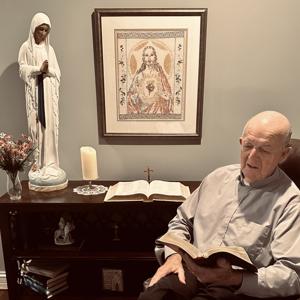


On Wednesday of the Sixth Week in Ordinary Time our Church invites us to read and reflect on a passage from the book of Proverbs (9:1-18) entitled "Wisdom and Foolishness". Our treasure, which follows, is from a commentary on the Book of Proverbs by Procopius of Gaza, bishop.
Procopius of Gaza was a paid teacher of rhetoric and philosophy who lived in Gaza (465 – 530). He wrote numerous works dedicated to pupils of the famous school of his native city, which was run by himself, or addressed to a wider public and rendered on festivals or important political-cultural events. He was highly valued because of the elegance and finesse of his style during the Byzantine period, and he was one of the last voices of Greek sophistry.
The book of Proverbs is an anthology of collections of sayings and instructions. Many of the sayings and perhaps some instructions were composed in the monarchic period (late eleventh to the early sixth centuries). Folk wisdom and observations could surely have been elaborated and re-expressed by learned scribes: "What oft was thought but ne'er so well expressed" (Alexander Pope). There can be no doubt, however, that Proverbs is sophisticated literature by talented writers, winning readers with its compelling portrait of wisdom and inviting them to see life afresh, "wisely," through its wit, originality, and shrewd observation.
The primary purpose of the book is to teach wisdom, not only to the young and inexperienced but also to the advanced. Wisdom in the ancient Near East was not theoretical knowledge but practical expertise. Jewelers who cut precious stones were wise; kings who made their dominion peaceful and prosperous were wise. One could be wise in daily life, too, in knowing how to live successfully (having a prosperous household and living a long and healthy life) and without trouble in God's universe. Ultimately wisdom, or "sound guidance", aims at the formation of character.
Despite its enormous popularity and influence, no copy of the original text has survived, and reconstructions have necessarily drawn on translations, commentaries, and quotations. Among the most important of these was a commentary written by Ephrem of Edessa (ca. 306-373), a theologian who settled in this important center of Christianity (now Urfa in eastern Turkey).
On Tuesday of the Sixth Week in Ordinary Time our Church invites us to read and reflect on a passage from the book of Proverbs (8:1-5, 12-36) entitled "An exhortation to choose wisdom". Our treasure, which follows, is from the Discourses against Arians by Saint Athanasius, bishop.
Saint Athanasius was born at Alexandria in 295. He accompanied Alexander to the Council of Nicaea and succeeded him as Bishop of Alexandria. He fought courageously against the Arian heresy. The Arian heresy taught that Jesus was not divine. For this he suffered many hardships and was exiled several times. His writings are outstanding in their explanation and defense of the true teachings of the faith. Saint Athanasius is a Doctor of the Church. He died in 373.
Arianism is the theological teaching attributed to Arius (ca. AD 250–336), a Christian presbyter in Alexandria, Egypt, concerning the relationship of God to the Son of God (Jesus of Nazareth). Arius asserted that the Son of God was a subordinate entity to God the Father. Deemed a heretic by the Ecumenical First Council of Nicaea of 325, Arius was later exonerated in 335 at the regional First Synod of Tyre, and then, after his death, pronounced a heretic again at the Ecumenical First Council of Constantinople of 381. Saint Athanasius of Alexandria (b. ca. 296-298 – d. 2 May 373), was the 20th bishop of Alexandria. His episcopate lasted 45 years (c. 8 June 328 – 2 May 373), of which over 17 were spent in five exiles ordered by four different Roman emperors. He is a renowned Christian theologian, a Church Father, the chief defender of Trinitarianism against Arianism, and a noted Egyptian leader of the fourth century.
The book of Proverbs is an anthology of collections of sayings and instructions. Many of the sayings and perhaps some instructions were composed in the monarchic period (late eleventh to the early sixth centuries). Folk wisdom and observations could surely have been elaborated and re-expressed by learned scribes: "What oft was thought but ne'er so well expressed" (Alexander Pope). There can be no doubt, however, that Proverbs is sophisticated literature by talented writers, winning readers with its compelling portrait of wisdom and inviting them to see life afresh, "wisely," through its wit, originality, and shrewd observation.
The primary purpose of the book is to teach wisdom, not only to the young and inexperienced but also to the advanced. Wisdom in the ancient Near East was not theoretical knowledge but practical expertise. Jewelers who cut precious stones were wise; kings who made their dominion peaceful and prosperous were wise. One could be wise in daily life, too, in knowing how to live successfully (having a prosperous household and living a long and healthy life) and without trouble in God's universe. Ultimately wisdom, or "sound guidance", aims at the formation of character.
Despite its enormous popularity and influence, no copy of the original text has survived, and reconstructions have necessarily drawn on translations, commentaries, and quotations. Among the most important of these was a commentary written by Ephrem of Edessa (ca. 306-373), a theologian who settled in this important center of Christianity (now Urfa in eastern Turkey
Today, February 17, as our Church celebrates the optional Memorial of Seven Founders of the Order of Servites, we are first invited to reflect on a passage from the letter of the apostle Paul to the Romans (12:1-21), entitled "The Christian life, spiritual worship". Our treasure, which follows, is from an account of the Servite Order.
In 1240, seven noblemen of Florence (Bonfilius, Alexis, Manettus, Amadeus, Hugh, Sostene and Buonagiunta) mutually decided to withdraw from the city to a solitary place for prayer and direct service of God. Their initial difficulty was providing for their dependents, since two were still married and two were widowers. Their aim was to lead a life of penance and prayer, but they soon found themselves disturbed by constant visitors from Florence. They next withdrew to the deserted slopes of Monte Senario.
In 1244, under the direction of Saint Peter of Verona, O.P., this small group adopted a religious habit like the Dominican habit, choosing to live under the Rule of St. Augustine and adopting the name of the Servants of Mary. The new Order took a form more like that of the mendicant friars than that of the older monastic Orders.
Members of the community came to the United States from Austria in 1852 and settled in New York and later in Philadelphia. The two American provinces developed from the foundation made by Father Austin Morini in 1870 in Wisconsin. Community members combined monastic life and active ministry. In the monastery, they led a life of prayer, work and silence while in the active apostolate they engaged in parochial work, teaching, preaching, and other ministerial activities.
Of all the letters of Paul, that to the Christians at Rome has long held pride of place. It is the longest and most systematic unfolding of the apostle's thought, expounding the gospel of God's righteousness that saves all who believe; it reflects a universal outlook, with special implications for Israel's relation to the church. Yet, like all Paul's letters, Romans too arose out of a specific situation, when the apostle wrote from Greece, likely Corinth, between A.D. 56 and 58.
Paul at that time was about to leave for Jerusalem with a collection of funds for the impoverished Jewish Christian believers there, taken up from his predominantly Gentile congregations. He planned then to travel on to Rome and to enlist support there for a mission to Spain. Such a journey had long been on his mind. Now, with much missionary preaching successfully accomplished in the East, he sought new opportunities in the West, to complete the divine plan of evangelization in the Roman world. Yet he recognized that the visit to Jerusalem would be hazardous, and we know from Acts that Paul was arrested there and came to Rome only in chains, as a prisoner.
On Saturday of the Fifth Week in Ordinary Time our Church invites us to read and reflect on a passage from the letter of the apostle Paul to the Galatians (5:25—6:18) entitled "Admonitions concerning charity and perseverance". Our treasure, which follows, is from a sermon by Blessed Issac of Stella, abbot.
Isaac of Stella was a monk, theologian, and philosopher in the late 12th century. Isaac's most popular work was an allegorical commentary on the canon of the mass in the form of a letter to John of Canterbury, bishop of Poitiers. His 55 surviving sermons, as well as his "Letter to Alcher of the Soul", constitute his real theological contribution.
The Galatians to whom the letter is addressed were Paul's converts, most likely among the descendants of Celts who had invaded western and central Asia Minor in the third century B.C. and had settled in the territory around Ancyra (modern Ankara, Turkey). Paul had passed through this area on his second missionary journey and again on his third. It is less likely that the recipients of this letter were Paul's churches in the southern regions of Pisidia, Lycaonia, and Pamphylia where he had preached earlier in the Hellenized cities of Perge, Iconium, Pisidian Antioch, Lystra, and Derbe; this area was part of the Roman province of Galatia, and some scholars think that South Galatia was the destination of this letter
Today, February 14th, as our Church celebrates the Memorial of Cyril Monk and Methodius, Bishop, we are encouraged to reflect on a passage from the first letter of Saint Peter the apostle (5:1-11), entitled "The duties of pastors and laity". Our treasure, which follows, is from an Old Slavonic Life of Constantine.
The brothers, Saint Cyril and Saint Methodius, called the Apostles of the Slavs, were born in Thessalonica, in 827 and 826 respectively. Though belonging to a senatorial family they renounced secular honors and became priests. They were living in a monastery on the Bosphorous, when the Khazars sent to Constantinople for a Christian teacher. Cyril was selected and was accompanied by his brother. They learned the Khazar language and converted many of the people. Soon after the Khazar mission there was a request from the Moravians for a preacher of the Gospel. German missionaries had already labored among them, but without success. The Moravians wished a teacher who could instruct them and conduct Divine service in the Slavonic tongue. Because of their acquaintance with the language, Cyril and Methodius were chosen for their work. In preparation for it Cyril invented an alphabet and, with the help of Methodius, translated the Gospels and the necessary liturgical books into Slavonic. They went to Moravia in 863 and labored for four and a half years. Despite their success, they were regarded by the Germans with distrust, first because they had come from Constantinople where schism was rife, and again because they held the Church services in the Slavonic language. On this account the brothers were summoned to Rome by Nicholas I, who died, however, before their arrival. His successor, Adrian II, received them kindly. Convinced of their orthodoxy, he commended their missionary activity, sanctioned the Slavonic Liturgy, and ordained Cyril and Methodius bishops. Cyril, however, was not to return to Moravia. He died in Rome, 4 Feb., 869.
Saint Methodius went to Constantinople around 870, and with the assistance of several priests, he completed the translation of the Holy Scriptures, with the exception of the Books of Maccabees. He translated also the "Nomo canon", i.e. the Greek ecclesiastical-civil law. The enemies of Methodius did not cease to antagonize him. His health was worn out from the long struggle, and he died 6 April, 885.
The first letter of Saint Peter begins with an address by to Christian communities located in five provinces of Asia Minor, including areas evangelized by Paul. Christians there are encouraged to remain faithful to their standards of belief and conduct despite threats of persecution. Numerous allusions in the letter suggest that the churches addressed were largely of Gentile composition, though considerable use is made of the Old Testament.
The contents following the address both inspire and admonish these "chosen sojourners" who, in seeking to live as God's people, feel an alienation from their previous religious roots and the society around them. Appeal is made to Christ's resurrection and the future hope it provides and to the experience of baptism as new birth. The suffering and death of Christ serve as both source of salvation and example. What Christians are in Christ, as a people who have received mercy and are to proclaim and live according to God's call, is repeatedly spelled out for all sorts of situations in society, work (even as slaves, the home, and general conduct. But overall hangs the possibility of suffering as a Christian. Persecution is later described as already occurring, so that some have supposed the letter was addressed both to places where such a "trial by fire" was already present and to places where it might break out.
On Wednesday of the Fifth Week in Ordinary Time our Church invites us to read and reflect on a passage from the letter of the apostle Paul to the Galatians (3:15—4:7) entitled "The purpose of the law". Our treasure, which follows, is from a letter by Saint Ambrose, bishop.
Saint Ambrose was born of a Roman family at Trier about the year 340. He studied at Rome and served in the imperial government at Sirmium. In 374, while, living in Milan, he was elected bishop of the city by popular acclaim and ordained on December 7. He devotedly carried out his duties and especially distinguished himself by his service to the poor, and as an effective pastor and teacher of the faithful. He strenuously guarded the laws of the church and defended orthodox teaching by writings and actions against the Arians. He died on Holy Saturday, April 4, 397. Saint Ambrose is a Doctor of the Church.
The Galatians to whom the letter is addressed were Paul's converts, most likely among the descendants of Celts who had invaded western and central Asia Minor in the third century B.C. and had settled in the territory around Ancyra (modern Ankara, Turkey). Paul had passed through this area on his second missionary journey and again on his third. It is less likely that the recipients of this letter were Paul's churches in the southern regions of Pisidia, Lycaonia, and Pamphylia where he had preached earlier in the Hellenized cities of Perge, Iconium, Pisidian Antioch, Lystra, and Derbe; this area was part of the Roman province of Galatia, and some scholars think that South Galatia was the destination of this letter.
Today, February 11, as our Church celebrates the Memorial of Our Lady of Lourdes, we are first invited to reflect on a passage from the letter of the apostle Paul to the Galatians (3:22 – – 4:7), entitled "Through faith we are the sons and heirs of God". Our treasure, which follows, is from a letter by Saint Marie Bernadette Soubirous, virgin.
Our Lady of Lourdes is a title of the Blessed Virgin Mary recalling her apparitions in 1858 in the grotto at Lourdes, France to Saint Bernadette Soubirous, a fourteen-year-old peasant girl. Our Lady instructed Bernadette to dig in the ground nearby, from which came a spring with healing properties, active to this day. After a thorough investigation, the apparitions were approved for devotion by the Catholic Church in 1862. A shrine was built there, which remains a popular place of pilgrimage. At least sixty-nine miracles have been approved involving the healing in the waters of Lourdes after extensive investigations by the Church.
Bernadette Soubirous was born in 1844, the first child of an extremely poor miller in the town of Lourdes in southern France. The family was living in the basement of a dilapidated building when on February 11, 1858, the Blessed Virgin Mary appeared to Bernadette in a cave above the banks of the Gave River near Lourdes. Bernadette, 14 years old, was known as a virtuous girl though a dull student who had not even made her first Holy Communion. In poor health, she had suffered from asthma from an early age.
There were 18 appearances in all, the final one occurring on the feast of Our Lady of Mt. Carmel, July 16. Although Bernadette's initial reports provoked skepticism, her daily visions of "the Lady" brought great crowds of the curious. The Lady Bernadette explained, had instructed her to have a chapel built on the spot of the visions. There, the people were to come to wash in and drink of the water of the spring that had welled up from the very spot where Bernadette had been instructed to dig.
According to Bernadette, the Lady of her visions was a girl of 16 or 17 who wore a white robe with a blue sash. Yellow roses covered her feet, a large rosary was on her right arm. In the vision on March 25 she told Bernadette, "I am the Immaculate Conception." It was only when the words were explained to her that Bernadette came to realize who the Lady was.
Few visions have ever undergone the scrutiny that these appearances of the Immaculate Virgin were subject to. Lourdes became one of the most popular Marian shrines in the world, attracting millions of visitors. Miracles were reported at the shrine and in the waters of the spring. After thorough investigation, Church authorities confirmed the authenticity of the apparitions in 1862.
During her life, Bernadette suffered a lot. She was hounded by the public as well as by civic officials until at last she was protected in a convent of nuns. Five years later, she petitioned to enter the Sisters of Notre Dame of Nevers. After a period of illness, she was able to make the journey from Lourdes and enter the novitiate. But within four months of her arrival, she was given the last rites of the Church and allowed to profess her vows. She recovered enough to become an infirmary and then sacristan, but chronic health problems persisted. She died on April 16, 1879, at the age of 35. Bernadette Soubirous was canonized in 1933.
The Galatians to whom the letter is addressed were Paul's converts, most likely among the descendants of Celts who had invaded western and central Asia Minor in the third century B.C. and had settled in the territory around Ancyra (modern Ankara, Turkey). Paul had passed through this area on his second missionary journey and again on his third. It is less likely that the recipients of this letter were Paul's churches in the southern regions of Pisidia, Lycaonia, and Pamphylia where he had preached earlier in the Hellenized cities of Perge, Iconium, Pisidian Antioch, Lystra, and Derbe; this area was part of the Roman province of Galatia, and some scholars think that South Galatia was the destination of this letter.
Today, February 10th, as our Church celebrates the Memorial of Scholastica, Virgin, we are invited to first reflect on a passage from the first letter of apostle Paul to the Corinthians (7: 25-40), entitled "Christian Chastity". Our treasure, which follows, is from the books of Dialogues by Saint Gregory the Great, pope.
Twins often share the same interests and ideas with equal intensity. Therefore, it is no surprise that Saint Scholastica and her twin brother, Saint Benedict, established religious communities within a few miles from each other. Born in 480 of wealthy parents, Scholastica and Benedict were brought up together until he left central Italy for Rome to continue his studies.
St. Scholastica consecrated her life to God from her earliest youth. After her brother went to Monte Cassino, where he established his famous monastery, she took up her abode in the neighborhood at Plombariola, where she founded and governed a monastery of nuns, about five miles from that of St. Benedict, who, it appears, also directed his sister and her nuns. She visited her brother once a year, and as she was not allowed to enter his monastery, he went in company with some of his brothers to meet her at a house some distance away. These visits were spent conferring together on spiritual matters. On one occasion they had passed the time as usual in prayer and pious conversation and in the evening they sat down to take their reflection. St. Scholastica begged her brother to remain until the next day. St. Benedict refused to spend the night outside his monastery. She had recourse to prayer and a furious thunderstorm burst so that neither St. Benedict nor any of his companions could return home. They spent the night discussing spiritual matters. The next morning, they parted to meet no more on earth. Three days later St. Scholastica died, and her holy brother beheld her soul in a vision as it ascended into heaven. He sent his brethren to bring her body to his monastery and laid it in the tomb he had prepared for himself. She died about the year 543, and St. Benedict followed her soon after. Her feast day is February 10th.
The Dialogues of Gregory the Great is a collection of four books of miracles, signs, wonders, and healings done by the holy men of sixth-century Italy. Writing in Latin in a time of plague and war, Gregory structured his work as a conversation between himself and Peter, a deacon. His focus is on miraculous events in the lives of monastics. The second book is devoted to the life of Saint Benedict.
The Dialogues were the most popular of Gregory's works during the Middle Ages, and in modern times have received more scholarly attention than the rest of his works combined. From this, the author himself is sometimes known as Gregory the Dialogist.
In his first letter to the Corinthians Paul warns against divisions within the Church and emphasizes the importance of unity among Church members. He warns members against sexual immorality, teaches that the body is a temple for the Holy Spirit, and encourages self-discipline.
On Friday of the Fourth Week in Ordinary Time our Church invites us to read and reflect on a passage from the second letter to the Thessalonians (2:1-17) entitled "The day of the Lord". Our treasure, which follows, is from a homily by a spiritual writer of the fourth century.
Saint Paul arrived in Greece for the first time around 50 A.D. In making converts in Philippi and, soon afterwards, in Thessalonica, he was beset by persecution from Jews and Gentiles alike. Moving on to Beroea, he was again harassed by enemies from Thessalonica and hurriedly left for Athens. Silvanus and Timothy remained behind for a while. Paul soon sent Timothy back to Thessalonica to strengthen that community in its trials. Timothy and Silvanus finally returned to Paul when he reached Corinth, probably in the early summer of A.D. 51.
Saint Paul's second letter to the Thessalonians distinguishes itself by the detailed teaching it presents at the end times. False teachers had been presenting fake letters as if they were from Paul and telling the Thessalonian believers that the day of the Lord had already come. This would have been especially troubling to them because Paul had encouraged them in his previous letter that they would be raptured before the day of wrath came upon the earth.
So, Paul explained to them that this future time of tribulation had not yet come because a certain "man of lawlessness" had not yet been revealed. Comparisons with other passages in Daniel, Matthew, and Revelation reveal this man to be none other than the Antichrist. But Paul encouraged the Thessalonians not to worry, because the Antichrist would not come until a mysterious restrainer—the Thessalonians apparently knew his identity—was removed from earth. The identity of this restrainer has been heavily debated, though due to the nature of the work the restrainer does, He is likely the Spirit of God working redemptively through the church. When the believers leave the earth in the rapture, all who remain will experience the wrath of the tribulation.
On Tuesday of the Fourth Week in Ordinary Time our Church invites us to read and reflect on a passage from the letter to the Thessalonians (4: 1-18) entitled "The holy life and the hope of the resurrection". Our treasure, which follows, is from a treatise Against Heresies by Saint Irenaeus, bishop.
Saint Irenaeus was a late second century Greek bishop noted for his role in guiding and expanding Christian communities in the southern regions of present-day France and, more widely, for the development of Christian theology.
On Jan. 21, 2022, Pope Francis named a Saint Irenaeus as a Doctor of the Church. Although he has just now been named a doctor of the Church, St. Irenaeus has always been known as a brilliant and orthodox teacher of the faith. The documents of the Second Vatican Council cite 14 references to his work, and the Catechism of the Catholic Church cites him 29 times.
Pope Francis assigned St. Irenaeus the title "doctor of unity" for his efforts to unite the Church, which was competing against the heresy of Gnosticism. Gnosticism taught that the world was created and ruled by a lesser divinity, the demiurge, and that Christ was an emissary of the remote supreme divine being, esoteric knowledge (gnosis) of whom enabled the redemption of the human spirit.
St. Irenaeus might also be the first doctor of the Church to die as a martyr. St. Irenaeus is known mainly for his clear and systematic teaching of the Christian faith because he considered the role of a bishop primarily as a teacher. He was particularly interested in apostolic succession, and he produced one of the earliest lists of the first bishops, going back to the time of the Apostles.
He is most known, though, for his treatises Against All Heresies, written about the year 180. Most of these heresies, as already mentioned, were from Gnosticism. He clearly understood the need to articulate the orthodox faith taught by the Apostles and against those who promoted other ideas that threatened the Apostles' teachings. All this was more than 100 years prior to the Council of Nicaea, which began to codify Christian dogma.
Saint Irenaeus was the last known living connection with the apostles. He is the earliest surviving witness to regard all four of the canonical gospels as essential.
Saint Paul arrived in Greece for the first time around 50 A.D. In making converts in Philippi and, soon afterwards, in Thessalonica, he was beset by persecution from Jews and Gentiles alike. Moving on to Beroea, he was again harassed by enemies from Thessalonica and hurriedly left for Athens. Silvanus and Timothy remained behind for a while. Paul soon sent Timothy back to Thessalonica to strengthen that community in its trials. Timothy and Silvanus finally returned to Paul when he reached Corinth, probably in the early summer of A.D. 51. Timothy's return with a report on conditions at Thessalonica served as the occasion for Paul's first letter.
The letter begins with a brief address and concludes with a greeting. The body of the letter consists of two major parts. The first is a set of three sections of thanksgiving connected by two apologiae (defenses) dealing, respectively, with the missionaries' previous conduct and their current concerns. Paul's thankful optimism regarding the Thessalonians' spiritual welfare is tempered by his insistence on their recognition of the selfless love shown by the missionaries. In an age of itinerant peddlers of new religions, Paul found it necessary to emphasize not only the content of his gospel but also his manner of presenting it, for both attested to God's grace as freely bestowed and powerfully effected.
The second part of the letter is specifically hortatory or parenetic. The superabundant love for which Paul has just prayed is to be shown practically by living out the norms of conduct that he has communicated to them. Specific "imperatives" of Christian life, principles for acting morally, stem from the "indicative" of one's relationship to God through Christ by the sending of the holy Spirit. Thus, moral conduct is the practical, personal expression of one's Christian faith, love, and hope.
From the publisher's feed