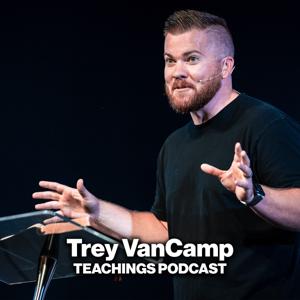
Trey VanCamp Teachings Podcast

Trey VanCamp Teachings Podcast

Download on the App Store

Trey VanCamp Teachings Podcast episodes

  • Tower of Babel is Happening Again? | Genesis 11
    In Week 3 of our Spiritual Warfare series, we look at the Tower of Babel. Genesis 11 tells the story of humanity trying to make a name for themselves by building a tower, likely a ziggurat, in an attempt to invade heaven and recreate Eden on earth. But God comes down to disrupt their plans, confuse their language, and scatter the nations. What started as a third rebellion to create heaven on earth on human terms ends as a tragic story of humanity repeating the same sin from the garden: to see, desire, and take.
    But the way of Jesus is to hear, trust, and obey. Where Babel climbs up to make a name for itself, Jesus comes down, humbles Himself, and is given the name above every name. A biblical theology of spiritual warfare helps us discern not only who we are up against, but what we are building, and whose name we are building it for.
    40 min
  • Making Peace With Your Work | Peacemaking E9
    In the last week of our Peacemaking Practice, we focus on our work. For most of us, our jobs and careers carry significant weight in our lives. Sometimes that weight is a blessing, where we feel like our work is fruitful and we get more joy than frustration from it. For others, work is a burden where we feel like we lack responsibility, control, or reward. In either case, God created us to work, which means that while our work is cursed by sin, it can be redeemed. In Ephesians 6, Paul gives us some helpful instructions we can use to begin making peace with and within our work. Our work can be redeemed if we commit to working respectfully, sincerely, willingly, and expectantly, remembering that ultimately we work for Christ.
    40 min
  • How to Parent Your Children | Peacemaking E8
    Ephesians 6:1-4
    For those with children, parenting can often become a battleground for peacemaking. We can ignore conflict, lash out in anger, or hold impossibly high expectations over our kids while they grow up. In Ephesians 6, Paul shows parents how to avoid these pitfalls. He tells them not to stir up anger in their children, but to “bring them up in the training and instruction of the Lord.” To bring them up means to nurture them so they’re prepared for the world when they leave the home. Training them means instilling discipline in them towards holiness, and to instruct them means to give them counsel, to listen, and to speak encouragement over them. Peacemaking in parenting then is more than avoiding conflict. It’s bringing peace to the household, or what the Bible describes as wholeness, flourishing, and living in the fullness of what God intended. Every parent is forming their child. The question is whether we are doing it intentionally.
    42 min
  • How to Honor Parents You No Longer Have to Obey | Peacemaking E7
    Our church gathers every Sunday at 8:30am & 10:15am at Queen Creek Junior High.
    20435 South Old Ellsworth Road, Queen Creek, AZ
    https://passioncreek.church/sundays/
    In week 7 of our Peacemaking practice, we turn our attention toward our relationship with our parents. Regardless of how old you are now, all of us have parents. And just like with our marriages, our relationships with our parents can be both a blessing and a burden. In Ephesians 6, Paul gives us instructions on how to navigate these relationships. He begins by telling children to obey their parents. But then he moves from obedience to honor, quoting the fifth commandment from Exodus 20. The distinction matters because obedience is seasonal, but honor is forever. As children, we honor our parents’ authority of command. As adults, that authority changes into an authority of counsel. The authority changes, but the honor doesn’t.
    The word honor carries the idea of weight, value, and significance. To honor someone is to give them weight, to recognize their value rather than treating them as insignificant. Honoring our parents, then, doesn’t mean giving them control of our lives or pretending they’re perfect; it means learning to recognize their value, give them appropriate weight, and love them well as the relationship changes.
    00:00 Why Thresholds Matter
    01:32 Relationships Shift With Change
    03:12 When Kids Become Adults
    05:35 Peacemaking With Parents
    07:47 Obedience Versus Honor
    09:32 Exodus And The Ten Words
    13:06 The Promise And Authority
    18:18 Command Versus Counsel
    21:08 Jesus Confronts Corban
    23:42 Honor Means Action
    27:47 What Honor Is Not
    29:18 Seat At The Table
    32:51 Honor Versus Contempt
    35:15 Identity In The Father
    37:16 Practices For This Week
    40 min
  • How Jesus Heals the Guilt and Grief of Your Past | Peacemaking E5
    Sometimes the hardest things we endure are not the things done to us, but the things we have done to ourselves. We carry past failures, mistakes, and missed opportunities with us throughout our lives. All of us have stories of relationships we have never repaired, chances we have never taken, and regrets from both things we have done and things we have left undone.
    But in Ephesians 5, Paul gives us a way forward. He reminds us that our past is real. All of us began in darkness. But now, through Jesus, we are in the light. We can make the most of our time today by learning to make peace with our past, confessing darkness, and accepting the life in the Spirit God has called us to live today.
    36 min
  • 4 Steps Down to Make Peace | Peacemaking E2
    THE WRITTEN RECAP
    The age of the trickster
    Every civilization has a name for him. The Polynesians call him Maui. The Norse, and Marvel, call him Loki. The Greeks named him Odysseus. Paul describes him in Ephesians 4:14 as human cunning. The trickster is never direct. He is always disguised. What looks like a gift can carry an army. What looks like peace can hide a war. And once you've survived enough Trojan Horses, you stop trusting gifts altogether. Every apology might have an agenda.
    Which is where we find ourselves. We've learned the language of peacemaking without living the virtues of peacemaking. We know the words: forgiveness, boundaries, accountability. We can even have ChatGPT write our apology texts. The problem is that it can give us the script but never the soul. Techniques, devoid of transformation, are just a bag of tricks.
    But Paul isn't only preaching about the manipulators out there. He warns us about the manipulator in here. When you've been manipulated, it gets easy to justify retaliation. Which is why he gives us the posture before he ever gets to the process.
    "Without the posture of Christ, peacemaking is no longer a practice that matures us, but a ploy to manipulate others."
    Ephesians splits right down the middle. Chapters 1 through 3 tell us what Christ has done. Chapter 4 opens with therefore. Peace has been received. Here is how peace gets practiced. Paul gives us the posture in four steps. But it isn't a staircase you climb up. It's steps you go down.
    Because ever since Genesis 3, humanity has been climbing. We climb for significance, for status, for control. And when someone hurts us, we don't want to move toward them. We'd rather tower over them. But reconciliation happens at eye level. Every virtue Paul names is another step down. The good news is not that we found a way up to God's level, but that God came down to ours.
    "Peace was made when God took the first step down. So it shouldn't surprise us that Paul's first instruction to peacemakers is to start coming down too."
    39 min
  • 4 Types of People | Peacemaking E1
    People of Peacemaking | Proverbs 1
    Conflict isn't just about what happened. It's about who you're dealing with.
    Before Solomon teaches us how to speak wisely, forgive wisely, or make peace wisely, he teaches us to recognize four different kinds of people: the simple, the young, the fool, and the wise. Each requires a different response.
    In this first message of our *Formed by Peacemaking* series, we'll discover why misdiagnosing a person's character often leads to making conflict worse—and why the first person a peacemaker must honestly identify is themselves.
    In this message you'll learn:
    * Why Proverbs is about wisdom, not just knowledge.
    * The four types of people Solomon introduces.
    * The difference between the untrained, unproven, unteachable, and unoffendable.
    * How the fear of God and life's tests reveal our character.
    * Why biblical peacemaking begins with confession before correction.
    Scripture: Proverbs 1
    If this message encouraged you, consider subscribing and sharing it with someone who wants to become more like Jesus in the middle of difficult relationships.
    00:00 Practice of Peacemaking
    02:51 Proverbs Wisdom Framework
    06:42 Four Types of People
    12:08 Simple Young and Fool
    19:43 Fools Reject Correction
    21:30 Becoming Unoffendable
    25:28 Peacemaker Matrix Explained
    36:06 Mirror Not Microscope
    39 min
  • The Fivefold Ministry in 2026 | Ephesians 4:7-13
    In the early 2000s, Disney was on the brink of collapse. Shareholders were revolting. Morale was at an all-time low. The board finally forced out longtime CEO Michael Eisner.
    Here’s what makes that story fascinating. Eisner’s first decade was historic. His last was abysmal. Same man. Same company. So what changed?
    Disney grew. Eisner never grew with it. Every decision, every ride, every film had to run through his micromanaging leadership. That style worked when the company was smaller. It was destroying them two decades later.
    Enter Bob Iger. In his memoir, The Ride of a Lifetime, Iger describes building his entire vision around three clear priorities. That vision transformed the company. Iger understood something Eisner never did: what got Disney here wouldn’t get Disney there. They didn’t need an updated Mickey. They needed an updated method.
    Churches face the same tension.
    By God’s grace, our church is growing. But the win isn’t a bigger crowd. It’s deeper formation. People embracing the practices of Jesus. Generational patterns changing. Men and women stepping into their calling.
    And that kind of growth forces an honest question: can the methods that got us here faithfully take us there?
    Part of the fear around growth is legitimate. Growth can veer into vanity. A pastor gets an ego, a church chases numbers, the mission gets lost. That danger is real and worth guarding against.
    But there’s another challenge we don’t talk about nearly as often. Growth creates complexity. More people means more stories, more needs, more questions. It’s like moving from two kids to three. You go from man-on-man to zone defense.
    So how does a growing church organize itself around spiritual formation? Paul answers that exact question in Ephesians 4.
    Serving Grace
    Everything hangs on one sentence: “Grace was given to each one of us” (Ephesians 4:7).
    In the first half of Ephesians, Paul celebrates saving grace. That’s what most of us think of when we see the word. Without it, we’re separated from God. It comes by His mercy, not our merit.
    But here, Paul shifts to serving grace. Saving grace gives us a place in God’s family. Serving grace gives us a purpose in God’s family. We aren’t just recipients of grace. We become participants in it.
    And who receives this serving grace? Each one of us. Not the professionals. Not just the staff. Every follower of the Way.
    Paul even quotes Psalm 68 with a twist. The original says the King received gifts from people. Paul writes that Jesus gave gifts to people. This King isn’t just here to receive. He’s so generous, He distributes His ministry through His whole Body.
    Five Ways Of Seeing
    Then Paul does something surprising. Instead of listing abilities, he lists people: apostles, prophets, evangelists, pastors, and teachers.
    Notice this isn’t a list of the ministers. It’s a list of the equippers. The leaders equip. The saints minister. Without that understanding, churches make attenders, not disciples.
    Here’s one way to grasp these five gifts. They can all walk into the same church, look at the same people, and notice something different. The apostle says we need to build and multiply. The prophet says we need to hear from God and pursue holiness. The evangelist says we need to reach the lost. The pastor says we need to care for and protect people. The teacher says we need to understand and live God’s truth.
    None of them are wrong. Each sees a different part of what the Body needs. The problem comes when we assume what we see is all there is to see. The prophet needs the shepherd. The evangelist needs the teacher. We need each other because the Church needs all of Jesus.
    Your Next Step
    This is why we’ve built a Discipleship Pathway around teaching, community, and practice. It’s not a shift away from anything. It’s a step further in. The goal is simple: deepen your discipleship and develop your gift for the Body.
    You can’t choose your gift. You discern it. Through prayer, practice, and community, you discover where God has empowered you to serve others.
    So here’s the question worth praying over: what’s your next step on the pathway? Formation doesn’t run through a handful of people at the top. Grace was given to each one of us. Including you.

    39 min
  • The Challenge of Mutual Submission | Ephesians 5:18-6:9
    Some passages of Scripture come with baggage. Ephesians 5:22–6:9 might carry more than any of them.
    Take a brief look at history and you’ll see why this may be one of the most dangerous passages in the Bible. Husbands have twisted “wives, submit” into permission to dominate and control. Verses about children have been used to silence honest questions and excuse abusive parenting. Slaveholders quoted “slaves, obey your earthly masters” to defend the indefensible.
    And it’s not just history. We all bring our own stories to this text. If you grew up in an unhealthy home, the word “submit” can put your nervous system on high alert. If “I love you” was followed by control or fear, it’s hard to imagine these words describing something beautiful. And if you’re not a Christian, this passage might be on your list of reasons why.
    Here’s the idea that reframed everything for me: the danger is not in what Paul wrote, but in how it’s read. Just as a hammer can build a home or demolish a window, God’s Word brings life when it’s rightly handled — and spreads great harm when it’s wrongly wielded. Passages become dangerous when they’re detached from the bigger gospel story.
    It starts with mutuality, not matrimony
    In many Bibles, Ephesians 5:22 begins a new paragraph under a heading like “Wives and Husbands.” But headings and verse numbers were added centuries later by editors. In the original Greek, verse 22 continues the sentence in verse 21: “Submitting to one another in the fear of Christ, wives to your husbands…”
    Paul doesn’t start with holy matrimony. He starts with holy mutuality. Submission here is mutual — not one-sided, not domineering, not hierarchical.
    Then Paul does something quietly subversive. Household codes were common in the ancient world, but they spoke only to the man of the house; everyone else was talked about, never talked to. Paul addresses the wife before the husband, the child before the father, the slave before the master. He treats wives as disciples, children as responsible, slaves as moral agents — every person made in the image of God, with dignity and purpose.
    What each of us lays down
    Submission literally means “to arrange yourself under” — not forced obedience, but a willing posture chosen out of reverence for Christ. In a gospel community, everyone gives something up. The wife lays down self-rule. The husband lays down self-interest. The child lays down self-will. The father lays down self-assertion. The worker lays down self-pity. The boss lays down self-importance.
    This is easier said than done. Our default settings fight against it. The consumer mentality treats people as resources to use; the crusader mentality treats people as rivals to beat. Both view submission as net loss. What happens when you submit and they don’t submit back? What if they take advantage of your sacrifice? What if they never change?
    The principle and the power
    The gospel answers with both a principle and a power.
    The principle: our mutual submission flows from our reverence for Christ, not our reaction to people. There’s a drumbeat under every role in this passage — “as to the Lord,” “in the Lord,” “as you would Christ.” If our willingness to submit depends on the other person deserving it, we’ll always find an excuse not to.
    One thing must be said plainly: if you are being abused, this passage is not God telling you to stay and endure it. Abuse is the opposite of everything Paul describes.
    The power: the main command in this whole passage isn’t “submit” — it’s “be filled by the Spirit.” Ephesians 5:18–6:9 is one long grammatical flow, and the Greek makes the main verb unmistakable. Speaking, singing, giving thanks, submitting — these are what a Spirit-filled life looks like. Mutual submission isn’t merely an ideal to aspire to. It’s the fruit of a Spirit-filled life.
    Which means the invitation isn’t to try harder. It’s to surrender deeper. This kind of life isn’t produced by stronger willpower; it’s produced by God’s presence. And it’s not a one-time decision — it’s a daily surrender.
    So here’s the reflection I’m carrying into this week: where am I white-knuckling a relationship God is asking me to surrender instead? Maybe start there, with five honest words: “Fill me, Holy Spirit… again.”
    34 min

About Trey VanCamp Teachings Podcast

From the publisher's feed

Trey Van Camp is the pastor of Passion Creek Church. He planted Passion Creek in 2016 in the East Valley of Phoenix, AZ and is known for being a vlogger on YouTube. This podcast consists of his…

More shows like Trey VanCamp Teachings Podcast

Craig Groeschel Leadership Podcast by Life.Church

Craig Groeschel Leadership Podcast

10,735 Listeners