
Sign up to save your podcasts
Or

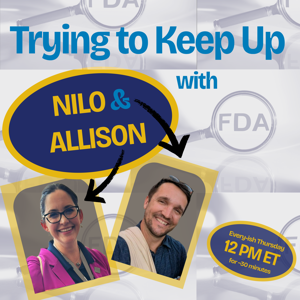


Can you treat varicose veins from outside the body? This week on Trying to Keep Up, Allison Komiyama and Michael Nilo start with Theraclion’s Sonovein System, which received De Novo authorization from the FDA. Allison likes the idea of treating a vein without an incision. She has a few more questions about the company’s “no infection” claim. Nilo, checking in from MedTech World in Malta, brings up a workshop on what focused ultrasound might do in the brain.
The hosts also dig into Abbott’s UltiSynq defibrillation lead, designed to deliver pacing and defibrillation through a single lead. That sends them into a discussion about implanted batteries, heart failure monitors, and how much work a device asks patients to do. Allison revisits her SONU congestion headband, complete with a tissue at the ready, and explains why she pays attention to the FDA’s mammography facility inspections.
On the regulatory side, Allison and Nilo look at the FDA’s discussion paper on autonomous and remotely operated medical robots, final guidance on diagnostic test validation during a declared emergency, and a proposal to move certain cancer tests from Class III to Class II. They also talk about reports that the FDA has put its priority drug review voucher program on hold.
And yes, Nilo’s backdrop really is in Malta. We're all jealous.
What do a leaky heart valve, a piece of conference swag, and Michael Nilo’s move from dental to cardiovascular devices at the FDA have in common? Nitinol. This week on Trying to Keep Up, Allison Komiyama and Michael Nilo get into the metal that remembers its shape and the newly approved Amplatzer Paraclose PVL Occluder. Nilo explains how the device plugs a leak around a surgically implanted heart valve and why that matters for someone who’s already had open-heart surgery. Allison has a follow-up question about nickel sensitivity. She leaves with homework.
The Virtuoso Endoscopy System, which received De Novo authorization from the FDA, gives surgeons needle-sized grippers to work with during rigid endoscopy. That gets the hosts talking about what counts as a better device. If the gold standard is a four-hour drive away, how should a reviewer weigh an option a patient can actually reach?
Allison also admits that quality systems make her eyes glaze over. She still wants to know why more companies don’t sign up for the Voluntary Improvement Program. Nilo gets the hesitation. Once you take a close look at your own process and find something you could fix, you have to decide what to do about it.
Also this week:
What medical device are you thankful for, and why? Email [email protected] for instructions to share a short video for TTKU’s Thanksgiving episode.
This week on Trying to Keep Up, Allison Komiyama and Michael Nilo catch up on hearing aid software, a CDRH Learn makeover, and draft guidance in a special Halloween Friday edition of TTKU. Nilo is a kangaroo. Allison is recovering from conference season. The jokes get dark early.
Allison’s discovery of Meta’s July 510(k) clearance kicks off a bigger conversation about hearing aids: more options, different form factors, and why comfort, cost, and appearance can influence whether people actually use them. They trace the hearing aid software pathway back to Apple’s De Novo and discuss the growing overlap between consumer technology and medical devices.
Then, something worth celebrating: CDRH Learn is searchable. The hosts applaud the redesign, give Joseph Tartall and the team a shout-out, and have one request: make it easier for newcomers who don’t yet know what to search for.
The regulatory discussion continues with:
Plus: NMCG’s regulatory consultancy award nomination, Nilo’s upcoming trip to MedTech World Malta, and RegulatoryAF updates.
Follow Trying to Keep Up for more conversations about the FDA, medical devices, and the questions that don’t come with easy answers. If you’re keeping up with us, rate the show and smash that like button.
This week on Trying to Keep Up, Allison Komiyama and Michael Nilo welcome Michael Owens, MS BME, RAC, a former FDA orthopedic device reviewer and assistant director with nearly 15 years of agency experience.
Fresh from The MedTech Conference in Boston, Allison and Owens share insights from conversations with FDA leadership, including updates on Predetermined Change Control Plans (PCCPs), the Safety and Performance Based Pathway, and potential improvements to the De Novo review process.
The conversation gets particularly interesting when Owens challenges the group to consider whether PCCPs can work beyond software. Could manufacturers use them to plan material, manufacturing, and compatibility changes before a device even reaches the market? And what happens when those plans reveal future product development strategies to competitors?
The team also explores how the FDA can preserve institutional knowledge, reduce reviewer workload, and keep pace with AI-enabled technology. Plus, Nilo shares his firsthand connection to a newly designated Breakthrough Device, and everyone has opinions about using AI to second-guess regulatory experts.
Additional topics include:
Resources discussed:
What does it take to go from reviewing medical devices at the FDA to leading a company through PMA approval, fundraising, and commercialization?
This week on Trying to Keep Up, Allison Komiyama and Michael Nilo welcome Shreya Mehta, former FDA cardiovascular device reviewer and current President & CEO of Zenflow, for a candid conversation about the realities of building a medical device company.
Shreya traces her journey from engineering and the FDA to Stanford's Biodesign Innovation Fellowship, where the idea for Zenflow began. Twelve years later, the company has secured PMA approval, raised $52 million in Series D funding, and partnered with Cook Medical to bring its technology for benign prostatic hyperplasia (BPH) to more patients.
She shares what she's learned about fundraising, managing investor expectations, assembling the right team, and navigating the transition from development to commercialization. The group also discusses why startups need to approach FDA pre-submissions strategically and how regulatory decisions affect business outcomes.
Then it's time to catch up on the latest medical device news, including a pediatric heart valve that grows with patients, a new autism diagnostic aid, and three medical innovations recognized by TIME.
Additional topics include:
Plus: a surprisingly practical conversation about medical devices as holiday gifts.
Join Allison, Michael, and Shreya for an inside look at the science, strategy, and persistence behind bringing medical technology to market.
A heart valve designed to expand as a child grows. A ring cleared to measure blood pressure without a cuff. Software that retrains its AI model daily. Allison Komiyama and Michael Nilo unpack a week of device news that raises questions about what innovation can do and how the FDA evaluates it.
They start with the Autus Size-Adjustable Valve, a pediatric pulmonary valve that can be widened as a child grows. Then they discuss Happy Health’s cuffless blood pressure ring and ProNova’s VIRTUE QA software, whose authorized predetermined change control plan allows machine-specific AI retraining with automated checks before an updated model goes live.
Additional topics include:
The hosts also share their usual detours, from wearable data and memorable device videos to Halloween jokes and registration for Regulatory AF.
This week on Trying to Keep Up, Allison Komiyama and Michael Nilo are joined by Tim Marjenin, VP of Neurology Regulatory Affairs at MCRA. Tim spent 16 years at the FDA as a lead reviewer and manager in the neuro group, giving the team plenty to discuss about what happens on both sides of the review process.
The conversation starts with a long-awaited update: the FDA finally published the De Novo decision summary for SmartFlow Neuro Cannula after more than two years. The device supports delivery of therapeutics directly into brain tissue, prompting a discussion about neurology, gene therapy delivery systems, and why De Novo decision summaries can take so long to become public.
From there, the team digs into one of the increasingly visible issues in medical device submissions: human factors. They discuss the growing scrutiny of usability, the challenges of responding to highly prescriptive deficiencies, and why home-use devices can create especially complex human factors questions.
Tim also weighs in on the evolving value of Breakthrough Device Designation. The group discusses whether Breakthrough still delivers meaningful regulatory advantages, how selective review teams have become, and where faster interactions can still make a difference.
Additional topics include:
The FDA’s FY2027 list offers a useful preview of the issues likely to keep regulatory teams busy, and if this episode is any indication, there will be plenty to keep up with.
This week on Trying to Keep Up, Allison Komiyama and Michael Nilo are joined by Laura Gilmour, MS, former FDA biomedical engineer and reviewer and Founder & Principal Consultant of LG Strategies, for a packed conversation about new device approvals, FDA guidance, patient engagement, regulatory resources, and what new reviewers need to learn on the job. Laura brings experience from several sides of MedTech, including device manufacturers, the FDA, additive manufacturing, consulting, and work supporting the Veterans Health Administration.
The team starts with two new PMAs: Promega’s OncoMate® MSI Dx Analysis System, a companion diagnostic for identifying certain patients with advanced solid tumors who may be eligible for KEYTRUDA®, and MedAlliance’s SELUTION SLR™ 014 PTCA Drug-Eluting Balloon for treating coronary in-stent restenosis. They also cover several recent Breakthrough Device Designations, including the NET Device for stimulant use disorder and VitaSmart HOPE for intestinal transplantation.
Then it’s time for eSTAR. Version 7.1 is here, along with new draft guidance addressing electronic submissions for PMAs. Allison and Michael discuss some of the latest eSTAR changes and what extending the template to PMAs could mean in practice. The group also digs into new draft guidance for robotically assisted surgical devices and an upcoming two-day FDA workshop on benefit-risk considerations for robotic devices with autonomous or remote teleoperation capabilities.
Laura, Allison, and Michael also explore patient engagement and how patient-generated data can influence benefit-risk discussions. Laura shares how her work with the Veterans Health Administration has shown her that different patient populations may have very different tolerances for risk. Michael explains why incorporating patient perspectives into an FDA discussion requires more than finding one patient willing to accept that risk.
Additional topics include:
Plus: a snail with a very long memory, a PCCP joke courtesy of last week’s guest, and the regulatory possibilities of a Roomba knife fight.
This week on Trying to Keep Up, Allison Komiyama and Michael Nilo are joined by Rob Allen, PhD, former FDA biomedical engineer and current Senior Director of Regulatory Affairs – Biocompatibility at MCRA, an IQVIA MedTech company. Allison and Rob record together from RAPS, while Michael joins from Missouri.
Rob breaks down the FDA’s recent Biocompatibility Risk Assessment Town Hall and its approach to ISO 10993-1:2025. The FDA shared examples of when materials and manufacturing information may support biological safety without additional testing. The group also discusses the impact in Europe, where notified bodies are asking companies to assess existing documentation against the updated standard.
Additional topics include:
Plus: RAPS observations, birthday cake, and Rob’s FDA-themed standup special.
Links & Resources
Connect
This week on Trying to Keep Up, Allison Komiyama and Michael Nilo are joined by former FDA branch chief and regulatory expert David Pudwill, aka Mr. Regulatory, for a packed conversation covering AI-enabled diagnostics, pediatric devices, drug shortages, biocompatibility, cybersecurity, and some unusually useful FDA website updates.
David reflects on nine years at the FDA, including his time in the Office of Legislation helping prepare agency leaders for congressional testimony. He also previews his upcoming RAPS presentation on drug shortages, including efforts to reshore heparin manufacturing and strengthen access to critical medications such as midazolam.
The team digs into Powerful Medical’s Queen of Hearts AI ECG model, which received De Novo authorization for identifying STEMI and STEMI-equivalent patterns in patients with suspected acute coronary syndrome. Unlike many AI tools discussed on TTKU, this one supports time-critical decisions where minutes can matter.
They also celebrate two pediatric device developments: Trexo Robotics’ Theo wearable robotic exoskeleton, which recently received 510(k) clearance after a previous FDA warning letter, and Neola Medical’s Breakthrough Device Designation for a non-invasive continuous lung monitoring system designed for premature infants.
Additional topics include:
Plus: elephant jokes, regulatory nostalgia, and plenty of dad-joke expertise.
Links & Resources: https://nilomed.com/ttku
Connect
From the publisher's feed
The FDA moves fast. Guidance changes. Policies evolve. Submissions get weird.
Former-FDA reviewers Michael Nilo and Allison Komiyama started Trying To Keep Up for a…
So they turned that call into a live conversation.
Each week they (try to) unpack what’s actually happening at CDRH...from policy changes and regulatory curveballs to the ripple effects hitting real companies, real submissions, and real timelines.
Expect:
• Hot takes on FDA updates
• Deep regulatory dives (and occasionally shallow ones)
• Guests, Q&A, and off-script conversations
• A healthy dose of jokes and regulatory nerd humor
This isn’t a polished podcast and there’s no rigid agenda...just two former FDAers (and sometimes guests) talking through a regulatory landscape that seems to change by the week. If you work in MedTech and sometimes feel like the rules changed overnight…you’re not alone.
We’re all just trying to keep up.